
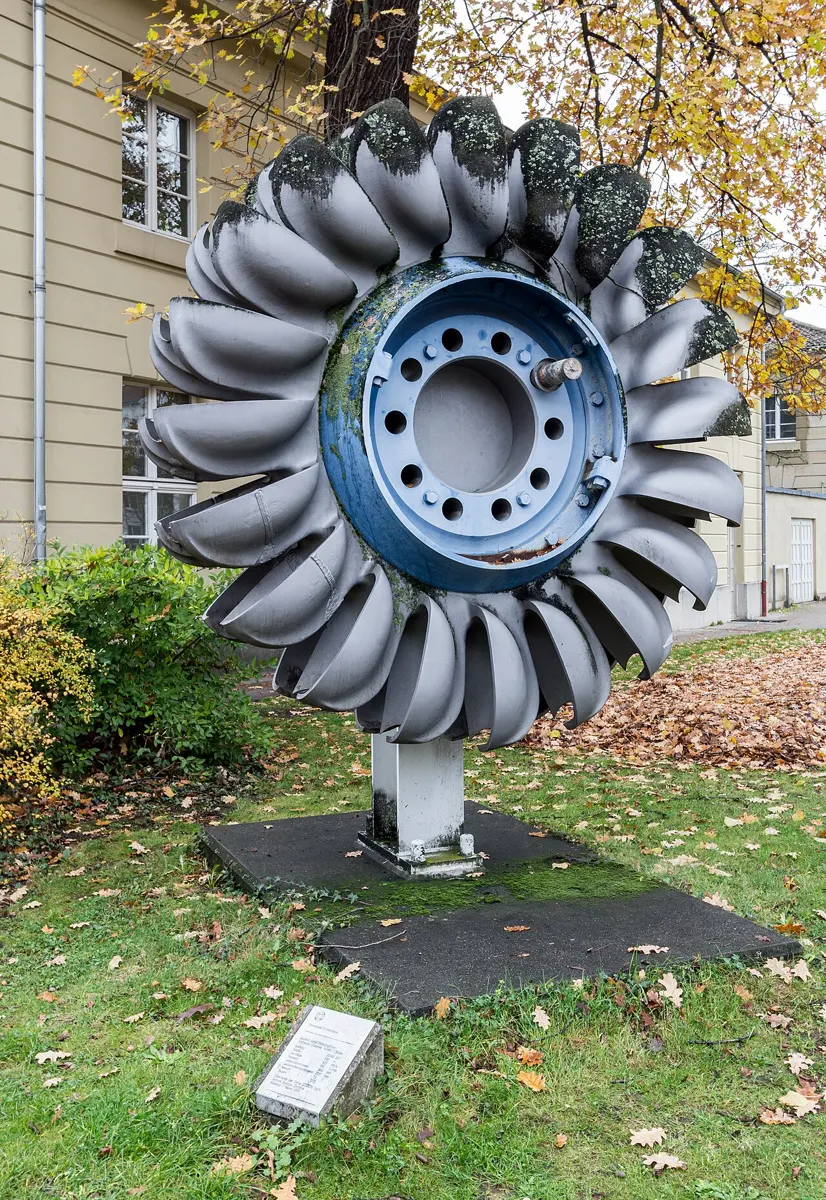
Water for Upper Tamakoshi, the biggest power station in Nepal when it opened in 2021, drops more than 800 m through shafts and a steel pipe and leaves a nozzle at well over 100 m/s, straight into the cups of a Pelton wheel. If the cups move too slowly, the water splashes off still carrying much of its energy. If they move as fast as the jet, the water never catches them and gives them nothing. Somewhere in between is the speed that takes the most power.
So here is this unit’s question: how fast should the cups move? To answer it you need two things: how quickly a quantity changes at one instant, its derivative, and how the derivative finds the top of a curve without drawing it. The answer comes at the end of 18.8.
Head, speed and units: ANDRITZ Hydronews 35 (2021).
18.1 Derivative of a function
How fast, at one instant
Drop a stone from a high bridge. Ignoring the air, it has fallen meters after t seconds. How fast is it going at t = 1?
Speed is distance over time, but at one instant no time passes: . So take a short time instead, from t = 1 to t = 1 + h, and find the average speed over it:
| Time taken, h (s) | 1 | 0.1 | 0.01 | 0.001 |
|---|---|---|---|---|
| Average speed (m/s) | 14.7 | 10.29 | 9.849 | 9.8049 |
As h shrinks, the averages head for 9.8 m/s. That is the speed at the instant t = 1: not any one average, but the limit they approach as the time shrinks to nothing. (Limits, and why can still have a limit, are Unit 17.)
The same question can be asked of anything that changes: how fast a tank fills at 10 o’clock, how fast a price rises in March, how steeply a road climbs at one bend. Each is a rate of change at an instant, and each is found the same way.
The derivative
For a function y = f(x), let x change by a small amount h. Then y changes by f(x + h) − f(x), and the average rate of change over that interval is
On the graph it is the slope of the line through P(x, f(x)) and Q(x + h, f(x + h)), a secant (a line cutting the curve at two points).
The derivative of f at x is the limit of that average as h → 0:
provided the limit exists. If it does, f is differentiable at x. Finding a derivative is differentiation, and finding it from this limit is differentiation from the definition, or from first principles.
As h → 0, Q slides along the curve to P, and the secant turns into the tangent at P. So the derivative is also the slope of the tangent: the steepness of the curve at that one point.
Many books write the definition with (“a small change in x”) for h: if y = f(x), then , so and
It is the same limit, and either form gets full marks.
Notation. The derivative of y = f(x) is written f′(x) (read “f dash x”), (“d y by d x”), y′, y₁, or . In , means “the derivative with respect to x of”; it is one symbol, not a fraction to cancel. Its value at a point is f′(a) or .
Which of these is the derivative of f at x = a?
Pick an answer to see why.
When there is no derivative
The limit can fail to exist. Take f(x) = |x| at x = 0:
From the right the slope is always 1, from the left always −1. The two one-sided limits differ, so |x| has no derivative at 0, though it is continuous there. The graph has a corner (Figure 18.2): no single line touches it there.
A function is not differentiable at x = a when its graph has
- a break there (it isn’t continuous),
- a corner (the one-sided slopes differ, as |x| at 0), or
- a vertical tangent (the slopes grow without bound: at 0, where ).
Differentiable means continuous. If f′(a) exists, then
- for h ≠ 0 (multiply and divide by h);
- as h → 0 the right side tends to f′(a) × 0 = 0 (the limit of a product is the product of the limits);
- so f(a + h) → f(a): f is continuous at a.
The converse is false: |x| is continuous at 0 but not differentiable there.
f(x) = |x − 3|. At x = 3, f is:
Pick an answer to see why.
18.2 Derivatives from the definition
Every derivative in this section is found straight from , with only the limits of Unit 17: , , , and . The trick each time is the same: rewrite f(x + h) − f(x) until an h cancels or one of those limits appears.
Algebraic functions
A constant. If f(x) = c, then f(x + h) − f(x) = c − c = 0, so : a flat line has slope 0.
. Let , n any rational number, and x > 0 (for a whole number n, any x).
- (the definition).
- Put z = x + h; as h → 0, z → x, and h = z − x: .
- That is the standard limit, . So
So , , and .
A question that says “from the definition” wants the working, not the rule. For a fraction, take the common denominator; for a root, rationalize:
Trigonometric functions
Angles are in radians throughout: only then.
sin x.
- ().
- So (divide by ).
- As h → 0, (cos is continuous) and . So
cos x. The same way, with :
tan x.
- (sin (A − B) on top).
- So .
Inverse trigonometric functions
, for −1 < x < 1.
- Let and . Then x = sin y and x + h = sin (y + k), so h = sin (y + k) − sin y.
- is continuous, so as h → 0, k → 0 too.
- .
- As k → 0, (the derivative of sine, found above), so the limit is .
- y lies in , where cos y > 0: .
, for every x. The same steps with x = tan y, h = tan (y + k) − tan y: the limit is .
Exponential and logarithmic functions
. .
Apart from its own multiples, the only function that is its own slope: at every point, climbs as steeply as it is high.
(a > 0). .
(x > 0; ).
- (a log of a quotient).
- Put , so h = xt and t → 0 as h → 0: .
. (change of base), a constant times , so the same steps give
is:
Pick an answer to see why.
Using , the derivative of is:
Pick an answer to see why.
18.3 Rules of differentiation
Working from the definition every time would be slow. The rules below are each proved once from the definition, and then they do the work. Throughout, u and v are functions of x with derivatives u′ and v′, and c is a constant.
Sum, difference and constant multiple
- (regroup).
- Each fraction tends to its derivative (the limit of a sum is the sum of the limits). For cu, the c comes out of the fraction and the limit the same way.
So a polynomial is differentiated term by term, after writing roots and fractions as powers: .
Product rule
- Add and take away u(x + h)v(x) on top: u(x + h)v(x + h) − u(x)v(x) = u(x + h)[v(x + h) − v(x)] + v(x)[u(x + h) − u(x)].
- Divide by h: .
- As h → 0, u(x + h) → u(x) (u is differentiable, so continuous), and the fractions tend to v′ and u′.
Quotient rule
- (common denominator).
- Add and take away u(x)v(x) on top: it becomes v(x)[u(x + h) − u(x)] − u(x)[v(x + h) − v(x)].
- Divide by h and let h → 0: the top tends to vu′ − uv′, the bottom to .
Chain rule
A composite function is a function of a function: is y = sin u with . Its derivative is the product of the two rates:
If u changes 3 times as fast as x, and y 2 times as fast as u, then y changes 2 × 3 = 6 times as fast as x.
Why it holds: let x change by , u by and y by .
- (when ).
- As , too (u is continuous), so and .
(A proof that also covers a u whose change is 0 at points near x needs one more step; the rule holds all the same.)
With the chain rule every rule of 18.2 grows: , , , and the general power rule
The other trigonometric and inverse functions
The rules finish the list. Write each as a quotient, or as a known inverse turned round:
- : .
- : .
- : .
- : , −1 < x < 1.
- : .
- : , |x| > 1.
- : , |x| > 1.
( is the same as , which most Nepali books write.)
Worked examples
If , then is:
Pick an answer to see why.
is:
Pick an answer to see why.
18.4 Derivatives of parametric and implicit functions
Parametric functions
Some curves are easiest to write with a third variable, a parameter: a point’s x and y are both given by t. A small stone stuck in a bicycle tyre’s tread, as the wheel of radius a rolls, traces x = a(θ − sin θ), y = a(1 − cos θ), where θ is the angle the wheel has turned (a cycloid). To find its slope there is no need to get rid of θ.
If x = f(t) and y = g(t), the chain rule gives , so
Implicit functions
gives y explicitly. An equation such as or ties x and y together without solving for y: it defines y implicitly. To find , differentiate both sides with respect to x, treating y as a function of x, so the chain rule gives
then solve for .
The slope of the curve at the point (1, 2) is:
Pick an answer to see why.
If and y = 2t, then is:
Pick an answer to see why.
18.5 Higher order derivatives
f′(x) is a function too, so it has a derivative: the second derivative,
then the third, (y₃), and the nth, ().
What it means: the first derivative is how fast y changes; the second is how fast that rate itself changes. If s is a car’s position at time t, is its velocity and its acceleration Grade 11: Grade 11 Physics, Kinematics. On a graph, f′′ says how the slope is changing: whether the curve bends up or down (18.9).
If y = A cos 3x + B sin 3x, then is:
Pick an answer to see why.
The second derivative of a parametric curve. is the derivative with respect to x of , which is a function of t. By the chain rule,
If , the value of at x = 1 is:
Pick an answer to see why.
18.6 Geometric interpretation of derivative
The derivative f′(a) is the slope of the tangent to y = f(x) at P(a, f(a)). If the tangent makes an angle with the positive X-axis (measured anticlockwise, ), then
So the sign and size of the derivative can be read off the curve:
- f′(a) > 0: is acute, the curve rises through P;
- f′(a) < 0: is obtuse, the curve falls;
- f′(a) = 0: , the tangent is parallel to the X-axis (a flat spot);
- growing without bound (): , the tangent is parallel to the Y-axis, and there is no derivative.
The bigger |f′(a)|, the steeper the curve. Grade 12 builds on this slope: the equations of the tangent and the normal through P, and rates of change such as how fast a balloon’s radius grows.
At which point of does the tangent make an angle of 45° with the positive X-axis?
Pick an answer to see why.
The tangent to at x = 1 makes an angle with the positive X-axis of:
Pick an answer to see why.
18.7 Monotonicity of a function and interval of monotonicity
A function is increasing on an interval if, as x goes right, f(x) goes up: for any x₁ < x₂ in the interval, f(x₁) < f(x₂). It is decreasing if f(x₁) > f(x₂) whenever x₁ < x₂. (Some books call these strictly increasing and decreasing, and use “increasing” for f(x₁) ≤ f(x₂).) A function that is only increasing, or only decreasing, on an interval is monotonic there, and that interval is an interval of monotonicity.
Unit 4 judged this from a graph. The derivative decides it from the formula, because a curve whose tangents all slope upward must climb:
On an interval where f′(x) > 0, f is increasing; where f′(x) < 0, f is decreasing.
(The proof uses the mean value theorem, met in higher mathematics. f′ may be 0 at single points without spoiling it: has f′(0) = 0 but increases everywhere, and x + sin x, with f′(x) = 1 + cos x ≥ 0, pauses at but never goes back down.)
To find the intervals of monotonicity:
- Find f′(x), and factorize it.
- Find where f′(x) = 0 or doesn’t exist: these points cut the domain into intervals.
- In each interval, find the sign of f′(x) (from its factors, or one test value).
- +: increasing; −: decreasing.
On which interval is decreasing?
Pick an answer to see why.
. How many real roots does f(x) = 0 have?
Pick an answer to see why.
18.8 Extreme values of a function
A function has a local maximum at x = c if f(c) ≥ f(x) for every x near c (on both sides), and a local minimum if f(c) ≤ f(x) there. Either is an extreme value (or extremum), and c is a point of extremum. “Local” matters: a hilltop is the highest point near it, not necessarily the highest point on the map.
Look at the tops and bottoms in Figure 18.5 and the widget above. At each one, the tangent is flat. That is always so where there is a tangent:
If f has a local extreme at c and f′(c) exists, then f′(c) = 0.
- Say f(c) is a local maximum. For small h > 0, f(c + h) ≤ f(c), so , and its limit, f′(c), is ≤ 0.
- For small h < 0, the top is still ≤ 0 but now the bottom is negative, so , and f′(c) ≥ 0.
- Both, so f′(c) = 0. (A minimum is the same with the signs swapped.)
A point where f′(c) = 0 or f′(c) doesn’t exist is a critical point; f′(c) = 0 alone makes it a stationary point. Every local extreme is at a critical point. But not every critical point is an extreme: has f′(0) = 0 and no extreme there. A test is needed.
First derivative test
Let c be a critical point. Look at the sign of f′ just left and just right of c:
- + then − (rising, then falling): a local maximum;
- − then + (falling, then rising): a local minimum;
- the same sign on both sides: no extreme ( at 0).
It works at corners too: |x| has no derivative at 0, but f′ = −1 on the left and + 1 on the right, so 0 is a local minimum.
Second derivative test
At a stationary point, f′(c) = 0:
- f′′(c) < 0: the slope is decreasing through 0, from + to −: a local maximum;
- f′′(c) > 0: the slope is increasing through 0: a local minimum;
- f′′(c) = 0: the test says nothing. Go back to the first derivative test.
Greatest and least values on a closed interval
On a closed interval [a, b], a continuous function has a greatest and a least value (the absolute maximum and minimum). Each is either at a critical point inside, or at an end of the interval, where the curve can be highest just because it stops there. So: find f at the critical points in (a, b) and at a and b, and compare.
Problems of the best
“The most”, “the least”, “the largest”, “the cheapest” are maximum and minimum questions. Write the quantity to make best as a function of one variable, using the condition to remove any other, then find its extreme.
Back to the Pelton wheel
The answer: the cups should move at half the speed of the jet. Here is why. Say the jet arrives at speed v and the cups move away from it at speed u.
- Riding on a cup, you see the water arrive at v − u. The cup turns it right round, so it leaves at v − u backwards.
- Each kilogram of water has its velocity (as the cup sees it) changed by 2(v − u), so the push on the cups is , where is the mass of water arriving each second.
- Power is force × speed: .
- at , and : a maximum.
At the water leaves the cups at speed backwards, as seen from a cup moving forwards at : it simply drops, its kinetic energy all given to the wheel. That is why every Pelton wheel is designed with its cups moving at close to half the jet’s speed.
f′(c) = 0 and f′′(c) = 0. What can you conclude?
Pick an answer to see why.
The greatest value of x(10 − x) is:
Pick an answer to see why.
18.9 Concavity and points of inflection
A curve can rise in two ways: faster and faster, bending upward, or slower and slower, bending over. The first derivative can’t tell them apart (both are positive); the second can.
A curve is concave upward (or convex) on an interval if its slope increases there: it bends up like a cup, and lies above its tangents. It is concave downward if its slope decreases: it bends down like a cap, and lies below its tangents. Since f′′ is the rate of change of the slope:
f′′(x) > 0 on an interval: concave up. f′′(x) < 0: concave down.
A point of inflection is a point of the curve where its concavity changes, from up to down or from down to up. There, if f′′ exists, f′′(c) = 0. But again, not the other way round: has f′′(0) = 0 and is concave up on both sides. An inflection needs f′′ to change sign.
To find concavity and inflections: find f′′, find where it is 0 or doesn’t exist, find its sign on each piece, and keep only the points where the sign changes.
The points of inflection of are:
Pick an answer to see why.
On which interval is concave upward?
Pick an answer to see why.
Exercise
Choose the correct option
is:
Pick an answer to see why.
A point where f′(x) = 0 is called:
Pick an answer to see why.
If f′′(x) < 0 on an interval, the curve y = f(x) is there:
Pick an answer to see why.
is:
Pick an answer to see why.
If and y = b tan θ, then is:
Pick an answer to see why.
If xy = 4, then is:
Pick an answer to see why.
The function is:
Pick an answer to see why.
The slope of the tangent to the curve , at t = 2 is:
Pick an answer to see why.
The least value of is:
Pick an answer to see why.
has three different real roots exactly when:
Pick an answer to see why.
f is differentiable with f′(x) > 0 for every x, and g(x) = f(−x). Then g is:
Pick an answer to see why.
Short questions
From the definition, find the derivative of
- a.cos 2x (2 marks)
- b. (2 marks)
- c., x > 0 (1 mark)
Hint
Answer
Differentiate with respect to x:
- a. (1 mark)
- b. (2 marks)
- c., for (2 marks)
Hint
Answer
A curve is given by x = a( cos t + t sin t), y = a( sin t − t cos t).
- a.Show that . (2 marks)
- b.Find . (3 marks)
Hint
Answer
If , show that . (5 marks)
Hint
Answer
If , show that . (5 marks)
Answer
For :
- a.find the points where the tangent is parallel to the X-axis; (2 marks)
- b.find the intervals in which f is increasing and decreasing. (3 marks)
Answer
Find the intervals of concavity and the points of inflection of . (5 marks)
Answer
Prove that for every x > 0. (5 marks)
Hint
Answer
Long questions
.
- a.Find the intervals of monotonicity of f. (2 marks)
- b.Find its local maximum and minimum values by the second derivative test. (2 marks)
- c.Find the intervals of concavity and the point of inflection. (2 marks)
- d.Find the greatest and least values of f on [ −2, 3]. (2 marks)
Answer
A closed cylindrical water tank is to hold a volume V.
- a.Show that the least sheet metal is used when its height equals its diameter. (5 marks)
- b.Find the radius and height of such a tank holding 1000 liters (1 m³), to the nearest centimeter. (3 marks)
Hint
Answer
Project work
Using what you learned
Our own questions of the kind IOE’s Section B sets: two- and three-step problems on the unit’s ideas.
An open tank with a square base and upright sides is to hold 32 m³ of water, using the least sheet metal. Its base side and its height are:
Pick an answer to see why.
The tangent to the curve at (1, 1) meets the curve again at:
Pick an answer to see why.
Printable PDFs
- Study notes 3 pages
- Worksheet 4 pages Answer key
- Harder practice questions 1 page Answer key
Practice every question in the book, and keep track of the ones you miss →
Where these facts come from
- Upper Tamakoshi: total output 456 MW from six units of 76 MW, net head 805 m, speed 600 rpm, completed 2021 (the opening, 18.8): ANDRITZ, Hydronews 35 (2021), “Upper Tamakoshi, Nepal”; its six units are Pelton turbines, and its gross head 822 m: Power Technology, “Upper Tamakoshi Hydroelectric Project”, read November 2026.
- A Pelton wheel gives the most power when its cups move at half the jet’s speed (18.8): Wikipedia, “Pelton wheel”, Design and “Optimal wheel speed”, read November 2026.
- Bhāskara II’s tātkālika gati in the Siddhānta Śiromaṇi (1150), and his rule for the sine read as the derivative of the sine, though he made no general notion of a derivative (18.1): K. Plofker, Mathematics in India (2009), pp. 186–188 and 196–197, and R. Cooke, The History of Mathematics: A Brief Course (1997), pp. 213–215, as cited in Wikipedia, “Bhāskara II”, Calculus, read November 2026; his dates: MacTutor, “Bhaskara II”.
- Leibniz’s Nova Methodus pro Maximis et Minimis, itemque Tangentibus in Acta Eruditorum, 1684, with the familiar d notation (18.1): MacTutor, “Gottfried Wilhelm von Leibniz”.
- The slope of the bending moment is the shear force, , and the moment has a local maximum or minimum where the shear crosses zero (18.8): Wikipedia, “Shear and moment diagram”, read November 2026.
- The S-shaped (logistic) growth curve and its point of inflection, which we apply to a total of cases (18.9): OpenStax, Calculus Volume 2, 4.4 “The Logistic Equation”.
- Definitions and the tests checked against OpenStax, Calculus Volume 1, Chapters 3 and 4 (CC BY 4.0).
- The unit’s items and project work: CDC, Secondary Education Curriculum 2078, Mathematics, Grades 11–12, 6.2 and sample projects 13 and 15; the marks: CDC, Specification Grid 2078, Mathematics, Grade 11; IOE, BE/BArch Entrance Syllabus 2083, Mathematics 5.2.
Found a mistake? Please tell us.