
Imagine a library where the books are piled up in the order they arrived. Finding a book on frogs would take all day. Now imagine the same library sorted into shelves: science here, stories there, and on each shelf the books in order. You could find anything in a minute, and you could even guess what an empty gap on a shelf should hold.
Chemists had exactly this problem. By 1869 they knew 63 elements, each with its own weight, color, smell and habits, and no order to them at all. Today we know 118 elements. About 92 of them are found in nature (up to uranium; a few, like technetium, only in tiny traces) and the rest have been made in laboratories. The periodic table is the library’s shelving system, and once you understand it, a single box in it tells you how an element will behave before you have ever seen it.
Why sort the elements?
Every element is made of one kind of atom: all the atoms of iron are iron atoms, all the atoms of oxygen are oxygen atoms. But elements are not all different in every way. Sodium and potassium are both soft, shiny metals that fizz in water. Chlorine and bromine both bleach and both poison. Elements come in families.
Classification means putting elements with similar properties in the same group, and elements with different properties in different groups. It makes the study of elements far easier: learn one member of a family well, and you already know a lot about the others.
A periodic table is a table of the elements in which elements with similar properties are kept in the same group and elements with different properties in different groups.
Mendeleev’s periodic table
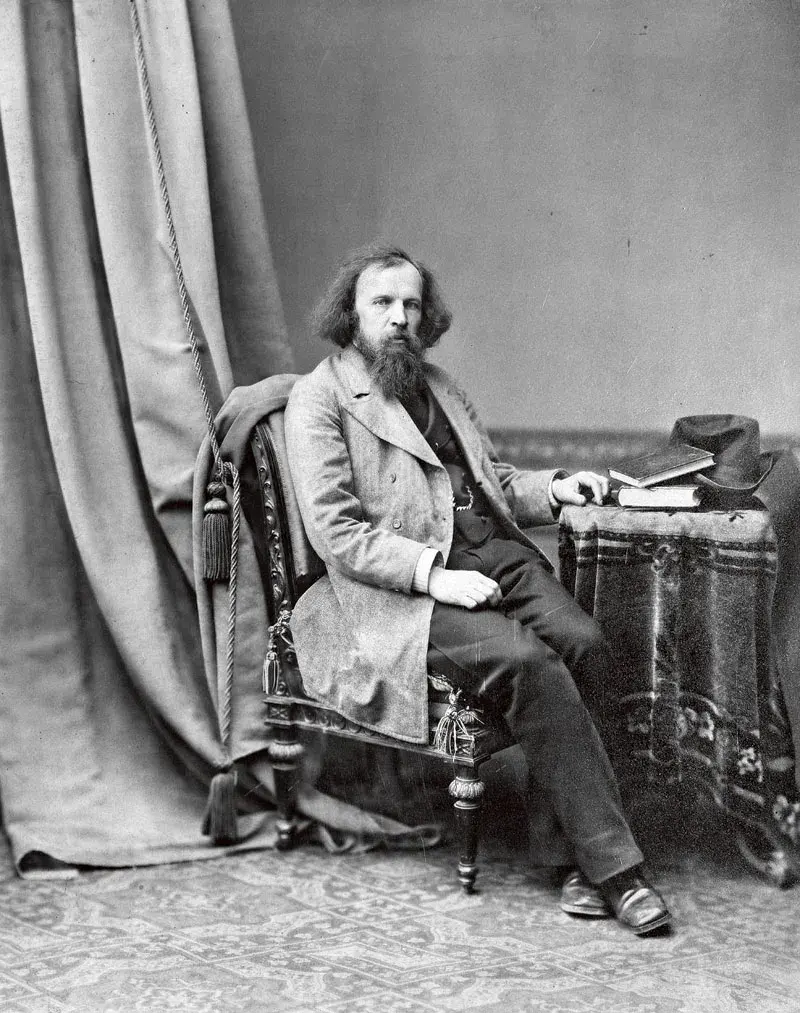
In 1869 the Russian chemist Dmitri Mendeleev wrote each known element on a card, with its atomic weight (we now say atomic mass) and its properties. He laid the cards out in order of increasing atomic weight, and noticed something wonderful: similar properties came back again and again, at regular intervals, like the days of the week. Lithium, sodium and potassium all came up at the same point in the pattern.
He stated this as Mendeleev’s periodic law:
The physical and chemical properties of elements are the periodic functions of their atomic weights.
“Periodic” means repeating at regular intervals. So the law says: arrange the elements by increasing atomic weight, and their properties repeat. Mendeleev made a table in which elements with similar properties sit in the same vertical column, called a group, and the elements between them run along a horizontal row, called a period.
The trouble with atomic weight
Mendeleev believed atomic weight was the most basic property of an element. It isn’t, and his table had problems because of it.
Isotopes. Carbon atoms come in three forms, C-12, C-13 and C-14, with atomic weights 12, 13 and 14. Forms of the same element with different atomic weights are called isotopes. Every carbon atom has 6 protons; isotopes differ only in their number of neutrons (6, 7 or 8). If atomic weight decided the order, each isotope would need its own box. Yet Mendeleev gave carbon only one box, and rightly so: all three isotopes behave alike chemically.
Pairs in the wrong order. By weight, iodine (126.9) comes before tellurium (127.6). But tellurium is clearly like sulphur and selenium, and iodine is clearly like chlorine and bromine. Mendeleev swapped them, trusting their properties over their weights. Argon and potassium, and cobalt and nickel, have the same problem. His law could not explain why.
So scientists went on searching for the property that really sets an element’s place.
Why didn’t Mendeleev give C-12, C-13 and C-14 separate places in his table?
Pick an answer to see why.
The modern periodic table
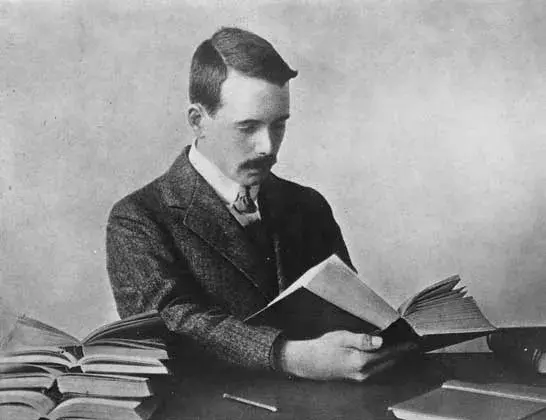
In 1913 the young English physicist Henry Moseley fired electrons at samples of different elements and measured the X-rays they gave off. The X-rays rose in frequency in perfectly even steps from one element to the next. The steps did not follow atomic weight; they followed the atomic number, the number of protons in the nucleus. Each element has its own atomic number, and no two share one.
This gave the modern periodic law:
The physical and chemical properties of elements are the periodic functions of their atomic numbers.
The table built on this law is the modern periodic table, also called the long form of the periodic table. The elements are arranged in order of increasing atomic number. Elements with similar properties still sit in the same vertical group, and each horizontal period runs in order of atomic number. With atomic number, tellurium (52) comes before iodine (53) by itself, and every isotope of an element shares one box, because they all have the same number of protons.
Here is the whole table. Switch between the ways of looking at it as you read the list of its features below.
To look up any element in detail, with its story and where you meet it in daily life, open our Periodic Table.
Features of the modern periodic table
- The elements are arranged in increasing order of atomic number.
- There are 7 periods and 18 groups. The elements in one period all have the same number of shells: period 3 elements all have three shells (K, L and M).
| Period | Number of elements | Kind of period |
|---|---|---|
| 1st | 2 | very short |
| 2nd | 8 | short |
| 3rd | 8 | short |
| 4th | 18 | long |
| 5th | 18 | long |
| 6th | 32 | very long |
| 7th | 32 | very long |
- The 18 groups are numbered 1 to 18, as the IUPAC (the International Union of Pure and Applied Chemistry) recommends. Many books also use the older names with A and B:
| IUPAC group | 1 | 2 | 3 | 4 | 5 | 6 | 7 | 8 | 9 | 10 | 11 | 12 | 13 | 14 | 15 | 16 | 17 | 18 |
|---|---|---|---|---|---|---|---|---|---|---|---|---|---|---|---|---|---|---|
| Old name | IA | IIA | IIIB | IVB | VB | VIB | VIIB | VIIIB | VIIIB | VIIIB | IB | IIB | IIIA | IVA | VA | VIA | VIIA | 0 (VIIIA) |
| Period 4 | K | Ca | Sc | Ti | V | Cr | Mn | Fe | Co | Ni | Cu | Zn | Ga | Ge | As | Se | Br | Kr |
- Metals are on the left, non-metals on the right, and metalloids in a thin zigzag between them.
- The families: alkali metals in group IA (1), alkaline earth metals in group IIA (2), transition metals from group IIIB to IIB (3 to 12), halogens in group VIIA (17) and noble gases in group 0 (18).
- The 15 elements from lanthanum (La, atomic number 57) to lutetium (Lu, 71) are the lanthanides. The 15 elements from actinium (Ac, 89) to lawrencium (Lr, 103) are the actinides. Both rows are kept separately below the main table, so that the table isn’t too wide to print.
- The 10 columns from group IIIB to IIB (groups 3 to 12, counting the three columns of group VIIIB) lie between the reactive metals and the non-metals. These are the transition metals.
- The table is also divided into s, p, d and f blocks, according to which subshell an element’s last electron goes into (you’ll see what that means in the next section).
How many elements are in period 4?
Pick an answer to see why.
Electronic configuration based on subshells
In Grade 9 you wrote electrons in shells: sodium is 2, 8, 1. That is the Bohr–Bury way. It explains a lot, but not everything. It can’t say, for example, why potassium’s fourth shell starts filling when the third shell has only 8 of its 18 places full. For that we need a closer look.
Shells, subshells and orbitals
The path in which electrons move around the nucleus is called an orbit or shell: K, L, M, N… (numbered 1, 2, 3, 4…, the number n). Each shell is divided into one or more subshells, and each subshell has one or more orbitals. Electrons are found in these orbitals.
Think of an apartment building. The shells are the floors. Each floor has a few flats (the subshells, called s, p, d and f), and each flat has a few rooms (the orbitals). Each room holds at most two electrons.
| Subshell | Orbitals (rooms) | Most electrons |
|---|---|---|
| s | 1 | 2 |
| p | 3 | 6 |
| d | 5 | 10 |
| f | 7 | 14 |
Shell number n has n subshells. So the K shell has 1, the L shell 2, the M shell 3 and the N shell 4:
| n | Shell | Subshells | Most electrons in the shell |
|---|---|---|---|
| 1 | K | 1s² | 2 |
| 2 | L | 2s², 2p⁶ | 8 |
| 3 | M | 3s², 3p⁶, 3d¹⁰ | 18 |
| 4 | N | 4s², 4p⁶, 4d¹⁰, 4f¹⁴ | 32 |
In “2p⁶”, the 2 is the shell, p is the subshell, and the small ⁶ is the number of electrons in it. The last column follows the rule you learned in Grade 9: a shell holds at most 2n² electrons.
The order of filling: the Aufbau principle
Electrons fill the lowest-energy places first, the way water fills a pot from the bottom up. This is the Aufbau principle (Aufbau is German for “building up”): electrons are filled into subshells in increasing order of their energy. A subshell starts to fill only when the one below it in energy is full: no electrons go into 2s until 1s is full.
The surprise is that the subshells of different shells overlap in energy. 4s is lower than 3d, so 4s fills first. The order is:
You don’t have to memorize it. Write the subshells in rows, one shell per row, and follow the diagonal arrows, as in Figure 14.4.
So potassium (19 electrons) is 1s², 2s² 2p⁶, 3s² 3p⁶, 4s¹. Its 19th electron goes into 4s, not 3d, and that is why its shells are 2, 8, 8, 1 and not 2, 8, 9. The old Grade 9 rule, “the outermost shell holds at most 8”, is really this: once a shell’s s and p are full (8 electrons), the next electron finds the next shell’s s subshell lower in energy than the d.
Here are the first 20 elements, both ways:
| Atomic number | Element | Symbol | K | L | M | N | By subshells |
|---|---|---|---|---|---|---|---|
| 1 | hydrogen | H | 1 | 1s¹ | |||
| 2 | helium | He | 2 | 1s² | |||
| 3 | lithium | Li | 2 | 1 | 1s², 2s¹ | ||
| 4 | beryllium | Be | 2 | 2 | 1s², 2s² | ||
| 5 | boron | B | 2 | 3 | 1s², 2s² 2p¹ | ||
| 6 | carbon | C | 2 | 4 | 1s², 2s² 2p² | ||
| 7 | nitrogen | N | 2 | 5 | 1s², 2s² 2p³ | ||
| 8 | oxygen | O | 2 | 6 | 1s², 2s² 2p⁴ | ||
| 9 | fluorine | F | 2 | 7 | 1s², 2s² 2p⁵ | ||
| 10 | neon | Ne | 2 | 8 | 1s², 2s² 2p⁶ | ||
| 11 | sodium | Na | 2 | 8 | 1 | 1s², 2s² 2p⁶, 3s¹ | |
| 12 | magnesium | Mg | 2 | 8 | 2 | 1s², 2s² 2p⁶, 3s² | |
| 13 | aluminium | Al | 2 | 8 | 3 | 1s², 2s² 2p⁶, 3s² 3p¹ | |
| 14 | silicon | Si | 2 | 8 | 4 | 1s², 2s² 2p⁶, 3s² 3p² | |
| 15 | phosphorus | P | 2 | 8 | 5 | 1s², 2s² 2p⁶, 3s² 3p³ | |
| 16 | sulphur | S | 2 | 8 | 6 | 1s², 2s² 2p⁶, 3s² 3p⁴ | |
| 17 | chlorine | Cl | 2 | 8 | 7 | 1s², 2s² 2p⁶, 3s² 3p⁵ | |
| 18 | argon | Ar | 2 | 8 | 8 | 1s², 2s² 2p⁶, 3s² 3p⁶ | |
| 19 | potassium | K | 2 | 8 | 8 | 1 | 1s², 2s² 2p⁶, 3s² 3p⁶, 4s¹ |
| 20 | calcium | Ca | 2 | 8 | 8 | 2 | 1s², 2s² 2p⁶, 3s² 3p⁶, 4s² |
Look down the last column and you can already see families: Li, Na and K all end in s¹; F and Cl both end in p⁵; Ne and Ar both end in p⁶.
In which subshell does the 21st electron (in scandium) go?
Pick an answer to see why.
Classification of elements in the modern periodic table
The elements are placed in the modern periodic table by their properties, and their properties come from their electronic configurations. Elements in the same group have the same number of valence electrons (electrons in the outermost shell), and so they behave alike.
Metals, non-metals and metalloids
By their metallic character, elements are divided into three classes: metals, non-metals and metalloids. Most elements, about four out of five, are metals.
Metals
Metals are on the left of the table. All the elements of groups IA to IIIA are metals, except boron (and hydrogen, which is a non-metal). Metals are good conductors of heat and electricity. Those of groups IIA and IIIA are less reactive than those of group IA.
The elements of groups IIIB to IIB are the transition metals: iron (Fe), cobalt (Co), nickel (Ni), copper (Cu), silver (Ag), gold (Au), mercury (Hg), zinc (Zn) and others. They are less reactive than the metals of groups IA and IIA, and their properties form a bridge (a transition) between the very reactive metals on the left and the non-metals on the right. Most of the metals you use every day are transition metals.
Alkali metals (group IA). These have one electron in their outermost shell; their valence-shell configuration is ns¹ (where n is the number of the outer shell). Lithium (Li), sodium (Na) and potassium (K) are in this group. Sodium is 1s², 2s² 2p⁶, 3s¹. They are very reactive. They react with water to form strong bases, which dissolve in water as alkalis, which gives them their name:
They are soft (you can cut sodium with a knife) and light: lithium, sodium and potassium all float on water while they react with it.
Alkaline earth metals (group IIA). These have two electrons in their outermost shell: ns². Magnesium (Mg) and calcium (Ca) are in this group. Magnesium is 1s², 2s² 2p⁶, 3s². Old chemists called the oxides of these metals (lime, CaO, and magnesia, MgO) “earths”, because they don’t melt or change in a fire. With water these earths make alkaline solutions, and the metals are common in the Earth’s crust, in rocks like limestone and marble: hence alkaline earth metals.
Non-metals
Non-metals are on the right of the table: most elements of groups VA, VIA and VIIA, and all of group 0 (18). Carbon (group IVA) and hydrogen are non-metals too.
Halogens (group VIIA, 17). These have seven electrons in their outermost shell: ns² np⁵. Fluorine (F), chlorine (Cl), bromine (Br) and iodine (I) are in this group. Chlorine is 1s², 2s² 2p⁶, 3s² 3p⁵. One more electron would give them a full shell of eight (an octet), so they grab one electron from other elements very readily. That makes them the most reactive non-metals. Halogen means “salt-maker”: with sodium, chlorine makes common salt, sodium chloride. The group has all three states: fluorine and chlorine are gases, bromine is a red-brown liquid, and iodine is a dark, shiny solid.
Noble gases (group 0, 18). Helium (He), neon (Ne), argon (Ar), krypton (Kr), xenon (Xe) and radon (Rn). Their outermost shell is full: eight electrons (ns² np⁶) or, for helium, whose only shell is the K shell, two (1s²). Argon is 1s², 2s² 2p⁶, 3s² 3p⁶. With a full shell, they have no need to lose, gain or share electrons, so they hardly ever take part in chemical reactions. They are also called inert gases.
Metalloids
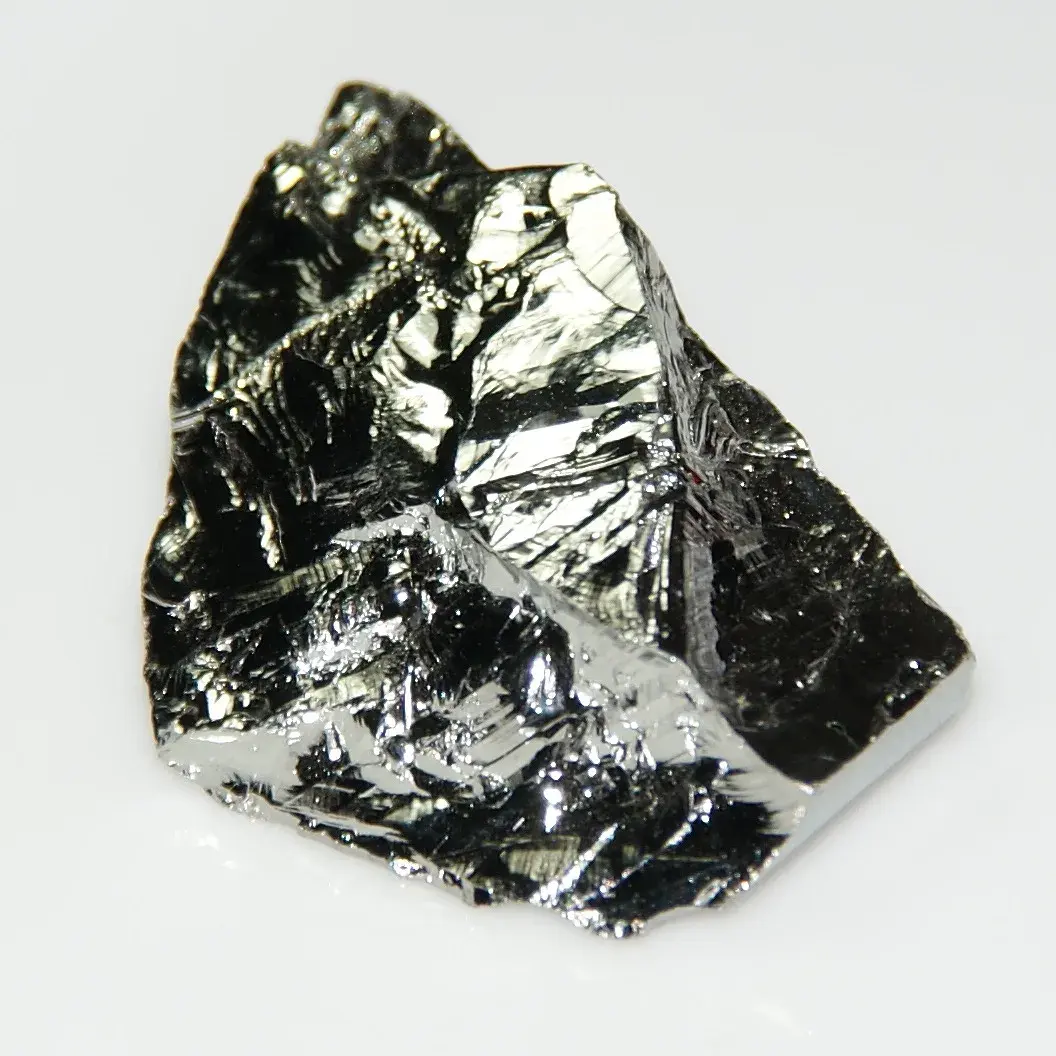
The elements that lie between metals and non-metals in the table and show some properties of metals and some of non-metals are metalloids: boron (B), silicon (Si), germanium (Ge), arsenic (As), antimony (Sb) and tellurium (Te). They conduct electricity, but less than metals and more than non-metals, which is why silicon and germanium are used as semiconductors in the chips of every phone and computer. Bismuth (Bi), below antimony, is a metal: it conducts electricity like one.
An element has the configuration 1s², 2s² 2p⁶, 3s² 3p⁶. What is it like?
Pick an answer to see why.
Which group has the valence-shell configuration ns²?
Pick an answer to see why.
How properties change across periods and down groups
The place of an element in the table tells you its properties, because periods and groups each change properties in a regular way. Two things explain almost all of it:
- Across a period (left to right), the number of shells stays the same, but each step adds one proton to the nucleus and one electron to the same outer shell.
- Down a group, each step adds a whole new shell, but the number of outer electrons stays the same.
A. Valency
The outermost shell of an atom is its valence shell, and the electrons in it are its valence electrons. An element’s valency (how many electrons it gives, takes or shares in a reaction) is set by its valence electrons.
Across a period, the number of valence electrons goes up one by one, so the valency changes: from group IA to VIIA and group 0, the valencies are 1, 2, 3, 4, 3, 2, 1, 0. Elements with 1 to 4 valence electrons usually give or share that many; those with 5 to 7 usually take or share (8 − that many) to reach eight.
Down a group, the number of valence electrons stays the same, so all the elements of a group have the same valency. Groups IA and VIIA have valency 1; groups IIA and VIA, 2; groups IIIA and VA, usually 3.
B. Atomic size
The size of an atom is set by how far its valence shell is from the nucleus.
Across a period, atoms get smaller. That seems odd: each step adds an electron, so shouldn’t the atom grow? But each step also adds a proton, and the new electron goes into the same shell. The nucleus, with more positive charge, pulls the whole shell in more tightly, and the atom shrinks. So the size of atoms decreases from group 1 to group 17 in a period.
Down a group, atoms get bigger. Each step adds a new shell, farther out. Lithium has two shells (K and L); sodium has three (K, L and M), so a sodium atom is bigger than a lithium atom.
C. Electropositivity and electronegativity
Electropositivity is the tendency of an element to lose its valence electrons and form positive ions (cations), like Na⁺. It is the same thing as metallic character. Electronegativity is the tendency of an element to gain electrons into its valence shell and form negative ions (anions), like Cl⁻. It goes with non-metallic character.
Both depend on how tightly the nucleus holds the outer shell.
- Across a period, atoms shrink, so the nucleus holds its outer electrons more tightly. Losing electrons gets harder and gaining them gets easier. So electropositivity (metallic character) decreases and electronegativity (non-metallic character) increases from group 1 to group 17.
- Down a group, atoms grow, so the outer electrons are farther from the nucleus and more loosely held. They are lost more easily, so electropositivity increases, and a new electron is pulled in less strongly, so electronegativity decreases.
Fluorine, small and with a strong pull, is the most electronegative element of all; cesium and francium, at the bottom left, are the most electropositive.
D. Chemical reactivity
A metal reacts by losing electrons; a non-metal by gaining them. So:
- Across a period, the reactivity of metals decreases (losing electrons gets harder) and the reactivity of non-metals increases (gaining gets easier). But the element at the far right, the noble gas, is inert.
- Down a group, the reactivity of metals increases and the reactivity of non-metals decreases.
Look at period 3:
| Atomic number | 11 | 12 | 13 | 14 | 15 | 16 | 17 | 18 |
|---|---|---|---|---|---|---|---|---|
| Element | Na | Mg | Al | Si | P | S | Cl | Ar |
| Valence electrons | 1 | 2 | 3 | 4 | 5 | 6 | 7 | 8 |
| Valency | 1 | 2 | 3 | 4 | 3 | 2 | 1 | 0 |
From sodium to argon, the atomic number rises and the protons and electrons increase, but every electron joins the same M shell. The growing pull of the nucleus draws the shell in, and the atoms shrink. Sodium is the largest, holds its one outer electron most loosely, and is the most reactive metal of the period. Argon is the smallest, but it is a noble gas and doesn’t react, so chlorine is the most electronegative and most reactive non-metal of period 3.
Down a group, metals grow and lose their valence electrons more easily, so the reactivity of group IIA increases in the order Be < Mg < Ca. Non-metals grow and gain electrons less easily, so the reactivity of group VIA decreases in the order O > S > Se.
Which is the most reactive metal: lithium, sodium, potassium or magnesium?
Pick an answer to see why.
Which is the most reactive non-metal: fluorine, chlorine, oxygen or neon?
Pick an answer to see why.
Want to practice? Our Periodic Table has games built on this unit: Guess the Element, Higher or Lower on atomic numbers, a periodic table Jigsaw, and Molecule Kitchen, where you combine atoms by their valencies.
Project work
Exercise
1. Choose the correct option
a. In which group do the elements with the electronic configuration 1s², 2s² 2p³ lie?
Pick an answer to see why.
b. What are the elements between groups IIA and IIIA in the modern periodic table called?
Pick an answer to see why.
c. Which of these non-metals is the most reactive?
Pick an answer to see why.
d. Which of these metals is the most reactive?
Pick an answer to see why.
e. In which group of the modern periodic table are the inert gases?
Pick an answer to see why.
f. Which shows the correct order of increasing chemical reactivity of metals?
Pick an answer to see why.
g. The positions of elements A, B, C and D are shown in Figure 14.6. Which of them can form an acidic oxide?
Pick an answer to see why.
2. Give reasons
Classification of elements is necessary.
Answer
The size of atoms increases from top to bottom in a group.
Answer
The size of atoms decreases from left to right across a period.
Answer
Hydrogen is a non-metal, but it is kept with the metals in the modern periodic table.
Answer
Potassium is more reactive than sodium.
Answer
Fluorine is more reactive than chlorine.
Answer
The metallic character of elements decreases and the non-metallic character increases from left to right across a period.
Answer
Inert gases are kept in group 0 of the modern periodic table.
Answer
A part of the periodic table is shown: Li, Be, B, C, N, O, F, Ne (groups IA to VIIIA). The atomic size decreases from Li to Ne.
Answer
3. Write the differences between
Group and period
Answer
Chlorine and sodium
Answer
Elements of group IA and group VIIA
Answer
Electronegativity and electropositivity
Answer
4. Answer these questions
State the modern periodic law.
Answer
How many groups and periods are there in the modern periodic table?
Answer
Write the position of sodium in the modern periodic table. Why is it known as an alkali metal?
Answer
Write the positions of these in the periodic table: alkali metals, alkaline earth metals, inert gases, transition metals, lanthanides and actinides.
Answer
Write the electronic configuration of sulphur and its position in the modern periodic table.
Answer
On what basis are groups and periods separated in the modern periodic table?
Answer
In which group are fluorine, chlorine and bromine? Which of them is the most reactive?
Answer
If you were given the chance to improve the modern periodic table, what changes would you make? Give reasons.
Answer
Quiz yourself: Matter, Atoms and Reactions, Grades 5–10 →
Practice every question in the book, and keep track of the ones you miss →
A companion to your textbook, not a replacement for it: study from the book your school uses, and where the two differ, follow your teacher. Found a mistake? Please tell us.