
High in Dolpo, in Mustang, around Kanchenjunga and below Everest, there are cliffs where winter nights can fall below −20 °C, each breath holds only about half the oxygen it would at sea level, and its main prey, the blue sheep, can run up rock faces. A big cat lives there: the snow leopard. Nepal’s first national estimate, announced in 2025 from camera-trap and dung surveys, put their number at about 397 (as of 2025), around a tenth of all the snow leopards in the world.
A snow leopard is built for that place. Its fur is thick, its paws are wide, and its tail is so long and heavy that it can wrap it round its face like a scarf. Nobody designed it, and no snow leopard ever decided to grow a longer tail. So how did it come to fit the mountains so well? The answer is a process you can put numbers on: small differences in who survives and has young, adding up over many generations.
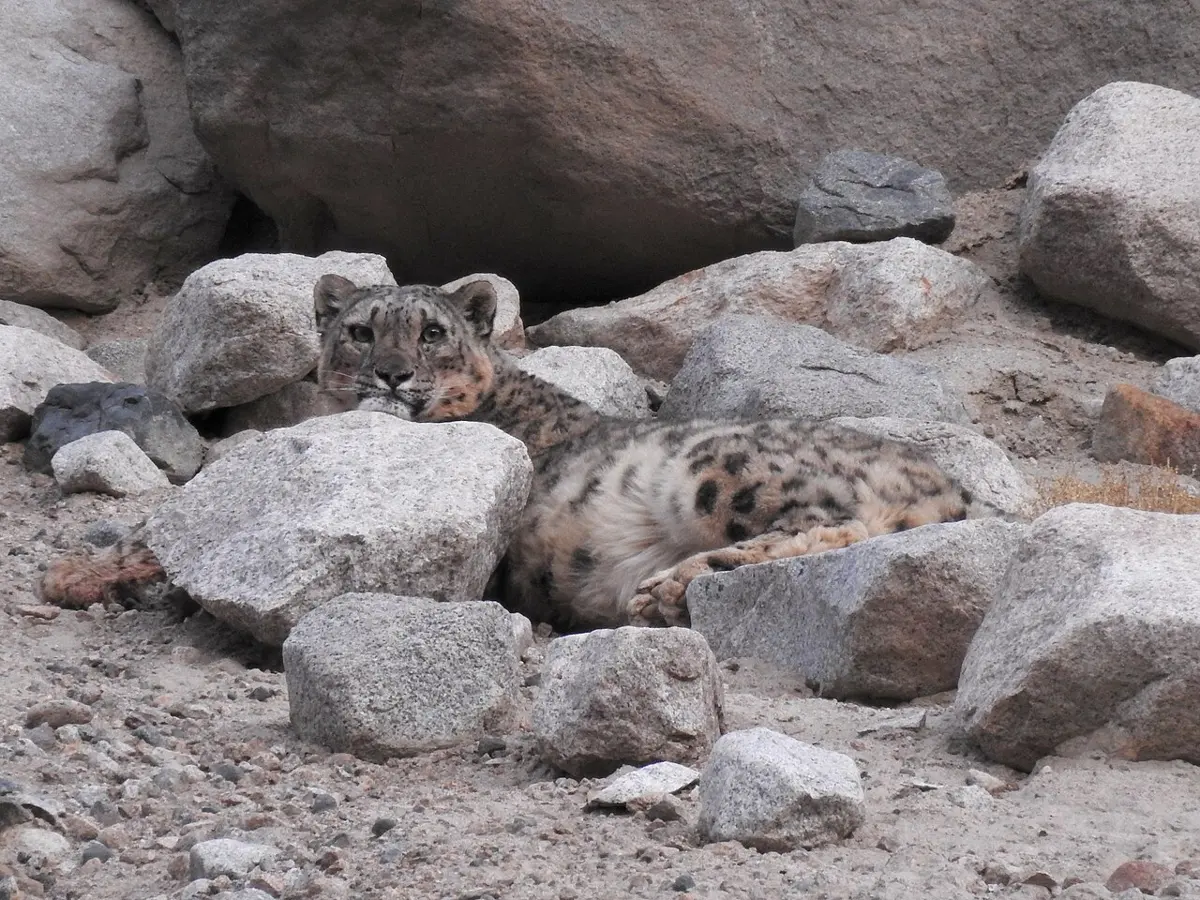
Made for the mountains
You learned in Grade 6 that living things have adaptations: features that help them live where they live. A fish has gills and fins for water; a camel stores fat in its hump and loses little water, for the desert. A snow leopard has a whole set of adaptations for cold, steep, rocky mountains.
| Feature | How it helps in the mountains |
|---|---|
| thick fur, up to 12 cm long on the belly in winter | keeps it warm on the coldest nights |
| wide, furry paws | spread its weight on snow, like snowshoes, and grip the rock |
| a thick tail about 1 m long, nearly as long as its body | balance when it leaps and turns on cliffs; a warm scarf when it sleeps |
| small, rounded ears | less skin to lose heat from |
| a large space inside its nose | warms the icy air before it reaches the lungs |
| long, strong back legs | powerful leaps up rocks after blue sheep |
| smoky gray coat with dark rosettes | hard to see against gray rock, so it can creep close to its prey |
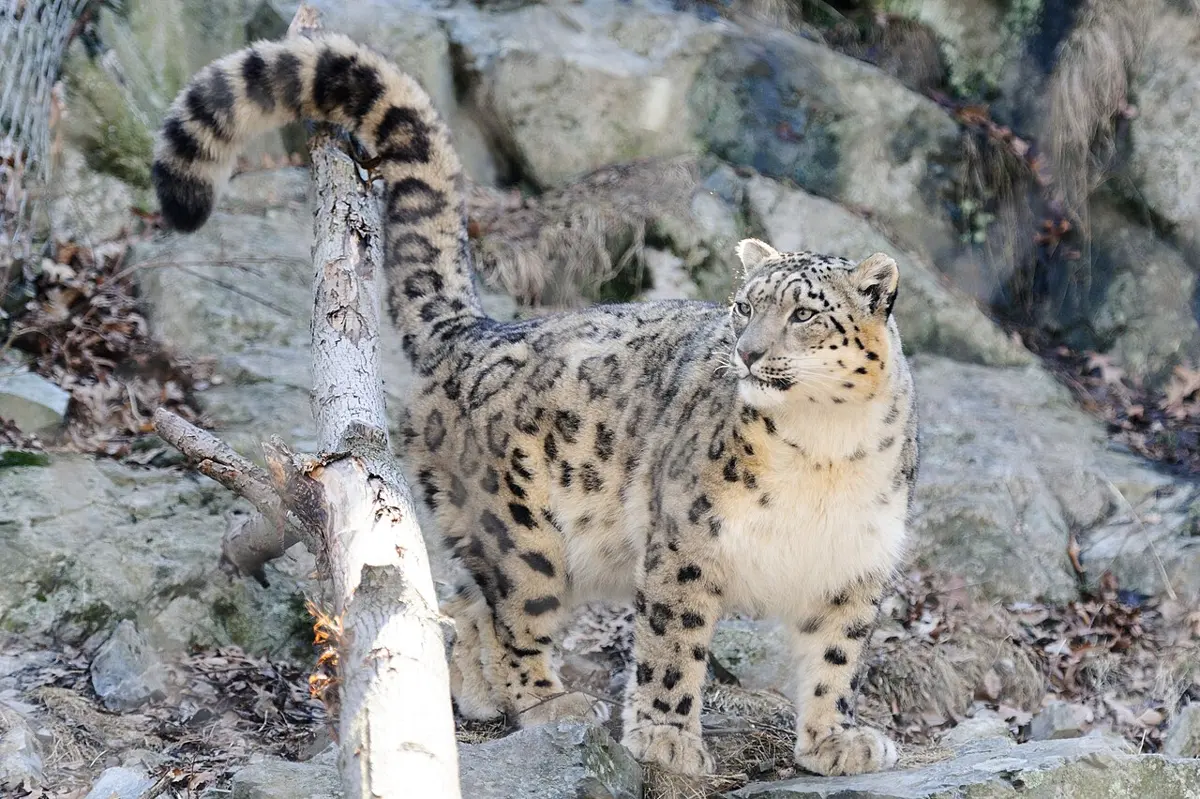
The snow leopard’s nearest relative is the tiger. Studies of their DNA show that the two come from one shared ancestor that lived roughly 2 to 5 million years ago. Over that time, the tigers’ family spread through the forests and grasslands of Asia, and the snow leopards’ family came to live high in the mountains of Asia. The two now look very different. The question of this topic is how that happened.
Which of these is an adaptation of the snow leopard to the cold?
Pick an answer to see why.
Two ways to explain it
There are two ways to explain how an animal comes to fit its home, and you will meet both in Grade 9 (Lamarckism and Darwinism).
- a.By trying. Each snow leopard grew thicker fur because it was cold, and passed its thicker fur on to its cubs. This was Jean-Baptiste de Lamarck’s idea, in 1809. It is wrong. Changes an animal gets during its life are not passed on: a wrestler’s muscles, a scar or a cut tail don’t appear in the next generation.
- b.By selection. In every litter of cubs, some happen to be born with thicker fur than others. In a hard winter, those with thicker fur are a little more likely to live, and to have cubs of their own, which are often born with thick fur like them. Generation after generation, there are more and more thick-furred snow leopards. This is natural selection, the idea of Charles Darwin and Alfred Russel Wallace, in 1858.
Grade 9 tells the idea in words. In this topic you will see how it works with numbers: why “a little more likely” is enough, and how fast a trait can spread or disappear.
A farmer says: “The yaks in our village got thicker coats because their grandparents spent so many winters in the snow.” What is wrong with this?
Pick an answer to see why.
No two snow leopards are the same
Look round your class. Everyone is a human, but no two people are the same height, with the same nose or the same voice. The differences between the members of one kind of living thing are called variation. Snow leopards vary too: in the thickness of their fur, the length of their tails, the size of their paws, the shade of their coat. The whole group of snow leopards that live and breed together in one place, for example in Dolpo, is a population.
Some of this variation is inherited: it comes from the parents’ genes. A cub whose parents both have very thick fur is likely to have thick fur too. Some of it is not inherited: it comes from what happens in the animal’s life. A cub that eats well grows bigger than its brother, and a scar from a fight is not passed on.
Where does inherited variation come from? You learned in Grade 8 Grade 8: Sexual reproduction that young made by sexual reproduction are each a new mix of their two parents, so brothers and sisters differ. New variations also appear from time to time, when a gene is copied with a small change, a mutation (you will meet it in Grade 9: Variation and mutation).
Which difference between two snow leopards could natural selection act on?
Pick an answer to see why.
A better chance, not a sure thing
Here is the heart of natural selection. A useful variation doesn’t make an animal sure to survive. It only makes its chance a little better.
Suppose that in a hard winter, a cub with thick fur has a 6 in 10 chance of living to grow up and have cubs of its own, and a cub with thinner fur a 4 in 10 chance. (These are made-up numbers, to show how it works. Real chances are hard to measure in a wild cat, but scientists have measured them in other animals: there are some below.) A chance of 6 in 10 means that out of many such cubs, about 6 in every 10 will live. It doesn’t say which ones. A thick-furred cub can still be caught in an avalanche, and a thin-furred one can be lucky.
With 50 cubs of each kind, chance evens out and the numbers come close to 30 and 20. With only a few cubs, luck can win. Try it.
In a valley, 6 in 10 thick-furred cubs survive a hard winter and 4 in 10 thin-furred ones. A cub with thick fur is born. Which statement is true?
Pick an answer to see why.
Adding up, generation by generation
A small advantage in one winter makes only a small change. But it happens again in the next generation, and the next. Let’s follow it, with numbers.
Suppose that, among 1,000 cubs born in the mountains, 100 happen to have thick fur and 900 thinner fur: 10% have thick fur. Suppose a thick-furred cub has a 6 in 10 chance of surviving to have cubs, and a thin-furred one 5 in 10: only a small advantage. And suppose every survivor raises the same number of cubs, with fur like its own, so the next generation has the same mix as the survivors.
A shortcut: the ratio
Look at the ratio of thick-furred to thin-furred cubs. At the start it was 100 : 900, or 1 : 9. Among the survivors it is 60 : 450. Divide both by 50 and it is 1.2 : 9. The ratio has been multiplied by
the number of times more likely a thick-furred cub is to survive. That happens again every generation: the ratio of thick to thin is multiplied by 1.2 each time. After two generations it is 1.2 × 1.2 = 1.44 : 9; after ten, ≈ 6.19 : 9.
Carry on the same way and you get this table. Notice the shape: slow at first, while thick fur is rare, then fast, then slow again as the last thin-furred ones become rare.
| Generation | About how many years | Ratio thick : thin | Thick fur |
|---|---|---|---|
| 0 | 0 | 1 : 9 | 10% |
| 1 | 8 | 1.2 : 9 | 12% |
| 5 | 40 | 2.5 : 9 | 22% |
| 10 | 75 | 6.2 : 9 | 41% |
| 15 | 110 | 15 : 9 | 63% |
| 20 | 150 | 38 : 9 | 81% |
| 30 | 225 | 237 : 9 | 96% |
So an advantage of 6 in 10 against 5 in 10 takes thick fur from one cub in ten to nearly all of them in about 30 generations, a couple of hundred years. Even a tiny advantage, 1% more likely to survive (a ratio of 1.01), would take it from 10% to 90% in about 440 generations: some 3,300 years. The snow leopards’ family has had millions of years.
Up and down: selection people have measured
Natural selection is usually far too slow to watch in a snow leopard. In animals that breed every year, or when the environment changes suddenly, scientists have seen it happen, and counted it.
The peppered moth
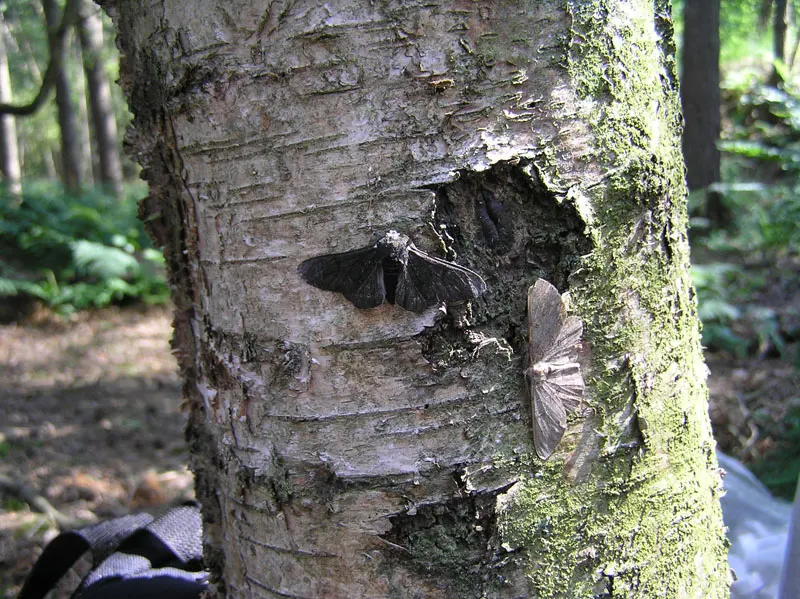
The peppered moth of Britain rests on tree trunks by day, and birds hunt it. Most peppered moths are pale, speckled with black, and almost invisible on trees covered with pale lichens. A rare inherited variation makes them black all over.
Why did black peppered moths become rare again after the 1950s?
Pick an answer to see why.
Elephants without tusks
Some African elephants are born without tusks. In most populations, only about 2 to 4 in every 100 females are tuskless. During the civil war in Mozambique, from 1977 to 1992, poachers killed more than 90% of the elephants in Gorongosa National Park, to sell the ivory. They shot mostly elephants with tusks, and mostly left the tuskless ones.
In a study published in 2021, scientists found that among the female elephants of Gorongosa, about 18% had been tuskless before the war, and about 51% of those that survived it.
This is selection by people, not by nature, and it shows that a useful feature can become less common too: tusks became rarer within a few decades. Among the females born since the war, about a third are tuskless: fewer than among their mothers, partly because a tuskless mother passes the trait on to only about half of her daughters, but still far more than before the war. Tusks are useful to an elephant, for digging and stripping bark, so now that the poaching has stopped, tuskless elephants may slowly become rarer again.
Try it at home: hungry birds
Questions
In a population of hares, 30% are born with white winter coats. In a snowy winter, white hares are twice as likely as brown hares to survive. What will the share of white hares among the survivors be?
Pick an answer to see why.
Which of these would make natural selection impossible?
Pick an answer to see why.
Explain how snow leopards came to have long, thick tails. Use the words variation, inherited, survive and generation.
Answer
Long ago, the snow leopards’ ancestors showed variation in their tails: some were born with longer, thicker tails than others, and this difference was inherited, so their cubs tended to have tails like them. On steep cliffs and in cold winters, cats with longer, thicker tails kept their balance better while hunting and kept warmer while sleeping, so they were a little more likely to survive and raise cubs. In each generation a slightly larger share of the parents had long, thick tails, so a larger share of the cubs did too. Over many thousands of generations, long, thick tails became normal for the whole population. No cat grew a longer tail because it tried or needed to.
In a valley there are 40 snow leopard cubs: 10 with thick fur and 30 with thinner fur. In a hard winter, 8 of the thick-furred cubs and 12 of the thin-furred cubs survive.
- a.Write each kind’s chance of surviving as “… in 10”.
- b.What percentage of the cubs had thick fur, and what percentage of the survivors?
- c.How many times more likely was a thick-furred cub to survive?
Answer
- a.Thick: 8 of 10, so 8 in 10. Thin: 12 of 30 = 4 of 10, so 4 in 10.
- b.Cubs: = 25%. Survivors: = 40%.
- c.8 in 10 ÷ 4 in 10 = 2 times as likely. (Check with the ratio: 10 : 30 became 8 : 12, and .)
A beetle comes in green and brown forms. On green leaves, birds eat more brown beetles. A scientist finds that the ratio of green to brown beetles is multiplied by 1.5 each generation.
- a.If the ratio starts at 1 : 1, what is it after 1, 2 and 3 generations?
- b.What percentage are green after 3 generations?
- c.Sketch a graph of the percentage of green beetles over 10 generations. What shape is it, and why does it flatten near 100%?
Answer
- a.1.5 : 1, then 2.25 : 1, then 3.375 : 1.
- b., so about 77%.
- c.After 4 generations about 84%, after 5 about 88%, after 10 almost 98%. The graph rises fast, then flattens. It flattens because the ratio keeps growing but each step adds less to the percentage: once nearly all beetles are green, there are few brown ones left to be replaced. It never quite reaches 100% while some brown beetles are still born.
A student says: “A snow leopard with thick fur will survive the winter, and one with thin fur will die. That is natural selection.” Explain what is wrong, and correct it.
Answer
Natural selection is about chances, not certainties. A thick-furred snow leopard can still die (of hunger, a fall or an avalanche), and a thin-furred one can live. What is true is that thick-furred cats are more likely to survive and raise cubs in cold places. Over a whole population and many generations, that better chance means a larger share of each generation’s parents have thick fur, so thick fur becomes more common.
Black peppered moths rose from rare to 98% around Manchester between 1848 and 1895, then fell to under 15% in parts of Manchester (a study published in 2011). Explain both changes using natural selection, and say what evidence shows that birds were the cause.
Answer
Rise: soot from coal-burning factories killed the pale lichens and blackened the tree trunks. On dark bark, pale moths were easy for birds to see and black moths were hidden, so black moths were more likely to survive and breed. The black color is inherited, so each generation had a larger share of black moths. Fall: after the clean-air laws of the 1950s, the lichens returned and the trunks grew pale again. Now black moths stood out and were eaten more, so their share fell each generation. Evidence: in Kettlewell’s experiments, a larger share of black moths was recaptured in a sooty wood (27.5% against 13% of pale ones), and a larger share of pale moths in a clean wood; and Majerus, releasing thousands of moths between 2001 and 2007, saw birds eat more of the black ones on pale trees.
Where to go next
- Why Do You Look Like Your Parents, but Not Exactly? Where inherited variation comes from: how genes pass from parents to young, and why brothers and sisters differ.
- How Did Farmers Make Our Crops? The same selection, done on purpose: how farmers turned wild plants into maize, rice and our other crops by choosing which ones to sow.
- Why Do Animal Numbers Rise and Fall? Why most young animals never grow up: food, hunters and disease, the struggle that does the selecting.