
On 4 December 2009, Nepal’s prime minister and most of his cabinet were flown by army helicopter to a flat stretch below Kala Patthar, about 5,240 m up, near the base camp of Everest, with oxygen cylinders kept close by. At eleven in the morning, in an icy wind, they held a cabinet meeting. They adopted an Everest Declaration, approved the speech Nepal would give on the climate, announced a new protected area around Gaurishankar, and were done in about ten minutes. The world’s leaders were meeting in Copenhagen the following week to talk about the climate, and the meeting was a message to them, sent from among the ice.
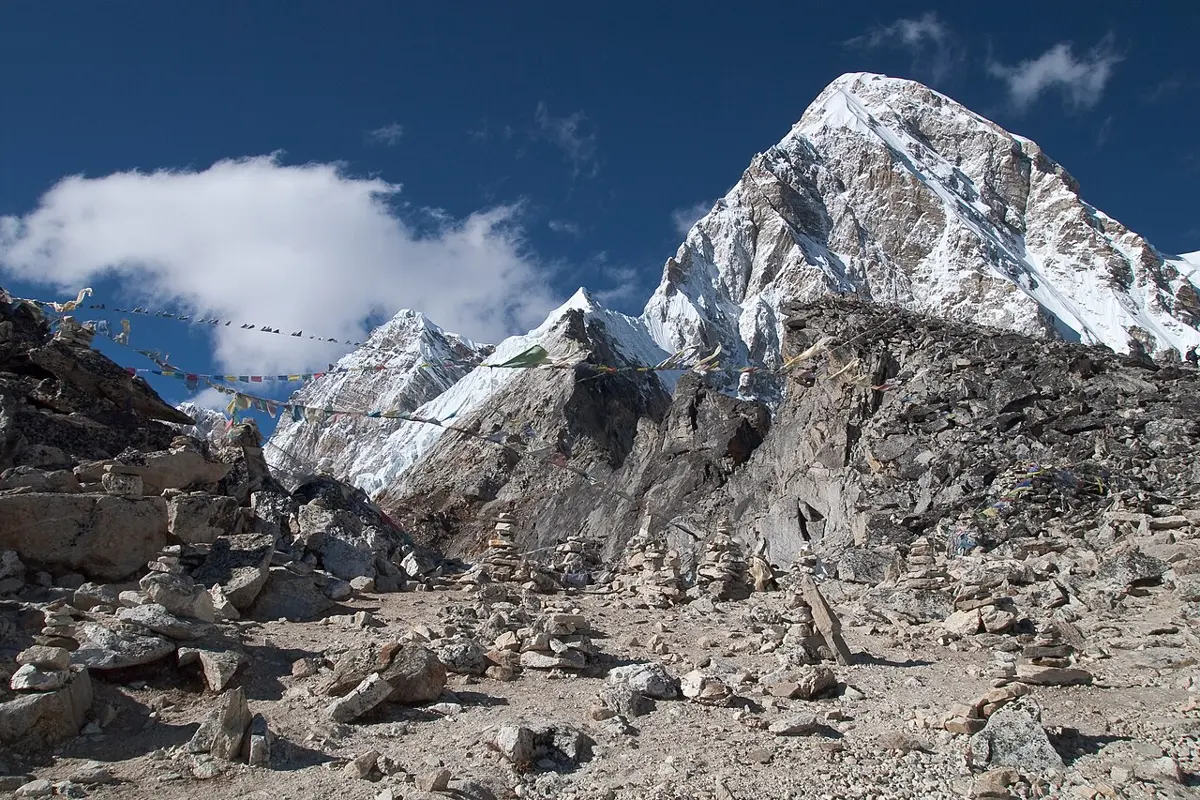
Why go so high to make a point about the air? Because the ice keeps count. A glacier is a record of years of weather added up, and the Himalaya’s glaciers have been losing more than they gain. This chapter is about why the world is warming, how anyone can be sure, what the climate’s own past says about it, what it means for the ice and the rivers below it, and the two quite different jobs it leaves for people. The plain answer first.
How it works
Sunlight comes through the air and warms the ground and the sea. The warm Earth then gives that energy back out toward space, not as light but as heat rays you can’t see, called infrared. A few gases in the air, carbon dioxide and water vapor and methane among them, let sunlight through but catch some of the outgoing heat rays and send part of them back down. They work like a thin blanket. With a little more of them, a little more heat stays in, and the surface warms until it gets rid of as much as it takes in again.
Now add the carbon. Coal, oil and gas are the remains of living things buried for millions of years. Burning them turns their carbon into carbon dioxide, and so does burning or clearing a forest. About half of what people release is soaked up by the sea and by plants on land. The rest stays in the air, and it stays for a very long time.
So the change runs in a chain. People burn carbon. Carbon dioxide builds up in the air. The blanket thickens and more heat stays in. The world warms, and ice, sea and rain change with it. That is all of it, in outline. The rest of the chapter is how anyone knows, and what follows. How the Earth’s heat balance works in detail is in Why Has the Climate Changed Before?
None of this is a new idea. In 1856 Eunice Foote found that carbon dioxide soaks up heat, simply by measuring how much a glass tube filled with it warmed up. In 1859 John Tyndall’s careful laboratory work picked out several gases that soak up heat rays, water vapor the most important of them. And in 1896 the Swedish scientist Svante Arrhenius worked out, in long and laborious sums, that doubling the carbon dioxide in the air would warm the Earth by some 5 to 6 °C. (Today’s best estimate, from far better methods, is about 3 °C.) He wasn’t worried about the future. He was trying to explain the ice ages, and at the rate coal was burned in 1896 he thought it would take perhaps three thousand years for the gas to build up that far. In chilly Sweden a few degrees warmer didn’t sound bad.
How we know
It took a careful young chemist to show that the gas really was building up. In the 1950s Charles David Keeling, at the California Institute of Technology, built a precise instrument for measuring carbon dioxide and began taking samples of air through the day and night. At Big Sur on the California coast, in rainforests and in mountain forests, he found the same thing: the air held more carbon dioxide at night, when plants stop taking it in and only breathe it out, and settled every afternoon at about the same value, 310 parts in every million.
In March 1958 one of his new analyzers began work high on Mauna Loa, a volcano in Hawaii. On its first day it read 313 parts per million. Then the number did something Keeling hadn’t expected. It rose until May, fell until October, and rose again, and the next year it did the same. “We were witnessing for the first time,” he wrote, “nature’s withdrawing CO₂ from the air for plant growth during summer and returning it each succeeding winter.” The forests and fields of the north, where most of the world’s land is, breathe in every summer and out every winter.
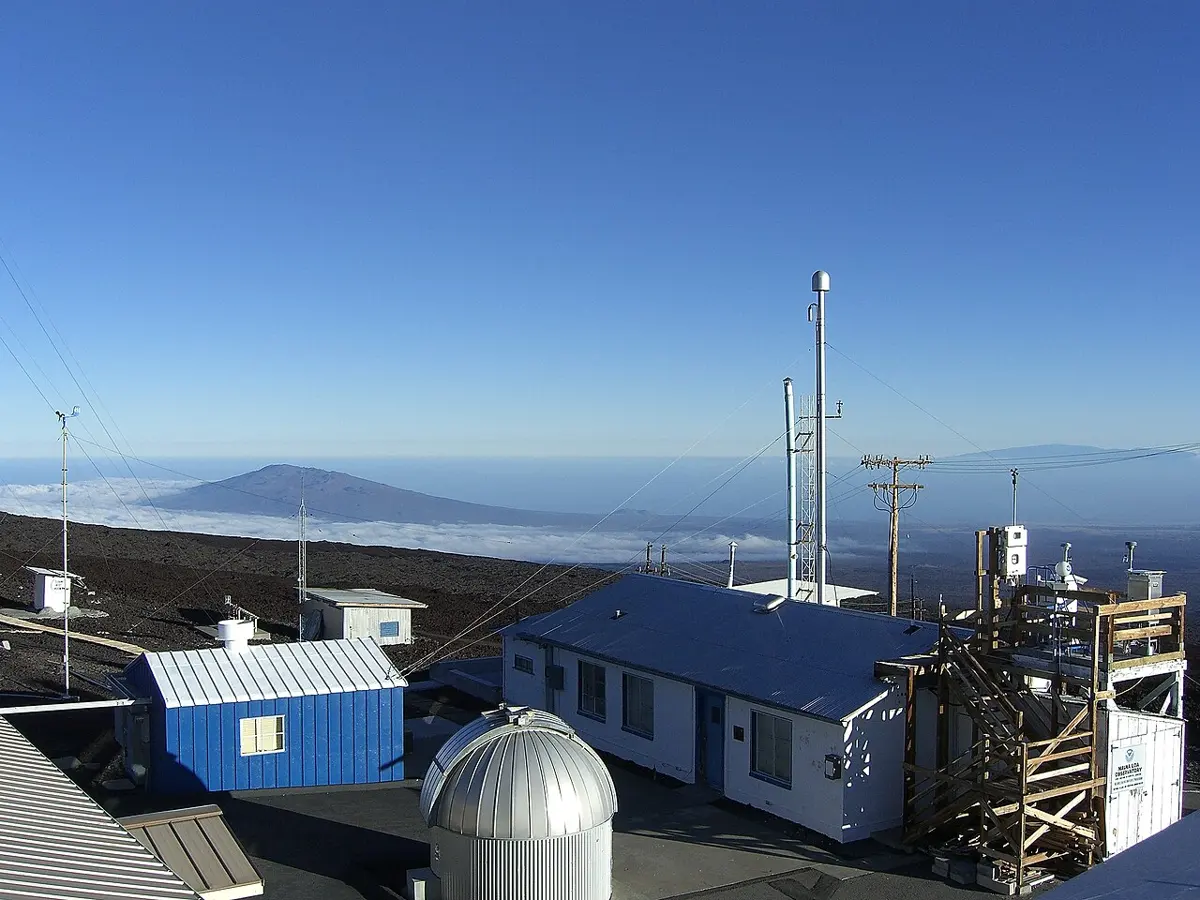
And each year’s average came out higher than the last. The measurements still go on, and the line they make, called the Keeling Curve, has climbed ever since, the yearly breath riding on top of it. The yearly average was about 316 parts per million in 1959 and about 427 in 2025.
The temperature record tells the same story from the other side. Each of the last four decades has been warmer than every decade before it since 1850. The years 2015 to 2025 are the eleven warmest on record. In 2025 the world was about 1.44 °C warmer than in 1850–1900. How those readings are gathered and checked is told in What Will the Climate Be Like When You Are Grown Up?
How can anyone tell that the extra carbon dioxide is ours, and not from volcanoes or the sea? The carbon carries a label. A little of the carbon in living things is carbon-14, a kind of carbon that slowly decays. Coal and oil are so old that all their carbon-14 has decayed away, so carbon dioxide from burning them has none. As it is added, the share of carbon-14 in the air drops, and that drop is measured. Fossil carbon is also short of another kind, carbon-13, and that share is falling too. And the sun can’t explain the warming: the pattern of warming since 1950 doesn’t match what a brighter sun would do.
The world’s climate scientists weigh all this together every few years for the Intergovernmental Panel on Climate Change, the IPCC. Its summary’s first sentence, in 2021, was this: “It is unequivocal that human influence has warmed the atmosphere, ocean and land.” Unequivocal means there is no room left for doubt. Of the climate papers published since 2012, more than 99% agree that people are causing the warming; how to read a number like that, and how it differs from a manufactured argument, is in Thinking Clearly’s Experts and agreement.
What the past teaches
The climate has changed before, many times and by far more than now. That is sometimes said as if it settled the matter. In fact the past is some of the best evidence there is, and it teaches three things.
The first is how much a few degrees can do. About 20,000 years ago, at the height of the last ice age, the world was on average about 6 °C colder than today, and about 14 °C colder in the Arctic. That was enough to bury nearly all of Canada and much of northern Europe under ice. Six degrees, averaged over the whole Earth, is the difference between this world and that one.
The second is that carbon dioxide and temperature have moved together. Air trapped in the ice of Antarctica and Greenland, drilled out in long cores, shows that in the ice ages the air held about 200 parts per million, and in the warm times between them about 280. The ice ages themselves were paced by slow changes in the Earth’s orbit; how carbon dioxide joined in is told in Why Has the Climate Changed Before?
The third is speed. As the Earth came out of each ice age, the world warmed by 4 to 7 °C over about 5,000 years. The 20th century’s warming, about 0.7 °C, came roughly ten times faster. Carbon dioxide is now far past its old range: the IPCC found that in 2019 it was higher than at any time in at least 2 million years. Its summary puts the whole picture plainly: “The scale of recent changes across the climate system as a whole – and the present state of many aspects of the climate system – are unprecedented over many centuries to many thousands of years.”
The longer story, of hothouse worlds and ice-covered ones, is in the Timelines’ Deep Time, and Earth Through Time shows how the land itself has moved through those climates.
The ice, and the rivers below it
The Himalaya are warming, and faster the higher you go. Across the Hindu Kush and Himalaya, the mountain region from Afghanistan to Myanmar, the average temperature rose by about 0.28 °C every ten years from 1951 to 2020; above 4,000 m it was about 0.34, below 2,000 m about 0.20.
The glaciers have answered. They lost ice in 2010–2019 about 65% faster than in 2000–2009. Almost all the world’s glaciers have been shrinking at once since the 1950s, which hasn’t happened in at least 2,000 years.
Ice and Wind told how a lake grows behind a moraine as its glacier melts back, and how such a lake bursts. Warming makes more of these lakes, and makes them grow. On the afternoon of 16 August 2024, two that hardly anyone was watching gave way above Thame, in the Khumbu. The upper one had formed only in the late 2000s and grown fast. It spilled over its dam and emptied into a second lake below it, which burst too. What set it off isn’t known for certain. The study of the flood found two possibilities: the dam was overwhelmed by melt after a spell of heat and rain, or ice or rock fell into the upper lake and raised a wave. Its model had the water reaching Thame in about 22 minutes. It destroyed a school, a health post, five hotels and seven homes, though no one was killed. Both lakes were small, and most surveys of dangerous lakes had left them out for that reason; the watching and warning go mostly to the large lakes on the danger list. Thame showed that a small, young lake can do great harm too.
How much ice will be left depends on how warm the world gets. If warming is held to 1.5 to 2 °C, the region’s glaciers are expected to lose 30 to 50% of their ice by 2100. At 3 °C about a quarter to under half would remain, and at 4 °C only a fifth to under a third. That last figure is where the “up to 80%” in the news comes from: it is the high-warming case, not the only one. And whatever happens, the ice already committed will keep melting for decades or centuries.
What does that mean for the rivers? It depends where you stand. High up, the ice and snow are nearly everything: in the upper Dudh Koshi below Everest, melting glaciers give almost half the water and melting snow most of the rest. Downstream the share shrinks fast. In the whole Trishuli, Marsyangdi or Tamor, glacier melt is only about a tenth of the flow, and over the Ganges’s whole mountain basin about 3%, with snow another 10%. Most of the water in Nepal’s big rivers is rain. Lose the ice and the Koshi doesn’t run dry.
But melt arrives when it counts. Snow melts from April to June and glacier ice through the summer, so in the hot weeks before the monsoon, before the rain takes over, it is a much bigger part of what flows. High in the mountains, springs are fed by it too, and their flow is expected to fall as the melt does. And there is a twist. A melting glacier gives more water at first, then less, as it gets too small to give much even melting fast. For most of the region’s rivers this “peak water” is expected around the middle of this century, after which water from the mountains is expected to fall, though the amounts are uncertain.
Rain will change too, though less certainly than heat. The IPCC expects the heaviest one-day rains to grow about 7% stronger for every degree of warming, and the world’s monsoons to bring more rain and wilder swings between wet and dry. Over South Asia in the 20th century, the warming from greenhouse gases would have brought more monsoon rain, but the haze of tiny particles that pollution puts in the air cooled it and held the rain back. One flood or one dry year is weather. What is shifting is how often such days come, and how hard they hit.
Two different jobs
All of this leaves two jobs, and they are easily mixed up.
The first is to stop the warming getting worse. That means cutting the gases. The IPCC’s summary is blunt about what it takes: limiting warming to any level means “reaching at least net zero CO₂ emissions”, putting no more carbon dioxide into the air than is taken out, along with deep cuts in the other gases. And in every future the IPCC looked at, even the one with the fastest cuts, the world keeps warming until at least the middle of this century.
The second is to live with the change that comes anyway. That is adapting: lowering a dangerous lake, as Nepal did at Imja in 2016; warning villages downstream when a river rises; growing crops that cope with a late monsoon; building away from the riverbank; storing water for the dry weeks. The Paris Agreement of 2015 names the two jobs side by side. Its aim is to hold warming “well below 2°C above pre-industrial levels”, trying for 1.5 °C, and, in the next line, “Increasing the ability to adapt”.
They are different jobs because different people can do them. Cutting is a job for the whole world at once, and it falls mostly on those who burn the most. In 2024 Nepal’s fuels and cement made about 0.05% of the world’s carbon dioxide, about 0.6 tonnes a person, against a world average of about 4.7 tonnes and about 14 tonnes for each person in the United States. If Nepal stopped tomorrow, the Keeling Curve would hardly notice. Still, Nepal has said it aims to reach net zero by 2045, by burning far less fuel and letting its forests take up carbon.
Adapting is the opposite. It has to be done where the risk is: nobody abroad can lower a lake or move a house for a village in Solukhumbu, wherever the money comes from. Nepal wrote its first national adaptation program in 2010, and that program and its climate policy say that at least 80% of the money for adapting and other climate work must be spent at the local level, where the risks are. Its National Adaptation Plan of 2021 lists 64 programs to 2050, in farming, forests, water, towns, roads and more, at a cost of about US$47.4 billion, of which it expects about US$45.9 billion to come from outside.
That last number is where the real argument lies. The science of why the world is warming isn’t in dispute among the people who study it. What to do about it is. Who should cut, and how fast? Should those who put the most carbon into the air over the past two centuries pay most of the cost of adapting elsewhere, or should every large emitter today carry its share wherever it is? How much should be spent now to spare people later? These are questions of fairness and money, and people who agree on every fact answer them differently. Thinking Clearly’s What facts can’t settle is about exactly that kind of question.
Adapting has limits, too. The IPCC found that some are already being reached, mostly for want of money and planning, and that above 1.5 °C of warming, places that depend on glacier and snow melt may meet limits no money can move. Adapting buys time and saves lives. It doesn’t make the first job unnecessary.
The cabinet at Kala Patthar met for about ten minutes. The ice beside it will take decades to give its answer, and how much of it is left in 2100 will be decided mostly by what is burned far from Nepal. What happens in the valleys below it, when the lakes grow and the rivers change their seasons, is the second job, and that one has to be done in Nepal.
Found a mistake? Please tell us.