
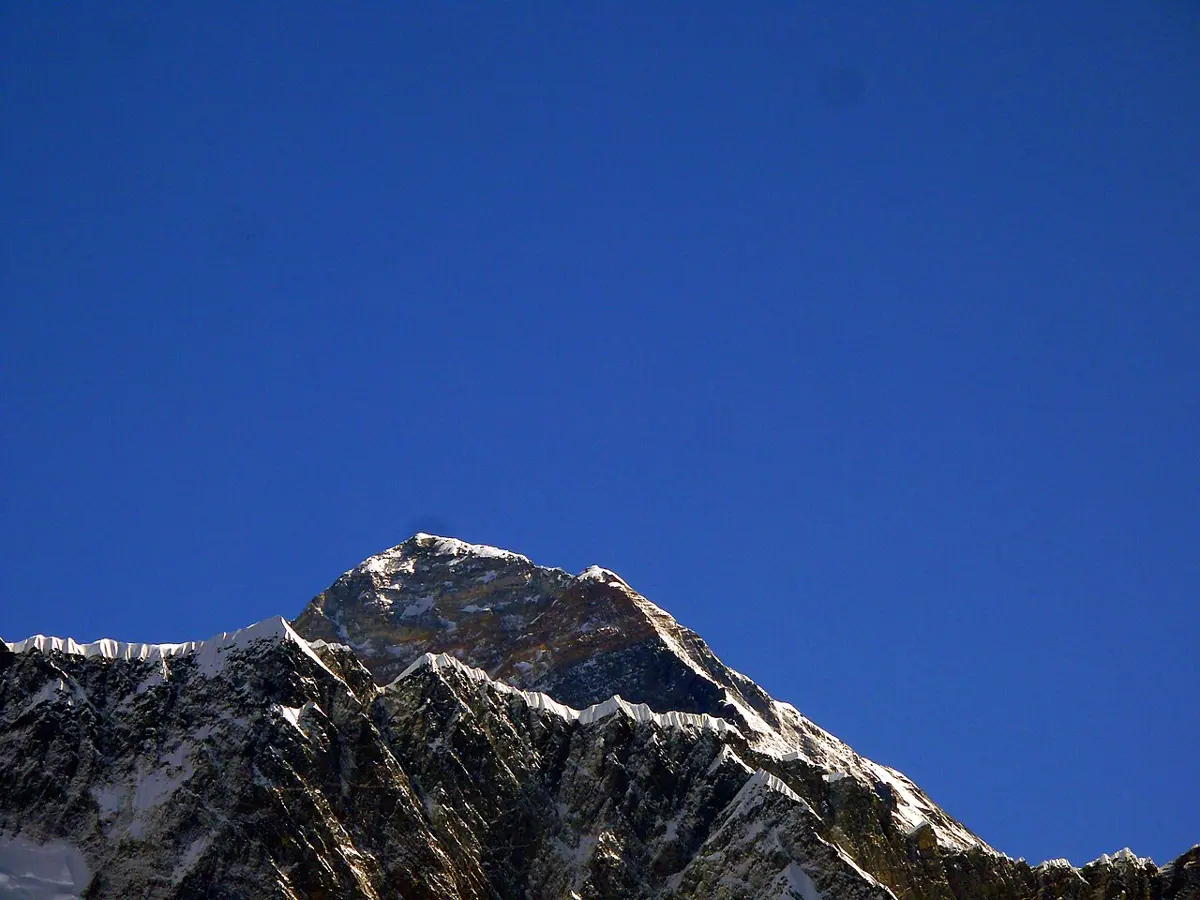
Near the top of Mount Everest, about 8,500 meters up, climbers cross bands of pale gray rock. It is limestone, the kind of rock that builds up on the floor of a warm, shallow sea, and it is full of the remains of sea animals: shells of brachiopods, broken stems of sea lilies called crinoids, and the tiny teeth of conodonts, small eel-like swimmers. The summit itself is made of it. The highest rock on Earth was laid down on a tropical sea floor about 460 million years ago.
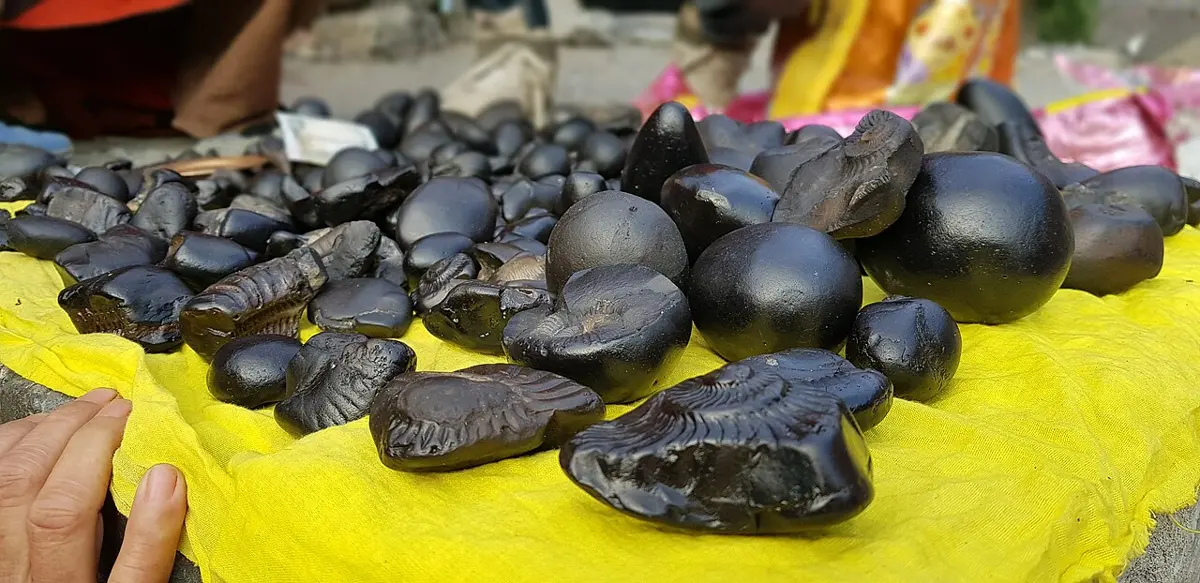
You don’t have to climb Everest to hold a piece of an old sea. On the valley floor at Muktinath, about 3,600 meters up behind the Annapurna range, black shale is studded with round stones. Split one open and inside there is often an ammonite, the coiled shell of a sea animal that lived at the very end of the Jurassic period, about 145 million years ago. The Kali Gandaki rolls such stones down its bed and rounds them smooth. Hindu scriptures written many centuries ago already speak of them as शालिग्राम (shaligram), stones held to be Vishnu himself, and pilgrims still make the long journey to the Gandaki and Muktinath to find them.
So the bottom of the sea is now on the roof of the world. To see how, you need the whole Earth: what it is made of, how it got that way, and why its outside won’t keep still. Here is the short version first.
The Earth is built in layers, the heaviest at the middle and the lightest on top. Its outer shell of cool, stiff rock is about 100 kilometers thick, and it isn’t one piece. It is cracked into a few great slabs, called plates, and many smaller ones. Underneath, the rock is so hot that, over millions of years, it can slowly flow, and the plates move on it, a few centimeters a year, carrying the continents and the ocean floors with them. India rides on one of those plates. For a hundred million years or so it moved north, and the sea that lay between it and Asia closed. When India met Asia, the edges crumpled, and old sea floor was pushed up into the mountains. How a mountain range rises is a story of its own, for later in this book. The rest of this chapter is about the Earth that makes it possible.
Like an egg, but not quite
It is 6,371 kilometers from where you stand to the center of the Earth. Geologists often compare the planet to a boiled egg, and the comparison works better than you might expect.
The shell is the crust. Under the oceans it is dark, heavy rock, mostly basalt, only about 5 to 10 kilometers thick. The continents are made of lighter rock, more like granite, and their crust is thicker, about 35 kilometers on average and much more under great mountain ranges. Thick or thin, it is a very thin skin for so big a ball. Draw the Earth to scale and the crust is thinner than the line around the circle.
Below the crust lies the mantle, the white of the egg, about 2,900 kilometers of rock that is hotter and heavier the deeper you go. It is often drawn as a sea of melted rock, but almost all of it is solid. What makes it strange is time. Steel softens and bends when it is hot enough, and mantle rock, hot and pressed under the weight of everything above it, does something like that over millions of years: it creeps, and it flows. The lava of a volcano comes from small places where the rock melts, not from a liquid layer under everyone’s feet.
At the center is the core, the yolk, and here the egg stops being a good comparison, because the core is metal: iron with some nickel, nearly twice as dense as the mantle. It comes in two parts. The outer core, about 2,200 kilometers thick, is liquid. As the Earth turns, that liquid metal churns, and its churning makes the Earth’s magnetic field, the one a compass needle feels (Earth’s Magnetic Field shows it changing year by year). Inside it is the inner core, a ball about 2,440 kilometers wide. At its edge it is probably about 6,000 °C, roughly as hot as the surface of the Sun, and yet it is solid, because the pressure of the whole planet on top of it won’t let the iron melt.
The heavy middle is no guess. The whole Earth averages about 5.5 times as heavy as the same amount of water. The rocks of the crust weigh only 2.7 to 3 times as much. So something far heavier must be hidden underneath.
For the plates, one more division matters, and it doesn’t follow the line between crust and mantle. The top of the mantle is cool enough to be as stiff as the crust above it. Together they make a rigid shell, the lithosphere (from the Greek for “stone”), about 100 kilometers thick. Below it, the mantle is hotter and softer, and this weak layer, the asthenosphere, is what the plates slide on. So a plate isn’t a slab of crust floating on liquid. It is a slab of stiff rock, crust and mantle together, lying on rock that is only a little less stiff, but enough.
How anyone knows
Nobody has ever been down there. The deepest hole people have drilled, on the Kola Peninsula in the far north of Russia, reached 12,262 meters in 1989, and a later branch of it was stopped partly because the rock at the bottom had reached 180 °C. That is 12 kilometers out of 6,371, a pinprick in the crust.
Everything below that has been worked out from earthquakes. When the ground breaks in a big earthquake, the shaking travels through the whole planet, and the speed of the waves changes with what they pass through. They bend at each change, and some bounce. There are two main kinds that go through the inside. One pushes and pulls the rock along the way it travels, like a sound. The other shakes it from side to side, and that kind can’t pass through a liquid at all. Seismographs around the world record when each kind arrives, and the pattern of arrivals is a picture of the inside.
Three people did the most to read it. Richard Dixon Oldham worked for the Geological Survey of India and studied the great Assam earthquake of 1897, which shook the whole of northeast India. In 1906 he used the records of distant earthquakes to show that the Earth has a large core, which he reckoned took up about two-fifths of its radius. Three years later, on 8 October 1909, an earthquake shook the Kupa valley about 40 kilometers southeast of Zagreb, and Andrija Mohorovičić, who ran the observatory there, noticed that stations farther away recorded each kind of wave twice. One set had come straight through the crust. The other had dived deeper, into faster rock, and overtaken it. The boundary between the two, the bottom of the crust, has been called the Mohorovičić discontinuity, or simply the Moho, ever since.
By 1926 it was clear that the side-to-side waves never cross the core, so the core had to be liquid. But that left a puzzle. Some waves turned up in places where a liquid core should have hidden them, and nobody could say why. In Denmark, Inge Lehmann worked through the records of a large New Zealand earthquake of 1929 and showed that they made sense if there was a smaller core inside the liquid one, solid, that bent the waves again. Her paper of 1936 has a title just two characters long, “P′”, the name of the wave she followed.
Where it came from
The Earth is about 4.54 billion years old, and it is the same age as the Sun and the rest of the Solar System. The clocks that tell us so are radioactive atoms in rocks and in meteorites, and the full story of reading them is Going Further’s How Old Is the Earth?.
It began as a slowly turning cloud of gas and dust. As gravity pulled the cloud together it flattened into a spinning disc, with the young Sun at its middle. The idea goes back to the philosopher Immanuel Kant in 1755 and the mathematician Pierre-Simon Laplace in 1796, and among the several ideas for how the planets formed, it is the one the evidence has kept. In the disc, grains of dust stuck together into lumps, lumps into bodies a few kilometers across, and those crashed into one another to build planets, over some tens of millions of years.
All that crashing made heat, and the young Earth was hot enough to melt. In a melted planet, heavy things sink and light things rise, the way stones settle to the bottom of a jar of muddy water. Iron sank to the middle and became the core; lighter rock rose around it, and from the lightest of it, over billions of years, the continents were made. That sorting is why the Earth has layers at all.
Then, most scientists think, about 4.5 billion years ago the Earth was hit by a body about the size of Mars, and the debris thrown out into space gathered into the Moon. It is the leading idea for where the Moon came from, though how the crash went is still argued. The oldest rocks on Earth whose age nobody doubts, found in northwestern Canada, are 4.03 billion years old, and a few tiny crystals of the mineral zircon in Western Australia are older still, up to about 4.4 billion. Nothing older survives on Earth, because the surface has been recycled again and again, for a reason that comes next.
The Earth has never cooled down. Some of the heat inside is left over from its formation, and more is made all the time by radioactive uranium, thorium and potassium in its rocks. That heat, slowly finding its way out, is what keeps the mantle moving.
A cracked shell
The idea that whole continents move was put forward by the German scientist Alfred Wegener in 1912, from the way their coasts fit together and the fossils they share. Most geologists turned it down, because he couldn’t say what could push a continent. The answer came in the 1950s and 1960s, from the floor of the oceans, and the evidence, step by step, is in Going Further’s Do Continents Really Move?.
Today the Earth’s shell is divided into seven or eight very large plates, depending on how you count, about a dozen if you count the next biggest too, and many small ones. Most carry both continent and sea floor, so the edge of a plate is not the edge of a continent. They move at about the speed your fingernails grow: the Atlantic Ocean widens by about 2.5 centimeters a year, and the fastest plates manage about 16.
A plate meets its neighbors in one of three ways. Where two move apart, hot rock wells up into the gap and makes new sea floor, along a range of underwater mountains more than 50,000 kilometers long that winds around the planet like the seam on a tennis ball. Where two move together, one usually bends down and sinks back into the mantle. And in some places they simply grind past each other. Each kind of meeting builds its own landscape and shakes in its own way, and those are the business of later chapters. On Earthquakes and Plates you can see every plate edge on the globe, colored by what it does.
Because sea floor is made at one kind of edge and swallowed at another, it never gets old. Hardly any of the ocean floor is older than about 200 million years, and the oldest of it is next to the continents, as far as it can be from where it was made. Why Is the Sea Floor So Young? lets you drill it yourself. Continents are different. Their rock is too light to sink, so when two plates meet it stays up, and it piles up. That is why the continents keep rocks billions of years old, while the ocean floors are young.
What pushes the plates? Heat, in the end, but nobody can watch the mantle, so the details are still argued. For a long time the favorite picture was of the mantle turning over slowly, like a pot of thick soup on a fire, carrying the plates along. Most geologists now think the strongest force comes from the edges where plates sink. Old sea floor is cold and heavy, and as it slides down into the mantle it drags the rest of its plate after it, the way a tablecloth slipping off a table pulls everything on it. New sea floor sliding off the high mid-ocean ridges helps too, a push from behind. And these aren’t really rivals: the sinking slabs are themselves part of the mantle’s slow turning over. Nobody has worked out exactly how these forces share the work.
Home
India’s rock was once part of a great southern land, with Africa, Antarctica and Australia beside it. When it broke away, it moved north across what is now the Indian Ocean, and the ocean that lay ahead of it, which geologists call the Tethys, was swallowed beneath Asia. On India’s northern edge, under seas that covered it again and again, layer after layer of sea-floor mud and limestone had been laid down over hundreds of millions of years: the limestone now on Everest’s summit, and, much later, the black shale of Muktinath with its ammonites. About 50 million years ago India reached Asia (most estimates fall between about 50 and 55 million). Continental rock doesn’t sink, so it crumpled and stacked, and the layers from the bottom of the Tethys were pushed up into the Himalaya.
It hasn’t finished. India still presses north, which is why Nepal has earthquakes, and why a later chapter of this book is about them. If you’d like to watch the whole journey, Earth Through Time turns the globe back a billion years and follows the rocks under Kathmandu as they travel.
So a शालिग्राम in a family’s prayer room is a small, round piece of all of this. It is an animal that lived in a sea south of the equator, buried in mud on the edge of a drifting continent, carried thousands of kilometers north on a plate, lifted almost four kilometers into the air, and rolled smooth by a river cutting down through the mountains it was lifted with.
Found a mistake? Please tell us.