
पाँचऔँले: the orchid with a hand underground
पाँचऔँले · Dactylorhiza hatagirea · An alpine ground orchid with hand-shaped tubers, orchid family
Hold up your hand and spread your fingers. Now imagine a plant whose root is shaped just like that, a little pale hand buried in the soil of a mountain meadow. In Nepali it is called पाँचऔँले (panchaunle), from पाँच (panch, five) and औँला (aunla, finger): “the five-fingered one”.
It is also an orchid, a cousin of the orchids sold in Kathmandu’s flower shops. But this one grows in cold meadows high in the mountains, and it is one of the most protected plants in Nepal.
How to know it
पाँचऔँले is Dactylorhiza hatagirea, an orchid that grows on the ground, not on trees. Look for:
- the plant: an upright herb 30 to 90 cm tall, with a stout stem;
- the leaves: five to seven long, narrow leaves that wrap around the stem at their base and get smaller toward the top;
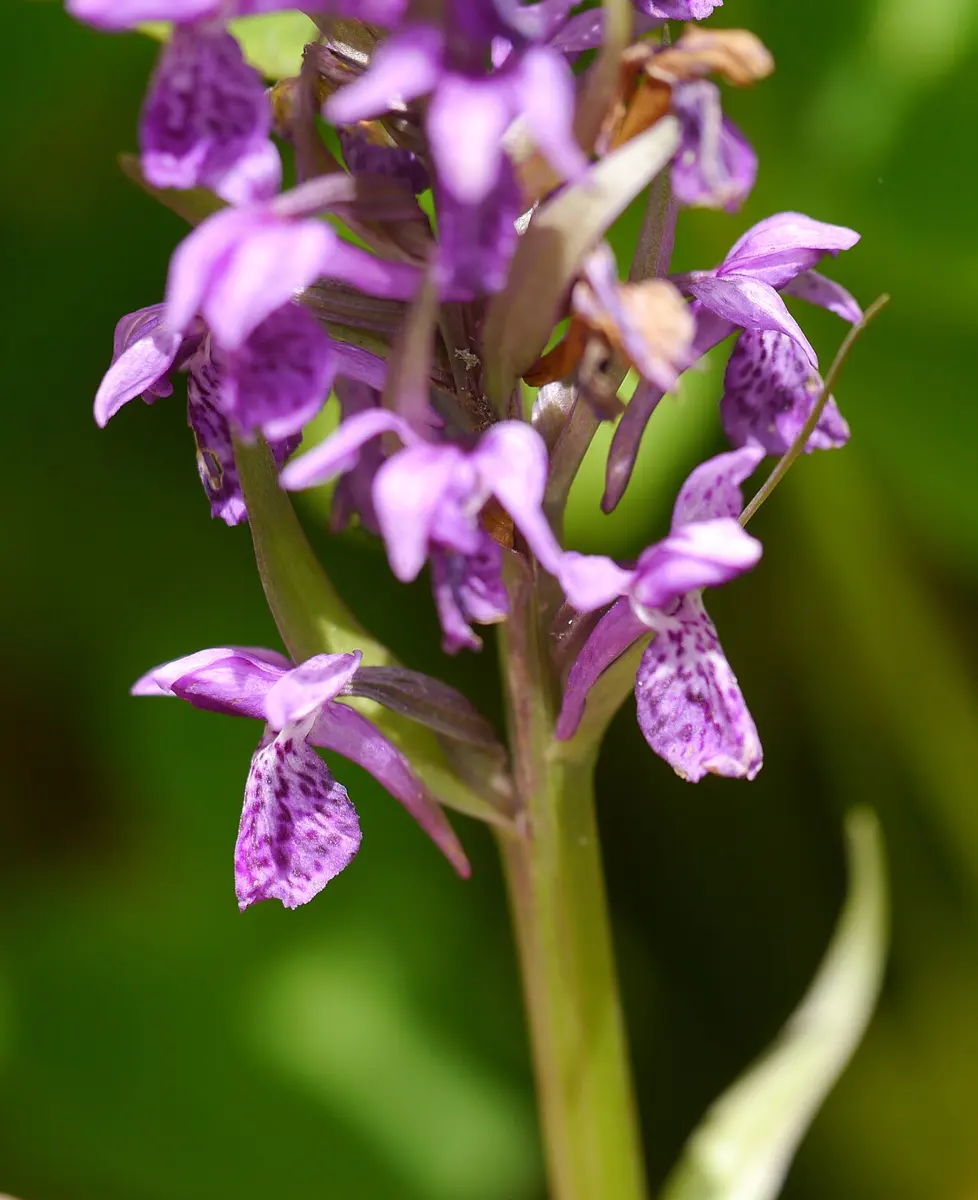
- the flowers: a dense spike, up to 15 cm long, of many small pink to purple flowers with darker purple marks and a curved spur (a little tube at the back of each flower). Packed around the stem, the spike looks a bit like a hyacinth;
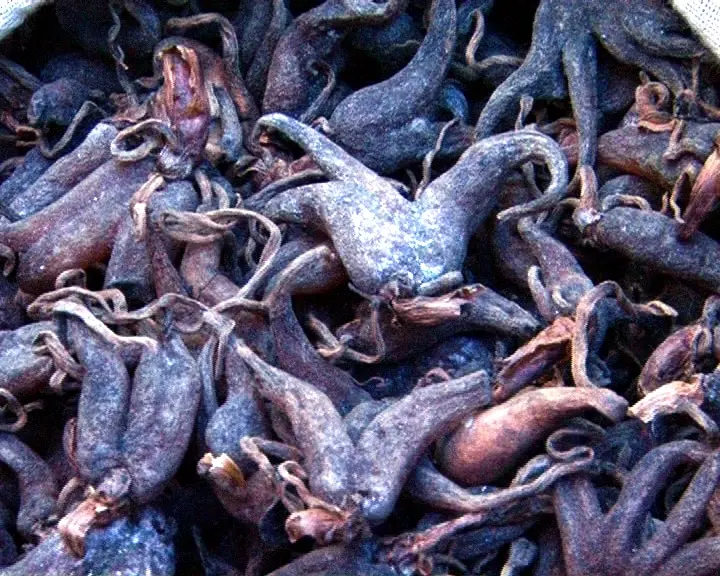
- the tuber: underground, a flattened, cream-colored tuber split into three to seven fingers, about 5 to 12 cm long. That is the “hand”, and the part that is collected.
Where it grows
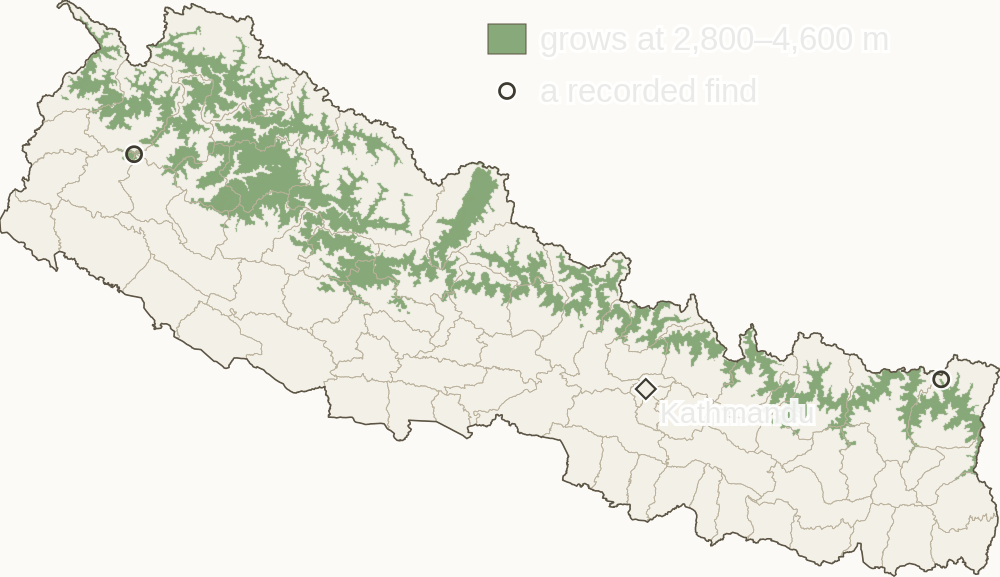
पाँचऔँले grows across the high mountains of Asia, from Pakistan and Afghanistan through India and Nepal to Bhutan, China and Mongolia. In Nepal it grows in moist alpine meadows and gaps in the forest between about 2,800 and 4,600 meters, and it likes soils rich in calcium. It is found in districts such as Dolpa, Humla, Jumla, Mustang, Rasuwa, Manang and Darchula.
Seeds like dust, and a fungus to feed them
Here is the “really?” part. A bean seed is packed with food: split one open and you see the thick seed leaves, a store that feeds the young plant until it has its own leaves. An orchid seed has almost nothing.
- One capsule of पाँचऔँले holds thousands of seeds as fine as dust, so small that the wind carries them far.
- Each seed has no food store (no endosperm) at all.
- To grow, the seed must meet the right fungus in the soil. The fungus’s threads grow into the seed and feed it sugar and minerals. पाँचऔँले depends in part on fungi called Rhizoctonia.
So an orchid seed is a lottery ticket: thousands are thrown into the wind, and only the few that land beside the right fungus can grow. Without its fungus, the seed cannot germinate at all. This is why so few seeds become new plants in the meadow.
Scientists have managed to raise पाँचऔँले from seed in the laboratory, by sowing the seeds together with their fungus (called symbiotic germination: growing together). Others have grown seedlings on a jelly with sugar added. That is a long way from a field of orchids, but it is a start.
Traditional uses
The tuber of पाँचऔँले is used in Ayurveda and in the folk medicine of the mountains. People in Nepal’s mountain districts use it, in tradition:
- for cuts and wounds, burns and boils, and broken bones;
- as a tonic for strength, and as a medicine for coughs, diarrhea and dysentery, and stomach trouble;
- in Manang, Buddhist lamas use it for religious purposes.
Its tubers also make a high-quality salep, a drink made from the powdered tuber of an orchid, taken as a tonic.
What science has tested
- In the laboratory and in animals: extracts of the tuber have been tested against bacteria in dishes and on inflammation in rats, with some effect.
- In people: we found no trials in people.
- How strong the evidence is: only in the laboratory and in animals; not tested in people.
Protected, but still dug
पाँचऔँले is one of the most threatened plants in Nepal:
| IUCN Red List | Endangered |
| CITES | Appendix II (all orchids are), so it can cross borders only with permits |
| Nepal | collection, transport and trade banned since 2058 BS (2001, Nepal Gazette); the Forest Act of 2076 BS (2019) also bans its use, sale and export |
Even so, it is still dug illegally. A study in two parts of Nepal from 2015 to 2017 compared:
- Manang, where the local community patrols its meadows and harvesting is controlled: 1.31 plants per square meter, a stable population;
- Darchula, where nobody controls harvesting: 0.72 plants per square meter. There, 92% of the people asked said illegal harvesting was common, and that the plant had become far rarer over the last few decades. Illegal traders in the district’s headquarters promise to buy the dried tubers, and it is traded mostly to India and China.
Collectors told the researchers that for every kilogram of dried tubers sold, about 500 to 1,000 mature plants are dug up.
A warming future
Scientists have used computer models of climate to guess where पाँचऔँले could grow in 2050 and 2070. One study predicts that most of its suitable places in Nepal will be lost by 2070, even under the kindest climate forecast. Another, modelling 29 medicinal plants together, predicts that its small suitable area will grow, to about three times its size. When models disagree like this, scientists keep watching the real plants.
Manang had nearly twice as many पाँचऔँले plants per square meter as Darchula. What does the study say made the difference?
Pick an answer to see why.
See it at the Science Playground
Our exhibit Medicinal and Culinary Herbs of Nepal shows dried herbs and spices used in Nepal. More plants in Herbs of Nepal.
Where these facts come from
- Chapagain D.J. et al., Illegal harvesting and livestock grazing threaten the endangered orchid Dactylorhiza hatagirea (D. Don) Soó in Nepalese Himalaya, Ecology and Evolution, 2021.
- Wani I.A. et al., Dactylorhiza hatagirea (D. Don) Soó: a critically endangered perennial orchid from the North-West Himalayas, Plants, 2020.
- Shrestha B. et al., Suitability of habitats in Nepal for Dactylorhiza hatagirea now and under predicted future changes in climate, Plants, 2021.
- Shrestha U.B. et al., Climate change-induced distributional change of medicinal and aromatic plants in the Nepal Himalaya, Ecology and Evolution, 2022.
- Smith-Hall C. et al., A roadmap to sustainable management of commercial medicinal and aromatic plants, fungi, and lichens in Nepal, Conservation Biology, 2025.
- Department of Plant Resources, Plants of Nepal: fact sheet, Government of Nepal, 2012 (archived copy).
- Dactylorhiza hatagirea: IUCN Red List category, GBIF (from the IUCN Red List), checked November 2026.
- Dactylorhiza hatagirea, Species+ (CITES listings), checked November 2026.
- पाँचऔँले in the Nepali Brihat Shabdakosh (Nepal Academy).