
चिराइतो: Nepal’s famously bitter herb
चिराइतो · Swertia chirayita · A bitter herb of the hills, gentian family
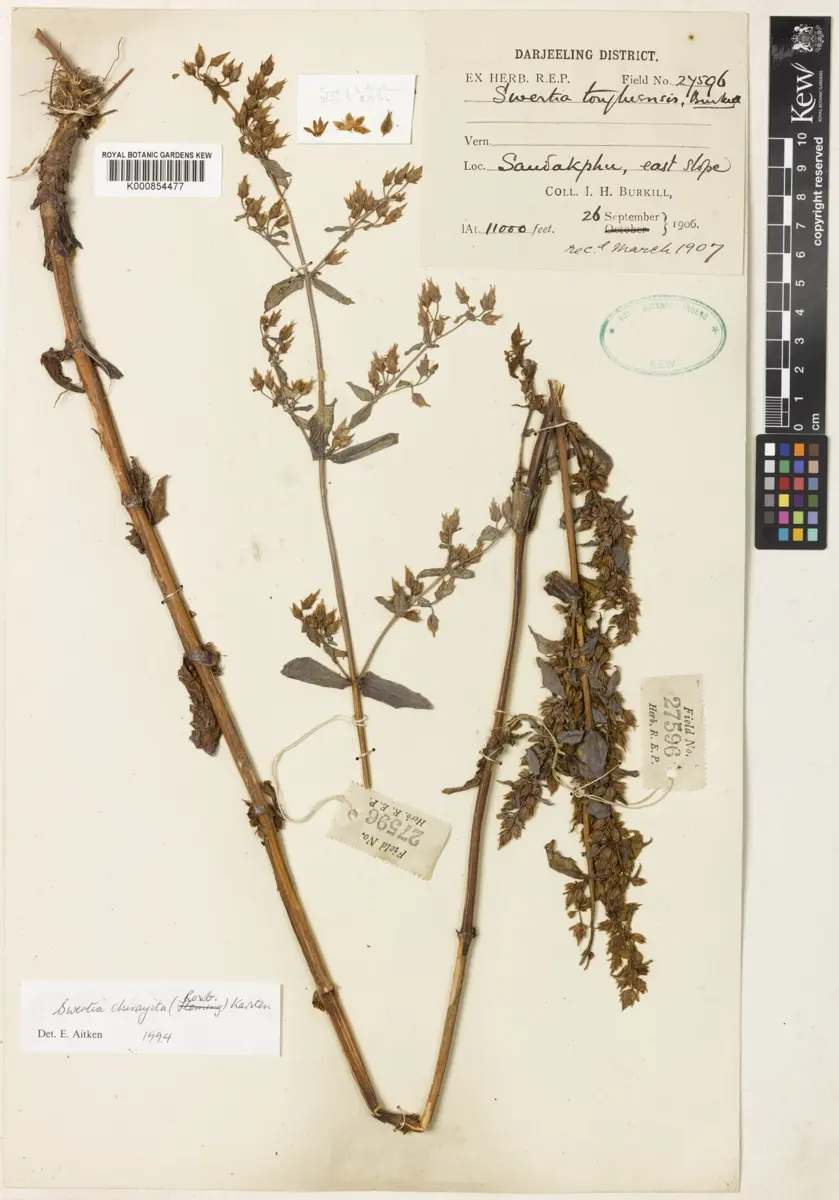
Many Nepali families keep a bundle of dried stems somewhere in the kitchen. When someone has a fever, a few stems go into water, and the patient is handed a glass of something so bitter it makes the face screw up. That bundle is चिराइतो (chiraito). The big Nepali dictionary describes it simply: a bitter wild herb whose decoction is drunk for malaria fever.
This page is about the plant behind the bundle: how to know it, where it grows, what tradition uses it for, what scientists have found inside it, and why it is now grown on farms in eastern Nepal.
How to know it
चिराइतो is a herb, not a shrub: it lives for one or two years (books disagree on which) and grows 0.6 to 1.5 meters tall. Look for:
- the stem: straight and upright, round near the bottom and four-sided near the top, orange-brown or purplish, with a large yellowish pith inside;
- the leaves: in opposite pairs, lance-shaped and pointed, without stalks, about 4 cm long, with 5 to 7 veins running along them;
- the flowers: small and very many, each with four petals, greenish-yellow tinged with purple, on big branched, leafy sprays;
- the root: simple and yellowish, about 7 to 8 cm long.
It belongs to the gentian family (Gentianaceae), a family well known for bitter plants.
You find a herb with a stem that is round at the bottom and square near the top, leaves in opposite pairs, and tiny four-petalled flowers. Is it surely चिराइतो?
Pick an answer to see why.
Where it grows
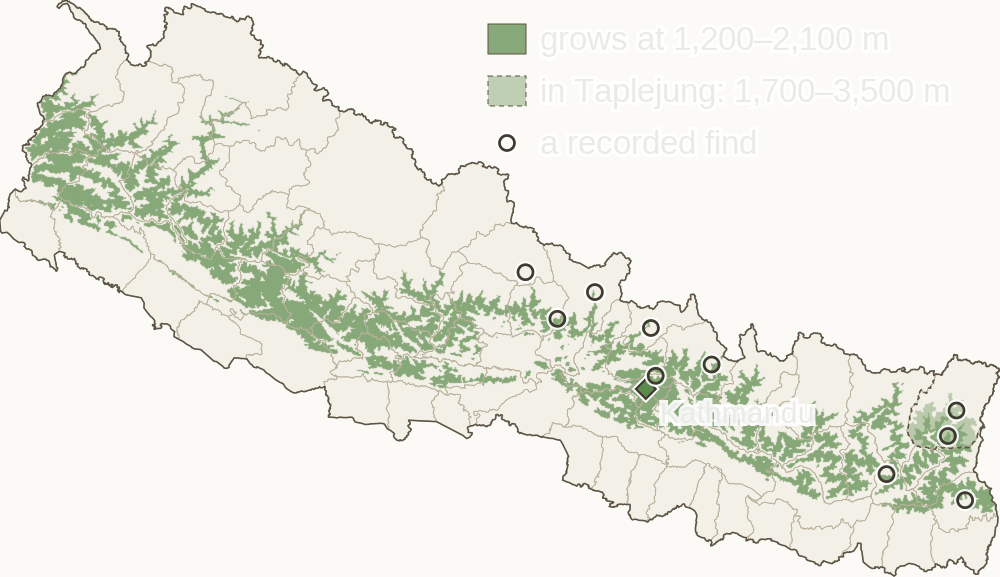
चिराइतो grows in the temperate Himalaya, from Kashmir to Bhutan, on moist, shady slopes. One review gives its range as about 1,200 to 2,100 meters; in Taplejung, the forest office says it is found from 1,700 to 3,500 meters. A study found it traded in 61 of Nepal’s 75 districts (as they were then).
Traditional uses
चिराइतो is used in Ayurveda, and in the Unani and Siddha traditions of South Asia; for a time it was even listed in the British and American pharmacopoeias, the official books of medicines, as a tincture and an infusion. The uses recorded for it include long-lasting fever, malaria, indigestion, liver problems, skin diseases and intestinal worms.
In Nepal, studies of the herbs people use have recorded it as:
- a medicine for fever, in Baitadi, Darchula and Dadeldhura in the far west;
- juice of the whole plant for fever, colds and headache, in Rasuwa, where people ranked it third among their most important medicinal plants.
These are the uses of a living tradition, passed down in families and by traditional healers. Whether a use works in the body is a separate question, which only careful tests in people can answer.
What science has found inside
Chemists have taken चिराइतो apart and found:
- amarogentin, which scientists describe as the most bitter compound ever isolated from a plant: this is why the drink is so bitter;
- swertiamarin, swerchirin and mangiferin, and many other compounds of a few chemical families (xanthones, iridoids and others).
Scientists have tested extracts of the plant and its compounds in the laboratory (on bacteria, viruses and cells in dishes) and in animals (mostly mice and rats). These studies looked at effects against bacteria, fungi and the malaria parasite, at swelling, blood sugar, the liver and more, and many found some effect.
But a review of all this research found no proper trials in people that test whether चिराइतो treats any illness; its authors call for such trials. It also says that information on the plant’s safety is not yet enough.
- How strong the evidence is: not tested in people. Promising results in dishes and animals, which is where research starts, not where it ends.
Trade: from the hills to India and Tibet
चिराइतो is one of Nepal’s important traded herbs. In 2008/09 it made up about 3% of the medicinal plants traded in Nepal, and India and China were its main buyers.
In Taplejung, in January 2023:
- the price had reached a record Rs 1,000 a kilogram, up from Rs 750 the year before, because of demand in India;
- Tibet, once the largest buyer, had bought none since the border closed in 2020, so the herb now went to India through the Kakarbhitta and Jogbani customs points;
- the forest office estimated that about 35 tonnes could be collected in the district each year, and only about half of the pickers had permits;
- 118.5 tonnes were exported to India in the first five months of that fiscal year, through Mechi customs.
Too much picking, and an answer: farming it
Wild चिराइतो is in trouble. Botanists in Nepal warned in 2010 that its large-scale export has made it vulnerable in Nepal, and reviews describe populations falling sharply because of over-harvesting and loss of habitat. The plant is hard to raise again from the wild: its tiny seeds often don’t sprout well. (One review calls it critically endangered by IUCN criteria, but it has not been assessed for the global IUCN Red List.)
The botanists’ answer was sustainable harvesting and cultivation, and that is what has happened: over the last twenty years farmers have started growing चिराइतो, and farms in Taplejung and other eastern districts now supply part of the trade. A planted crop is ready about 28 months after planting.
See it at the Science Playground
Our exhibit Medicinal and Culinary Herbs of Nepal shows dried herbs and plant products used in Nepal’s kitchens and traditional remedies. Look for the bitter ones, and see the other pages of Herbs of Nepal.
Where these facts come from
- Kumar V. and Van Staden J., A review of Swertia chirayita (Gentianaceae) as a traditional medicinal plant, Frontiers in Pharmacology, 2016.
- Phoboo S. and Jha P.K., Trade and sustainable conservation of Swertia chirayita in Nepal, Nepal Journal of Science and Technology, 2010.
- Barakoti T.P., Bhusal C. and Yadav J.K., Field based seed germination technologies for domestication of chiraito (Swertia chirayita) in Nepal (abstract), Nepal Journal of Science and Technology, 2023.
- Gautam A., Chiraito herb hits all-time high of Rs1,000 per kg, The Kathmandu Post, 2023.
- Kunwar R.M. et al., Medicinal plants, traditional medicine, markets and management in far-west Nepal, Journal of Ethnobiology and Ethnomedicine, 2013.
- Uprety Y. et al., Indigenous use and bio-efficacy of medicinal plants in the Rasuwa District, Central Nepal, Journal of Ethnobiology and Ethnomedicine, 2010.
- Ambu G. et al., Traditional uses of medicinal plants by ethnic people in the Kavrepalanchok District, Central Nepal, Plants, 2020.
- Smith-Hall C. et al., A roadmap to sustainable management of commercial medicinal and aromatic plants, fungi, and lichens in Nepal, Conservation Biology, 2025.
- Swertia chirayita: IUCN Red List category, GBIF (from the IUCN Red List), checked October 2026.
- चिराइतो in the Nepali Brihat Shabdakosh (Nepal Academy).