
यार्सागुम्बा: the fungus inside a caterpillar
यार्सागुम्बा · Ophiocordyceps sinensis · A fungus that grows on moth caterpillars, not a plant
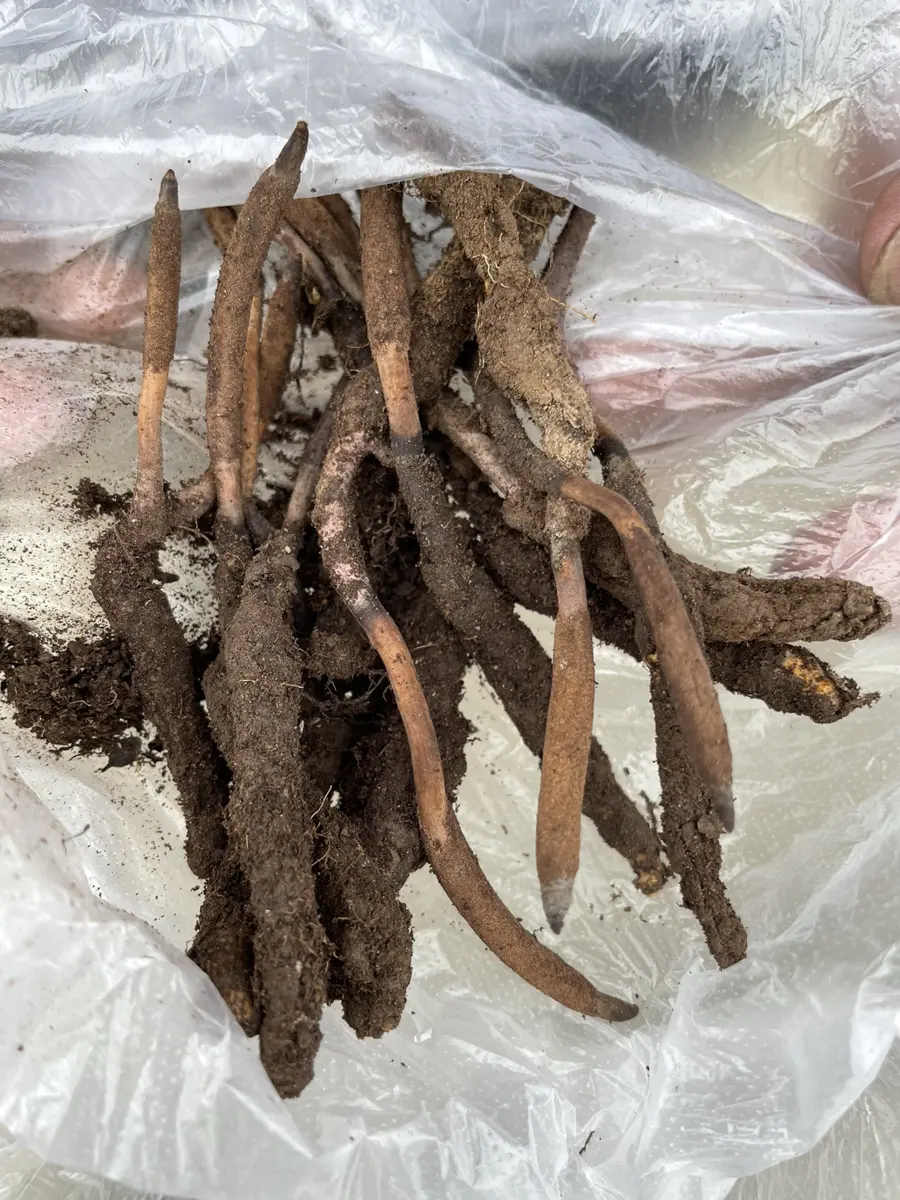
Every spring the news in Nepal carries the same story: in May and June, families from villages in Dolpa, Jumla and Darchula climb to meadows high above the tree line, hoping to dig up something worth more, gram for gram, than gold. They kneel and bend low over the steep grassy slopes, looking for something no thicker than a pencil lead and only a few centimeters long. One piece can fetch a collector up to a thousand rupees. The thing they are looking for is यार्सागुम्बा (yarsagumba).
Many people call it a herb, and it is sold beside herbs. But it isn’t a plant at all. It is a fungus, a relative of the molds and mushrooms, and it grows inside a living caterpillar.
Not a plant: a fungus and a caterpillar
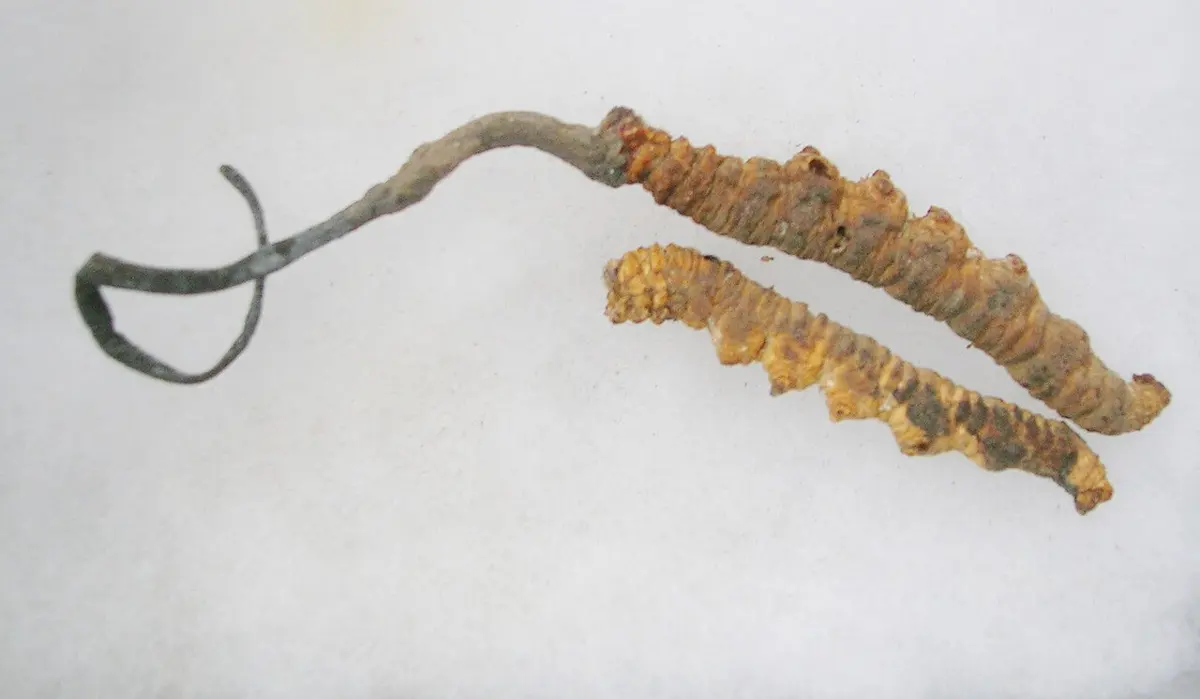
Pick up a piece of यार्सागुम्बा and you are holding two living things that became one:
- the lower part is the dead body of a caterpillar, a moth’s larva, yellowish-brown, with its rings and legs still clear;
- the upper part is a thin, dark brown stalk growing out of the caterpillar’s head. That stalk is the fungus’s fruiting body, the part that makes spores.
The fungus is Ophiocordyceps sinensis (it used to be called Cordyceps sinensis). Unlike a plant, it has no green chlorophyll and cannot make its own food from sunlight; it feeds on its host. Its hosts are the caterpillars of ghost moths (the genus Thitarodes): it can infect more than 50 species of them.
The names say the same thing. In Tibetan it is yartsa gunbu, from which Nepali takes यार्सागुम्बा, meaning “summer grass, winter worm”. The Chinese name, dongchong xiacao, means “worm in winter, grass in summer”.
Where it grows
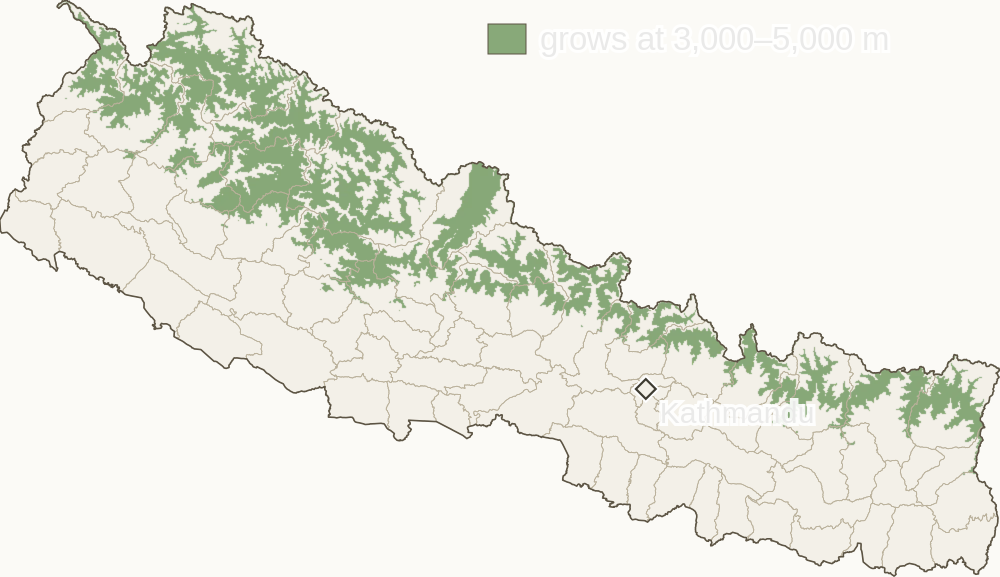
यार्सागुम्बा grows in the alpine grasslands of the Himalaya and the Tibetan Plateau, in Nepal, China, India and Bhutan, between about 3,000 and 5,000 meters. A study of 400 places where it has been found worked out that it does best between 3,200 and 4,900 meters, in cold places where the mean winter temperature is between −15 and −5 °C.
In Nepal, Dolpa, Darchula and Jumla supply the most. Researchers have noticed that it was once found from about 3,000 meters up, but is now rarely found below 4,000 meters.
How a fungus takes over a caterpillar
This is the part that makes people say “really?”. Scientists have pieced together its life like this:
- Summer: the fungus’s stalks release spores onto the soil. Rain carries them down to where the caterpillars live.
- Late autumn: a spore lands on a caterpillar and gets in through its skin or its gut. Caterpillars at certain moults are the easiest to infect.
- Inside: the fungus multiplies in the caterpillar’s blood, like yeast, until it fills the whole body cavity.
- The strange move: the infected caterpillar crawls upward, to just 2 to 5 cm below the surface, and dies there with its head pointing up. The fungus makes it do this: scientists say the fungus manipulates its host.
- Before the soil freezes, a tiny bud of the fungus starts to grow from the dead caterpillar’s head. The fungus has eaten everything inside except the caterpillar’s hard outer skin, which is why the body keeps its shape.
- Spring: after the snow melts, the stalk pushes up through the soil and ripens, ready to release spores in summer.
Head up, close to the surface: just the place from which a stalk can reach the light and scatter spores on the wind. The caterpillar dies in the one position that helps the fungus most.
Traditional uses
यार्सागुम्बा has been used in Tibetan and Chinese medicine for centuries, as a tonic. Studies of the herbs people use in Nepal record:
- its juice taken as a tonic, in Rasuwa;
- its use for sexual vigor, in the far west, where nearly everyone asked agreed on this use.
In recent decades the demand has grown hugely, above all among city people in China, who use it as a tonic and as a medicine for a growing list of illnesses.
What science has tested
- Kidney disease: the best summary of the trials is a Cochrane review (2014). It found 22 trials in China, with 1,746 people with long-term kidney disease, in which Cordyceps preparations were added to normal treatment. Some kidney tests improved, but most trials were badly reported or badly run, so the reviewers said the evidence was of low quality and no firm conclusion could be drawn.
- Other uses (tonic, strength, sexual vigor, cancer): chemicals in it such as cordycepin have shown “potential” in research, but we found no good trials in people.
- How strong the evidence is: weak. Some small, poor-quality trials, and no proof that it works for any illness.
Worth more than gold
In May 2017, the best pieces sold in Beijing for more than US$140,000 a kilogram, more than three times the price of gold. Its price in China rose by about 20% a year on average from 1997 to 2012.
In Nepal, collection and trade were banned until 2001; after the ban was lifted, tens of thousands of people began to collect it. Prices reported by collectors and traders in Karnali:
| Price | |
|---|---|
| 2002, a collector in Dolpa remembers | Rs 60,000 a kilogram |
| Before the Covid pandemic, a trader in Dolpa | Rs 3.2 million a kilogram |
| 2023, the same trader | Rs 2.7 million a kilogram |
| 2024, the same trader | Rs 2.2 million a kilogram |
| 2025, what collectors are paid | no more than Rs 1,000 a piece |
For many families it is the main source of cash. In Garjyangkot, a village in Jumla, a study found that it gave, on average, 64.5% of a household’s cash income, and about 86% for the poorest households. The money went on food, clothes, festivals, medical care, children’s schooling and savings.
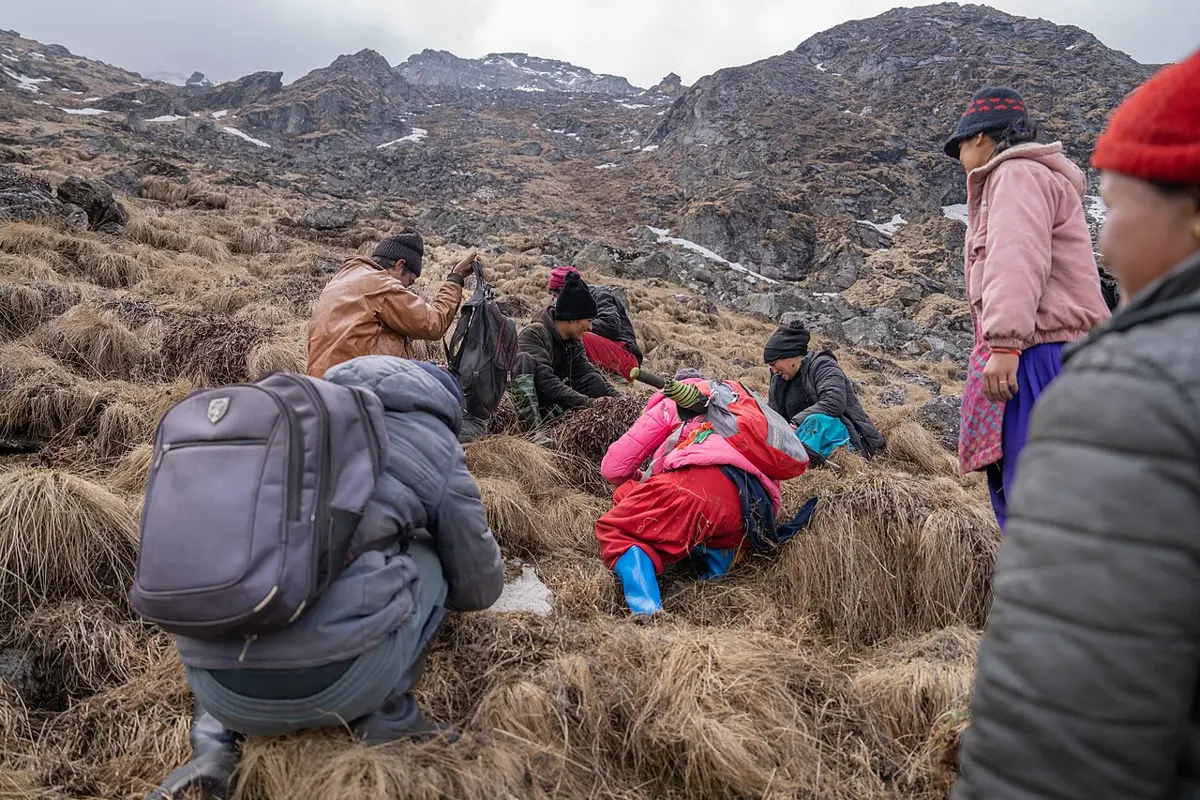
The work is hard and dangerous. Collectors cross cliffs and risk altitude sickness and lightning. Police in Karnali Province counted 39 collectors who died during the harvest in three years.
Harder to find
Collectors across Nepal, India, Bhutan and China say there is less यार्सागुम्बा than before. A large study in 2018 brought together what collectors said and what climate records show:
- in Nepal, India and Bhutan, collectors blame mostly over-harvesting: so many people search the meadows that few fungi are left to release spores;
- collectors usually dig the fungus up before it releases its spores, because buyers pay less for ripe ones, so fewer spores reach the soil for the next generation;
- warming is also to blame: winters have grown warmer across its habitat in Nepal, India and Bhutan since 1979, and the fungus grows best in the coldest places. In Dolpa, collectors who blamed the climate spoke of less winter snow (66% of them), earlier snowmelt (52%) and warmer weather (38%).
Exports recorded by Karnali Province’s forest office fell from 1,214 kg in 2018–19 to 214 kg in the year before May 2025. The IUCN Red List rates the fungus Vulnerable.
Buyers pay more for a piece of यार्सागुम्बा dug up before it releases its spores. Why is that a problem for next year’s harvest?
Pick an answer to see why.
See it at the Science Playground
Our exhibit Medicinal and Culinary Herbs of Nepal shows dried herbs and spices used in Nepal. More plants (and this one fungus) in Herbs of Nepal.
Where these facts come from
- Hopping K.A., Chignell S.M. and Lambin E.F., The demise of caterpillar fungus in the Himalayan region due to climate change and overharvesting, PNAS, 2018.
- He Z. et al., The conservation crisis of Ophiocordyceps sinensis: strategies, challenges, and sustainable future of artificial cultivation, Journal of Fungi, 2025.
- Shrestha U.B., Dhital K.R. and Gautam A.P., Economic dependence of mountain communities on Chinese caterpillar fungus Ophiocordyceps sinensis (yarsagumba): a case from western Nepal, Oryx, 2019 (online 2017).
- Zhang H.W. et al., Cordyceps sinensis (a traditional Chinese medicine) for treating chronic kidney disease, Cochrane, 2014.
- Li Y. et al., Arsenic species in Cordyceps sinensis and its potential health risks, Frontiers in Pharmacology, 2019.
- Gautam K.P. and Neupane R., Risk is high but returns are low for yarsagumba collectors, The Kathmandu Post, 2025.
- Yarsagumba pickers rue poor harvests as winters grow warmer, The Kathmandu Post, 2025.
- ANSAB, Yartshagumba, Cordyceps sinensis, information sheet.
- Uprety Y. et al., Indigenous use and bio-efficacy of medicinal plants in the Rasuwa District, Central Nepal, Journal of Ethnobiology and Ethnomedicine, 2010.
- Kunwar R.M. et al., Medicinal plants, traditional medicine, markets and management in far-west Nepal, Journal of Ethnobiology and Ethnomedicine, 2013.
- Ophiocordyceps sinensis: IUCN Red List category, GBIF (from the IUCN Red List), checked November 2026.
- यार्सागुम्बा in the Nepali Brihat Shabdakosh (Nepal Academy).