
In a museum in New Delhi there is a girl made of bronze who is about as tall as your hand is long. She stands with her right hand on her hip and her left resting on her leg just above the knee, the left leg bent a little forward. Her left arm is covered in bangles from the wrist almost to the shoulder; her right has only a few. Her hair is worn in short curls on top, with one long thick lock brought round behind her head and over her shoulder. Apart from the bangles and a necklace with three pendants, she wears nothing at all. She was dug up in the digging season of 1926–27 in a house in Mohenjo-daro, in what is now Pakistan, lying beside a small fireplace, and she is more than four thousand years old.
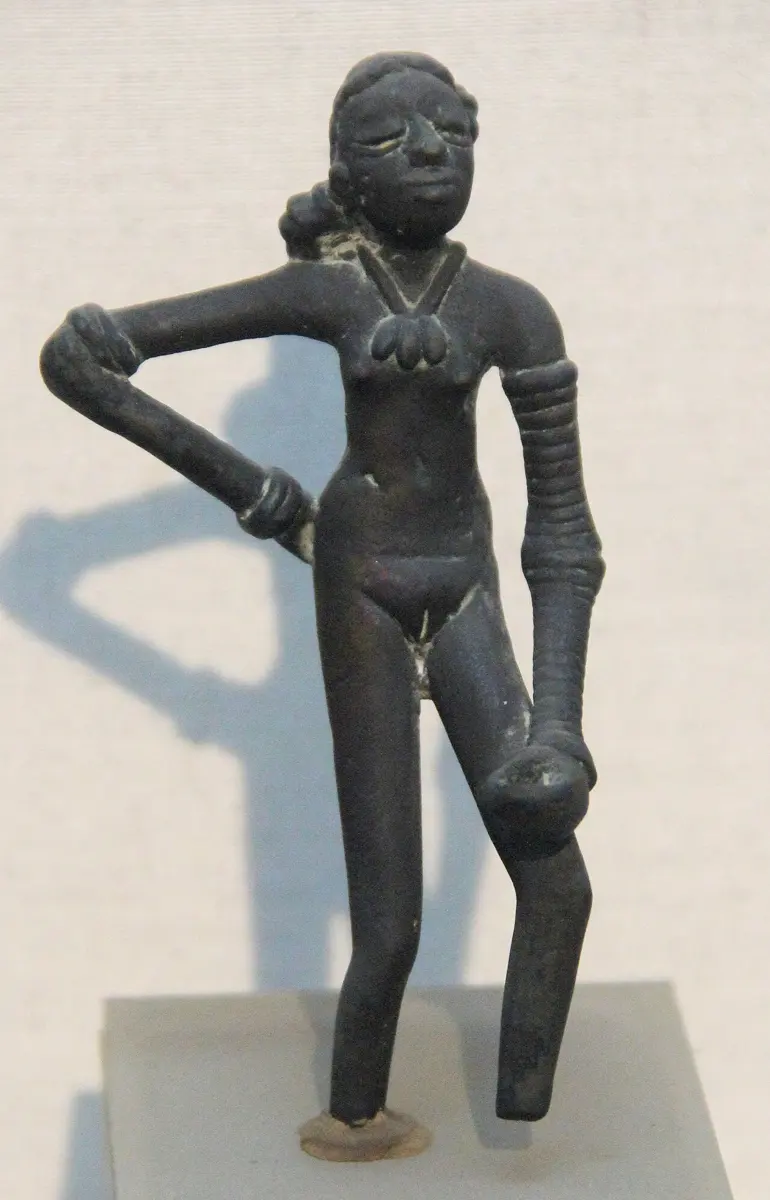
The archaeologist who first described her called her a dancing girl, beating time to music with her feet, and the name has stuck, though it was only his guess. Who she really was, nobody knows. What is certain is how she was made. She was cast in metal, all in one piece, and the bronzes of her city were most probably made the way Patan’s casters still make their gods: a figure modeled in wax, wrapped in clay, the wax melted out and the metal poured in, as Lost Wax tells. The method was old long before anyone in the Kathmandu Valley used it.
She came from one of the first cities in the world. More than five thousand years ago, and over the next two thousand years, along three great rivers, people did something new. Beside the Tigris and Euphrates in what is now Iraq, beside the Nile in Egypt, and beside the Indus, farmers grew more food than they ate, and the extra fed people who did not farm at all: priests, scribes, soldiers, kings, and full-time makers of things. Writing appeared. So did a new kind of art. It was bigger, built into walls and temples, made to last, and much of it was made for three customers: the gods, the kings, and the dead. Each river made its art from what it had. Mesopotamia had mud, Egypt had stone, and the Indus had baked brick. How these cities grew and were governed is told in World History’s chapters on Mesopotamia, Egypt and the Indus cities. This chapter looks at the things they made.
A mountain of mud
Southern Mesopotamia is a flat plain of river mud. There is almost no stone and no big timber. So its builders made nearly everything from the mud itself, shaped into bricks and dried in the sun, and for their grandest work they baked some of the bricks hard in a kiln and stuck them together with bitumen, the black tar that seeps out of the ground there.
The greatest building of the city of Ur was a ziggurat, a stepped tower with a small shrine on top for the city’s god, the Moon. A king named Ur-Nammu began it, a little over four thousand years ago, and stamped his name and titles on its bricks. Its lowest stage alone was about 60 meters long, 45 wide and 15 high, and the whole tower rose to about 21 meters. It is solid all the way through: a core of sun-dried mud brick wrapped in a skin of baked brick set in bitumen, more than two meters thick.

That combination, soft inside and hard outside, should sound familiar. The thick walls of a Newar temple are built the same way, with sun-dried bricks inside and fired, shaped bricks on the face, as Brick and Timber shows. In both, the cheap material carries the weight and the expensive one keeps off the weather. And at Ur the builders had the same worry as anyone who builds with mud: water. Mud brick that gets damp swells. So all over the ziggurat’s walls, in rows one above another, are tall narrow slits that run clean through the baked skin deep into the core, loosely filled with broken pottery, to let the damp drain out before it could push the walls apart.
The man who dug the ziggurat out in the 1920s, the British archaeologist Leonard Woolley, found something else. When his team tried to draw its plan, the measurements kept refusing to agree. Then they saw why. There was hardly a straight line in the building. The walls lean inward and bulge very slightly outward, too little to notice, as if the builders wanted the great mass to look strong instead of sagging. The same trick turns up again, more than fifteen hundred years later, in the most famous temple in Greece, in the next chapter.
The ziggurat was patched and rebuilt for centuries. About 550 BCE Nabonidus, the last king of Babylon, finished its top and buried clay cylinders in the corners telling how he had done it. Those cylinders, dug out in the 1850s, are how the mound was first known to be Ur.

Mesopotamia’s most famous object is a stone, and a rare one, because stone had to be brought from far away. It is a pillar of black basalt more than two meters tall, made about 1750 BCE for Hammurabi, king of Babylon. Most of its surface is covered in rows of tiny wedge-shaped writing: 282 of the king’s judgments, each set out the same way, “if” this happened, “then” this is what follows. One says that if a man puts out another man’s eye, his own eye shall be put out. As law it belongs to World History. As an object it was something more. At the top, above the writing, is a carving that anyone could understand, whether they could read or not. Hammurabi stands before Shamash, the sun god and the god of justice, who sits on a throne with flames rising from his shoulders and hands the king the signs of the power to rule. The picture says, before a single word is read, that the laws below come from heaven. About six hundred years later a king of Elam, a neighboring kingdom in what is now Iran, carried the stone home as a trophy of war. French archaeologists dug it up there, in the city of Susa, in 1901 and 1902, and it has stood in the Louvre since 1904.
Stone forever
Egypt had plenty of stone, and a river to float it on. Its kings used both for the largest buildings anyone had ever made.

The Great Pyramid at Giza, built for the king Khufu about 4,500 years ago, is first of all a building problem. Its base is a square about 230 meters on each side, and when it was finished it stood about 146 meters high. Most of it is roughly cut local limestone, piled block on block. Over that went a smooth outer skin of fine white limestone brought by boat from quarries at Tura, across the Nile, as the diary of an inspector named Merer records in World History. When Flinders Petrie, an English archaeologist, measured the pyramid with great care in the early 1880s, he found its four sides equal to within a couple of centimeters. The few casing blocks still in place at the bottom, some of them weighing sixteen tons, meet along joints about half a millimeter wide, as straight, he wrote, as the best straight-edges of the opticians of his own day. And the builders had squeezed mortar into those joints too.
How they got the blocks up there is still argued, and there is no agreed answer. What has been found is where the builders lived. In 1988 a team led by the archaeologist Mark Lehner began digging 400 meters south of the Sphinx and found a whole town built by the king for the work: bakeries, workshops, storerooms and houses, more than seven hectares of it. When the last pyramid at Giza was finished, the town was taken down, its timbers and bricks pulled out to be used elsewhere. Grain from great royal silos was made into the bread and beer that fed the workforce.
What happened next is part of the pyramid’s story too. Much later, in the Middle Ages, most of the white skin was stripped away and carried off as ready-cut stone for other buildings. What you see today is the stepped core that was never meant to be seen.
Egyptian painting followed rules, and the rules held, with one short break, for nearly three thousand years. Even the body had its measurements. A painter laid a grid of squares over the wall and drew a standing figure on it: eighteen squares from the ground to the hairline, the knee at the sixth line, the shoulders at the sixteenth, each square about as wide as a fist. So a figure came out the same shape whatever its size, the way Tibetan thangka painters would later be taught to build a figure on a grid, as Palm Leaf, Paubha, Thangka tells. You can see the rules at work in one picture, made about 1350 BCE for the tomb of a man named Nebamun, a scribe who kept count of the grain at the great temple of the god Amun.

Nebamun stands in a little papyrus boat in the marshes, a throwing stick raised in one hand and birds held in the other. His face is shown from the side, but his shoulders face straight out at you, and his legs are from the side again, a body nobody could actually stand in. Each part is drawn from the angle that shows it most clearly. He is far bigger than his wife behind him, and his daughter at his feet is tiny: in Egyptian pictures, size tells you who matters most. And yet in the middle of all these rules, his cat is in the papyrus, grabbing one of the birds. The painters were allowed some fun.
The painting has had a rough life. Around 1820 a young Greek named Giovanni d’Athanasi, digging for the British consul in Egypt, Henry Salt, found the tomb and had his workmen cut the best pieces off the wall with knives, saws and crowbars. Salt sold them to the British Museum. D’Athanasi never told anyone exactly where the tomb was, and he died poor in 1854 with the secret. Look closely and you can see older damage too: in ancient times someone chiseled out the name of the god Amun, even where it appeared inside Nebamun’s own name.
That damage was done on the orders of a king. About the time Nebamun died, Akhenaten came to the throne, turned against Amun and the old gods for a single god, the sun’s disk, built a new capital at Amarna, and had his artists paint and carve in a radical new style. It is the one break in three thousand years.
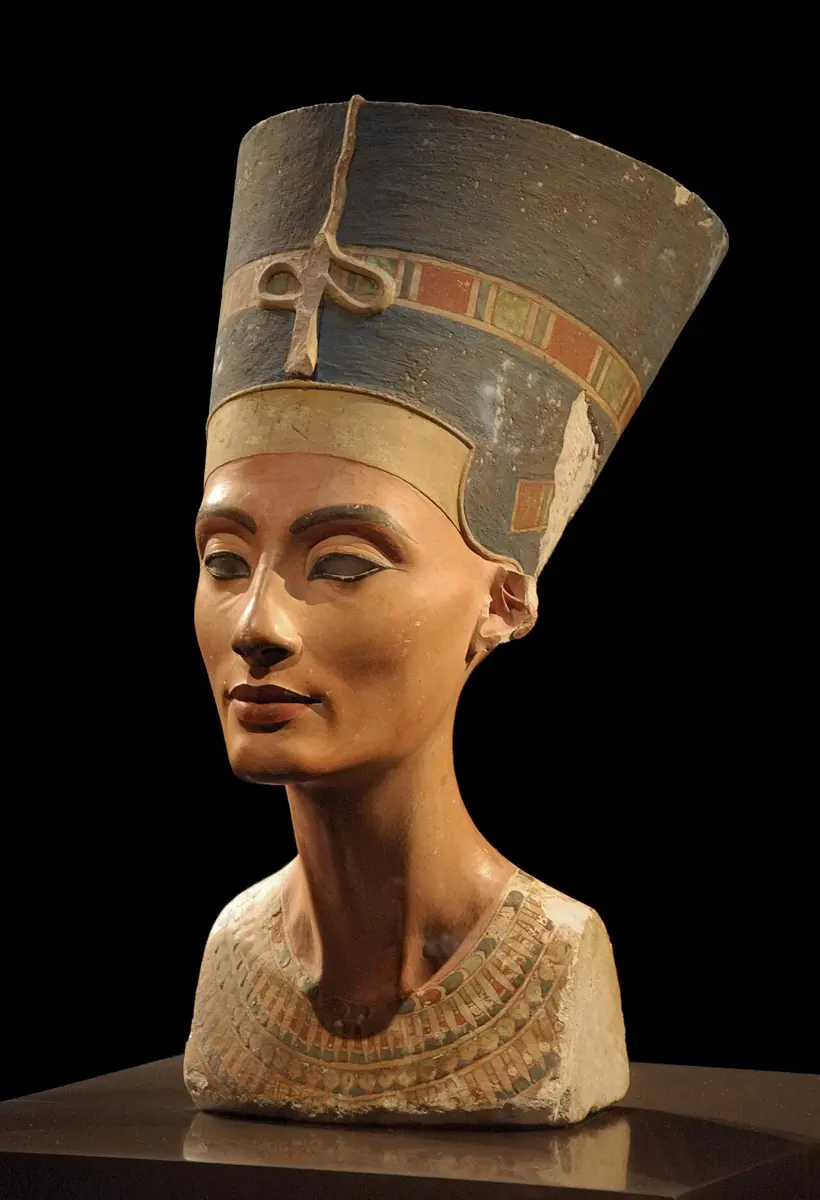
The best-known face of that time is his queen’s. On 6 December 1912 a German team digging at Amarna found the painted bust of Nefertiti lying in the ruins of a sculptor’s workshop, later linked by an inscription to a sculptor named Thutmose. Their leader, Ludwig Borchardt, wrote in his diary that evening: “Description is useless, must be seen.” She is a limestone core covered with layers of fine plaster, modeled and painted. Her right eye is a disk of polished rock crystal over black-dyed beeswax. Her left eye is empty; whether it was ever inlaid is still argued. Whether she was a finished portrait or a model for other sculptors to copy is still an open question.
After Akhenaten the old gods came back, and so did the old style. The young king who brought them back was Tutankhamun. When Howard Carter, the English archaeologist who had found his tomb, lifted the lid of the innermost coffin on 28 October 1925, he saw the king’s mummy wearing “a golden mask of sad but tranquil expression”. It was made for his burial, about 1323 BCE, of thick sheet gold. The eyes are white stone with pupils of black volcanic glass, the eyebrows and eye-lines blue lapis lazuli, and on the forehead rise a cobra and a vulture, the signs of Lower and Upper Egypt. It is not quite a portrait. Carter took it to show the king as Osiris, the god of the dead.

Drains before palaces
The Indus cities, beside the river that flows from the Himalaya through Pakistan to the sea, were built of baked brick, laid out on a plan, and lived in between about 2500 and 1900 BCE. The most famous building in Mohenjo-daro is not a palace or a tomb. It is a pool. The Great Bath is about 12 meters long and 7 wide, with a flight of steps down into it at each end. Its bricks were laid so tightly, and finished so well, that the archaeologist who measured it in the 1920s said he had never seen its equal in any ancient building. Behind the walls was a layer of bitumen to keep the water in. What it was for is not known for certain; it may have been for bathing as part of some ceremony.
In 1931 John Marshall, the Director-General of Archaeology in India, who announced these cities to the world, noticed something about them that still holds. In Egypt and Mesopotamia, he wrote, people poured their money and effort into magnificent temples for the gods and palaces and tombs for kings, and the ordinary people lived in poor houses of mud. In the Indus cities it seemed the other way round. Nobody had found a building that was clearly a temple or a palace, but the townspeople had roomy houses of baked brick, with their own wells and bathrooms, and covered drains running along the streets. A city that seems to have built drains before palaces is a puzzle, and the people who could explain it left writing that nobody can read.
That writing is on the Indus civilization’s most numerous works of art, found in abundance in the ruins: small square seals, carved in a soft stone called steatite and then hardened and coated white, each with a short line of signs above an animal. The animals are carved with great skill, and the best of them, the humped bulls, have the weight and life of creatures the carver had watched for years. Many show an animal with a single horn that nobody has ever seen alive. A few clay sealings, the marks such seals left when pressed into clay, have been found too.
Then there are the few bronzes, like the girl this chapter began with. A second bronze girl, rougher and less well kept, turned up in Mohenjo-daro in another house a few years after the first.
What the rivers left
Put the three rivers side by side and a pattern shows. In each, art moved off the cave wall and into the city, and it went to work. It held up a god’s shrine above the plain, told everyone where the law came from, guarded a dead king and gave him a face for ever. Its makers were mostly nameless craftsmen, working to rules and paid by kings and temples. Each river used what it had, mud, stone or brick, and what it had shaped what it made. And some of their methods never stopped being used: mud inside and fired brick outside, wax melted out of a clay mold, curves too slight to see that make a building look strong. A temple builder or a caster in the Kathmandu Valley would understand most of what the craftsmen of Ur, Giza and Mohenjo-daro were doing. The next chapter goes west, to the Greeks and Romans, who turned building into a system.
Found a mistake? Please tell us.