
About 4,500 years ago, a man named Merer kept a diary of his work. He was an inspector, a middle-ranking official in charge of a team of boatmen, probably about forty of them, and the diary is mostly a list of days. “Day 27: sets sail from She-Khufu, sails towards Akhet-Khufu, loaded with stone, spends the night at Akhet-Khufu. Day 28: casts off from Akhet-Khufu in the morning; sails upriver towards Tura South. Day 29: Inspector Merer spends the day with his team hauling stones in Tura South; spends the night at Tura South.” And so on, for months, day after day.
Tura was a quarry of fine white limestone on the east bank of the Nile. Akhet-Khufu, “the Horizon of Khufu”, was the name of the Great Pyramid of Giza, then being finished across the river. She-Khufu was “Khufu’s pool”, most likely a great man-made lake beside the pyramids. So the diary is the log of the men who carried stone for the pyramid, most likely the smooth white blocks that once covered its outside, written by someone who was there. It never says how the pyramid was built. It says where Merer slept, and that one day a boat was sent to the town of Heliopolis to fetch the team’s bread.
The papyrus rolls were found in 2013, at the entrance to a storeroom cut into the rock at a harbor on the Red Sea, the harbor used to reach the copper and turquoise mines of Sinai. They are the oldest archive of papyri ever found in Egypt. And they show what a pyramid really was: not the work of one king, but of a state, with quarries, boats, canals, harbors, officials, rations and paperwork, all pointed at one building.
Here is the whole story in a few lines. Egypt is a desert with a river through it, and every summer the river flooded and left behind wet, rich mud. Farmers on that strip of mud fed one of the longest-lasting states in history. Around 3100 BCE the villages along the Nile came under a single king, and within five centuries the kings were building pyramids. Upstream, in what is now Sudan, the Nubian kingdom of Kerma grew into a power of its own, which Egypt feared, fought and in the end conquered. Then, from about 1550 BCE, Egypt became an empire, one of a handful of great kingdoms that wrote to each other and traded with each other. Soon after 1200 BCE that whole connected world broke down together. Egypt survived, weaker, and lasted as a kingdom for another thousand years.
A river in a desert
Egypt is almost all desert. Yet in the same months as Nepal’s monsoon, heavy rains fall on the highlands of Ethiopia, far to the south, and pour into the Nile. For thousands of years the river rose every summer, spread over the flat land on each side, and slowly drained away in the autumn, leaving a fresh layer of black mud. The Greek traveler Herodotus, who visited Egypt, called it land the river had laid down, “the river’s gift”.
Farmers worked with the flood rather than against it. They divided the land beside the river into great basins, ringed with earth banks and fed by canals. When the river rose, the water was let into each basin and held there for about a month and a half, soaking the soil and dropping its mud. Then it was let out, and the seed went straight into the wet ground. Three or four months later came the harvest. The Egyptian year followed the river in three seasons, Akhet, the flood, Peret, the growing, and Shemu, the harvest, and their calendar had 365 days: twelve months of thirty days and five days left over at the end. Wheat and barley were the great crops, for bread and beer.
The flood was a gift that could fail. A low Nile left the higher fields dry, and that meant hunger; a high one broke the banks. Only in 1970, when the Aswan High Dam was finished, did the Nile stop flooding.
Around 3100 BCE the villages along this green ribbon came under one king. A carved stone palette from about that time, found at Hierakonpolis in the south, shows a king named Narmer wearing the white crown of the south on one side and the red crown of the north on the other, the earliest king known to be shown in both. Later Egyptians remembered the first king as Menes, and Narmer may be the same man. Whether the palette records a real war of unification, or simply shows what a king was supposed to be, is argued. Either way, with a few breaks Egypt stayed one land for nearly three thousand years.
Kings, pyramids and the people who built them
The king was not an ordinary man. He was the son of the sun god. Much later Egyptians called the king per-aa, “great house”, a word first used for his palace, and from it comes our word pharaoh.
For his tomb, the king Djoser, who ruled from about 2630 BCE, had a pyramid built at Saqqara. It rose in great steps and was the first great building in Egypt made of stone. Within a century his successors learned to make the sides smooth, and around 2550 BCE Khufu built the largest of them all at Giza. The Great Pyramid was about 146 meters high when it was finished, made of some 2.3 million blocks of stone, most weighing a couple of tonnes or more, and it stayed the tallest building on Earth for more than 3,700 years.
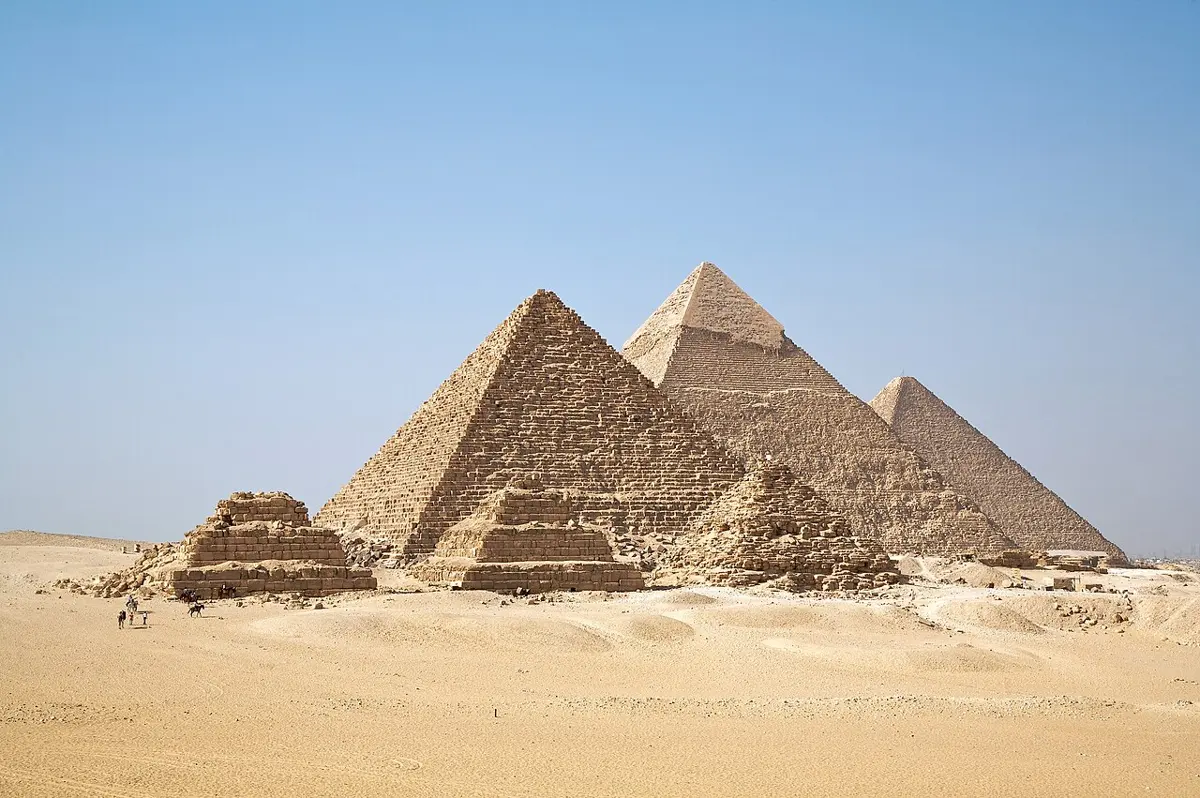
Who built it? For a long time people pictured armies of slaves, and Herodotus, two thousand years later, was told of a hundred thousand workers. Recent digging tells a different story. Just south of the pyramids, the archaeologists Mark Lehner and Zahi Hawass and their teams have uncovered a whole town built by the state for the builders of the Giza pyramids: bakeries, workshops, long halls where teams of workers lived, and royal grain silos from which bread and beer were handed out. Nearby is the workers’ own cemetery, with hundreds of skeletons and small tombs that give the men’s titles. Some had broken bones that had been set and healed. One man had lost a leg and lived on for years.
Today’s estimates run from a few thousand men on the pyramid itself to twenty or thirty thousand counting everyone who quarried, hauled, baked and brewed for them, many of them farmers. Every family owed the king work as well as grain, and men were called up in turns, organized in teams with names such as “Friends of Khufu”. So the builders were not slaves, but they weren’t volunteers either. They were paying a tax with their labor, and some, like Merer’s boatmen, worked for the king full time.
Later kings of this age, which historians call the Old Kingdom, built smaller pyramids, and from the reign of Unis on, spells for the dead king were carved on the walls inside, the Pyramid Texts. The dead had to be ready for the next life, and the body had to last. The richest were made into mummies over about seventy days: the organs were taken out and kept in jars, the body was dried for forty days in natron, a natural salt, then wrapped. Poorer people were buried in the dry desert sand, which preserved many of them too.
All of this was run by writing, from the king’s orders down to Merer’s diary. Egyptians had two kinds of writing: hieroglyphs, the pictures carved on temple walls, and hieratic, a quick joined-up hand for everyday use, written with a reed pen on papyrus, a sheet made from a river reed. Very few people could read and write, perhaps one person in twenty at most, perhaps more in some towns.
Most Egyptians were farmers, and they left almost no writing of their own; little was written about them either, since writing was for the state’s business and the lives of officials. A part of every harvest went to the king or to a temple, and every family owed work as well.
Were there slaves? Yes, though historians argue over how many, and even over what to call them, since the Egyptian words usually translated “slave” could also mean a laborer or a servant. The clearest cases were foreigners taken in war. Even in the Old Kingdom, prisoners brought back from raids into Nubia were plainly enslaved. From about 1550 BCE, when Egypt’s armies fought year after year, captives came home in far greater numbers, and kings gave them to temples, to officials and to soldiers as their share of the loot, to work fields, workshops and households. By the time of the Ramesses kings, slaves could be bought, sold and hired out, yet they had some protection in law, and a few even held land of their own. Egyptian servants seem usually to have been treated more like hired workers than like goods. Much later, in hard times, some poor Egyptians sold themselves into service to escape hunger.
Nubia upstream
South of Egypt, the Nile runs through rock in a series of rapids, called cataracts, and beyond the first of them lies Nubia, today’s southern Egypt and northern Sudan. Egypt wanted what Nubia had: gold above all, and cattle and ivory. Egyptians wrote of Nubia as a land of enemies, and for a long time historians, reading the Egyptian records, believed them.
In 1913 the American archaeologist George Reisner began digging at Kerma, on the Nile in northern Sudan. He found a town, a towering mud-brick temple and great royal tombs. But it was Charles Bonnet, a Swiss archaeologist who dug there for decades from the 1970s, who showed that Kerma was the capital of a Nubian kingdom, the oldest city in Africa outside Egypt yet found.
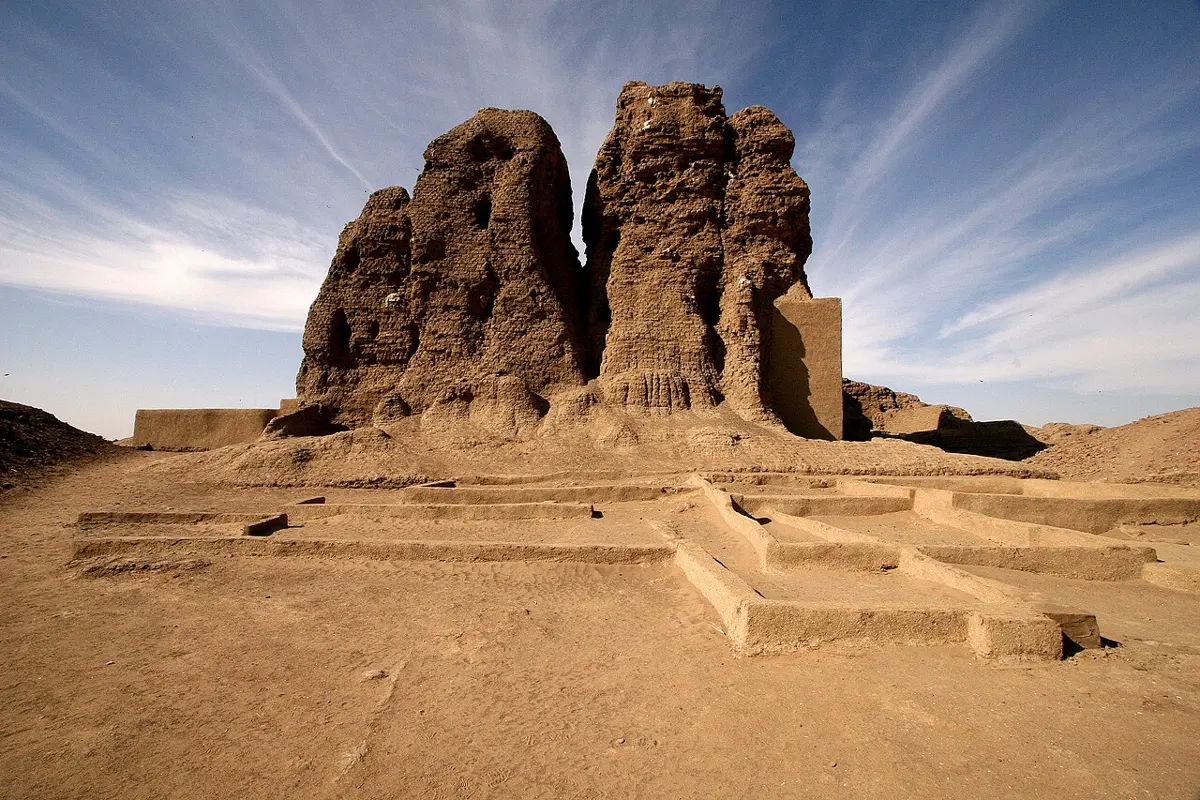
Kerma began around 2500 BCE and was strongest between about 1750 and 1500 BCE, when it controlled the Nile from the first cataract to the fourth. Its later royal tombs were some sixty meters across, and in each were buried more than a hundred people, killed to go with the king into the next life, and thousands of cattle skulls were laid around royal graves. Kerma had no writing of its own, so we know its kings only from what their neighbors wrote.
What their neighbors wrote shows how much they feared them. In the Middle Kingdom, soon after 2000 BCE, Egypt’s kings built great mud-brick fortresses on the Nile in Nubia to hold the border. When Egypt split apart again, about 1640 BCE, the north fell to the Hyksos, rulers from West Asia whose families had long been living in the Nile delta and who now took power there. Kerma took the fortresses. One Egyptian governor’s tomb tells of an attack from Kush, as Egyptians called the Nubian kingdom, deep into southern Egypt, though how great a blow it was is argued. The south, ruled from Thebes, was caught between two powers. When the Theban king Kamose marched north against the Hyksos, around 1550 BCE, his men caught a letter on its way from the Hyksos king to the ruler of Kush, asking him for help against Kamose. Kamose had the story carved on a stone at Karnak, in Thebes.
The Thebans won. Kamose’s successor, Ahmose, drove the Hyksos out and made Egypt one kingdom again, and then Egypt turned south. Under Thutmose I and his successors, its armies destroyed Kerma, and by about 1450 BCE all of Nubia was ruled by Egypt and its gold flowed north.
An empire among empires
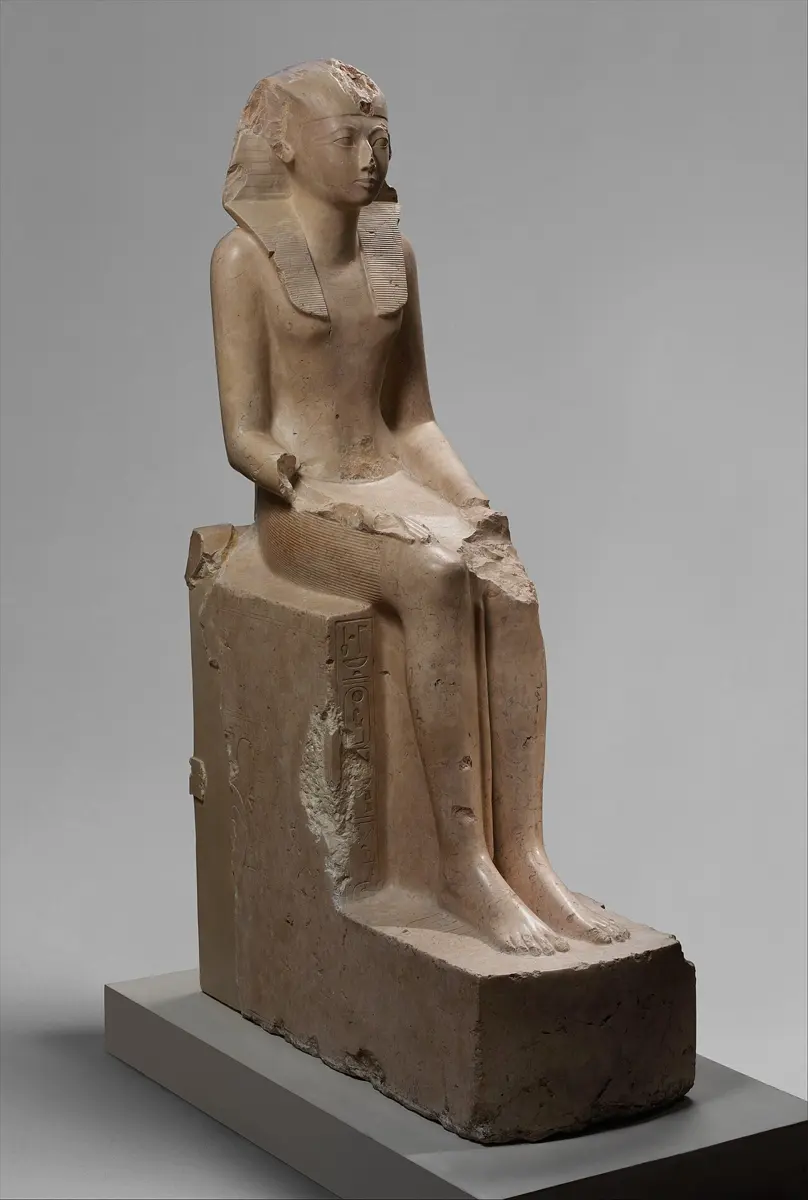
This was the New Kingdom, the age of Egypt’s greatest power, from about 1550 to 1070 BCE. Its kings were buried in rock-cut tombs across the river from Thebes. One of them was a woman. Hatshepsut, the daughter of Thutmose I and the widow of Thutmose II, first governed for her young nephew, Thutmose III, and then, around 1473 BCE, took the full titles of a king and ruled beside him for about fifteen years. She sent an expedition to the distant land of Punt and built her temple at Deir el-Bahri. After she died, her name and her images were hacked off many of her monuments.
Egypt was now one of a small club. The kings of Egypt, Babylon, Assyria, the Hittites of Anatolia and the Mitanni of northern Syria wrote to each other as equals and called each other “brother”. About 350 of their letters were found at Amarna, in Egypt, in the 1880s, written in Akkadian, Mesopotamia’s language, in cuneiform. One king of Mitanni, asking the pharaoh for gold, wrote that in his brother’s country gold was as plentiful as dust.
Goods moved as freely as letters. Late in the 1300s BCE a merchant ship sank off the south coast of Turkey, at a place called Uluburun. Divers found about ten tonnes of copper from Cyprus on board, a tonne of tin, partly from the mountains of Central Asia, glass from Egypt and West Asia, logs of African blackwood, and a little gold scarab with the name of Nefertiti, Egypt’s queen. Copper and tin together make bronze, which every kingdom needed for tools and weapons, so none of them could do without the others.
They also fought. Around 1274 BCE Ramesses II met the Hittite army at Kadesh, in Syria, and both sides claimed the victory. Some fifteen years later Egypt and the Hittites made a peace treaty, promising to help each other against attack and to send back each other’s runaways. Both sides’ copies survive: one in hieroglyphs on temple walls in Egypt, one in Akkadian on a clay tablet from the Hittite capital.
When the connected world fell
Then, in a few decades soon after 1200 BCE, nearly all of it came apart. The Hittite empire vanished. The rich port of Ugarit, on the Syrian coast, was burned. The Mycenaean kingdoms of Greece came to an end.
Many things went wrong at once. Letters from these years speak of hunger. A Hittite ruler wrote that it was “a matter of life or death!”, and the pharaoh Merneptah sent grain by ship “to keep alive this land of Hatti”. Pollen in old soils shows a long drought beginning about this time. Earthquakes may have added to it. And people were on the move, hungry and armed. The last king of Ugarit wrote that enemy ships had come and were setting fire to his cities.
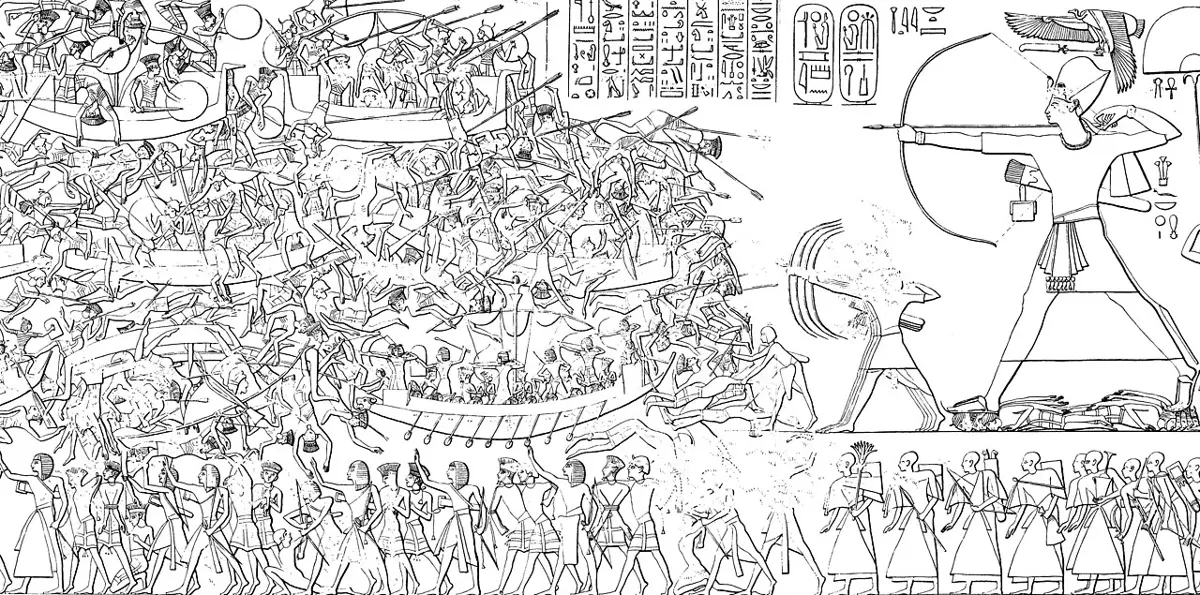
In the eighth year of his reign, around 1177 BCE, the pharaoh Ramesses III recorded on the walls of his temple at Medinet Habu, near Thebes, how invaders had come by land and sea. “As for the foreign countries, they made a ‘conspiracy’ in their isles,” it says. “No land could stand before their arms,” and it names the Hittites’ land and Carchemish among those they swept away. Egyptians named five peoples among them. Historians call them the Sea Peoples, and nobody knows for sure where they all came from. Ramesses, by his own account, beat them, and had the battle carved in stone.
Egypt survived when the others did not. But it was poorer, and it never ruled Syria again. Near the end of Ramesses III’s reign, the craftsmen who cut and painted the royal tombs, who lived in a village of their own called Deir el-Medina, went unpaid. So they put down their tools, marched out and sat behind a temple, shouting “We are hungry!” until officials found grain for them. A scribe wrote it all down. It is one of the oldest strikes on record.
Within a century Egypt had split again, and for the rest of its long life it was ruled as often by outsiders as by Egyptians. The first of them came from Nubia: Kush had risen again, and for half a century in the 700s and 600s BCE its kings ruled Egypt as pharaohs. After them came Persians, then Alexander of Macedon and the Greek-speaking kings who followed him, and finally Rome, in 30 BCE. The hieroglyphs were forgotten, until French soldiers found a stone at Rosetta with one decree in hieroglyphs, a later Egyptian script and Greek, and in 1822 the French scholar Jean-François Champollion announced that he could read them again.
Ancient Egypt lasted so long because the Nile made it rich and simple to hold together: one river, one road, and a flood that turned a strip of desert into fields. On that wealth its kings built a state that could feed and organize tens of thousands of workers, farmers paying their tax in work, and the pyramids are the proof. Egypt was never alone. Nubia upstream was a power of its own, long underrated because the Egyptians wrote the records. And by the New Kingdom, Egypt was part of a world of kingdoms tied together by letters and trade. When drought, hunger and war struck that world around 1200 BCE, the ties that had made it rich helped bring it down all at once.
Found a mistake? Please tell us.