
In 1879 a Spaniard named Marcelino Sanz de Sautuola, who had studied natural science and history, took his daughter María into a cave called Altamira, near the north coast of Spain. A local man had found it about ten years before, and Sautuola had been in once already and seen some black lines on the walls that he didn’t think people had made. Since then he had been to the great exhibition in Paris and seen tools and carved bones that had come out of caves in France, and he came back keen to search the caves near home himself. It was María who looked up. She was the first to see the animals painted on the ceiling: bison and horses in red and black, most of them about as long as a grown man is tall.
Sautuola published what they had found the next year, and said the paintings were from the Old Stone Age, when the people who made the tools in the French caves had lived. Almost nobody believed him. Scholars of every camp met the claim with skepticism; the science of the time had no room for Ice Age painters this good. It took more than twenty years, and painted caves found one after another in France, before the leading French scholar of prehistory, Émile Cartailhac, wrote an article about Altamira in 1902 and gave it the title “Mea culpa d’un sceptique”, my fault, as a skeptic.
He was right, and the answer is the plain one this chapter starts from. Long before anyone farmed, built a town or wrote a word, people were painting animals on the walls of caves, carving figures out of ivory and stone, and pressing their hands to the rock and blowing paint around them. The oldest pictures that survive are more than fifty thousand years old. They are some of the best things people have ever drawn. And for nearly all of them we don’t know why they were made.
Into the dark
Here is a second discovery, as good as the first. On the hill above the town of Montignac, in south-west France, was a foxes’ den, and a story in the town said it was the way into a secret passage to the old manor of Lascaux. In September 1940 an apprentice mechanic of seventeen named Marcel Ravidat tried to explore it, and on the 12th he came back with three other boys, Jacques Marsal, Georges Agniel and Simon Coencas, fifteen and sixteen. They made the hole bigger, Marcel slid down a shaft onto a heap of loose stones, the others followed, and by the light of a lamp they had made in a hurry they walked along a passage and found its walls covered with horses, bulls, deer and stags, in red, yellow and black. The cave was Lascaux. The next day Marcel let himself down an eight-meter shaft on a rope and found a painting of a man facing a bison. The boys told their teacher, and eight days after their first visit the most famous expert on cave art in France, the priest Henri Breuil, was there to see it.

Lascaux shows better than anywhere how such pictures were made, because so much of the painters’ kit was left behind on the floor. The paint was earth and charcoal. Reds came from hematite, an iron ore; yellows from goethite, another iron mineral; blacks from charcoal or from manganese ore. These were ground on stones into powder and mixed with nothing but water. In some other caves the painters mixed in powdered talc. The whole kit, as the archaeologists who studied Lascaux put it, was a few flints, some blocks of pigment, grinding stones, a few brushes and pads, and stencils cut from hide, though most often the stencil was a hand. Where the rock was too lumpy to brush, as in the cave’s frieze of small horses, the paint was sprayed. Lines were often scratched into the rock with a flint, and some animals are engraved with no paint at all.
The hardest problem was the dark. The paintings at Lascaux are in the cave’s inner rooms and passages, where no daylight reaches. More than a hundred lamps were found there, most of them nothing more than a flat piece of limestone with a shallow hollow for the fuel, which was animal fat. One is finer, carved and polished from red sandstone, with a handle, and it was found at the foot of the shaft with the man and the bison. Some of the animals are painted where the wall meets the ceiling, two and a half to three and a half meters up, and in one gallery holes in the rock seem to show where beams once held a platform. So the painters went into the dark with little flames of burning fat, sometimes built scaffolding, and worked on walls they could see only a small patch of at a time. It is hard to imagine anyone doing that without a reason.
One of the oldest kinds of picture is also the simplest. Put your hand flat on a rock, fill your mouth with red paint and blow, and when you lift your hand away its shape is left behind in the bare stone. Hand stencils like this are found in caves in Spain, France and Indonesia, made by people who never met. Sometimes the hand itself was dipped in paint and pressed on the wall instead, and at Chauvet, below, people made rows of big red dots with their painted palms.
How old?
Sautuola couldn’t prove his paintings were old. Today there are two good ways to find out, and both are cleverer than they first sound.
The first is radiocarbon. Living things take in carbon, and a tiny part of it is a radioactive kind, carbon-14, which breaks down at a steady rate after the plant or animal dies. Measure how much is left in a piece of charcoal and you know roughly when the wood it came from stopped growing. Black paint made of charcoal can be dated this way, and so can the charcoal from the painters’ fires and torches on the floor. The method was new when Lascaux was found: in 1951 charcoal from the cave went to Willard Libby’s laboratory in Chicago, where the method had just been invented, and the date that came back put the paintings near the end of the Ice Age. Better measurements have since moved it more than once, and the experts are still refining it.
The second works for red paint too, which has no carbon in it. Water seeping through limestone leaves a thin crust of calcite, the same mineral that builds stalactites, and over thousands of years such a crust can form over a painting. The water carries a little uranium, which turns into thorium at a known rate. Measure the two in the crust and you know when it formed, and since the crust lies on top of the paint, the paint must be older still. This gives a minimum age, never an exact one. At Altamira it showed that a red sign on the wall is at least 35,600 years old.

The cave that changed the dates most was found in southern France in December 1994, when three cave explorers, Jean-Marie Chauvet, Éliette Brunel and Christian Hillaire, felt a draft coming out of a small hole in a cliff, dug through, and lowered a ladder into the dark. Éliette noticed a little mammoth in red ochre on a wall, and then there were hundreds more. Chauvet Cave holds 435 animals, and most of them aren’t the ones people ate. Big cats, mammoths, rhinoceroses and bears make up almost two-thirds of those that can be named, animals that were generally not hunted. They are engraved, or drawn in charcoal and red paint, their bodies shaded by smudging the charcoal to show their roundness, and some drawn with a try at perspective. More than eighty radiocarbon dates show people first came into the cave about thirty-six thousand years ago. Its first paintings are about fifteen thousand years older than Lascaux’s, and just as skilled. Whatever the story of art is, it isn’t a story of clumsy beginnings slowly getting better.
Then the oldest pictures turned out not to be in Europe at all. On the Indonesian island of Sulawesi, scientists dating calcite crusts found a hand stencil at least 39,900 years old in 2014. Then, in 2021, they dated a painting of a warty pig in a cave called Leang Tedongnge to at least 45,500 years. And in 2024 they reported, in another Sulawesi cave, a scene in red of human-like figures with a pig, at least 51,200 years old. That is the oldest picture known anywhere, and it may tell a story: people, an animal, something happening between them. Modern humans had left Africa, as World History tells, and by then had reached the islands of South-East Asia, and they seem to have been painting wherever they went.


India has its own great gallery of rock paintings, the shelters of Bhimbetka, on five hills in the forests of Madhya Pradesh. The archaeologist Vishnu Wakankar used to say he spotted the odd shapes of the rocks from a train in 1957, got off and went to look, and he spent the rest of his life, until 1988, studying them. Hundreds of the shelters are painted: hunters, dancers, drummers, animals of the forest, and, in the later ones, soldiers and riders on horses and elephants. People went on painting there for thousands of years, into historic times; every one of its more than five hundred horses belongs to those later periods. How old the earliest paintings are is still argued. Wakankar put most of the oldest just after the Ice Age, from about ten thousand years ago, and a few green figures further back, in the Ice Age itself; others put them later.
Carving
Not all the earliest art was on walls. Some of it could be carried.
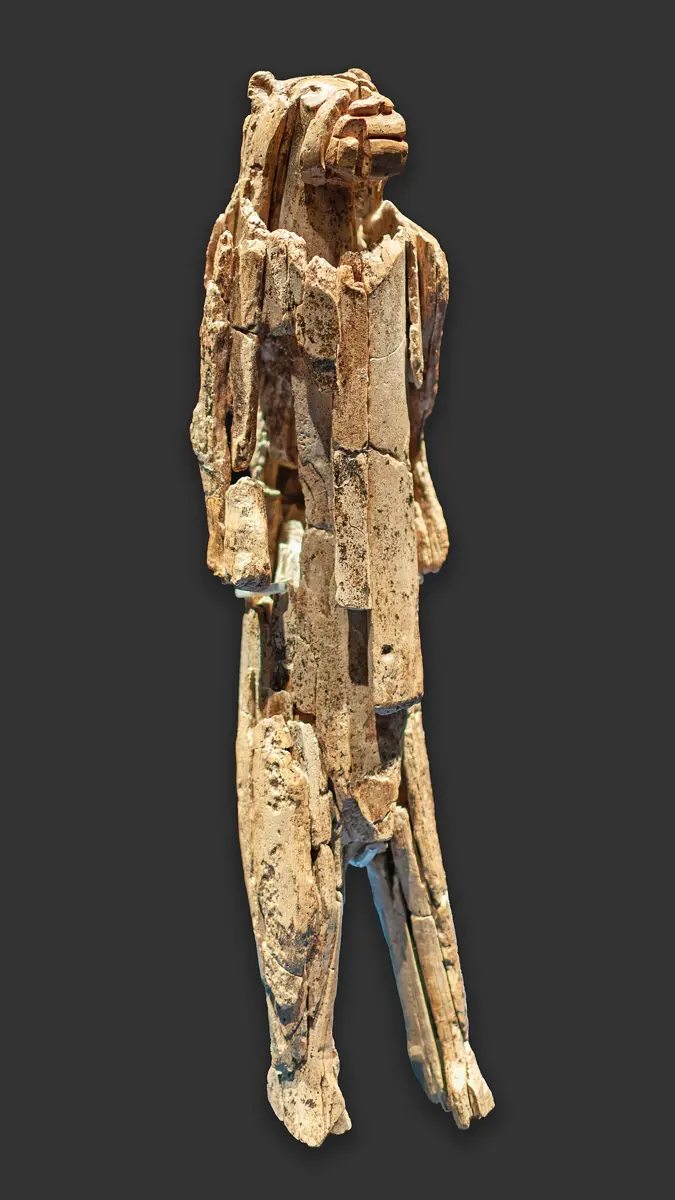
In August 1939, a week before the Second World War began, a dig in a cave called Stadel, in southern Germany, came to a hurried end. Among the finds were many small pieces of mammoth ivory, which went into a box in the museum at Ulm and stayed there for thirty years. When an archaeologist named Joachim Hahn fitted together more than two hundred of them, they made a standing figure about thirty centimeters tall with a human body and the head of a cave lion. More pieces were added later, and from 2008 archaeologists went back to the cave, sifted the soil the 1939 team had shoveled back into its trenches, and found more pieces of the same figure. The layer it came from has been dated to about forty thousand years ago. Germans call it the Löwenmensch, the lion-person, a word that doesn’t say whether it is a man or a woman. Whatever it was, it was something nobody had ever seen, a creature that existed only in someone’s head.
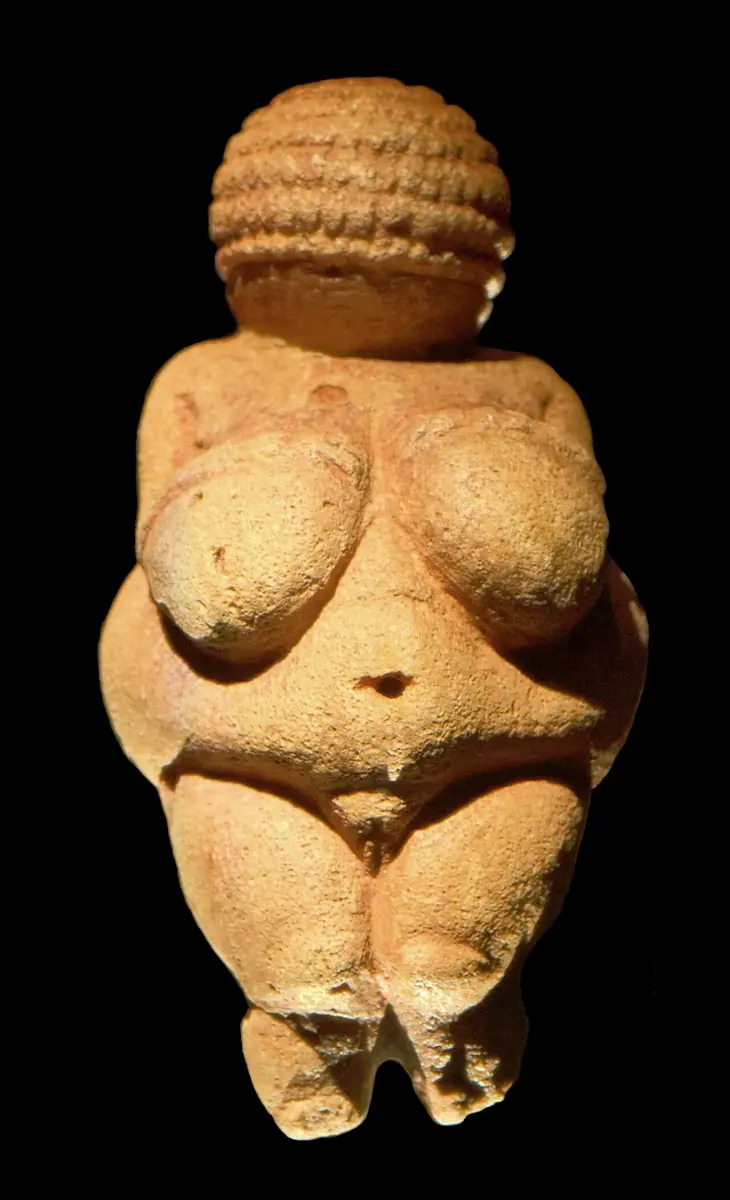
The most famous small carving of all was found on 7 August 1908 on the bank of the Danube in Austria, in a dig led by Josef Szombathy. It is a woman, eleven centimeters high, with heavy breasts and belly, her arms resting on them and her head covered by what looks like rows of braids or a woven cap. She has no face. She was once painted red. Her carver made her about thirty thousand years ago from a kind of limestone that doesn’t occur near Willendorf, where she was found; when scientists studied the grains of her stone in 2022 and compared them with rocks across Europe, the closest match was near Lake Garda in northern Italy, hundreds of kilometers away. She is called the Venus of Willendorf, after the Roman goddess of love, a name that tells us more about the men who named her than about her. Nobody knows whether she was a goddess, a charm for a healthy birth, a portrait, or a toy.
The caves of Mustang
Nepal has caves that look as if they ought to belong in this chapter. In Mustang, along the gorge of the Kali Gandaki, there are about ten thousand of them, dug by hand into soft cliffs, some on their own and some in groups stacked eight or nine storeys high. Nobody knows for certain who dug them, or why so high. Some of the caves have Buddhist paintings on their walls: in one a team of climbers and archaeologists found a mural twenty-six feet long with portraits of forty-two great yogis, and in another eight thousand handwritten manuscripts, most of them about six hundred years old.

But the Mustang caves aren’t Ice Age art. The archaeologists who have climbed into them find three stages. About three thousand years ago people used some of them as tombs. From about a thousand years ago families lived in them. Later still, between about the twelfth and fifteenth centuries, monks used them to meditate in and painted their walls. Their paintings are far younger than Lascaux’s, made by people who wrote books and followed the Buddha. They belong with the Buddhist painting of the mountains told in Palm Leaf, Paubha, Thangka.
What did they mean?
Since Altamira, everyone who has seen these pictures has wanted to know what they were for, and each age has given the answer that suited it. The first scholars thought it was art for art’s sake: hunters with time on their hands, decorating their homes. Then it was hunting magic: paint a bison with a spear in it and you’ll kill one tomorrow. But at Chauvet most of the animals are big cats, mammoths, rhinoceroses and bears, which were generally not hunted. In the middle of the twentieth century French scholars counted where each kind of animal was placed in each cave and argued that every painted cave was an organized world, laid out on a plan. In the 1990s others linked the paintings to shamanism, the belief among many hunting peoples that some people can travel into a world of spirits. And one expert who studied Lascaux for more than ten years found that on every panel the horses were painted first, then the bulls, then the stags, and that each is shown as it looks at a different season, the horses in early spring, the bulls in summer, the stags in autumn, as if the painters were marking the turning of the year.
Each idea explains something, and none of them explains everything. The people who painted Chauvet left no words, and the last of them died tens of thousands of years ago, so the honest answer is that we don’t know, and probably never will. That isn’t a failure. It is a way of reading the past that this book will use again and again: say what can be measured (the paint, the lamps, the dates, the animals counted), say what is a guess, and keep the two apart.
What we can say is enough to change how you think of the people who made them. They had the same eyes and hands and brains as anyone alive, and they used them to make pictures that stop visitors in their tracks today. The paintings are also fragile. Lascaux was opened to visitors in 1948; ten years later green algae were growing on the walls, and in 1963 it was closed. Altamira lets in five people a week. Chauvet was closed from the start, and people visit a copy instead, the largest copy of a painted cave in the world. The next chapter moves on to the first cities, where people built their pictures into walls of mud brick and stone, and signed some of them with the names of kings.
Found a mistake? Please tell us.