
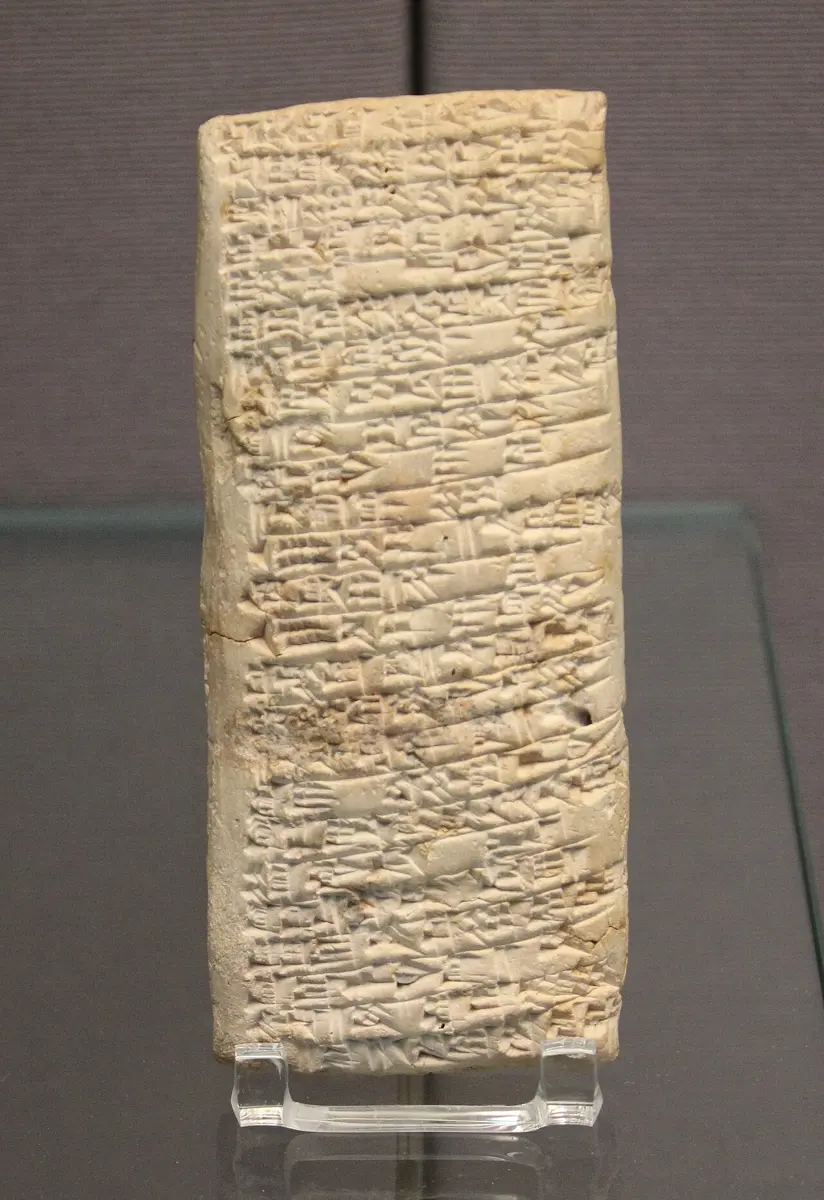
About 3,750 years ago, in the city of Ur in what is now southern Iraq, a man named Nanni sent a letter to a copper dealer called Ea-nasir, and he was angry. Ea-nasir had promised him good copper. Then, Nanni says, he set out poor ingots in front of Nanni’s servant and told him to take them or go away. “What do you take me for,” Nanni asks, “that you treat somebody like me with such contempt?” Men he had sent to collect his money had come back empty-handed several times, through enemy country. From now on, he says, he will choose every ingot himself, in his own yard, and turn away any that isn’t good.
The letter was dug up in the 1920s in a house at Ur where the tablets of Ea-nasir’s business were kept, and it belongs to the British Museum in London. We have only Nanni’s side of the quarrel, so we can’t say whether Ea-nasir really cheated him. But nearly four thousand years later we can read a customer’s complaint, word for word, because the people of this land were the first to write. And they didn’t start writing to send letters, or to record laws, or to tell stories. They started to keep accounts.
Here is the whole story in a few lines. Between about 3500 and 3000 BCE, on the flat land between the Tigris and Euphrates rivers, villages grew into the first cities in the world, and Uruk was the biggest of them. Its temples handed out rations to many workers, and to keep track of it all, officials began to press marks into soft clay. Over the next few centuries those marks became a full writing, called cuneiform, that could set down anything a person could say. For centuries the cities fought one another, until about 2300 BCE a king called Sargon of Akkad conquered them all and made the first empire. Around 1750 BCE a king of Babylon, Hammurabi, had his laws carved on a tall black stone. They are the most famous laws of the ancient world, and they gave one punishment for a man of high rank, another for a commoner and another for a slave. Kingdoms and empires came and went in this land for more than a thousand years after him, until the Persians took Babylon in 539 BCE.
Between the rivers
The Greeks later called this land Mesopotamia, “between the rivers”, and the name stuck. Most of it is Iraq today. In the north there are hills and rain enough to farm. The south, where the first cities grew, is a flat plain of river mud, hot and dry, where crops grow only on water led from the rivers by canals. The soil is rich, but the land has almost nothing else. There is no good building stone, no good timber and no metal ore. The people of the south built with mud bricks and reeds, and anything harder had to come from far away.
So from the very start these cities traded, some of them very far. The deep blue stone lapis lazuli came from the mountains of Badakhshan, in what is now Afghanistan. Copper came by sea from Magan, today’s Oman, through the island port of Dilmun, today’s Bahrain, which is where Ea-nasir bought his. And some of the most prized goods came from a land the records call Meluhha, which most scholars take to be the Indus cities of today’s Pakistan and northwest India. Long red beads of carnelian, drilled the way Indus bead makers drilled them, turn up in the graves of Ur’s rulers from about 2600 BCE. A seal from about 2000 BCE belonged to one Shu-ilishu, whose job was to translate the language of Meluhha, and at least one village of Meluhhans lived in Mesopotamia. People from the Indus, two chapters on, were living among the first cities, speaking their own language.
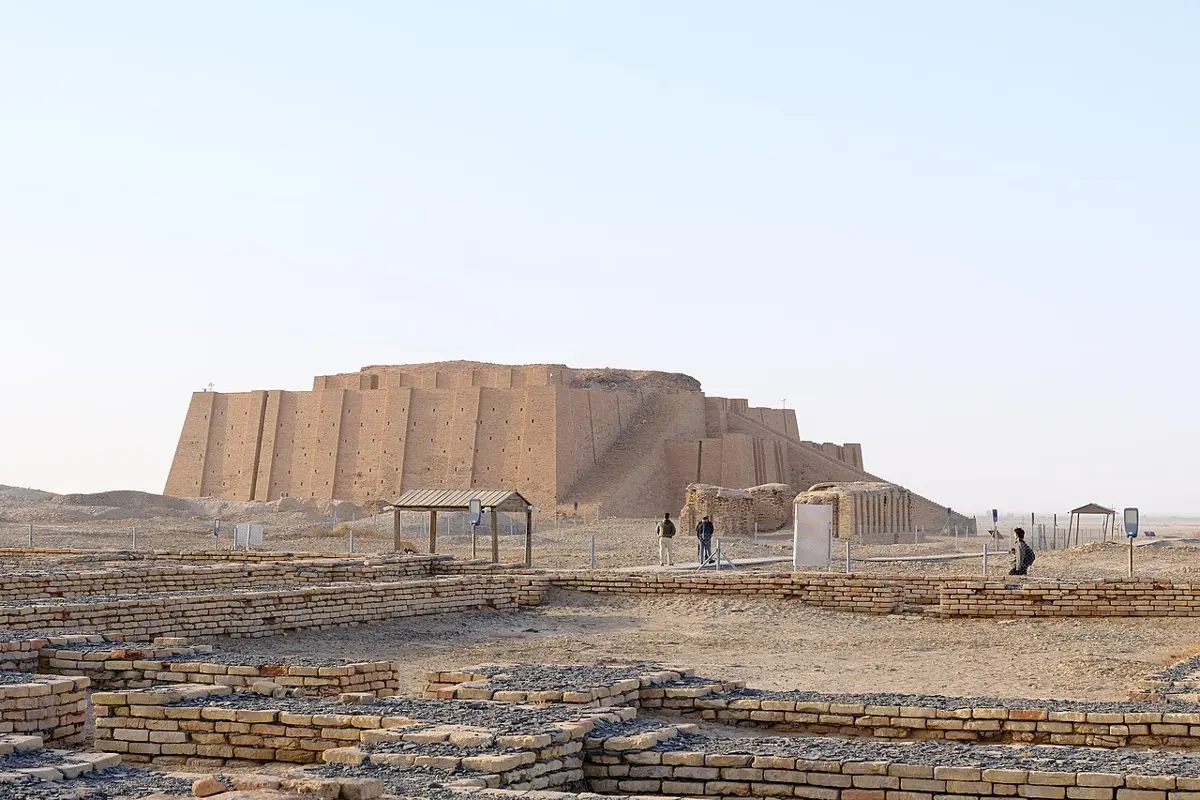
The biggest of the cities was Uruk. By about 3200 BCE it was the largest place in Mesopotamia, and perhaps in the world. It covered about 250 hectares, as much ground as some 350 football fields, and it may have had a few tens of thousands of people. Its heart was a group of great temples of mud brick, their walls covered in patterns of colored clay cones pushed into the plaster like pins into a cushion. Around them lived not only farmers but people who grew no food at all: potters, metalworkers, weavers, priests and officials. One of the oldest written lists ever found, from Uruk, names 120 kinds of official, from the leader of the city and the leader of the law down to the leader of the plow and the leader of the lambs. Soon after 3000 BCE a wall some nine kilometers long went right round the city. Later stories said it was built by Uruk’s king Gilgamesh.
From counting to writing
Feeding a city like that took a great deal of keeping track. The temples owned land, herds and stores, and paid their workers in rations. Who had brought in how many sheep? How much barley had gone out, and to whom? Nobody can hold all that in their head, so the officials of Uruk began to write it down.
What came just before is argued. People across West Asia had long made small clay counters, and around the time of the first cities counters were sometimes sealed inside a hollow ball of clay, like an envelope, so that nobody could tamper with a deal, with marks pressed on the outside to show what was inside. One well-known theory says that someone then saw the marks alone were enough, and flattened the clay into a tablet. How far each step led to the next is still debated, but the oldest tablets do begin with numbers.
The earliest of them come from Uruk, from about 3300 to 3200 BCE. They are small pillows of clay, often no bigger than the palm of a hand, with round and wedge-shaped dents for numbers and simple drawings, scratched with a reed, for the things counted: grain, fish, sheep and other animals. About six thousand of these early tablets are known, and nearly all of them are accounts. There are no stories, no prayers, no letters and no history in them at all. Those came some seven hundred years later. Alongside the accounts, though, are lists of signs and words, which the clerks copied to learn their trade. Writing was something that had to be taught.
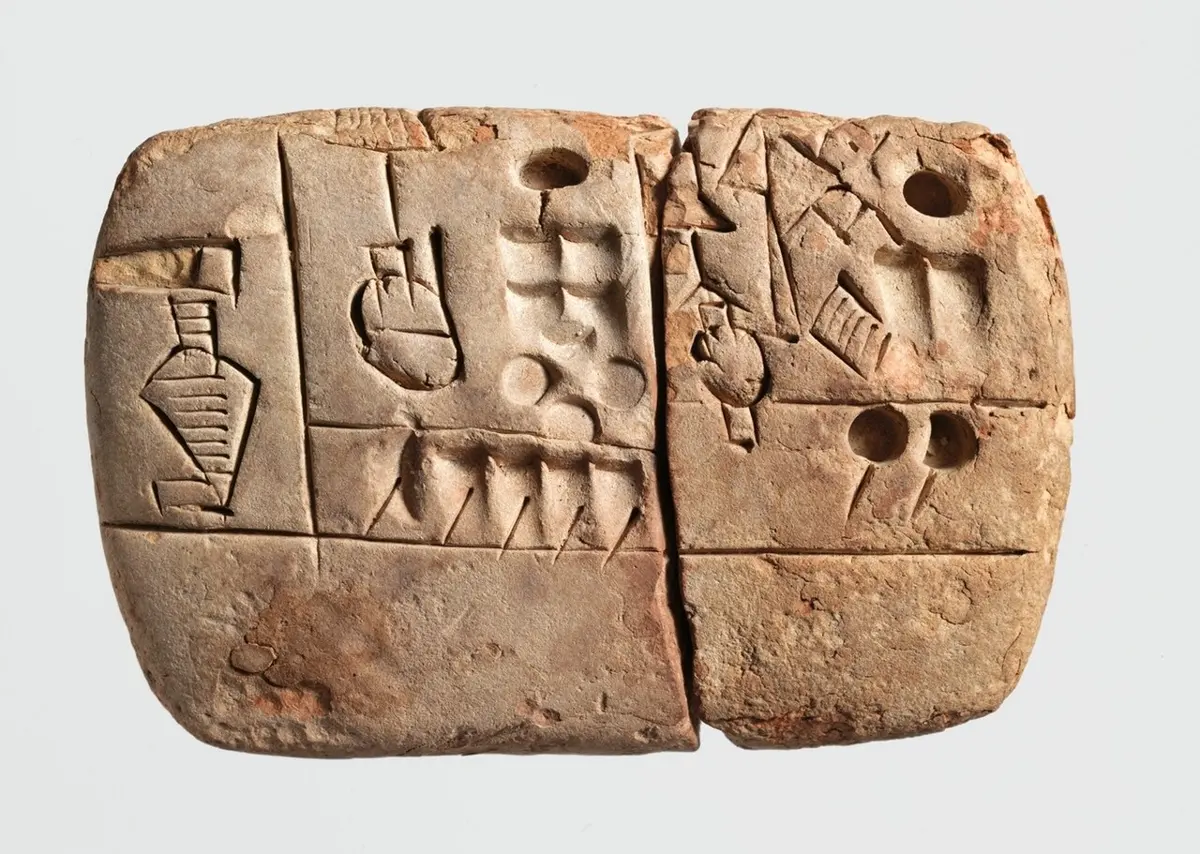
A picture of a sheep can say “sheep” in any language, but it can’t write a person’s name or a word like “give”. The big step came when a sign could stand for a sound as well as a thing, much as a drawing of an eye and a drawing of a tin can could be read together, in English, as “I can”. Signs like that turn up only now and then in the earliest tablets, and they are used regularly only after about 2600 BCE. But once they were, a scribe could write down anything at all.
Over the same centuries the drawings changed. Scribes stopped scratching lines and instead pressed the cut end of a reed into the clay, which leaves a little wedge. Each sign became a cluster of wedges, and in the end few of them looked like anything. Many centuries later, European scholars called it cuneiform, from the Latin for “wedge”. It was used for more than 3,000 years, for Sumerian, the first language written in it, then for Akkadian, a language not related to it at all, and for Hittite, Hurrian and many more. By the time of Nanni’s letter, Akkadian was the language of business and Sumerian was a language of the classroom, kept alive the way Sanskrit and Latin have been. Hundreds of thousands of tablets have been dug up, and nobody alive could read one until the 1850s.
The Mesopotamians counted in sixties as well as tens, and sixty was handy because it divides evenly in so many ways. Astronomers in Babylon kept using it for the sky, Greek astronomers took it from them, and from them come the 360 degrees of a circle and the minutes and seconds of an angle. The minutes and seconds on a clock came from the same idea, but much later: most people had no use for minutes until clocks began to show them, in the late 1500s.
Kings and the first empire
For centuries southern Mesopotamia was a patchwork of city-states, each a city with its own fields and villages, its own god and its own ruler, and they fought each other often. Gilgamesh, if he was a real king, ruled Uruk around 2700 BCE. Nothing written in his own time names him, but he became the hero of the stories that grew into the Epic of Gilgamesh, the oldest great poem we have. In it a proud king loses his dearest friend and goes to the ends of the earth looking for a way never to die. He fails, and comes home to Uruk and its wall, which will last after him.
Then, around 2300 BCE, one man ended the age of separate cities. Sargon of Akkad began, by later tradition, as cupbearer to the king of Kish. He took the throne for himself and conquered all of the south. He and his grandson Naram-Sin went on to rule, at the empire’s height, from the Mediterranean to the mountains of Iran. It was the first empire, many peoples under one king. Sargon had it written that the ships of Meluhha, Magan and Dilmun tied up at the quay of his city, Akkad, and that 5,400 men ate bread before him every day. Akkad itself has never been found.
To hold the old Sumerian cities, Sargon put his own family in their highest offices. He made his daughter, Enheduanna, high priestess of the moon god at Ur. In 1927 the archaeologist Leonard Woolley dug up a disk of white stone at Ur that shows her at a ceremony and names her as Sargon’s daughter. Hymns to the goddess Inanna that name her as their author were copied in schools for centuries afterward. If she wrote them, she is the first author in history whose name we know. The copies were made some six hundred years after her time, though, and scholars argue over whether she composed them or later scribes gave her the credit.
Sargon’s empire lasted about a century and a half. Around 2100 BCE the kings of Ur ruled much of the land and built the great ziggurat, and their king Ur-Namma left a collection of laws, the oldest that survives.
Hammurabi’s laws
Then Ur fell too, and the cities had their own kings again, until a king called Hammurabi pulled them together. He ruled Babylon from about 1792 to 1750 BCE. Babylon’s kings had held only a small territory. In some thirty years of war and dealing, Hammurabi made it the master of all of southern Mesopotamia and more, and it stayed the most important city of the land for more than a thousand years after him.
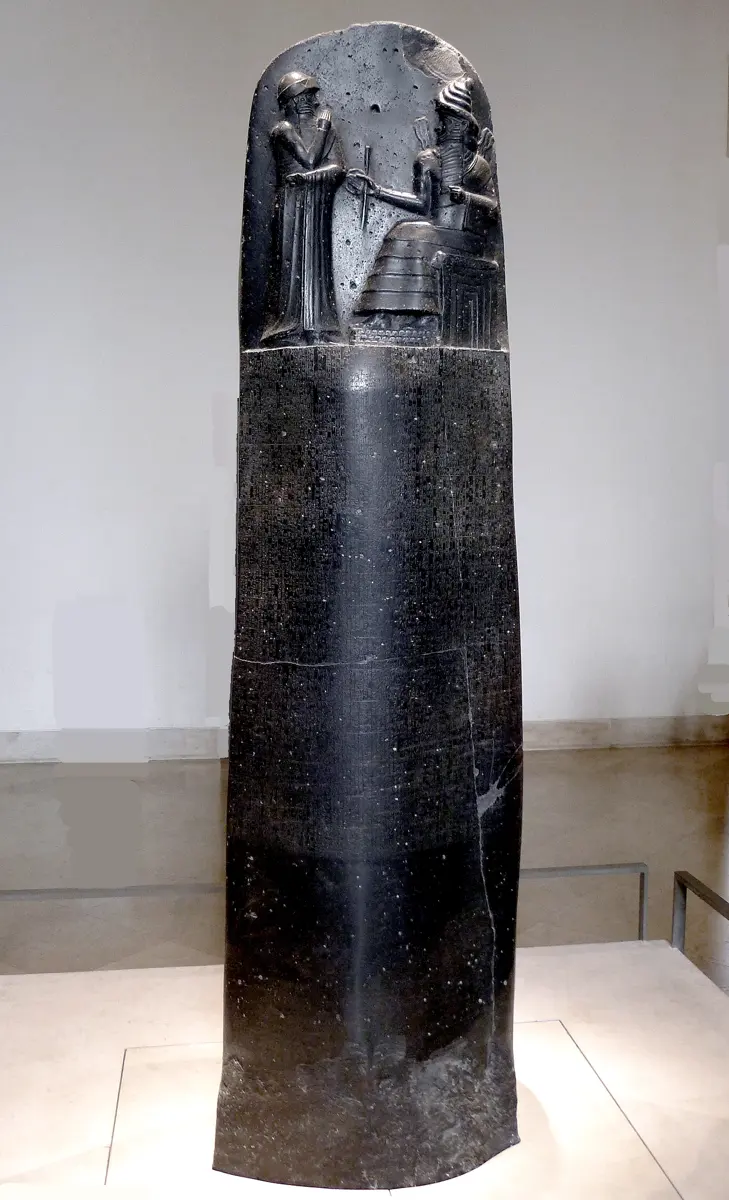
Near the end of his reign he set up a pillar of polished black stone, 2.25 meters tall. At the top, carved in relief, he stands before Shamash, the sun god and the god of justice. Below, in about 4,130 lines of cuneiform, come his laws, wrapped in a poem in his own praise. In its opening he says the gods chose him to make justice rule the land, to destroy the wicked, and to stop the strong from harming the weak. At the end he invites anyone who has been wronged to come and stand before his image and have the stone read out, to learn his rights.
Between those come about 280 laws. They are written as cases, “If a man does this, then that”, and they cover farming, trade, loans, marriage, theft, wages and injury. Many sound sensible today. A man who can’t prove a charge of murder he has brought against another is himself put to death. If a storm or a flood destroys a farmer’s crop, he need not repay his loan of grain that year, and pays no interest. A woman whose husband neglects her, through no fault of her own, may take back her dowry and go home to her father’s house.
But these laws don’t treat everyone alike. They know three kinds of people: the awilum, a free man of high standing; the mushkenum, a free man of lower standing, something like a commoner; and the slave. Exactly who counted as which is still argued, but the difference shows plainly in the laws on injury. A man who put out the eye of another man of his own rank lost his own eye, and if he broke his bone, his own bone was broken. If he did the same to a commoner, he paid a mina of silver, about half a kilogram. If he did it to another man’s slave, he paid half the slave’s price.
An eye for an eye, then, but only between equals. Below them an eye was worth some silver, and a slave’s eye was a loss to the slave’s owner. A surgeon who saved a high-ranking man’s eye was paid ten shekels of silver, five for a commoner and two for a slave. If a house a builder had built fell down and killed the owner, the builder was put to death. If it killed the owner’s son, the builder’s son was put to death. The prices are in silver weighed out on scales, because there were no coins yet. The first coins were made more than a thousand years later, in Lydia, in what is now western Turkey.
Men and women weren’t equal before these laws either. A man in debt could hand over his wife, his son or his daughter to work for the man he owed, for three years. A wife caught with another man was to be tied up with him and thrown into the river, unless her husband chose to spare her. And if a man struck a pregnant woman of high rank and she died, it was his own daughter who was put to death. The laws did look after people in some ways, as with the farmer’s loan and the neglected wife’s dowry, and they did say the strong should not harm the weak. But they set a poor man’s eye at a lower price than a rich man’s, and they left slaves as property. It is a law of its time, for an unequal society, and that is what makes it so useful to historians. It shows, in a king’s own words, who mattered how much.
Did judges actually use it? Strangely, perhaps not. Thousands of records of real lawsuits survive from Hammurabi’s time and after, and none of them quotes his stone. Many scholars now think it was less a law book for courts than a model of good judgments, set up to show the gods and the people what a just king Hammurabi was. Scribes copied it in their schools for a thousand years, and a copy was kept in a royal library in the 600s BCE.
In the 1100s BCE a king from Elam, in what is now Iran, carried the pillar off to his city of Susa as loot, and there French archaeologists dug it up in 1901–02. It stands in the Louvre in Paris today.
Long after Hammurabi
Babylon was sacked by the Hittites, from what is now Turkey, in 1595 BCE, and for centuries other peoples ruled it. In the north, the city of Ashur grew into the center of the Assyrian kingdom, and from about 900 BCE Assyria built the greatest empire the region had seen. One of its last kings, Ashurbanipal, gathered thousands of tablets in his capital, Nineveh. Among them was the Epic of Gilgamesh, with its story of a great flood much like Noah’s in the Bible. In 612 BCE Nineveh fell to the Babylonians and the Medes of Iran, and Assyria’s rule soon came to an end.
Babylon was free again, and great again, under its own kings. The most famous of them, Nebuchadnezzar II, who ruled around 600 BCE, is the king later stories credit with the Hanging Gardens of Babylon, one of the Seven Wonders of the ancient world. They may be only a story. No writing from Babylon mentions them, and no dig there has found them for certain. Every account of them was written in Greek, centuries later, and only one names Nebuchadnezzar. Herodotus, the Greek historian, described Babylon without mentioning any garden. Stephanie Dalley, a scholar of cuneiform at Oxford, has argued that the famous garden was real but stood at Nineveh, made by the Assyrian king Sennacherib around 700 BCE, with a great aqueduct to water it, and that later writers mixed up the two cities and the two kings. Others aren’t convinced, and nobody knows for sure.
In these last centuries Babylon’s astronomers did their finest work. From 652 to 61 BCE, almost without a break, they kept a diary of the night sky: the moon and the planets, eclipses, the weather, the height of the Euphrates and the price of barley and wool in the market. In 539 BCE Cyrus of Persia took Babylon, and the land became part of a still larger empire. Cuneiform faded slowly after that. The last tablet from Uruk that can be dated is an astronomer’s almanac from about 80 CE.
Mesopotamia gave the world its first cities, its first writing and its first empire, and much of what came after was built on them. The cities grew because the land, with canals, could feed far more people than ever before, and because they traded across half of Asia for what they lacked. Writing began as accounts for the temples, and only later did it carry letters, laws, poems and science. Hammurabi’s laws show that the first states were built on inequality, with every person’s worth set by their rank, and that the kings wanted to be seen as just all the same. And the clay that made it all lasted. Because a baked or buried tablet can survive for thousands of years, more ordinary voices reach us from these cities than from almost anywhere else in the ancient world, down to an angry customer at Ur. Far to the west, along a single river, another state was taking shape at the same time, and it is the next chapter.
Found a mistake? Please tell us.