
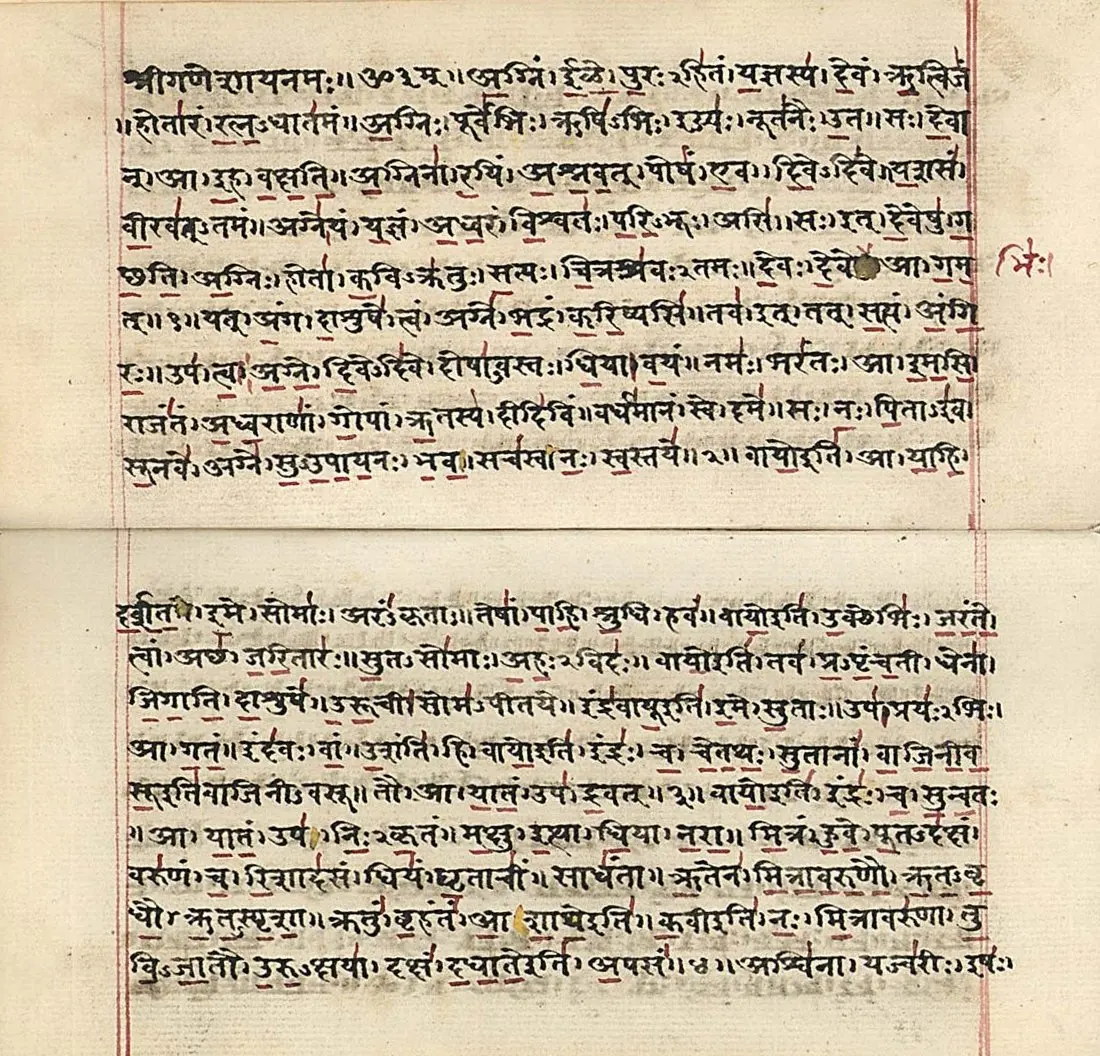
A boy who is to learn the Rigveda in the old way starts when he is seven or eight. He learns it as a sound, not as a book. A teacher says a few words, the boy says them back, and the next day there are a few more. The Rigveda has 1,028 hymns, so this goes on for years, and for most of that time he doesn’t understand what he is saying. Understanding is not the point. The point is that not one syllable, and not one rise or fall of the voice, may change.
So he learns each hymn more than once. First he learns it the way it is sung, with the words running into each other. Then he learns it word by word, with a pause after each, the पदपाठ (padapāṭha). Then in pairs, the क्रमपाठ (kramapāṭha): if the words are 1, 2, 3, 4, he says 1-2, 2-3, 3-4. Then braided, the जटापाठ (jaṭāpāṭha): 1-2, 2-1, 1-2, then 2-3, 3-2, 2-3. The hardest pattern, the घनपाठ (ghanapāṭha), swings back and forth like a bell: 1-2, 2-1, 1-2-3, 3-2-1, 1-2-3. With the pairs alone, the Dutch scholar Frits Staal reckoned, learning the Rigveda takes at least five years.
Why all this? Because in a plain recitation a forgotten word leaves no trace. You simply say the line without it, and nobody can tell. In the pairs and braids, every word is tied to its neighbors several times over, so a missing word leaves a hole that anyone can hear. The method worked. The Rigveda has no variant readings: wherever another old book quotes it, the words are the same. Writing was kept away from it for centuries. One old rule says a student mustn’t recite the Veda if he has eaten meat, seen blood or a dead body, or written. The hand-copied books came much later, and the copies vary more than the chanting does.
In 2003 UNESCO named the tradition of Vedic chanting one of the treasures of humanity’s living heritage. It also noted how little is left of it: of more than a thousand schools that once recited the Vedas, each in its own way, thirteen survive.
Here is the whole story in a few lines. The Vedas are four collections of hymns, chants and ritual words in the oldest form of Sanskrit. Their people were herders and farmers who prized cattle and horses, fought each other and their neighbors, and offered milk, butter, grain and a sacred drink called soma into the fire, praying to gods of fire, storm, sky and dawn. Most scholars place the oldest hymns in the land of the Indus and its rivers, in today’s Pakistan and north-west India, a few centuries after the Indus cities had faded, roughly between 1500 and 1200 BCE, and the Vedic age as a whole to about 500 BCE. Others hold that the hymns are far older, and that their makers were the Indus cities’ own people. Over those centuries the Vedic way of life moved east along the Ganga plain, as far as Mithila. Somewhere along the way, people came to be sorted into four ranks, the four वर्ण (varṇa). And whether the Vedic people came into South Asia from outside, or had always been there, is the most argued question of this part of history.
What the hymns are
Most of the Rigveda’s hymns are praise and requests. The very first is to Agni, fire, who carries the offerings up to the gods. Indra, the storm god who wields the thunderbolt, has more hymns than anyone, for killing the serpent who held back the waters and for helping his people in battle. Soma is both a god and a drink, pressed from a plant nobody can now identify for sure. Ushas is the dawn. The poets ask for cows, horses, sons, long life and victory, and they are proud of their own skill. One short verse sums up a whole household. “A bard am I,” a poet says, “my dad’s a healer, my mom grinds grain on the stones,” and they are all after wealth in their different ways.
The hymns were made by families of poets over several hundred years. Six of the ten books are “family books”, each kept by one family of priests, and these are thought to be the oldest. The tenth book is the youngest. The other three Vedas came later. The Samaveda is mostly the Rigveda’s own verses set to tunes for singing. The Yajurveda holds the words a priest says while he does each step of a sacrifice. The Atharvaveda is the most everyday of the four, full of charms against fever, snakebite and rivals in love. After them came long prose books explaining the rituals, and then the Upanishads, whose questions belong to the next chapter.
How can anyone date poems that were never written down? Only from what they mention. The Rigveda knows copper and bronze but not iron, which appears in later Vedic texts, and iron came into use in the north of South Asia around 1200 to 1000 BCE. It knows no great cities, only ruins and small forts, so it seems to come after the Indus cities had gone. And a treaty between two kings in what is now Syria and Turkey, from about 1400 BCE, calls on four Vedic gods, Mitra, Varuna, Indra and the twin Nasatyas, as witnesses, with their names in an old Indian form. So the hymns’ language and gods were already known far to the west by then. That is how most scholars reach their range. Others read the hymns’ descriptions of the stars and of the सरस्वती (Sarasvati) river as pointing to the third millennium BCE or earlier, and the argument is still going on.
Where did they come from?
On some things everyone agrees. In 1786 William Jones, a British judge in Calcutta, said that Sanskrit was so close to Greek and Latin, in its words and its grammar, that no expert could compare them without believing all three came from one source. It was the start of the idea of the Indo-European family of languages, which takes in Nepali and Hindi, Persian, Greek, Latin, Russian and English. Sanskrit’s closest relative is the language of the Avesta, the old holy book of Iran. Everyone agrees, too, that the Indus cities wound down slowly, and that no army of invaders destroyed them. The old story of a conquering “Aryan race” sweeping in from the north-west has been given up. The race was always a European invention: in the hymns, आर्य (ārya) is what the poets call their own people and way of life, not a color of skin or shape of skull.
What is argued is the direction. Did the language of the hymns come into South Asia from the north-west, or did it grow up there and spread out?
Those who hold the first view, among them the American linguist Michael Witzel, picture people speaking an early form of Sanskrit moving in over generations from Central Asia, in small groups, herding animals through the passes, and mixing with the people already living in the Punjab, whose languages left their mark. Their reasons come mostly from words. The Rigveda’s word for the war chariot, रथ (ratha), is the same old word as Latin rota, which only means “wheel”. Light chariots with spoked wheels first turn up around 2000 BCE, on the grasslands near the Ural Mountains, which suggests the word took its new meaning in that region. For the plants and animals of South Asia, though, the hymns use words borrowed from other languages: मयूर (mayūra) for the peacock, and later व्रीहि (vrīhi) for rice. For the elephant they made up a word, हस्तिन् (hastin), “the one with a hand”, as if it were new to them.
Then, in 2019, came ancient DNA. A large study by geneticists and archaeologists, led by the geneticist Vagheesh Narasimhan, read the genes of 523 ancient people from Central and South Asia. It found that ancestry from herders of the steppes, the grasslands north of the Black and Caspian Seas, reached South Asia in the first half of the second millennium BCE. It was the same steppe ancestry that had spread into Europe about a thousand years before, and Europe is the other home of the Indo-European languages. The woman buried at Rakhigarhi, the one Indus person whose DNA has been read, had none of it. Most of the ancestry of people in South Asia today still comes from those who were there before; the steppe part makes up as much as about 30 percent in some groups. It came mostly through men, and it tends to be higher, with exceptions, in groups that were traditionally priests, the keepers of the Sanskrit texts, though the authors warned that this pattern was not a formal test. They concluded that these movements of people were likely the way Indo-European languages came into South Asia.
Those who hold the second view, among them B. B. Lal, a former head of the Archaeological Survey of India, and the writer Shrikant Talageri, see no break in the ground. In their reading, the people of the Indus cities and their descendants simply carried on, villages after the cities, and the Vedic people were among them. They point out that the Rigveda praises the सरस्वती as a mighty river, and that the river now identified with it had shrunk by the end of the Indus cities, so the hymns, they argue, must be older. Talageri reads the order of the Rigveda’s books another way: in his analysis, the oldest are set east of the सरस्वती, in today’s Haryana, and the later ones reach westward toward Afghanistan, so the movement was outward from India, not inward. To the DNA they answer that genes show where people’s ancestors came from, not what language they spoke, and that most of South Asia’s ancestry is its own. One of the 2019 study’s own authors, the Indian geneticist Niraj Rai, leans this way too: he said he didn’t think there was enough proof that the languages came from outside, though he also said there was no evidence that the Indus people were the Vedic people.
What does the DNA settle, then? It shows that people with steppe ancestry did come into South Asia, around the time most scholars date the earliest hymns. It cannot show which language anyone spoke. “Bones don’t speak,” as Narasimhan himself put it. And almost no ancient DNA has yet been read from the Ganga plain or from the later Vedic centuries. Nor do the two views split neatly by country. Most scholars in the West rule out South Asia as the first home of the Indo-European languages, but many Indian scholars hold the first view too, and some in the West have come to doubt it.
The question has never been only about the past. The conquering race was nineteenth-century Europe’s idea, and many on the second side see in the migration story the colonial scholars’ distortions carried on. The old conquest story was argued over by India’s campaigners against caste too, long before the DNA, and in opposite ways. Jotirao Phule read it as true, a conquest of the land’s first people, whose descendants, in his reading, were the Shudras and those treated as untouchable. B. R. Ambedkar, the Dalit leader and lawyer who chaired the committee that drafted India’s constitution, called that invasion “an invention”: the Vedas, he wrote, know no Aryan race and no conquest of the people they fought. In India today the question is tied to who counts as belonging, and every side knows it. This book takes no side on it.
The four वर्ण
The word वर्ण (varṇa) means “color” or “appearance”. In the hymns it often stands for a whole group of people, as when the poets set their own people, the आर्य, against their enemies, the दास (Dāsa), people who didn’t keep the poets’ rites. European scholars once took the color to be skin; the hymns’ latest translators read the line between them as one of culture and politics. In most of the Rigveda the poets speak of priests, of rulers and warriors, and of the clans or ordinary people, but they never set out a fixed order of society. That appears in one hymn, in the late tenth book: the पुरुष सूक्त (Puruṣa Sūkta), the hymn of the cosmic man. In it the gods sacrifice a giant being, Purusha, and make the world from his body, the moon from his mind and the sun from his eye. One verse makes people too:
ब्राह्मणोऽस्य मुखमासीद्बाहू राजन्यः कृतः ।
ऊरू तदस्य यद्वैश्यः पद्भ्यां शूद्रो अजायत ॥
“The Brahmin was his mouth, his arms were made the राजन्य (rājanya), the ruler; his thighs were the Vaishya; from his feet the Shudra was born.” It is the only place in the Rigveda that lists all four, and it doesn’t use the word वर्ण. The hymns’ latest English translators find no elaborate caste system in the Rigveda, only the four-part scheme in an early form, and they call the scheme, then and later, “a social ideal rather than a social reality”: a picture of society in the books, more than the way people actually lived. Like many scholars, they take the hymn to be a late addition, perhaps made to give the four ranks a story of how they began. Ambedkar read it differently. The rest of the Rigveda, he pointed out, names Brahmins and Kshatriyas many times but never the Shudra, so to him there had been three ranks from early on, and the fourth, with the two verses that name it, was added later, to give the four the Veda’s authority.
Was वर्ण once a matter of the work you did, open to change, and only later a matter of birth? Many people say so today, and it is worth testing against the texts. The verse of the bard with a healer for a father and a grain-grinder for a mother sounds like a family of different trades, though it says nothing of वर्ण and is itself a late addition to its book. A later book, the छान्दोग्य उपनिषद् (Chāndogya Upaniṣad), tells of a boy, सत्यकाम जाबाल (Satyakāma Jābāla), who wanted to study and didn’t know who his father was. He told his teacher the truth, and the teacher accepted him as a Brahmin. Some read this as worth counting over birth. Others point out what the teacher actually said: that nobody but a Brahmin would speak so truthfully, so the boy must be one. The same book, a few pages on, is plain about birth. People of good conduct, it says, are born again as a Brahmin, a Kshatriya or a Vaishya, and people of bad conduct as a dog, a pig or a चाण्डाल (cāṇḍāla), a man the Upanishad puts outside the four ranks altogether, below them all. By then, in the texts at least, rank came with birth, and some people were below everyone.
The texts are not the only witness. Studies of the DNA of living Indians show that different groups mixed widely until somewhere between four thousand and two thousand years ago, and that the mixing then largely stopped, as people married only inside their own group. The rule against marrying across castes is written in law books of those later centuries, and the genes record it.
It helps to keep two words apart. वर्ण is the four-part scheme of the books. जाति (jāti) is the group a person is actually born into, the one whose members marry each other and share a name and often a trade. There are thousands of जाति, and people in many places tried to fit them into the four वर्ण, never neatly. What both came to mean, in practice, was a ranking by birth, which decided whom you could marry, eat with or touch, and kept some people out of temples, schools and wells. That is unequal, and the people at the bottom have said so most clearly. Ambedkar answered the reformers of the Arya Samaj who wanted to keep the four वर्ण but base them on worth rather than birth. As long as the old labels remained, he wrote, Hindus would go on reading them as “high and low, based on birth”, and he found the whole scheme “utterly repellent”.
The move east
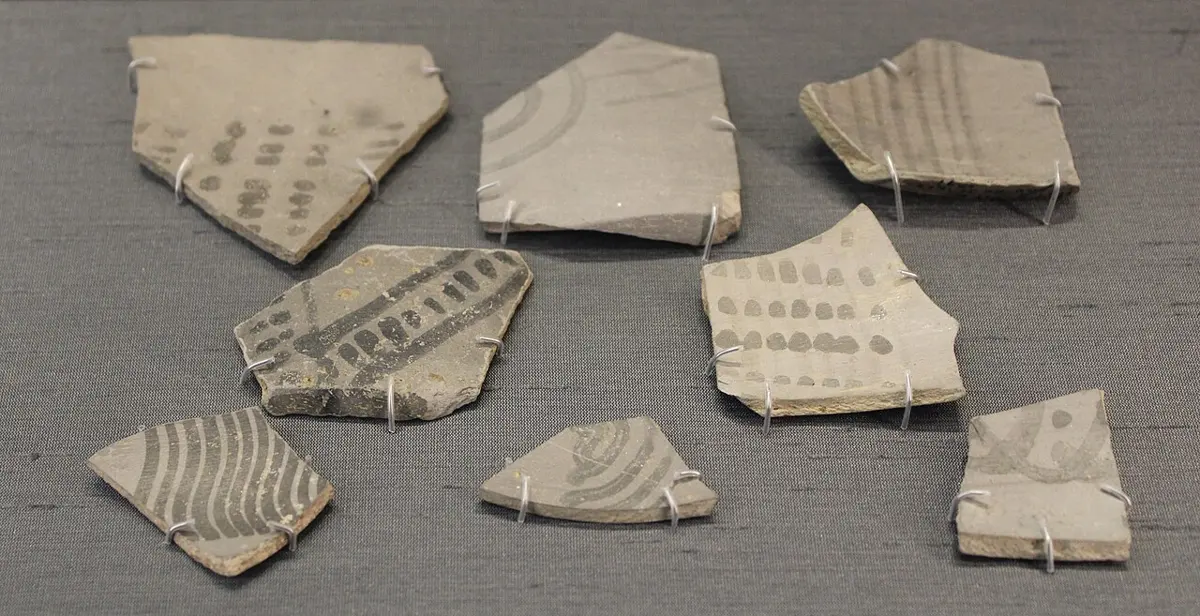
The later Vedas were made farther east. Their heartland was the land of the Kuru and Panchala peoples, between the Yamuna and the Ganga in today’s Haryana and western Uttar Pradesh, where the Yajurveda’s ritual words were gathered under the Kuru kings. In the same region and the same centuries, from about 1200 to 800 BCE, people made a fine gray pottery painted with black lines and dots, and some archaeologists take its villages to be the later Vedic people’s, though nobody can prove it. Iron came into use. The forests of the plain were cleared and the wetter land farmed, and rice, which the Rigveda doesn’t mention, became a main crop.
The rituals moved on, toward the east and the foot of the Himalaya. An old book of rituals tells it as a story: a king carried the sacred fire in his mouth, it leapt out and burned its way east until it reached a river flowing down from the north, and the king settled beyond it, in a land called Videha, which is Mithila. By late Vedic times Videha was a center of learning in its own right, and the Rigveda itself was given the form it is still recited in by a school of scholars there. The hymns that started out in the Punjab were fixed for good in Mithila, part of which is now in Nepal.
By about 500 BCE the plain was a different world. It had rice fields, kingdoms instead of clans, and soon cities again, for the first time since the Indus. The ritual priests were at the center of it, and not everyone was content with that.
So the Vedic age left two things. One is a body of hymns kept word for word by memory for some three thousand years, through a method so careful that the chanted Rigveda is more exact than any copy. The other is an idea of society as four ranks, which hardened over the centuries into thousands of birth groups, ranked high and low, and which many people have spent their lives fighting. Where the people of the hymns came from is still argued, and the DNA has sharpened the argument without ending it. What isn’t argued is that their language, their gods and their rituals spread across the whole north of South Asia, and that within a few centuries people on the plain where the hymns ended up were asking whether any of it was true.
Meanwhile, in Nepal: the land where the fire stopped was Mithila, and Nepal’s History, for the Curious tells its story, from Janaka’s court to Janakpur today. How caste was written into Nepal’s own law in 1854, and slowly written out again, is in The Law of 1854.
Found a mistake? Please tell us.