
For a long time, farmers in the north of China dug up old bones in their fields and sold them as medicine. People called them “dragon bones”, and following the old rules of Chinese medicine, the bones were ground into a powder that was meant to cure all sorts of illness. Some of them had scratches on them. Nobody paid the scratches much attention.
Then, in 1899, a scholar named Wang Yirong, a collector of old bronzes and the head of the Imperial Academy in Beijing, saw some of these bones and recognized the scratches as writing, very old Chinese writing. He bought pieces from a dealer who had got them from farmers. A later story says he found them in a packet of medicine bought for his malaria, and that is how it is usually told, but nobody can show that it happened that way. What is certain is that Wang didn’t live to study them. In 1900, in the violence of the Boxer Rebellion, he killed himself. Another collector, Liu E, who came to own about five thousand pieces, printed rubbings of some of them in a book in 1903, and the news spread. Soon collectors, Chinese and foreign, were paying high prices for the bones, and some sellers carved extra writing onto real ones to raise the price.
The bones came from fields around the village of Xiaotun, near the city of Anyang, in Henan province. In 1928 the newly founded Academia Sinica, China’s national academy of research, sent archaeologists to dig there. In fifteen seasons before 1937 they uncovered palace foundations, royal tombs and many more inscribed bones. In 1936 a single pit, known by its excavators’ label YH127, held 17,096 inscribed pieces. Anyang turned out to be the last capital of the Shang, a line of kings described in Chinese histories written about a thousand years later. Without the bones, nobody could be sure the Shang had existed at all. The bones name their kings and confirm much of what the old histories say about them.
Here is the whole story in a few lines. Along the Huang He, the Yellow River of northern China, and along other rivers in what is now China, farming villages grew over thousands of years into towns, and the towns into cities ruled by kings. The last Shang kings, who ruled from Anyang from about 1300 BCE, asked their ancestors and gods questions by cracking bones with heat, and had the questions and answers carved on the bones. That is the oldest Chinese writing we have, and the ancestor of the characters Chinese people write today. Around 1046 BCE a people called the Zhou, from the west, overthrew the Shang. To explain their victory they said that Heaven had taken away the Shang’s right to rule, its mandate, and given it to them because the last Shang king was wicked. That idea, the Mandate of Heaven, outlived the Zhou and shaped how China’s rulers explained their power for many centuries after. And the Shang never stood alone. Other peoples lived around them with powerful cultures of their own, and grain, horses and chariots came to them from far away.
The yellow river
The Huang He gets its name and its color from the soil it carries. In its middle course it cuts through the Loess Plateau, a huge region of fine, yellow, wind-blown dust that crumbles easily, and it carries so much of this silt that it has one of the largest loads of sediment of any river on Earth. When it reaches the flat North China Plain it slows down and drops the silt on its own bed. Over time the riverbed rises above the land around it, by as much as ten meters, and the river runs inside earth banks, called levees, that people have built higher and higher to keep it in. When a bank breaks, the river pours out over the plain, and sometimes it doesn’t go back. In the last two thousand years it has jumped into a completely new course at least seven times, and each time millions of people lost their homes.
It is a hard river to live beside. Yet farmers in the north of China had grown millet, a small, hardy grain, for thousands of years before any city stood there. Wheat came later, from West Asia. The oldest wheat found in China, from about 2600 BCE, turned up not in the far west but in the lower Yellow River valley, as if it had first arrived as a rare grain for important people, brought down from the grasslands to the north.
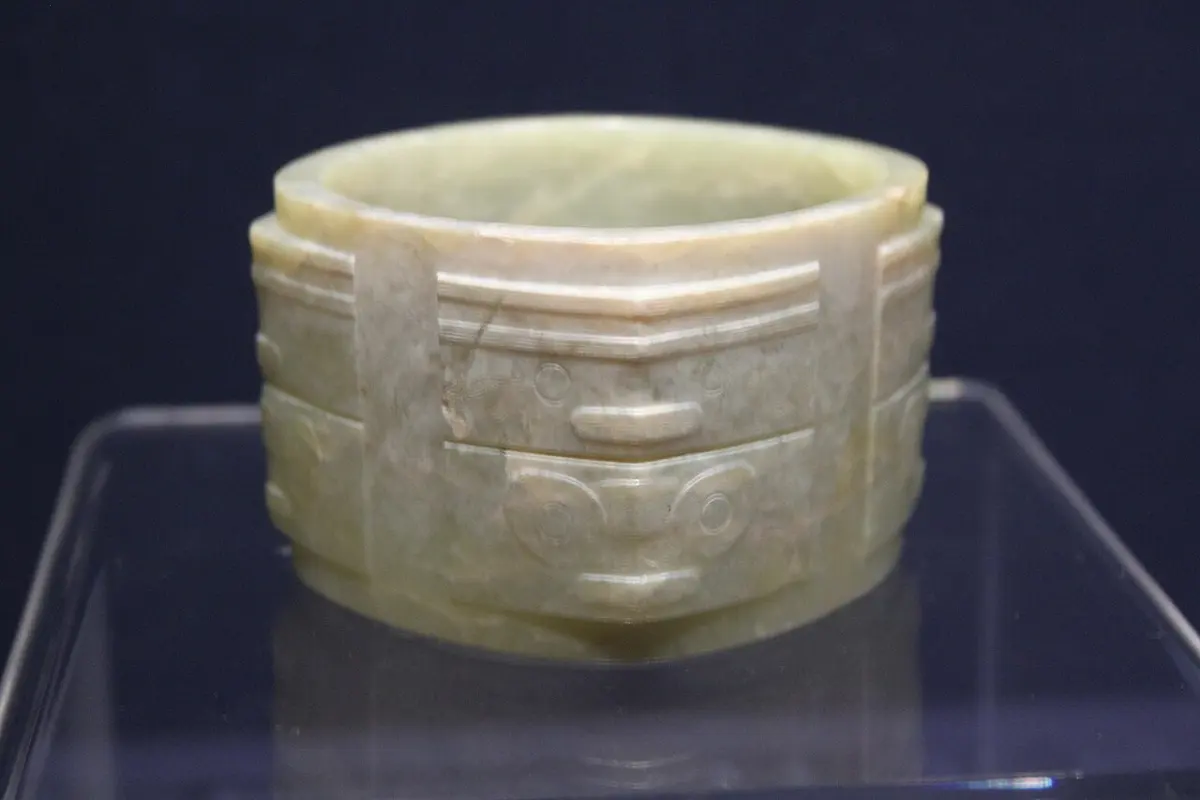
The Yellow River wasn’t the only place where something like a civilization grew. Far to the southeast, near the mouth of the Yangtze, the other great river of China, the people of Liangzhu built a city between about 3300 and 2300 BCE. They lived by growing rice. They built high dams in the valleys and low ones on the plain to control the water around their city, and they buried their important dead with carved jade, which suggests they shared one set of beliefs over a wide area. UNESCO, which made Liangzhu a World Heritage site in 2019, calls it an early regional state. It shows that the roots of Chinese civilization lie in more than one river valley.
Xia: a dynasty in the old books
Chinese histories, the oldest of them written down by the Zhou, say that before the Shang there was another line of kings, the Xia. Whether the Xia were real is one of the biggest arguments in Chinese archaeology.
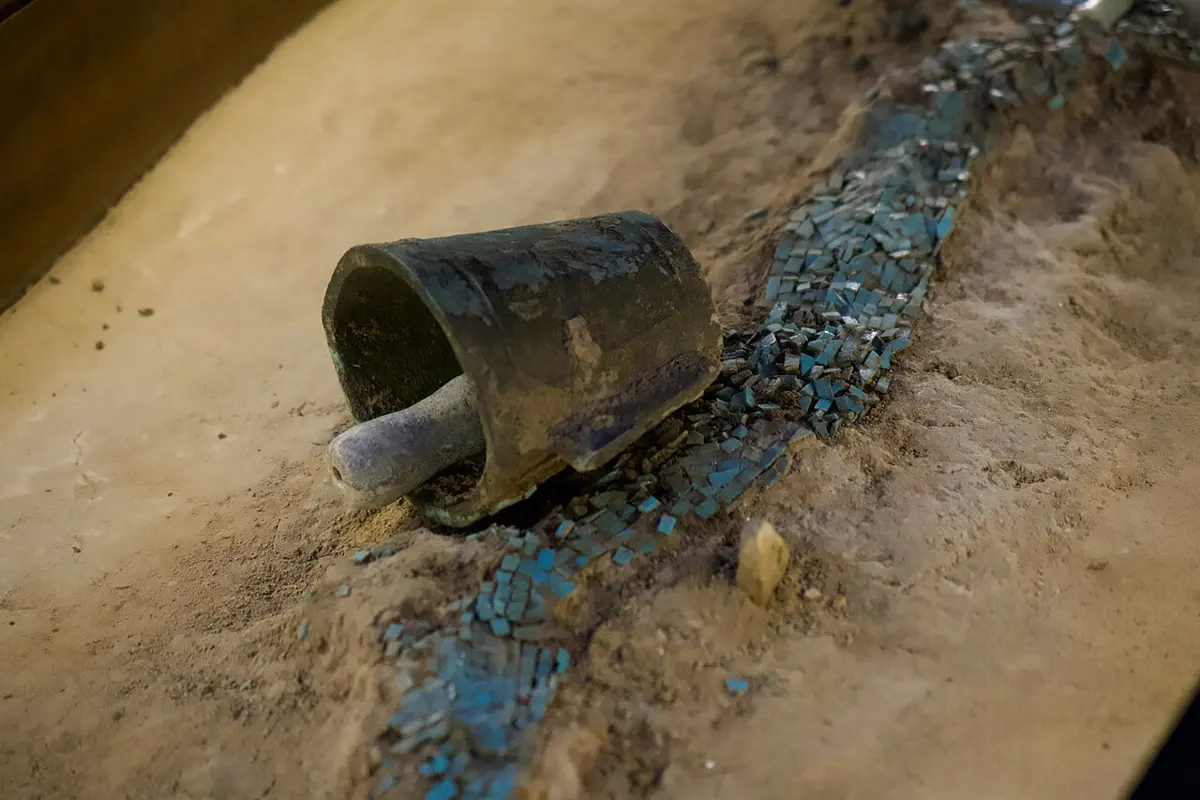
The place at the center of it is Erlitou, beside the Luo River, a tributary of the Yellow River, in Henan. Between about 1900 and 1500 BCE it was the biggest town of its time in northern China, at its largest some 300 hectares. Its builders laid out a palace area of about 12 hectares, ringed by four roads about 20 meters wide, and they had a foundry for casting bronze. Archaeologists found wheel tracks there, the earliest in China, a meter apart. And in a grave inside the palace area, a man aged about 30 to 35 had been buried with a long dragon shape, made of some two thousand pieces of turquoise and jade, laid along his body.
In 2000 a large project paid for by the Chinese government, the Xia–Shang–Zhou Chronology Project, published dates for the first three dynasties: the Xia from about 2070 to 1600 BCE, and the Shang from about 1600 to 1046. Most Chinese archaeologists think that Erlitou was a capital of the Xia, and argue over where in its history the Shang took over. Other scholars, in China and outside it, are doubtful, and some think the Zhou may have made up the Xia, or at least shaped their story, to support their own claim to rule. The difficulty is that nothing written has been found at Erlitou, so nothing there says who its rulers were or what they called themselves. Two archaeologists who know the site well, one of them from China’s own Institute of Archaeology, wrote in 2007 that the evidence so far can neither prove nor disprove the old accounts of the Xia. Until writing turns up, Erlitou is a great town without a name.
Asking the bones
With the Shang at Anyang, the questions at last come with answers, because the bones can be read.
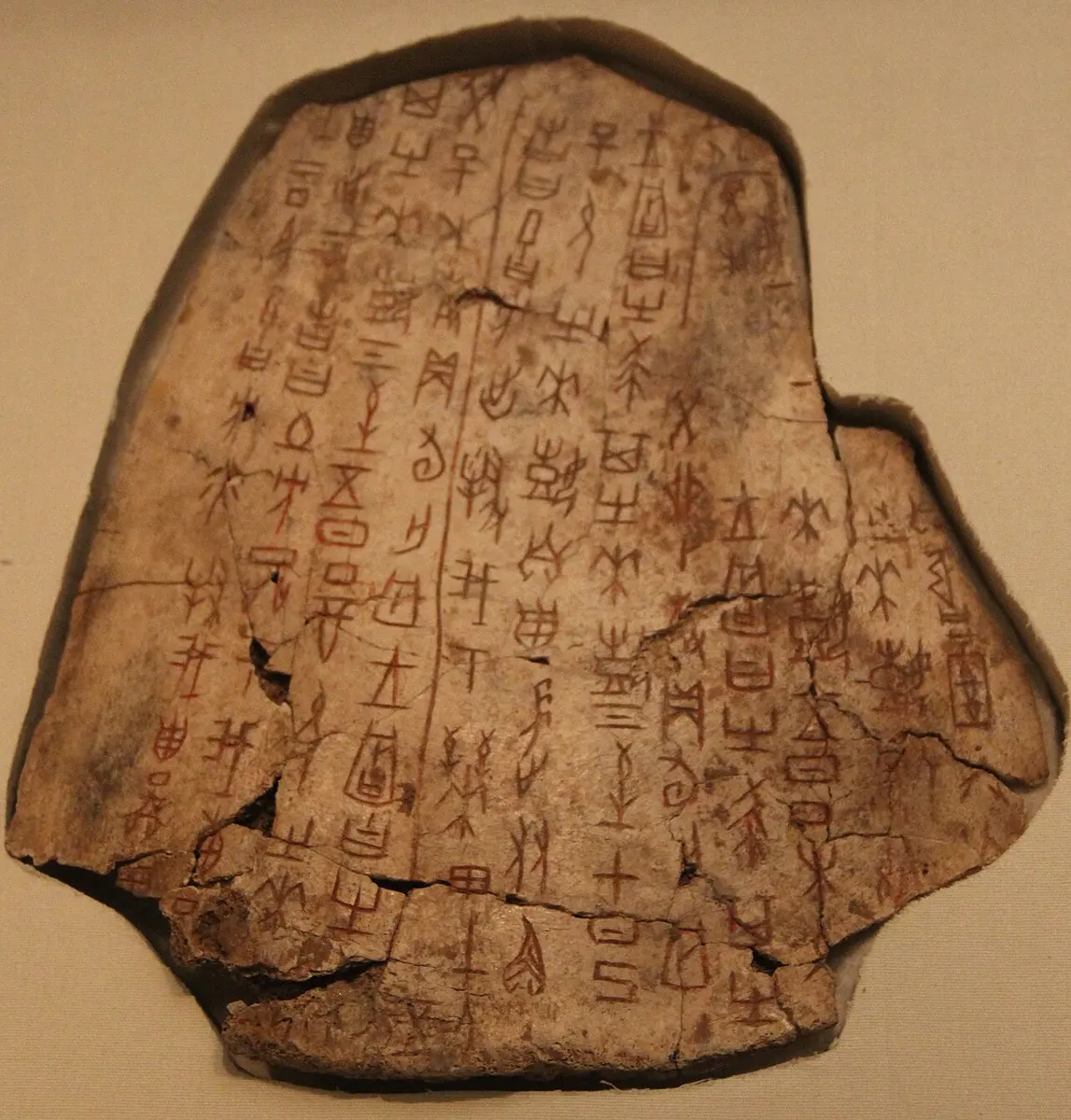
The method went like this. Diviners, the specialists who did the work, took the flat shell from the underside of a turtle, or the shoulder blade of an ox, and cleaned and smoothed it. On the back they carved rows of small hollows, which thinned the bone in exactly the right places. Then they put heat to a hollow, and the bone cracked on the other side, in a shape like the letter “T” lying on its side, with a long line and a short branch. The Chinese character for “to divine”, 卜, is a picture of that crack. The crack was the answer. The king himself, as a rule, gave the reading, and afterward scribes carved on the bone what had been asked, what the king had said, and sometimes what actually happened. Making the cracks so neatly is harder than it sounds. One modern scholar of the bones never managed to crack an ox’s shoulder blade at all. Another tried a fresh cow’s, first with charcoal and then with a red-hot soldering iron, and nothing happened except some scorching.
The Shang kings divined about everything: sacrifices to ancestors and gods, harvests, wind and rain, journeys, hunts, wars, illness and childbirth, and every ten days, as a routine, about whether there would be trouble in the ten days ahead. Illness, for instance, was thought to be sent by an unhappy ancestor, so the king divined again and again to find out which one, and then to find out what sacrifice would make things right.
Here is one record, from the reign of the king Wu Ding, as a modern scholar translates it. On a day called jiashen in the Shang calendar, a diviner named Que asked whether the birth of Lady Hao’s child would be good. The king read the cracks and said that if she gave birth on a ding day it would be good, and on a geng day very good. The record ends: “On the thirty-first day thereafter, on jiayin, she gave birth. It was not auspicious; it was a girl.” Whether it was called bad luck because the baby was a girl, or because of the day, or because the birth was hard, scholars argue. But the scribes wrote down an outcome the king hadn’t hoped for.
Sometimes they even wrote down that he was slightly wrong. On another bone the king said it would rain on a bing day. The scribes noted that it rained four times in the days that followed, none of them on a bing day.
The writing on the bones is already mature, not a first try. Several thousand different characters have been found, and many of them still can’t be read. They are the direct ancestors of modern Chinese characters, and reading them has changed what scholars thought they knew. The character for king, 王, was long explained as three lines for heaven, earth and humankind, joined by the king’s line through the middle. On the oracle bones it looks more like an axe thrust into the ground.
Lady Hao and the world around the Shang
Anyang was a capital for more than two centuries. Its palace area holds the foundations of more than eighty buildings of rammed earth, made by pounding layer after layer of soil hard between wooden boards. Nearby lie the royal tombs, huge pits with pits of chariots and the bodies of people killed as sacrifices around them. Nearly every royal tomb there was robbed long ago. One was not.
In 1976 a team led by the archaeologist Zheng Zhenxiang was testing the ground with long, narrow probing shovels when they found the tomb of Lady Hao, Fu Hao in Chinese, the same woman whose childbirth Wu Ding asked about. It was not large, a pit about 5.6 by 4 meters, but it was untouched. In it were 468 objects of bronze, among them over 200 vessels for ceremonies and 130 weapons, 755 objects of jade, 564 of bone, mostly hairpins, and about 6,900 cowrie shells. With her were buried six dogs and sixteen people.
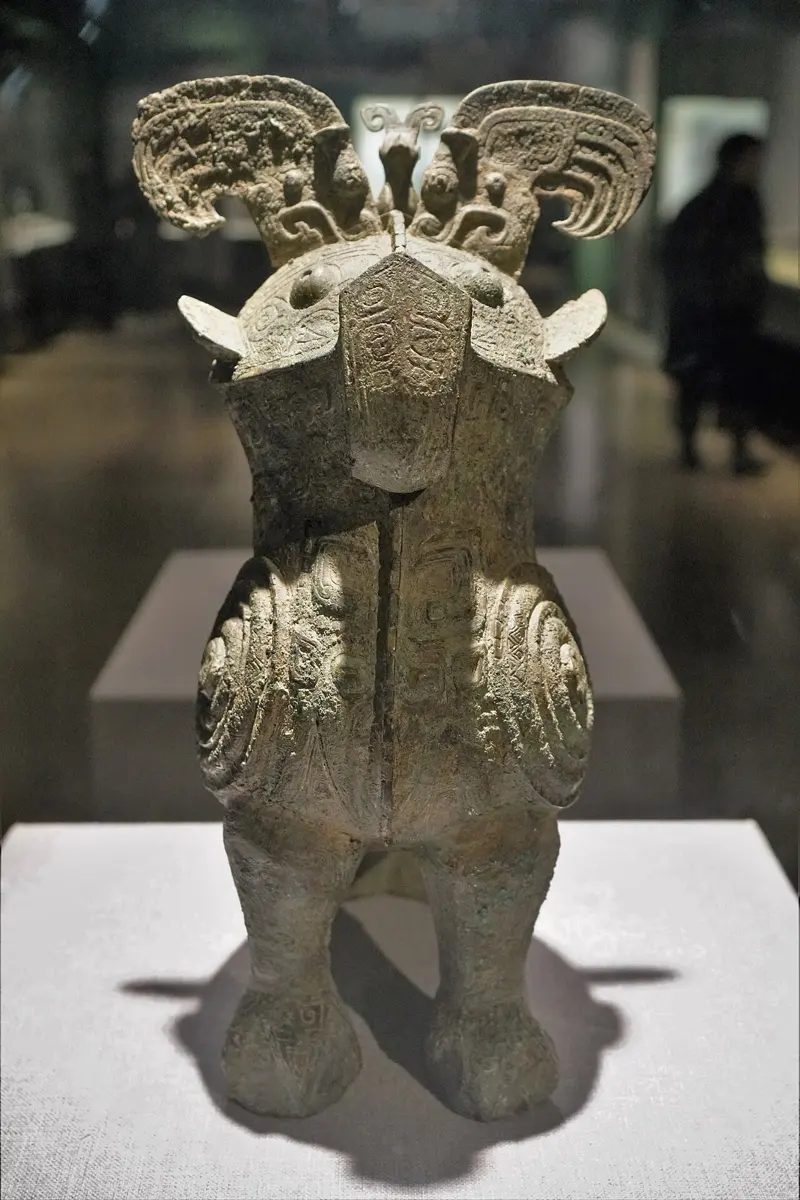
The bones say more about her than any tomb could. She was one of Wu Ding’s wives, but she also led armies on campaigns, carried out important sacrifices herself and controlled an estate of her own. Bronzes in her tomb carry her name, and the weapons in it fit what the bones say.
The cowries in her tomb are a clue to something else: the Shang were not shut off from the world. Cowries are the shells of sea snails, and Anyang lies far inland; where they came from is argued, but it was a long way off. Wheat had come from West Asia. And by about 1200 BCE, the Shang kings were riding in chariots pulled by horses, and were buried with them. Horses and chariots, and the skill to breed, train and repair them, came from the grasslands of the north and north-west, where herders had driven chariots before them. The horses kept on coming from the north, because the farmland of the Yellow River plain was poor country for breeding good ones.
Nor were the Shang the only powerful people around. In 1986, two pits were found at Sanxingdui, near Chengdu in Sichuan, about 1,100 kilometers southwest of Anyang. They were packed with nearly a thousand objects that had been deliberately buried: gold, jade and bronzes unlike anything at Anyang. There was a bronze man in a long robe, about two and a half meters tall with his base, and over the years more than a hundred bronze heads have been found there, with masks with huge ears and bulging eyes. Some of the figures were cast in separate parts and then joined together. No writing has been found there at all, so these people are known only from what they made.
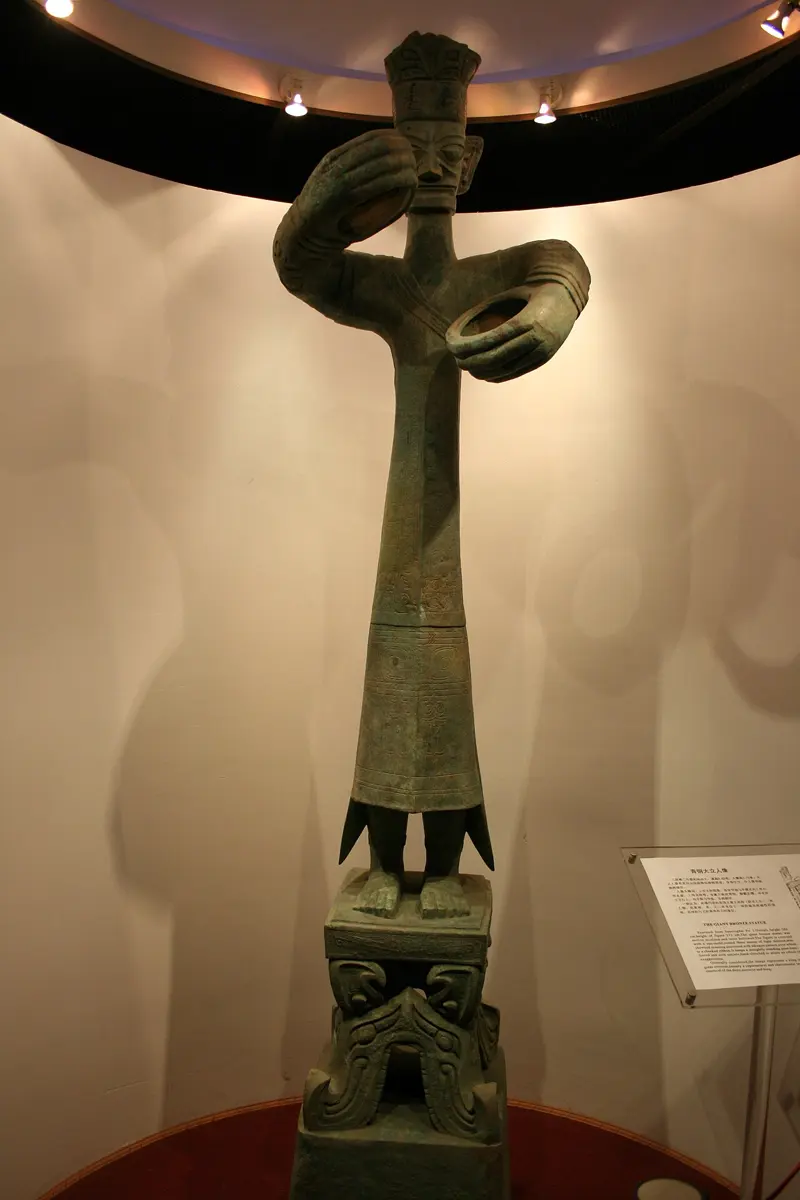
From 2020, archaeologists opened six more pits beside the first two, working inside cabins kept at a steady temperature and dampness, and by 2024 had taken out more than 17,000 objects, among them a gold mask and a kneeling bronze figure carrying a vessel on its head. Radiocarbon dating puts the filling of most of the pits between about 1200 and 1000 BCE, the same time as the last phase of the Shang at Anyang. Pieces in them show links both with the Shang and with peoples along the Yangtze, yet for a long time Sichuan was left out of the story of how Chinese civilization began. Ancient China, it turns out, was many centers in contact with one another, not one.
The Mandate of Heaven
West of the Shang lived the Zhou, a people who had moved south from the high, dry Loess Plateau. Around 1046 BCE, under their king Wu, they defeated the Shang in battle and took over their lands.
The Zhou needed to explain why the gods had let this happen, both to themselves and to the Shang people they now ruled. Their answer is preserved in the Book of Documents, a collection of speeches and records, some of which go back to the early Zhou. In one of them, called “The Many Officers”, the Duke of Zhou, the brother of King Wu, is said to be speaking in the king’s name to the leading men of the defeated Shang at Luo, a city newly built to keep them under control after they had rebelled.
His argument, in short, goes like this. Long ago Heaven gave the right to rule to the kings of Xia. The last Xia king gave himself up to idleness and pleasure, so Heaven took the mandate away from him and commanded Tang, the first Shang king, to overthrow him. For generations after that, the Shang kings ruled well and looked after the sacrifices, and Heaven protected them. But the last Shang king forgot Heaven and did not look upon the misery of his people. So Heaven, which does not support those who neglect virtue, turned to the Zhou. “It was not that our small domain dared to take aim at the mandate of Yin,” he says, Yin being another name for the Shang. Heaven had done it. The officers of Shang would have to stay in Luo and serve the Zhou, but they would suffer no further punishment, and in time their houses might flourish again.
It was a clever speech. It turned a conquest into Heaven’s justice, and it told the defeated that they had brought it on themselves. Something like the idea may already have been in the air. The Shang called their high god Di, and one Shang bone asks whether enemies were attacking “because the Deity commands them to make disasters for us”.
The idea had a sharp edge, too. If Heaven gives the right to rule to a good ruler and takes it away from a bad one, then anyone who overthrows a king can say that Heaven was on his side. It also put a duty on rulers. Long after anyone feared that Heaven would strike down a bad emperor, China’s rulers and their advisers still argued over what each new law would mean for the poorest of their people. The Chinese word for “revolution” today, geming, first meant “overturning the mandate”. China’s later history, from the Qin and Han empires on, carries the story forward.
The Huang He’s civilization grew from farming villages on a silty, flooding river, as Mesopotamia’s and the Indus’s did, but it never stood alone. It shared China with other peoples, the jade-carvers of Liangzhu, the builders of Erlitou and the bronze-casters of Sanxingdui, and it took in wheat, horses and chariots from far away. What made the Shang different is that they wrote, and their writing was never lost. The questions their kings carved on bones three thousand years ago can still be read, in characters whose descendants Chinese children learn today. And the Zhou, who overthrew them, left behind an idea that shaped how China’s rulers explained themselves for many centuries: that the right to rule comes from Heaven, and that a ruler who rules badly can lose it. Far to the southwest, beyond the Himalaya, another people were carrying their most important words a different way, not on bone but in memory.
Found a mistake? Please tell us.