
An old Sanskrit book of rituals, the शतपथ ब्राह्मण (Śatapatha Brāhmaṇa), tells a strange story about fire. A king called विदेघ माथव (Videgha Māthava) once carried the sacred fire, Agni, in his mouth. When his priest called out the word for butter, the fire leapt out and fell to the earth. Then it went off eastward, burning its way across the land and drying up the rivers, with the king and his priest following behind. At last it reached a river that came down from the northern mountains, the सदानीरा (Sadānīrā), “the river always full of water”. That river the fire did not burn over.
Beyond it, the story goes on, the land had been wild and marshy, and Brahmins, the priests who kept the fire rituals, did not cross into it. By the time the book was written it was well farmed. The king asked the fire where he should live, and the fire said: east of this river. The river, the book adds, was still the border between two peoples, the Kosalas to the west and the Videhas to the east.
Nobody reads this as a report of a walking fire. It reads as a memory, folded into a story, of the way of life of the Vedas, the oldest sacred hymns of the Hindus, spreading east along the plains below the Himalaya. The सदानीरा is most likely the Gandaki, which you know as the Narayani where it leaves Nepal. The land east of it, where the fire told the king to settle, was called Videha. Today it is called Mithila.
The land between the rivers
Mithila is the flat, wet, rich plain between the Gandaki in the west and the Kosi in the east, with the hills of Nepal to the north and the great river Ganga to the south. Its northern strip lies in today’s Nepal, in the districts of Madhesh Province from Saptari to Parsa. The larger part lies in Bihar, in India. The border between the two countries runs straight across it, and the border is far younger than Mithila: for nearly all of Mithila’s history it wasn’t there.
When was ancient Videha? Nobody can say closely. The books that mention it were learned by heart for centuries before anyone wrote them down, so their dates are guesses within a few centuries. Most scholars put the oldest of them somewhere around 800 to 500 BCE, nearly three thousand years ago. In those centuries the people of the plain were farmers. Rice was their main food, and they lived in villages; towns came later.
Almost everything we know about ancient Videha comes from books and from living tradition. No ancient capital has yet been dug out of the ground and shown to be the city of the Janakas. What the old books describe, what the epic tells, and what people still do in Mithila today are three different kinds of knowing, and they are worth keeping apart.
Arguments at a king’s court
In the old books one king of Videha stands above the rest: Janaka of Videha. He was famous not for wars but for arguments.
The बृहदारण्यक उपनिषद् (Bṛhadāraṇyaka Upaniṣad), one of the oldest of the Upanishads, the books in which Hindu thinkers asked what lies behind the world and the self, tells how Janaka once held a great sacrifice. Brahmins came from the old lands far to the west, of the Kurus and Panchalas. Janaka had a thousand cows penned up, with gold tied to the horns of each, and announced that the wisest Brahmin present could drive them home. Nobody dared to claim them. Then a teacher named याज्ञवल्क्य (Yājñavalkya) told his student to take them away.
The other Brahmins were furious, and one after another they questioned him to prove he wasn’t the wisest. One of them was a woman, गार्गी (Gārgī). She asked what the world is woven on, as cloth is woven on threads, and when he answered she asked what that was woven on, and then what that was woven on, until याज्ञवल्क्य told her to stop asking too much or her head would fall off. She fell silent. But she came back. This time, the Upanishad says, she rose like a warrior from Kashi or Videha stringing his bow, with two questions as her arrows. He answered both, and गार्गी told the gathering that none of them would beat him.
Another woman in the same book, मैत्रेयी (Maitreyī), was one of the two wives of याज्ञवल्क्य. When he was about to leave home and divide his wealth, she asked him whether the whole earth full of riches would make her live forever. No, he said. Then what would she do with it, she asked, and she asked him instead to teach her what he knew.
There are a few surprises in these scenes. One is that the book doesn’t stop to explain why women are taking part in a debate among scholars; it simply has them do it. Another is where the debate happens. To the Brahmins of the west, Videha seems to have been a rough frontier, the far end of their world. Yet in this book the best of them come east, to Janaka’s court, and lose. Whether the debates happened exactly as told, nobody can say; these are teachings set as scenes. But they show that by the time the book was composed, Videha had become a center of learning that the rest of the Vedic world had to reckon with.
Sita, and what the ground says
The Janaka most Nepali students know is a different figure, from a different kind of book. In the रामायण (Rāmāyaṇa), the epic of Ram, King Janaka of Mithila is plowing a field when he finds a baby girl in the furrow. He names her Sita, and raises her as his daughter. When she is grown, he keeps a mighty bow of the god Shiva that no man can even lift, and promises Sita to whoever can string it. Prince Ram of Ayodhya lifts it, strings it, and breaks it. So Ram and Sita are married in Mithila.
That is the story, and for millions of people it is sacred. It also has a history of its own. The part of the Ramayana that tells of the bow and the marriage, its first book, is thought to have been added to the epic after its core was composed. The name Janaka is the same, but the older Vedic books, which know Janaka of Videha well, never connect him with Ram or with Sita. Sita’s very name means the furrow made by a plow, which fits a farming land’s story of a girl born from the field.
The later sacred books, the Puranas and the epics, give Mithila a longer story still, and it is the one most Nepali students learn at school. The old books say the first king was Nimi, and that his son Mithi gave the land its name. Mithila’s tradition counts fifty-six kings of the Janaka line, of whom Sita’s father is the best known, and a kingdom of sixty thousand villages. This is Mithila’s own account of itself, and it is worth knowing. No inscription, coin or dug-up city has yet been found to confirm it, so this book tells it as what it is: the tradition.
What does the ground say? Less than one might hope, so far. Nobody knows for certain where the ancient city of Mithila stood. Janakpur in Nepal, Sitamarhi just across the border, which tradition names as the place Sita was found, and a big ruined fort called Balirajgarh in Bihar have all been suggested. At Balirajgarh archaeologists have dug several times since the 1960s and found the brick walls of a fortified town more than two thousand years old, and a new dig has begun there. Some think it could be the old capital; so far nothing found there proves it. In Nepal, a few years ago, the Department of Archaeology dug beside the Jamuni River in Dhanusha district and found brick walls, floors, iron slag and fine black pottery of the same age, from about the third century BCE into the first centuries CE. More recently its team found stone inscriptions more than a thousand years old at a temple in Dhanusha. Each find shows that this plain held towns and temples long ago. None of them has yet been shown to be the Mithila of the Janakas.
How Videha’s kings came to an end is told differently too. Buddhist books tell of Ajatashatru, king of Magadha, planning war on the Vajjis, a league of clans around Vaishali, and later accounts count the Videhas in that league. The account most Nepali students learn says Magadha attacked while a Janaka still ruled Mithila. Either way, Magadha’s kings came to rule the plain, and Mithila’s next great kingdom, at Simraungadh, lay many centuries ahead.
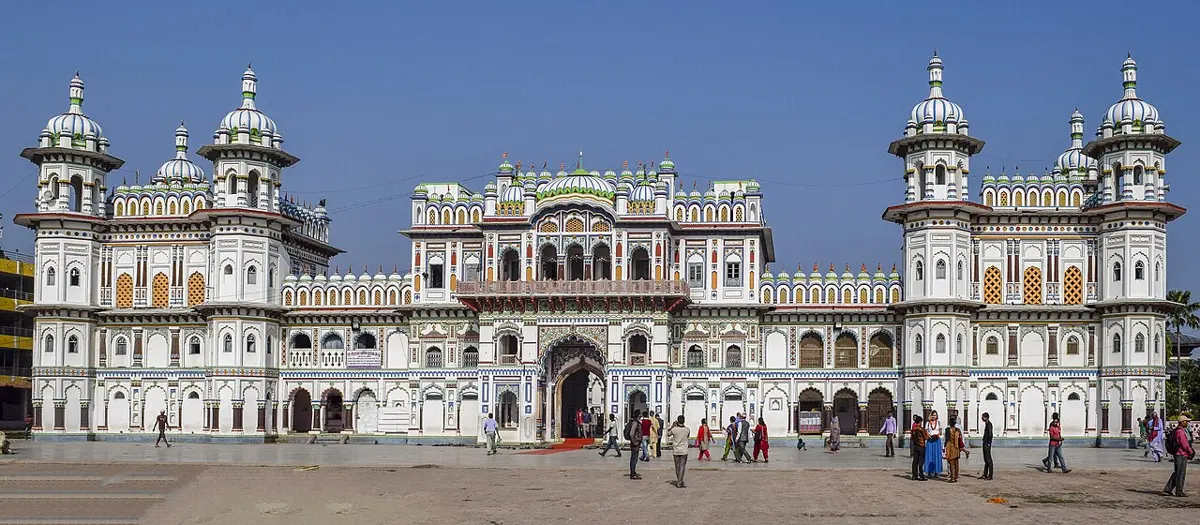
Janakpur, lost and found
Here is the surprise in Janakpur’s own story. Pilgrims come to it today as the city of Janaka and Sita, but for a long time nobody knew where that city was. Local tradition itself says that ancient Janakpur was destroyed and the forest covered it.
As far as the surviving records show, the town as we know it was found again, or founded, about three hundred years ago. Wandering Hindu holy men, followers of Ram, had been searching northern India for the places named in his story. Some of them came into the forest of the eastern Tarai. The stories they left behind tell of a holy man who dreamt under a banyan tree and dug up images of the gods, and of hermitages set up where the city was believed to have been. The land records are firmer. The original grants are lost, but confirmations written about a century later show that the kings of Makwanpur, a hill kingdom that ruled this part of the Tarai, had given land to these holy men and to the goddess Janaki, one grant dated 1727. The holy men must have arrived around the turn of the eighteenth century.
Even then, the forest wasn’t empty. Mounds of old brick in the area show that farmers and small chiefdoms had been living there for centuries. One mound, at Banauli, is linked by tradition to विद्यापति (Vidyāpati), Maithili’s best-loved poet, who lived about six hundred years ago: he is said to have taken refuge there with Queen Lakhima after her husband, the king he served, was lost in battle. The hill kings’ gifts seem not to have been only piety. A king gave land to a god to win the god’s help in taking or keeping land, and this plain was rich and fought over; the big gifts stopped once Nepal’s borders were fixed, early in the nineteenth century.
The earliest description of a pilgrimage to Janakpur, written about a century after the holy men came, warns pilgrims going on to Dhanusha, about twenty kilometers to the north-east, of elephants, tigers, rhinoceros and wild buffalo, and a journey through jungle too thick for words. At Dhanusha pilgrims still worship a long narrow seam of rock as a piece of Shiva’s broken bow. At that time Janakpur itself was less a town than a pilgrimage ground, with a customs shed for goods on their way to the plains and a market held in an open field. The great white Janaki temple came much later. One student of these stories put it well: they tell us not what happened in the past, but what people meant by it.
Mithila now
None of this makes Mithila any less real. It is a living culture, and a large one.
Its language, Maithili, is the mother tongue of more than three million people in Nepal, about one in nine, more than any other language except Nepali, and of many more across the border. Its festivals fill the year: Chhath, the dances of Jhijhiya, and in the month of Mangsir, Vivah Panchami, when crowds come to Janakpur to celebrate the wedding of Ram and Sita.
And it paints. For centuries the women of Mithila have painted the mud walls of their houses, for festivals and above all for weddings, with gods, fish, birds, elephants and dense borders, often in colors made at home. For a long time this was hardly known outside the villages. In Bihar the outside world noticed it after a great earthquake brought down house walls and a British official saw the paintings inside. Much later, during a drought, women there began to paint on paper to sell. In Janakpur, a women’s art center begun in the late twentieth century helped village women move their wall designs onto Nepali lokta paper. What was painted on a wall for a family is now sold on paper.
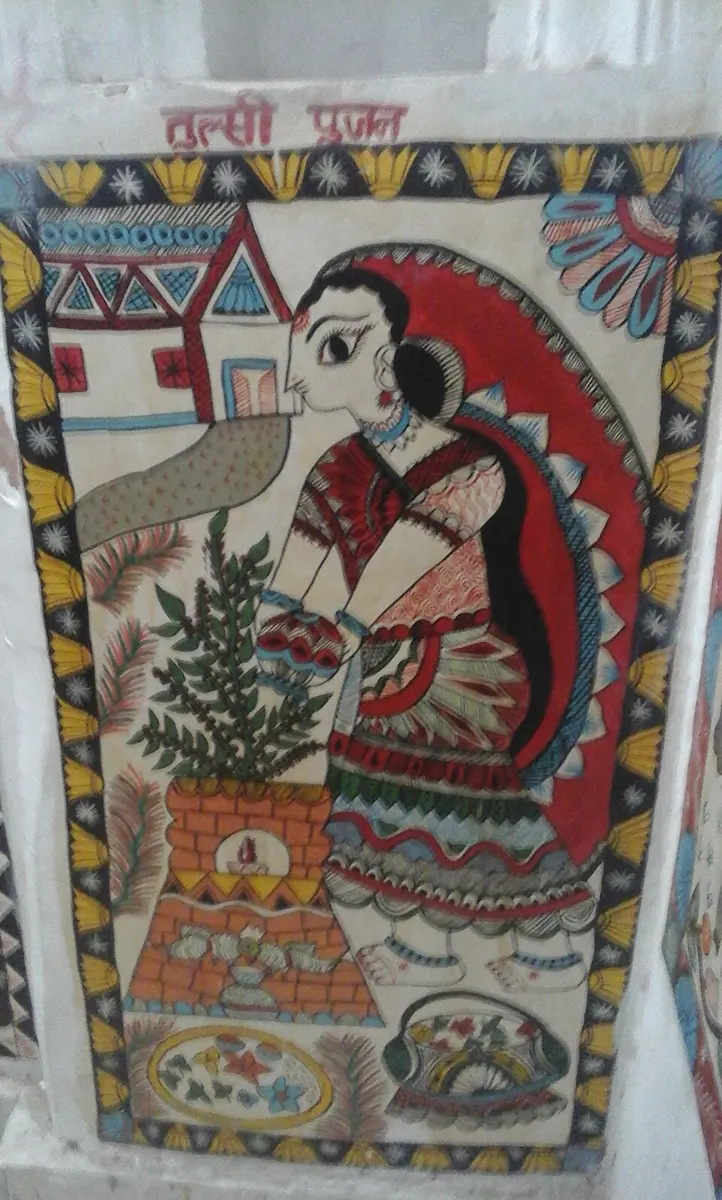
So Mithila is three things at once. It is the Videha of the oldest books, a land of farmers and teachers that the Vedic world came to respect. It is the Mithila of the Ramayana, sacred to millions as the home of Sita. And it is the Mithila of today, with its own language, songs, festivals and paintings, across a border that cuts it in two. The first is known from texts, the second is a story told with love, and the third you can visit. What the ground has not yet given us is the city of Janaka itself. But one thing is plain: the plains of the Tarai were never the edge of Nepal’s history. Long before the hill kingdoms, they were one of its oldest centers.
Found a mistake? Please tell us.