
This chapter is about the Atlantic slave trade. It tells plainly what people suffered, mostly in the words of those who lived through it, and shows no pictures of cruelty.
The boy had been taken from home at the age of eleven, he wrote, and sold and sold again, carried by land and by river through country after country. Six or seven months after he was kidnapped, he came to the sea. He had never seen it before. The first thing he saw at the coast, he remembered, was the sea, and a slave ship lying at anchor, “waiting for its cargo”.
He was carried on board, and the crew handled him and tossed him up to see if he was healthy. Their complexions, so unlike his own, their long hair and their language made him sure he had come into “a world of bad spirits”. He saw a great copper pot boiling, and many Africans chained together, and he fainted on the deck. When he came round he asked the Black men who had brought him aboard whether the white men were going to eat him. They told him no, and then they went back to the shore. Their pay, he thought, had already been handed over.
The boy grew up to be Olaudah Equiano, also known as Gustavus Vassa, and in 1789 he published the story of his life in London. It went through nine editions while he lived. It may not be the whole truth about his beginning. Two old records, the register of his baptism in London as a boy and a ship’s list from years later, give his birthplace as Carolina, in North America. If they are right, he learned the voyage from others. Historians are still divided, and nobody can settle it now. But other Africans who crossed the ocean told of it in their own words too, and they tell the same story.
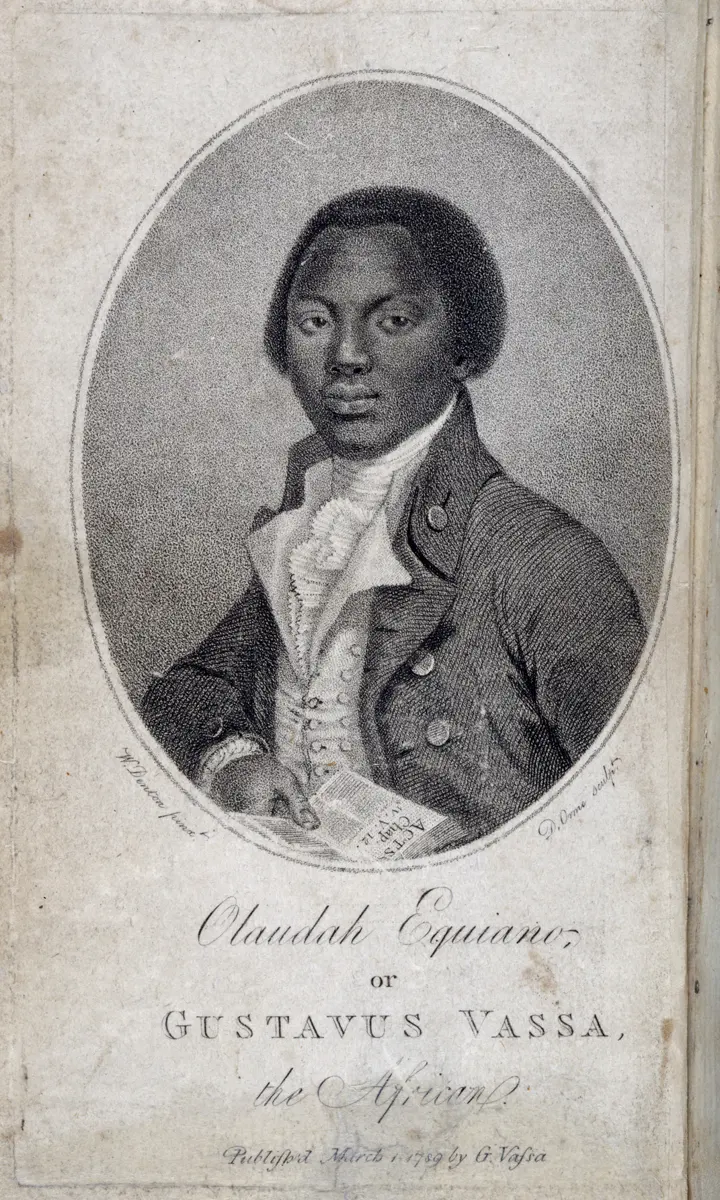
Here is the whole story in a few lines. Between about 1500 and 1866, ships from Europe, and later from Brazil and the United States, carried about 12.5 million Africans across the Atlantic to be slaves. About 10.7 million lived to land. Nearly all of them went to the Caribbean and South America, and most were set to growing sugar. African rulers and merchants sold the captives at the coast, mostly people taken in wars and raids. The trade was ended in the 1800s by a long campaign, by the enslaved people who fought it, and, some historians argue, by money.
Sugar
Sugarcane is a hungry crop for workers. It was planted and cut by hand, and the cut cane was crushed and its juice boiled down on the estate itself, so a sugar estate was a farm and a factory at once. It needed many workers at the same time, and the planters wanted workers they did not have to pay.
The plantation was an old idea by the time it crossed the ocean. Growing sugar with enslaved workers had moved slowly west, from the Mediterranean to islands in the Gulf of Guinea, off Africa, then to Brazil and at last to the Caribbean. Chapter 20 tells why the Americas’ own people weren’t there to do the work: by then most of them had died. So the planters bought Africans. About eight in every ten captives carried across the Atlantic went to places that grew sugar, and about ninety-five in every hundred to the Caribbean and South America. Fewer than four in a hundred went to North America.
That last number hides something. Fewer than half a million Africans were landed in North America, but by 1860 the United States had nearly four million enslaved people, and numbers like that can only have grown by children being born. On the sugar islands it went the other way. In Jamaica more of the enslaved died than were born, so the planters kept buying people just to keep the numbers up. The ships kept sailing, in part, because so many of the people they carried died on the islands.
And who ate the sugar? Chapter 1 followed the spoonful in a glass of tea. In Europe sugar had been a costly medicine and a treat for the rich. The anthropologist Sidney Mintz traced how in Britain it turned, surprisingly fast, from a luxury into an everyday necessity. Workers in English towns stirred it into their tea and spread it as jam on their children’s bread. Sweetness for millions in Europe was paid for by millions in the Caribbean and Brazil.
The crossing
The voyage from Africa to the Americas came to be called the Middle Passage, the middle side of a triangle: ships sailed from Europe with cloth, guns and metal, swapped them in Africa for captives, carried the captives west, and came home with sugar.
Mahommah Gardo Baquaqua crossed it in the 1840s. He was a young Muslim man from Djougou, in what is now the north of Benin, who had served in the household of a king. People he knew, he said, made him drunk at a feast, and in the morning he woke a prisoner, sold. A trader fastened a forked stick round his neck and marched him toward the coast, and he was sold from one owner to the next on the way, through the kingdom of Dahomey and its capital. At the shore he was branded with a hot iron, “the same as they would the heads of barrels”. A boat taking captives out to the ship turned over in the surf, and about thirty people drowned.
He was put naked into a hold so low that nobody could stand, men on one side and women on the other, where day and night were the same. The food was boiled corn. The water was a pint a day, about half a liter. A great many died on the way. One man, wild with thirst, tried to grab a knife from the sailor who brought the water, and was taken up on deck. “I never knew what became of him,” Baquaqua said. They were let up to wash only twice, once at sea and once before landing at Pernambuco, in Brazil. Two years later he escaped from a ship in New York, and in 1854 he told his story to an editor, Samuel Moore, who wrote it down. Of the hold he said that its “loathsomeness and filth” would never leave his memory.
Equiano’s account agrees with his. Below deck the heat and the closeness were so great that people could hardly breathe, many fell sick and died, and the chains chafed. He was flogged for refusing to eat. One calm day two men chained together got through the netting round the ship and jumped into the sea, and a third followed; the crew pulled one of them back and flogged him “for thus attempting to prefer death to slavery”.
The people in the holds did not simply wait. Ottobah Cugoano, a Fante boy from the coast of what is now Ghana, was kidnapped as a boy with other children who had gone into the woods to gather fruit. On the ship that was to sail from Cape Coast the captives made a plan to set it on fire and die together rather than be carried away. Someone gave the plan away, and it was put down, he wrote, in “a cruel bloody scene”.
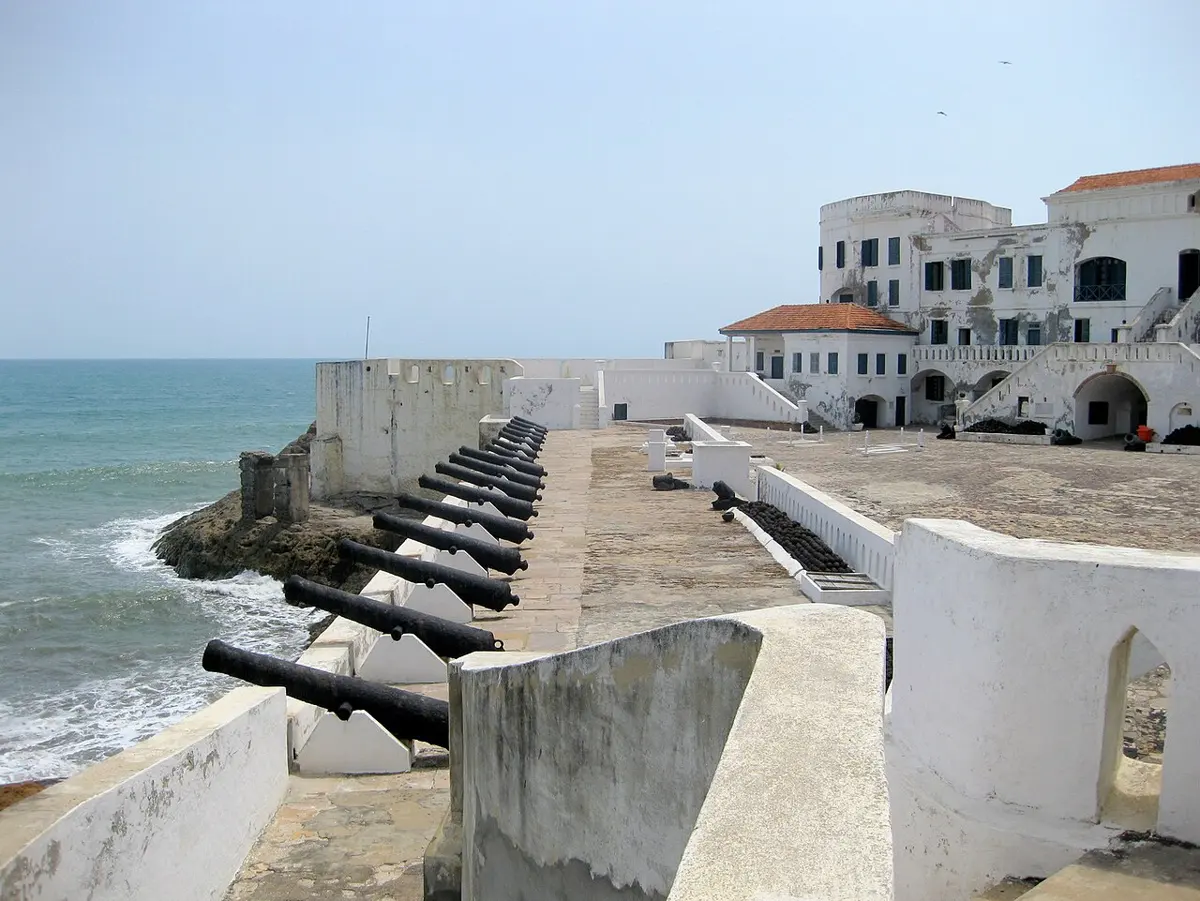
How many died on the ships? Of the 12.5 million who were put on board, about 1.8 million did not live to land, roughly one in every seven. How many died on the way to the coast, or soon after landing, nobody counted.
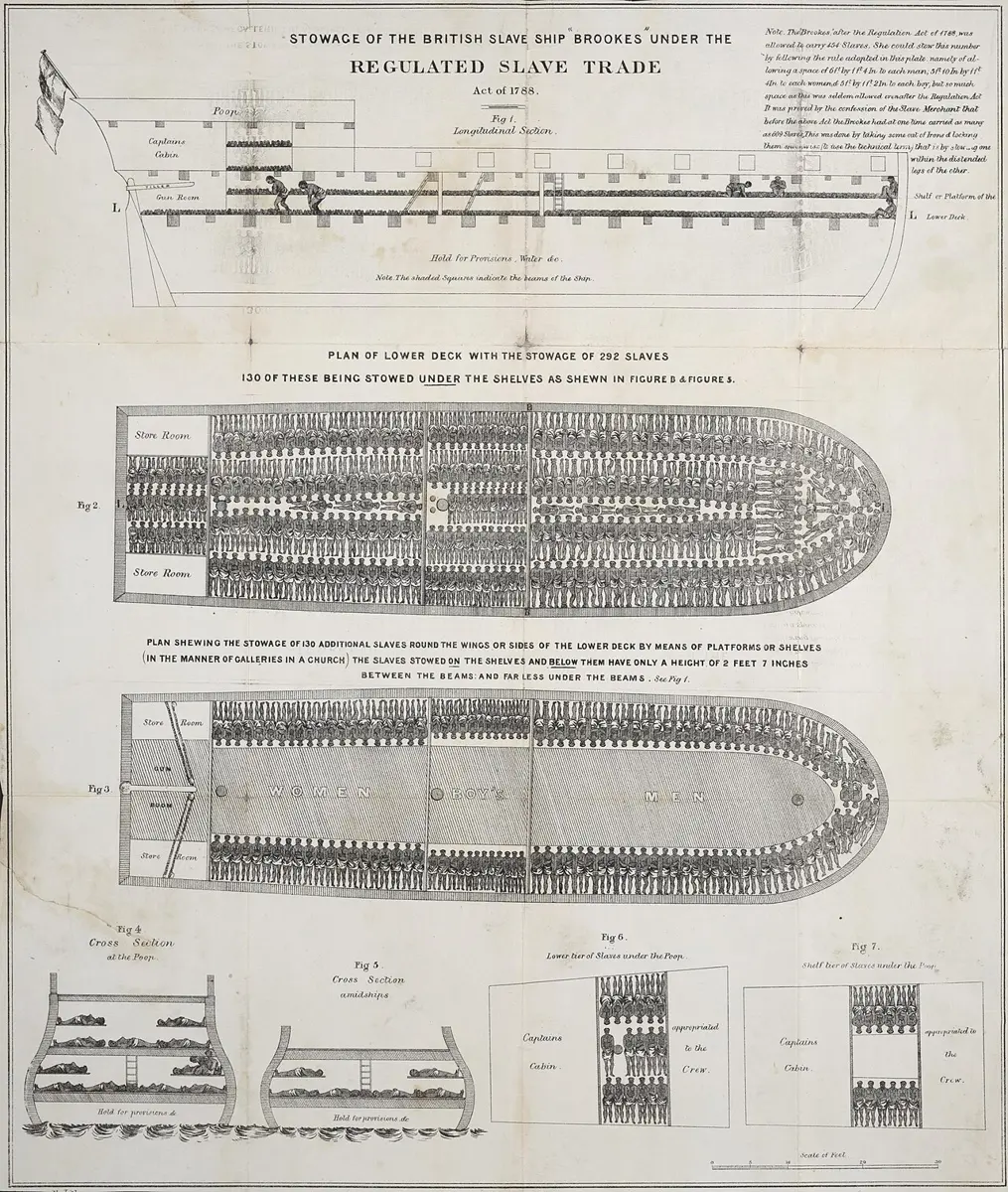
Two things made the crossing visible to people in Britain who would never see a ship. One was a picture. In 1788 abolitionists in Plymouth drew the plan of a real Liverpool ship, the Brookes, with the captives laid out in rows on its decks, as many as a new law of 1788 allowed. A note on one printing added that before the law, by the slave merchant’s own admission, the ship had once carried 609 people. A London committee printed it again in 1789 and sent it to members of Parliament, and it was copied again and again. It is still the best-known image of the trade, and it shows exactly what its makers wanted people to see, human beings packed like goods.
The other was a court case. In 1781 the crew of the Zong, a ship owned in Liverpool and sailing from Africa to Jamaica, threw captives into the sea, alive, in groups over several days; with those who jumped after them, more than 130 people died. The owners said the water was running out, and claimed the people’s value from the insurers, as if a cargo had been lost. A jury in London found for the owners in March 1783, and that month Equiano brought the news to Granville Sharp, an Englishman who fought slavery in the courts. Sharp tried to have the crew tried for murder. When the insurers appealed, in May, the chief judge, Lord Mansfield, said the jury had seen it as no different in law from throwing horses overboard, and he ordered a new trial, which seems never to have been held. Nobody was ever tried for the killings.
Who sold them
Equiano and Cugoano were both clear about how they had been taken. They had been seized by Africans and sold by Africans. The man who led Cugoano to a fort was handed a gun, a piece of cloth and some lead for him. “I must own, to the shame of my own countrymen,” Cugoano wrote, that it was Africans who had first kidnapped and betrayed him. Then he added: “but if there were no buyers there would be no sellers.”
Both halves of that are true. Along the coast, African states took a full part in the trade and grew strong on it. Dahomey, the kingdom Baquaqua walked through, is the best-known case. In 1727 it conquered the port of Ouidah, and before its trade closed in the 1860s Ouidah sent more than a million people across the Atlantic; only one port in Africa, Luanda, in Angola, sent more. At first the kings tried to keep the trade in their own hands and got their captives by raiding, and later merchants grew up who bought them from inland. Some historians once thought Dahomey’s kings had wanted to stop the trade. Others answer that they never meant to, and that Dahomey’s wars grew as the demand for captives over the sea grew.
But the demand came from the plantations of the Americas, and the money from the Americas and Europe. The ships were fitted out and insured in ports such as Liverpool, where the Brookes came from and the Zong’s owners lived, and the guns and cloth that paid for people came on those ships. The sellers were real, and they don’t lift the weight off the buyers.
The older trades
The Atlantic was not the first trade in African captives, and it was not the only one. For more than a thousand years caravans had taken enslaved people north across the Sahara (Chapter 15 crossed it with Ibn Battuta, who saw enslaved men digging salt), and ships had carried them from the Red Sea and the coast of East Africa to Arabia, the Persian Gulf and India. Slavery itself was older still. Rome brought home millions of slaves, and Nepal kept slaves until 1925.
Historians have tried to count these trades too, from much thinner records. One careful set of estimates comes to about seven and a half million people taken across the Sahara between 650 and 1900, and three to four million from the Red Sea and East Africa between 800 and 1896. Those are enormous numbers, and every one of them was a person. But they were spread over more than a thousand years. Across the Sahara, the estimates come to a few thousand people a year, and about twelve thousand a year at their highest. The Atlantic carried 12.5 million in under four centuries, and at its peak, in the last quarter of the 1700s, about eighty thousand a year.
Comparisons like these turn up in arguments today, sometimes to make one trade look smaller so that another looks worse. That isn’t the point of counting. The older trades happened, they were cruel, and they deserve their own history. None of it makes what happened on the Atlantic any smaller, and the Atlantic doesn’t make them any smaller either.
How it ended
By the 1780s Equiano was a free man. In 1766, in the Caribbean, he had bought his freedom from his master for forty pounds, money he had made by trading on his voyages as a sailor. In London both he and Cugoano wrote against the trade, Cugoano in a book of 1787 and Equiano in his life story two years later. Granville Sharp and a committee founded in London in 1787 gathered evidence and printed the Brookes, and the campaign won huge support across Britain. In 1807 Britain abolished the slave trade.
The enslaved people fought it too. The rising that made Haiti free is told in Chapter 26. In the British colonies their resistance came to a head in a great rising in Jamaica at Christmas 1831. In 1833 Parliament ended slavery itself in the British Caribbean, Mauritius and the Cape. Even then the freed people were made to go on working without pay for some years as “apprentices”. And the owners were paid for the loss of their property: £20 million, about four tenths of everything the British government spent in a year. The people who had been enslaved got nothing. Historians at University College London have traced where that money went, to merchants and bankers, clergymen and widows, and about half of it stayed in Britain.
Why did Britain do it, when the trade made so much money? In 1944 Eric Williams, a historian from Trinidad who later became its first prime minister, argued in Capitalism and Slavery that the profits from slavery had helped pay for Britain’s factories, and that Britain ended slavery once the sugar islands had stopped paying. Other historians answered that the islands’ trade was still growing in the years before 1807, so the cause must have been the anger of the British public instead. Many historians now doubt that slavery was ended because it stopped paying, some still defend Williams, and how much slavery paid for Britain’s factories is argued too. It isn’t settled. The researchers who traced the compensation money count all three things together: the doubts of businessmen, the resistance of the enslaved, and a campaign with huge public support.
Other countries kept going, and the last slave voyages across the Atlantic that the records know of sailed in 1866. Brazil, the last country in the Americas, ended slavery on 13 May 1888.
For more than three centuries, then, ships from Europe and the Americas carried Africans across the Atlantic, more than twelve million of them, to grow sugar and other crops on land emptied by conquest and disease. One in seven died at sea, and on the sugar islands so many died that the ships never stopped. African rulers sold the captives, but the demand, the ships and the money came from Europe and the Americas. The older trades across the Sahara and the Indian Ocean were large and cruel too, and slower; neither history makes the other smaller. And the people in the holds left their own words: a boy who thought he had come among bad spirits, a young man given a pint of water a day, and a writer who said that without buyers there would be no sellers.
Meanwhile, in Nepal: slavery here was written into the law of 1854 by caste, and ended by Chandra Shumsher in 1924 and 1925; both are in Nepal’s History, for the Curious, in The Law of 1854 and Life under the Ranas.
Found a mistake? Please tell us.