
Sometime in the early 1600s, in the reign of Jagatjyoti Malla of Bhaktapur, a load of मास, black lentils, came into the Valley from the east with some strange grains mixed in. One old chronicle says what happened next. “The clever people of the country were immediately assembled,” and they decided that this new grain would cause a famine. So it was sent back where it came from, and to clear away any bad luck it had left behind, Brahmans were fed and the gods were worshipped.
The grain was maize. The chronicle was written down long afterward, so nobody can say how much of this happened. But if the clever people did send it away, it didn’t stay away. In 1793 a British visitor to the Valley named it first among the crops on the dry hillsides. Today it is Nepal’s second crop after rice, about three million tonnes a year from about a million hectares.
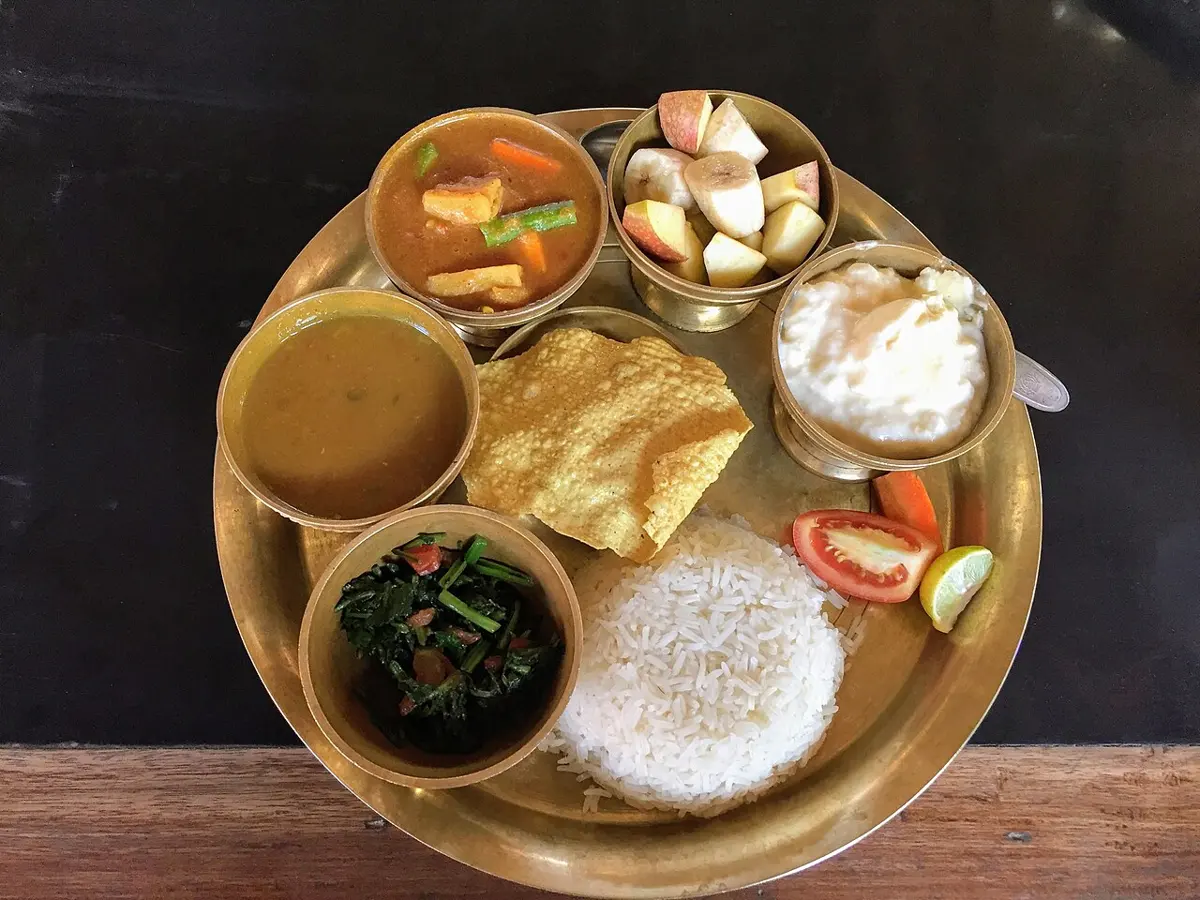
Now look at a plate of दालभात, rice and lentils. Those two have been eaten in Asia for ages. But the potato in the तरकारी curry, the tomato in the अचार pickle and the chili in nearly everything would have baffled anyone in Asia a little over five hundred years ago. They all came from the other side of the world, and they got here because of something that happened in 1492.
What crossed, and which way
For a very long time the world had two halves that knew nothing of each other. People had walked into the Americas from Siberia during the last Ice Age, over land that the rising sea later covered. After that, the Americas went one way and Africa, Asia and Europe went another. Each half tamed its own plants and animals and caught its own diseases, and almost nothing passed between them.
In 1492 Christopher Columbus, sailing for Spain, crossed the Atlantic with three ships and came back. Others followed, and they kept coming. Within a lifetime the two halves were joined, and four kinds of traveler began to cross.
Plants went both ways. Out of the Americas came maize, potatoes, sweet potatoes, cassava, chilies, tomatoes, peanuts, pineapples, tobacco and cacao. Into them went wheat, rice, sugarcane, coffee and bananas.
Animals went nearly all one way, into the Americas: horses, cattle, pigs and sheep. The Americas had few farm animals to send back.
Germs went mostly the same way: smallpox, measles, typhus and more.
People went one way too. Europeans crossed, most of them by choice. Africans crossed in chains, and far more of them.
So here is the whole story in three lines. The Americas gave the rest of the world new food, and it fed many more people than the old crops could. The rest of the world gave the Americas germs and conquerors that killed most of the people living there. Then it filled the emptied land with farms worked by enslaved Africans.
Historians call this the Columbian Exchange, a name Alfred Crosby gave it in a book of 1972. “Exchange” sounds like a fair swap. It wasn’t.
Why the germs went one way
Many of the great killing diseases started in animals. Asia, Africa and Europe had kept far more farm animals than the Americas, for thousands of years and at close quarters, so far more diseases had jumped from animals to people there. Those diseases had long been part of life. The peoples of the Americas had never met them, and nobody’s body had any defense.
Smallpox is first recorded in the Americas in 1518. Two years later it reached Tenochtitlan, the great city of the Mexica, or Aztecs, where Mexico City stands today. They were in the middle of a war with the Spanish conqueror Hernán Cortés, and smallpox may have killed four in every ten people there. By one estimate, Central Mexico had just under 15 million people in 1519 and about 1.5 million a century later. The Taíno of Hispaniola, among the first people Columbus met, were all but gone within fifty years.
Nobody counted the whole of it, and guesses at how many people lived in the Americas in 1491 have run from 8 million to over 110 million. One recent count, which pulls together 119 estimates for different regions, comes to about 60 million, and finds about nine in every ten of them gone by 1600. Even the Black Death, the plague that killed somewhere between a third and a half of Europe in the 1300s, did nothing like that.
Germs didn’t do this alone. There was war. Conquerors enslaved people and moved them by force. When a whole village fell sick at once, nobody was left to plant, harvest or nurse the sick, so people who might have lived died of hunger and neglect. And so much farmland went back to forest that, by that same count, the new trees pulled enough carbon dioxide out of the air to leave a dip in the tiny bubbles of old air trapped in Antarctica’s ice.
Now the sugar comes in. Sugarcane, long grown in South Asia, grew very well in the Caribbean and sold for a lot of money in Europe. The land was there, and the people who might have been forced to work it had died. Planters bought Africans instead. About 12.5 million were forced onto slave ships, and about 10.7 million lived through the crossing. Only about 3.4 million Europeans went to the Americas up to 1840. For centuries the typical person arriving in the Americas was an enslaved African. That trade needs a chapter of its own, and it has the next one.
What the food did
Why should a new crop matter so much? Because a crop can turn useless land into food. Rice needs water. Maize will grow on a dry slope, and potatoes on high, cold ground, and in each case a field that fed nobody could now feed a family.
The potato shows how much this counted. It gives so many calories and nutrients that people can stay healthy on little else besides milk or butter. Two economists compared places in Asia, Africa and Europe whose land suited the potato with places whose land didn’t, before and after it arrived. By their careful estimate, the potato alone explains about an eighth of the rise in population and nearly half of the growth of cities.
The same thing went on across the map. In Lesotho, the average person gets about 1,500 calories a day from maize. The ten countries that eat the most cassava are all outside the Americas. Spanish ships crossing the Pacific to the Philippines from 1565 carried silver to buy Chinese silk, and they carried sweet potatoes and maize as well. China is still among the countries that eat the most sweet potatoes.
There was a danger in this, and Ireland found it. By the 1840s millions of Irish people lived almost entirely on potatoes, many of them one variety. In 1845 a plant disease, potato blight, reached Ireland and rotted the crop in the ground. British relief fell far short, and in the famine that followed about a million people died and a million or more left.
Then there are the crops that gave little in the way of calories and changed the taste of everything. Columbus had gone looking for the spices of India. In 1493 a writer at the Spanish court recorded that he had brought back a new pepper with more bite than the old kind. It had reached India by 1542, probably around the Cape on Portuguese ships. Black pepper had to be bought. A chili could be grown from seed behind the house. Sichuan cooking, Korean kimchi and Hungarian paprika all stand on it, and so does almost every curry in South Asia. Italy’s tomato sauce is much the same story: the first Italian recipe with tomatoes appeared only in 1692.
How it reached Nepal
Here the record goes thin. Nobody wrote down the day the first potato was planted in Nepal, or who carried the first chili seed up from the plains. What survives is a handful of moments when a visitor happened to make a list.
Maize has the best trail. After the chronicle’s story comes Colonel Kirkpatrick’s mission of 1793, which found it growing on the hillsides that couldn’t be watered, eaten mostly by the farmers who grew it. Ten years later Francis Buchanan, later Hamilton, listed it next after rice in Palpa. In the 1840s and 1850s Brian Hodgson found the word मकै, or something like it, in 16 of the 23 languages he listed among the hill peoples of eastern Nepal and northeast India, and a word doesn’t travel that far overnight. Maize grows on बारी, the dry upper fields where rice can’t go, so it added to what the hills could grow. It may have helped them fill with people, as the new crops did elsewhere. We found nobody who has measured it.
The potato took longer. Kirkpatrick had hoped for good vegetables in the Valley’s cool air, and was disappointed to hear that people “could not raise even potatoes” without fresh seed from Patna every year. A decade on, Buchanan found that the potato “grows tolerably” in the hills, though not as well as at Patna, which he put down to “a want of care”. It reached the Sherpas of Khumbu around the 1850s or 1860s, by one count. In the high valleys it let people settle higher and stay through the winter.
Chili is harder. It turns up in Kirkpatrick’s list of goods brought up from British India, as red pepper, beside tobacco. A decade on, Buchanan found even the poorest people in and around the Valley cooking their radishes or lentils with salt, capsicum and turmeric. Hodgson noted plots of it in the eastern hills. The name is a puzzle of its own. खुर्सानी seems to come from Khorasan, a province of Persia, and nobody knows whether the plant really came that way or only the name did. तमाखु, tobacco, and अनारस, pineapple, came through Portuguese, and सुर्ती, another word for tobacco, is named for the port of Surat. The Mughal emperor Akbar was eating pineapple at his table by 1595, so that one, at least, moved fast.
The tomato seems to have come last, and when is unknown. Kirkpatrick’s list doesn’t name it, nor Buchanan’s, nor one from the Valley in 1877 that does give potatoes and red pepper. In much of India, too, it seems to have stayed a stranger until the later 1800s. A Nepali dictionary of 1931 has it as गोलभेँडा, “round brinjal”, and that’s the first sure sign of it here that we’ve found. Two other arrivals are just as unrecorded. Sweet potato, the सखरखण्ड, was doing well by Buchanan’s time. And the सयपत्री in every Tihar garland, a name out of Sanskrit meaning “a hundred petals”, is a flower from Mexico.
Our own crop
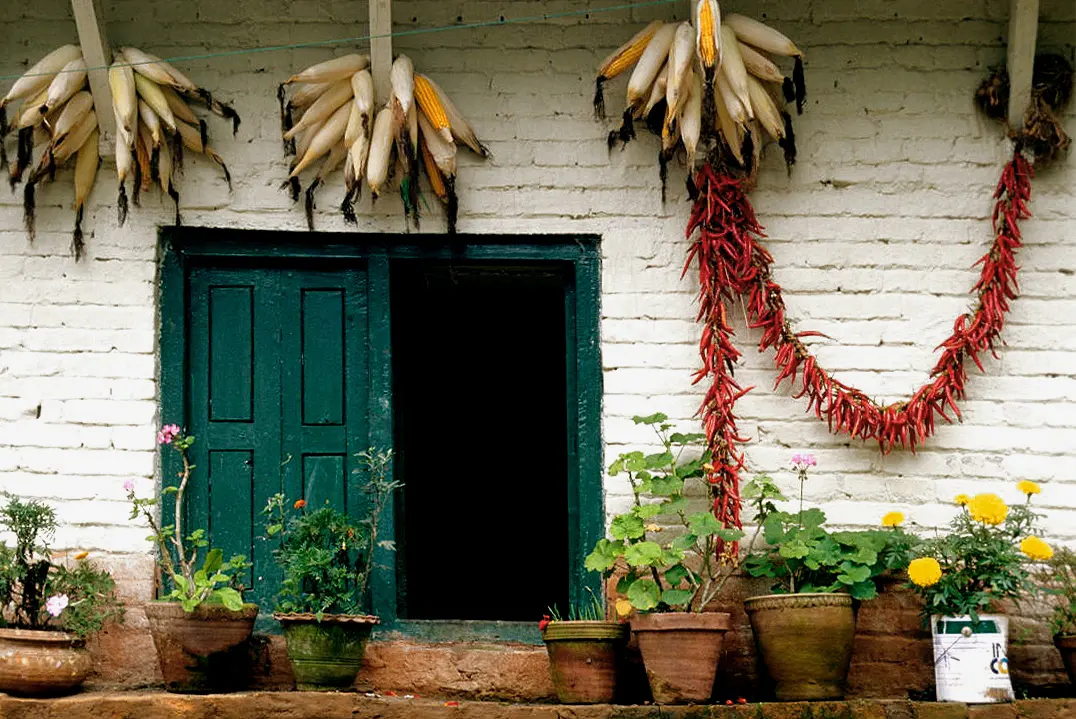
In March 1972 Anne Desjardins, an American Peace Corps teacher in Lamjung, sat by a wood fire eating maize porridge with lentils and mustard greens, and wondered how a plant from the Americas had become the staple food of a Himalayan village. Her neighbors didn’t see the question. Their मकै was local, they told her, and so were the chilies and tomatoes in their curries. These had been with them since their ancestors’ time. Even at Dasain, she wrote, villagers wear pale yellow seedlings of maize in their hair, where the जमरा sprouts are usually barley.
They were right, in the way that matters to anyone eating. In about three and a half centuries the crop had gone from a grain that frightened the Valley to one that nobody could imagine the hills without. You can see the same thing in the center’s own garden, where papaya, pineapple, pumpkin and chili grow as if they’d always been here.
But maize didn’t make itself. Farmers in Mexico bred it from a wild grass called teosinte, and farmers in the Andes bred the potato. The peoples who gave the world this food were the peoples those ships nearly destroyed. They are on every plate of दालभात too.
Found a mistake? Please tell us.