
The words on the pillar at Changu Narayan begin with a date, and it is a very careful one. It gives the year, 386, then the month, ज्येष्ठ (Jyeṣṭha), जेठ in today’s Nepali, the bright half of the month and its first day. It says the moon stood among the stars called रोहिणी (Rohiṇī), and it names the hour, the one called अभिजित् (Abhijit), around midday. Whoever wrote it wanted the day fixed beyond any doubt. What it doesn’t say is the one thing a reader today needs to know: year 386 of what?
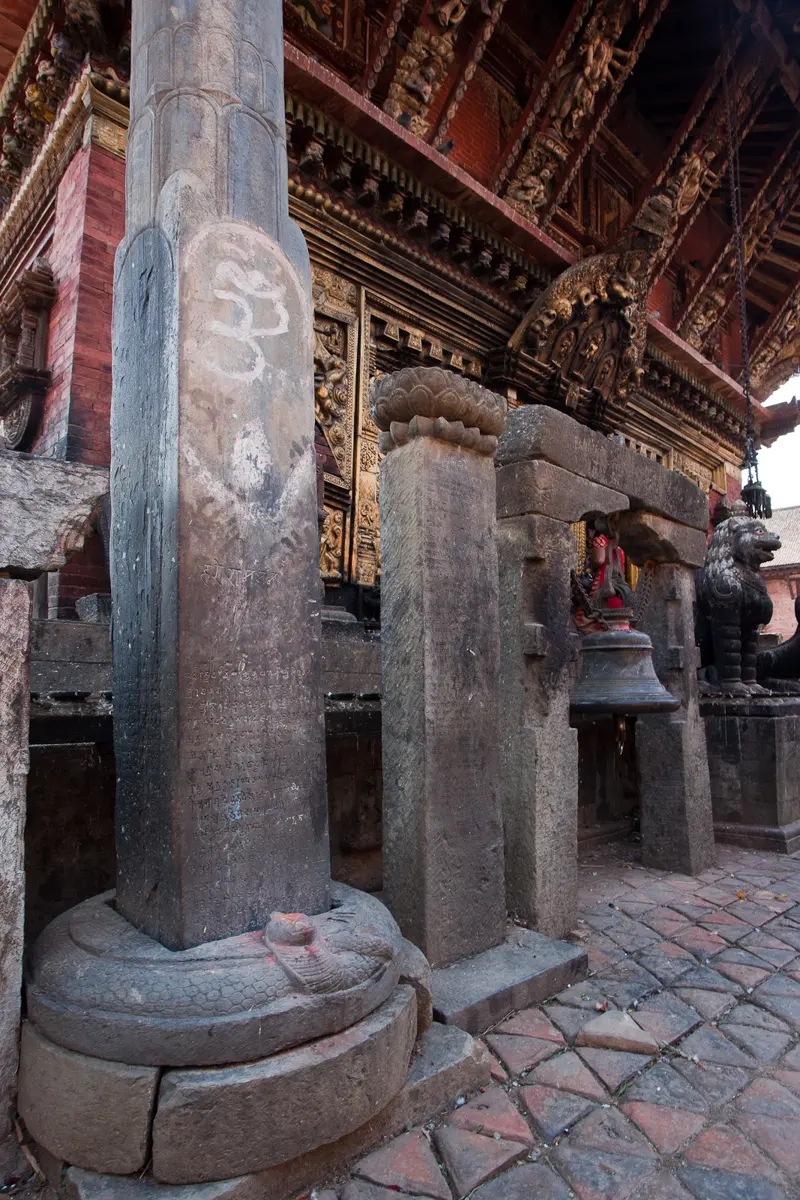
Like every date, it counts from a starting point, the way this year’s date counts from the year 1 CE. Most historians now agree that this one counts from the start of the Shaka era, a count of years widely used in India that began in 78 CE. That makes year 386 the year 464 CE. The king who set the date was मानदेव (Mānadeva), of the family we call the Licchavis, and with his pillar the Valley’s history gets something it never had before: a run of stones, one after another, each dated in a count that can be turned into our own.
The Licchavis ruled the Valley for about four hundred years after him, and they left about two hundred inscriptions, most of them dated. These are the first written history of Nepal made in Nepal. They tell us who the Licchavis said they were, which kings came in what order, and, with some detective work, in which years.
A famous name
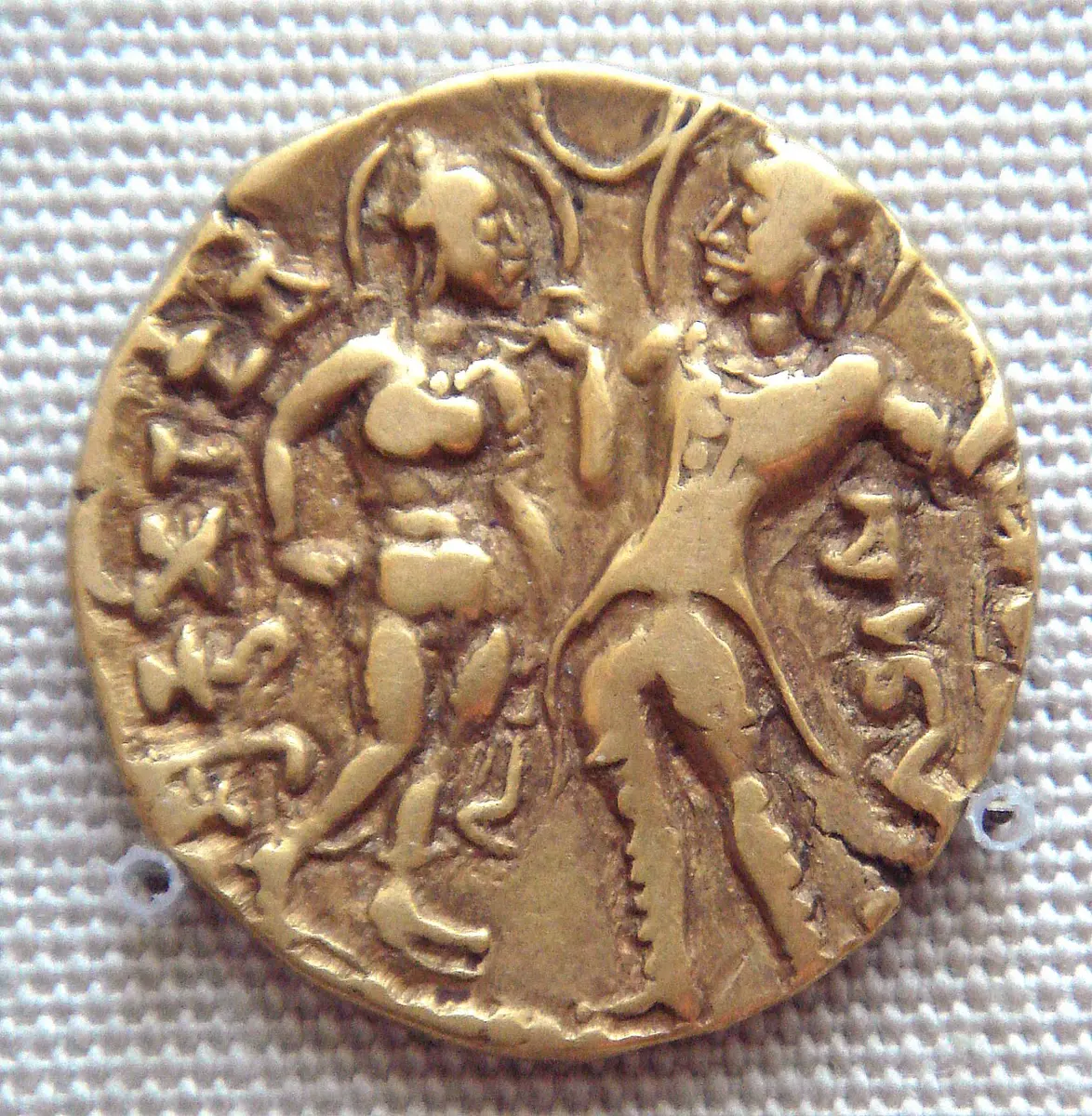
Long before there were Licchavis in the Valley, there were Licchavis in the plains. In the Buddha’s time they were a clan who ruled together, without a king, from the city of Vaishali, in today’s Bihar. Buddhist books tell how Ajatashatru, king of Magadha, made war on them and their neighbors. Their name outlived that war by many centuries. In the early 300s CE, the first great Gupta emperor, Chandragupta I, married a Licchavi woman, Kumaradevi. Gold coins show the two of them side by side, and the other side of the coin names not a king but a people: “the Licchavis”. Their son, Samudragupta, called himself the son of a Licchavi daughter, and he is the emperor whose pillar first mentions Nepal.
So the name carried honor, the way an old family name still does. And the kings of the Valley took it up, but not at first. Mānadeva’s pillar names his father, his grandfather and his great-grandfather, वृषदेव (Vṛṣadeva), and never calls any of them a Licchavi. The word first appears on a stone set up by his daughter, विजयवती (Vijayavatī), who calls her father the full moon of the Licchavi family. More than eighty years later, from the 590s, “banner of the Licchavi family” became one of the titles the kings used about themselves.
The fullest family tree was carved in 733, at Pashupati, by a king named जयदेव (Jayadeva), the second of that name. It starts with the sun. In the family of the sun, it says, was born a king called Licchavi, who gave the line its name. Thirteen generations later came सुपुष्प (Supuṣpa), then after twenty-three more a Jayadeva who was famous, then twelve more kings, and then Vṛṣadeva, a follower of the Buddha’s teaching, from whom the list runs down, son after son, to Jayadeva himself. Between the first Licchavi and Vṛṣadeva lie close to fifty kings, and only two of them have names. Long lists with stretches of unnamed kings are how ruling families across South Asia gave themselves a glorious past, and nobody keeps a memory of fifty generations.
How the Licchavis came to the Valley is a question the stones never answer. The Grade 9 इतिहास book tells it this way: after Ajatashatru took Vaishali, about 500 BCE, Licchavis fled north and took shelter in Nepal, served the Kirat kings, and in time removed the last of them, a king called Gasti, and ruled in his place. No ancient source, Indian or Nepali, tells of that journey, and the Buddhist books that describe Ajatashatru’s war say nothing of it. So historians read the same few facts in different ways. Some think a family really did come up from the plains, perhaps much later, around the Gupta age. Others think rulers who were already in the Valley took the famous name once they were secure, the way many ruling families in South Asia gave themselves noble ancestors. One small clue is argued over: when Samudragupta’s poet listed the king of Nepal among the rulers who bowed to the emperor, would an emperor proud of his Licchavi mother have boasted of a Licchavi bowing to him? The evidence doesn’t settle it, and this book doesn’t either.
Two things are certain. By 464, a family ruled the Valley that wrote fine Sanskrit, in the script and poetic style of Gupta India. And the villages, rivers and fields named on its stones mostly carried older names, from Tibeto-Burman languages like those of the Kirat peoples and the Newars (Chapter 4). Whoever the kings were, they ruled a land whose people had named it long before.
The kings on the stones
The first king whose own words survive is Mānadeva, and he ruled for about forty years, from 464 to about 505. The story his pillar tells, of a mother kept from her husband’s funeral fire and a son who marched east and west, is in Chapter 1. Other stones fill in his family. A queen, क्षेमसुन्दरी (Kṣemasundarī), set one up at Lazimpat, in what is now Kathmandu. His daughter Vijayavatī set up a Shiva linga at Suryaghat by Pashupati. Mānadeva himself had great carvings of Vishnu taking his three giant strides made for Lazimpat and for a spot beside the Bagmati, near Pashupati.
After him the stones keep coming, and they keep their count. His son reigned only briefly, then his grandson, वसन्तदेव (Vasantadeva), for over twenty-five years, then a line of kings through the 500s. Most of these stones record gifts: land given to a temple, a water spout built for a village, a king freeing a village from a tax. They show kings, priests, nobles and rich traders. Farmers appear mostly as the people a grant was about.
Toward the end of the 500s, the stones change. From year 515 of the count, the king, शिवदेव (Śivadeva), issues his orders together with a powerful noble, अंशुवर्मा (Aṃśuvarmā), whose name soon appears on more stones than any king’s. How Aṃśuvarmā rose until he ruled in his own right is the next chapter’s story. For the dates, what matters is something that happened along the way: in his time, the stones start counting the years differently.
Two counts of years
Line up all the Licchavi stones by their dates and they fall into two groups. About seventy are dated from 386 up to the 530s. Then, with Aṃśuvarmā, a new count appears, starting not at 1 but at 29, and about a hundred stones and manuscripts are dated in it, all the way to 301. Soon after that comes नेपाल संवत् (Nepal Sambat), the count the Valley then kept for nine hundred years.
The second count is the easier one to fix, because it can be checked from outside Nepal. China’s court histories record that a king of Nepal named नरेन्द्रदेव (Narendradeva) sent an envoy to the emperor in 651. Narendradeva’s own stones fall between years 67 and 103 of the new count, so its year 1 must be somewhere in the 500s. Two dates in this count also name the day of the week, and a weekday can be checked against the calendar. A gold covering offered at Changu Narayan on a Sunday in year 31 lands on a Sunday in February 608, and a manuscript finished on a Sunday in year 301 lands on one in 878. Nepal Sambat began in 879, just after that, as if one count simply handed over to the next. So year 1 of the second count is about 576, give or take a year.
Who started it is another matter. A note added to a later manuscript calls it Mānadeva’s count, so some historians imagine a second Mānadeva around 576, who left no stones of his own. Tibetan writers give the honor to Aṃśuvarmā. Others think it was never really a new count at all, but the old one started again near its year 500, a little as people write “’26” for 2026. The numbers come out the same whichever is right.
That leaves the first count, and year 386. When scholars began reading the stones in the 1880s, they tried several starting points, which made Mānadeva a king of the 300s in one reading and of the 700s in another. Most now settle on the Shaka count. Their full case leans on the astronomy in the dates, which is hard going, but the man who appears in both counts shows the idea simply.
Aṃśuvarmā is on the old count’s stones from year 515, at Śivadeva’s side, and he himself dated at least one stone in the old count, in year 536. His own stones in the new count run from year 29 to year 45, which is 605 to 621. One man, one life. Whatever year the old count starts in, his old-count stones have to fall within the years he was alive and in power.
Start the old count in 78 and his stones land neatly. His old-count stones fall between 593 and 614, his new-count ones between 605 and 621: one working life of under thirty years, with a few years when he used both counts. Start it much earlier, and he serves at Śivadeva’s side half a century or more before his last stone, or the two groups of stones never meet at all. Start it much later, and his old-count stones come after his own last one, when other kings were already ruling in his place. Only a start not far from 78 gives him one ordinary working life, and the one count in use in that age that starts there is the Shaka count. The astronomy in the dates points the same way, which is why most historians settle on it.
The pillar’s own careful date agrees. The moon in रोहिणी on the first day of the bright half of ज्येष्ठ fits 464. That check is weaker than it looks, though, because the same moon on the same day of the month comes round several times a century, so it fits other years too. One stone, at Sikubahi in Patan, may carry a date in both counts at once, which would settle it, but its last line is worn and partly buried, and scholars read it differently. Nobody can prove 464 the way the weekday proves 608. It is simply the answer that makes all the stones fit together best.
Reading the dates
All this matters for more than the Licchavis, because a Nepali student meets dates in four different counts. Each is just a different starting point, and each is turned into another by adding or taking away a fixed number.
The Shaka count started in 78 CE, so adding 78 gives the year CE, as with 386 and 464. The Vikram count, विक्रम संवत् (Vikram Samvat), which Nepal uses today, started 57 years before the CE count, so taking away 57 gives the year CE: 2083 is 2026. The Grade 9 book gives Mānadeva’s reign as वि.सं. ५२१ to ५६२, which is the same 464 to 505 in another count. Nepal Sambat started in 879, so adding 879 or 880 gives the year CE: the earthquake that the old chronicle dates to 375 is 1255 (Chapter 1).
Why “879 or 880”? Because none of these counts starts its year on 1 January. Nepal Sambat’s new year falls in the autumn, around Mha Puja, and the Vikram year in Nepal begins in mid-April. So each count’s year overlaps two of ours, and for part of the year the number to add or take away is one different. A careful historian gives a date like “1255” only when the month is known, and otherwise writes it as two years, 1254–55. The difference between counts is also a clue to who ruled: after Gorkha took the Valley in 1769 (Chapter 17), Nepal Sambat was dropped from official papers in favor of the Shaka count and later the Vikram count, and since 2023 the government has used it again beside Vikram Samvat.
So the Licchavis gave the Valley its first dated history, and its first puzzle about dates. They were a ruling family with a famous name from the plains, which they may have brought with them or taken up once they ruled; their stones don’t say. Their kings, from Mānadeva on, set up stones that count the years, first in one count and then in another. The second count is fixed by China’s records and the days of the week. The first is tied to it by one man, Aṃśuvarmā, who appears in both, and the start that fits best puts Mānadeva’s pillar in 464 CE.
Meanwhile, in the world: while Mānadeva ruled the Valley, the Gupta empire still held much of northern India, where the young Aryabhata wrote a book of mathematics and astronomy in 499, when he was 23; in Europe, in 476, the last emperor of the western Roman Empire was put off his throne.
Found a mistake? Please tell us.