
In 97 CE a Chinese officer named Gan Ying set out westward to find a country called Da Qin. The Chinese knew it only from travelers’ tales: a great land in the far west, with more than four hundred walled towns and rulers who were not born to the job but chosen as the worthiest man. Da Qin was the Roman Empire. Gan Ying had been sent by Ban Chao, the Han general in the oasis kingdoms of Central Asia, and he got a very long way, across the lands of the Parthians, the empire that ruled what is now Iran and Iraq, down to a great sea, almost certainly the Persian Gulf.
There the Parthian sailors told him what lay ahead. With good winds the crossing took three months. With bad ones it could take two years, so anyone who sailed carried food for three years, and out on that sea men were seized with longing for home, and some died of it. When Gan Ying heard this, the Chinese history says, he gave up and went home. The Parthians, who grew rich on the trade between the two, may not have wanted them to meet. So the two largest states on Earth knew each other only as rumors, one at each end of Eurasia. Yet they were alike in ways neither could have guessed.
Here is the whole story in a few lines. Rome began as a small city in Italy that threw out its kings and ran itself as a republic, with two leaders elected every year, a council called the Senate, and assemblies of citizens. Its poorer citizens won written laws. Rome conquered the whole Mediterranean and brought home millions of captives as slaves. Civil wars ended the republic, and from Augustus on Rome was ruled by emperors, though they pretended otherwise. Inside the empire a new faith, Christianity, grew from a small persecuted group into the empire’s own religion. In China, a hard state called Qin conquered all its rivals in 221 BCE and made one empire, with one script, one set of weights and one law. The Han dynasty that followed ruled for four centuries through educated officials. Each empire held about sixty million people. Both broke apart in the end, but China was put back together, and Rome never was.
A city without a king
Rome’s own story of its beginning is of twin brothers, Romulus and Remus, fed as babies by a she-wolf. The Roman historian Livy, who wrote it down some seven centuries later, passed it on as tradition and claimed no more. For 244 years, he says, Rome had kings. Then, in what Romans counted as 509 BCE, they drove out the last of them.
In place of a king they elected two consuls each year, so that no one man held power for long and each could stop the other. A council of former officials, the Senate, controlled the money and dealt with foreign states. Assemblies of citizens voted on laws and on war and peace, and elected the officials. A Greek historian, Polybius, who knew Rome well, tried to say what kind of state this was. Look at the consuls, he wrote, and it seemed a monarchy; at the Senate, a government of nobles; at the people, a democracy. That was its strength, he thought: each part could block the others.
Who counted as “the people” was another matter. A few old families, the patricians, held the offices; everyone else was a plebeian. Early in the republic, Livy says, the plebeians simply walked out and camped on a hill three miles from the city. They came back only on terms: officials of their own, the tribunes, who could protect any plebeian against a consul, a post no patrician could hold.
Next they demanded laws written down where anyone could read them, so that the patricians could no longer say what the law was. Around 450 BCE a board of ten men drew them up and set them out in public, the Twelve Tables. The tablets are long gone, and the laws survive only as short, blunt pieces quoted by later writers. “If the plaintiff summons the defendant to court, the defendant shall go,” the first began. A debtor who didn’t pay within thirty days could be put in chains. Women were to be under a man’s guardianship, and patricians and plebeians were not to marry each other at all. Romans still called these laws the source of all their law, and the statesman Cicero learned them by heart as a boy.
The republic went to war again and again. It took the rest of Italy, then collided with Carthage, a trading city on the coast of today’s Tunisia. They fought three wars. In the second, the Carthaginian general Hannibal marched an army, with elephants, from Spain over the Alps into Italy, and at Cannae at least 67,500 Romans were killed or captured. Rome kept fighting and beat him at last in Africa. In the third war, in 146 BCE, the Romans took Carthage itself and burned it. Over the next century they took the kingdoms of the eastern Mediterranean one by one.
The wars made Rome rich, and they filled Italy with slaves. Captives were sold by the tens of thousands; children of slave mothers were slaves too, and babies left out to die were picked up and raised as slaves. Nobody counted them. Older estimates put two or three million slaves in Italy by the end of the republic, a third of everyone there. The most careful recent estimate is lower, one million to one and a half million at any one time, but to keep that many Italy had to take in two to four million people over two centuries, more than all the free people who moved there by choice.
What their lives were like is hard to see, because hardly any slave wrote it down. What owners wrote is full of the whip, the chain, the brand and the cross. A slave was property. Yet Rome also freed slaves on a large scale, and a citizen’s freed slave became a citizen too, and often owned slaves in turn. Some fought back. About seventy gladiators, men trained to fight to the death for the crowd, broke out of their school at Capua, led by Spartacus, a man from Thrace, north of Greece. Runaway slaves joined them in tens of thousands, and they beat one Roman army after another. When the Romans finally crushed them, about six thousand captured rebels were nailed to crosses along the whole road from Capua to Rome.
From republic to emperors
Conquest broke the republic. Generals with armies loyal to themselves fought each other for power. One of them, Julius Caesar, led his army across the Rubicon, the little river at the edge of Italy, saying, the story goes, “The die is cast,” and won the civil war that followed. In 44 BCE a conspiracy of more than sixty men stabbed him to death.
His adopted son won the next civil wars and was more careful. He kept the Senate, the consuls and the elections. In his own record of his deeds he says he handed the state back to the Senate and people, and had no more power than his colleagues in each office, only more standing. The Senate gave him the name Augustus. In fact he held the army and the money, and every ruler after him was what we call an emperor. Romans had distrusted kings for five centuries, so the first emperor made a show of bringing back the republic.
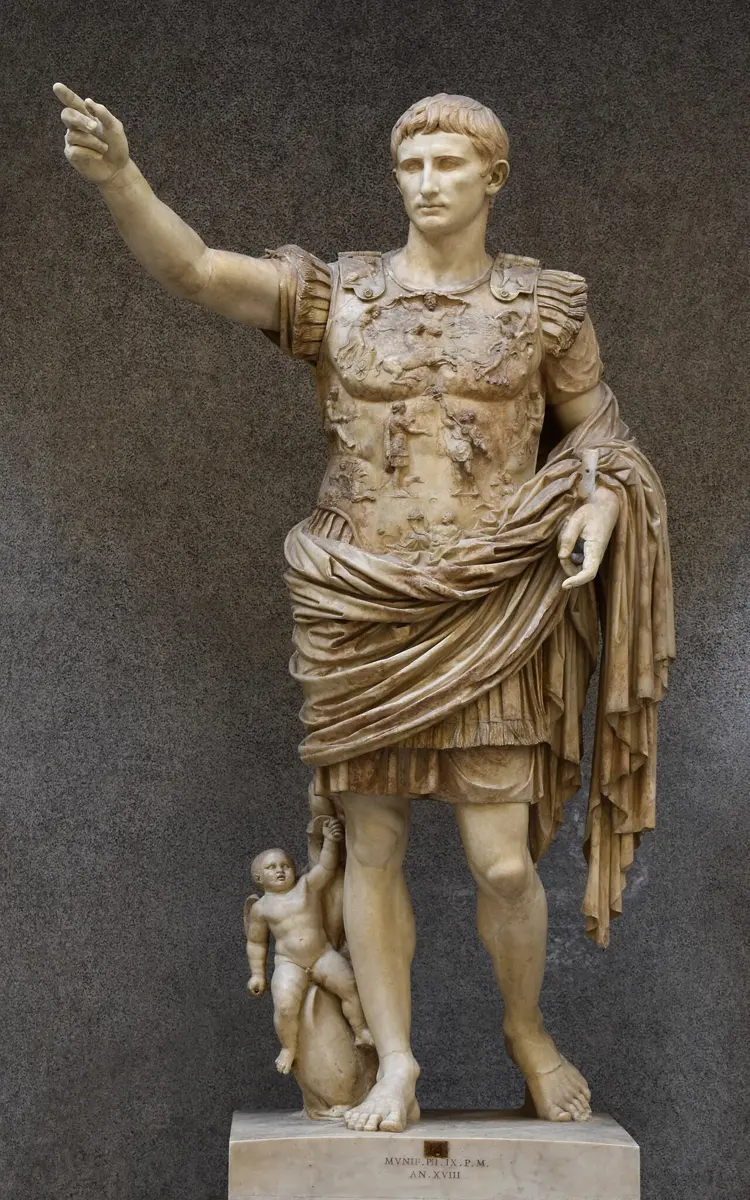
Augustus counted 4,937,000 Roman citizens in his last census, but citizens were only a part of the people Rome ruled, from Britain to Egypt. In 212 CE the emperor Caracalla made every free man in the empire a citizen; a senator who lived through it thought he did it to collect more tax. Latin spread across the western provinces, and Spanish, Portuguese, French, Italian and Romanian all grew from it.
Not everyone saw Roman peace as a gift. The historian Tacitus gave a speech to Calgacus, a leader in the far north of Britain, before a battle with the Romans: they call robbery, slaughter and plunder by the false name of empire, Calgacus says, and “they make a solitude and call it peace.” A Roman wrote those words.
Qin, and the Han state of officials
At the other end of Eurasia, China had been split for centuries among warring kingdoms. In the end there were seven, and the hardest, Qin, in the far west, conquered the other six. In 221 BCE its king took a new title, which English translates as emperor. He would be the First Emperor, he declared, and those after him would simply be numbered, Second, Third, for ten thousand generations.
The great historian Sima Qian, writing about a century later, lists what he and his minister Li Si did to make one country out of seven. The land was divided into thirty-six commanderies, each with a governor, a commander and an inspector sent from the capital. Weights and measures were made the same everywhere, and so was the width of cart axles, and writing too: one way of drawing each character for the whole empire. The weapons of the conquered states were melted down into bells and twelve giant bronze statues.
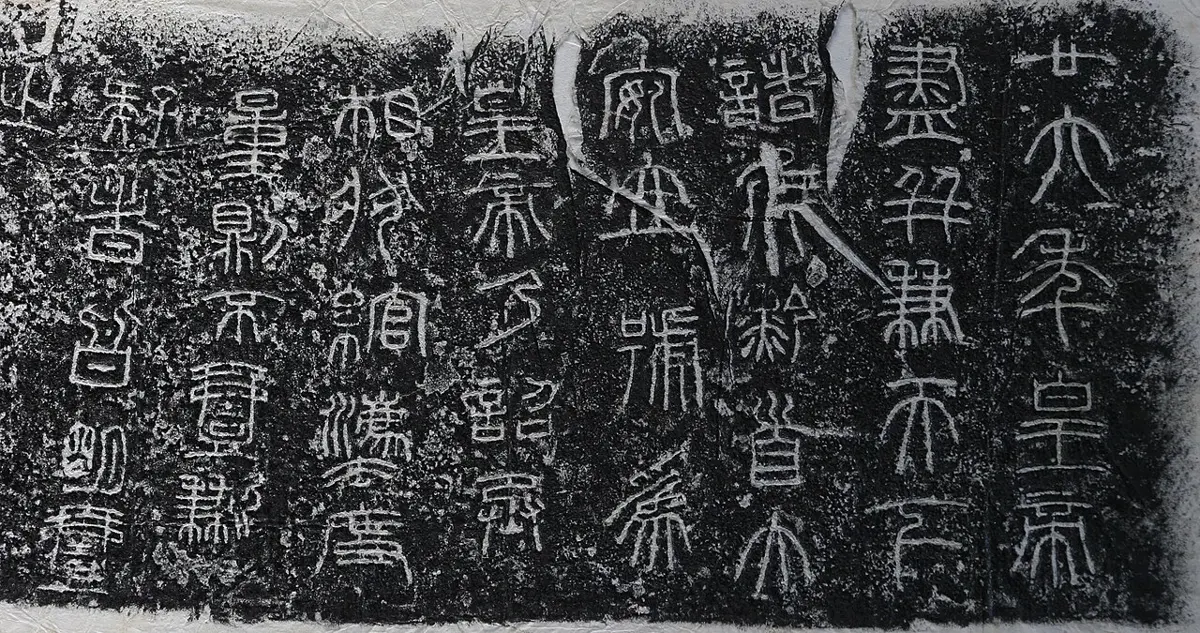
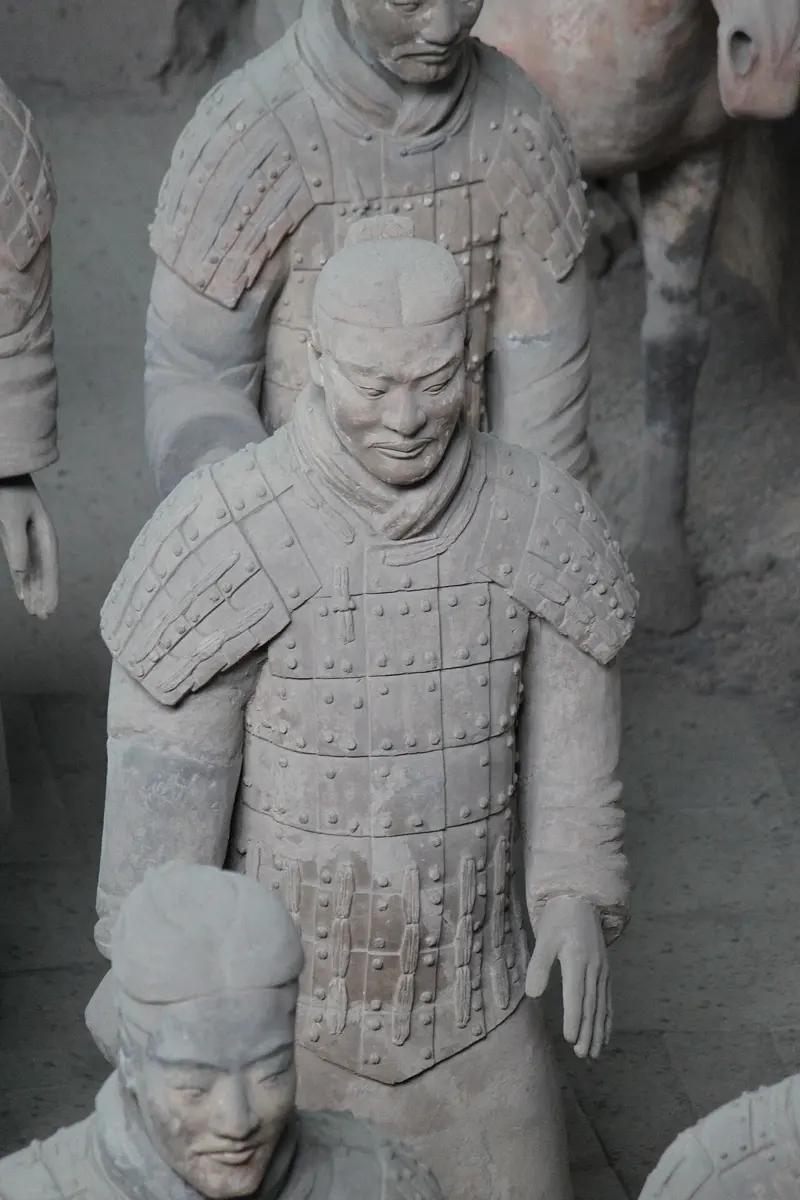
Li Si proposed burning every history but Qin’s, and other old books, sparing only those on medicine, divination and farming, and Sima Qian says more than 460 scholars who broke the ban were put to death. How much of that is true is argued: no writing older than his mentions the killings. Nobody doubts the labor. Sima Qian says 700,000 men worked on the First Emperor’s tomb, near today’s Xi’an. In 1974 farmers digging a well near it found the first of its pits, and more than eight thousand life-size clay soldiers have been counted there since. The tomb itself has never been opened.
The empire died with him. The year after, Sima Qian tells, nine hundred conscripts marching north to guard the frontier were held up by heavy rain and knew they would be late, and under Qin law, he says, the penalty for that was death for all. So two of them, Chen Sheng and Wu Guang, rebelled instead. “Are kings and lords, generals and ministers, a breed apart?” Chen Sheng asked. Within a few years the Qin was gone. The winner of the wars that followed was Liu Bang, a man of no family, once head of a small police post in his district, who in 206 BCE founded the Han dynasty. It ruled until 220 CE.
The Han ran the one empire the Qin had made on paperwork, written on strips of bamboo and wood. Its officials were ranked in sixteen grades, from the Chancellor down to the clerks of the counties, and paid in measures of grain. Many were recommended by governors as “filial and incorrupt”, good sons and honest men, and from 124 BCE an imperial academy taught young men the classics Confucius’s followers had kept, to train them for office. Rome governed with far fewer officials. The Han even counted all their people: a census in the dynasty’s history, usually dated to 2 CE, lists 12,233,062 households and 59,594,978 people.
Such a state could argue with itself in public. Its wars against the Xiongnu, the horse-riding peoples of the northern steppe, were ruinously expensive, so the emperor Wu took over the making and selling of salt and iron, which every household needed. In 81 BCE, after his death, the court called more than sixty scholars from the provinces to say what troubled ordinary people, and set them to debate the finance minister, Sang Hongyang. Their words survive as the Discourses on Salt and Iron. The state, the scholars said, should not compete with the people for profit. Its foundries made big tools to fill their quotas, the iron so blunt it wouldn’t cut grass, and the poorest were plowing with wood and weeding by hand. The minister answered that the frontier had to be paid for. He won, and only the state’s liquor business was given up. The argument itself, over how far a state should run its people’s business, is still going on.
Sima Qian himself paid for speaking up. He defended a general who had surrendered to the Xiongnu, and was sentenced to death; too poor to buy his way out, he took the other punishment the law allowed, castration, a deep disgrace. A death, he wrote to a friend, can be as weighty as Mount Tai or as light as a goose feather, and he chose to live and finish his history. Every history of early China still depends on it.
The next great history, of the Han themselves, was a family’s work. Ban Gu wrote most of it, and his sister Ban Zhao finished it; their brother was Ban Chao, the general who sent Gan Ying west. Ban Zhao taught at court and wrote Lessons for Women for the girls of her family. Much of it teaches humility: in the old days, she reminds them, a baby girl was laid below the bed, to show she was lowly and must humble herself before others. Yet in the same book she asks a sharp question. Boys are taught to read from the age of eight. Why should girls not be taught the same way?
A new faith in Rome
In Judaea, on the empire’s eastern edge, in the time of the early emperors, a Jewish preacher, Jesus of Nazareth, gathered followers, and the Roman governor, Pontius Pilate, had him crucified. His followers believed he had risen from the dead, and that belief became the foundation of a faith that spread through the cities of the empire. Rome noticed it first as trouble. When a great fire burned Rome, Tacitus says, the emperor Nero blamed the Christians, already hated by the crowd. Some were torn apart by dogs; some were nailed to crosses and burned to light the night. Even people who despised them, Tacitus says, began to pity them.
Some decades later Pliny, a governor on the Black Sea coast of today’s Turkey, wrote to the emperor Trajan about them. The faith had reached towns, villages and farms, people of every age and rank. He executed those who would not give it up, yet found that all they did was meet before dawn, sing a hymn to Christ as to a god, swear not to steal or cheat, and share a plain meal. Trajan told him not to hunt Christians out.
Persecution came and went for two more centuries. Then the emperor Constantine turned to the Christian God, before a battle in 312 by the stories told later, and in 313 he and his fellow emperor let Christians and everyone else follow the religion they chose. In 380 the emperor Theodosius ordered all the peoples of the empire to follow the Christian faith as the bishops of Rome and Alexandria taught it. The persecuted faith had become the empire’s own. It did not end Roman slavery, which almost nobody in the ancient world, Christians included, questioned.
Side by side, and the two ends
Put the two empires side by side and the likeness is striking. Each covered about four million square kilometers and held about sixty million people. Between them, around 2,000 years ago, they ruled perhaps half of humankind, and no two governments have ruled so large a share since. Each was made the same way, too: a world of a few warring states, conquered by one hard state on its western edge.
They were also unlike. Rome ran its provinces with few officials, and its fields and households with many slaves. Han China had slaves too, but far fewer, perhaps one person in a hundred; its men owed the state a month’s labor each year and service in the army, and it was run by educated officials. Rome’s emperors pretended not to be kings. China’s never needed to.
In the reign of the emperor Marcus Aurelius, both were struck by disaster. A pox-like plague swept the Roman Empire for at least a decade. Nobody knows what the disease was, or how many it killed: estimates run from about a million to several million. Chinese records of the same decades tell of epidemics too, but whether it was the same sickness, carried along the roads between them, nobody can say. In those years, the Chinese history records, men claiming to come from “Andun”, king of Da Qin, perhaps Marcus Aurelius himself, turned up from beyond the frontier with ivory and rhinoceros horn. Chapter 13 follows the roads between the two.
The Han went first. At court the emperor’s eunuchs and his officials fought each other for power. In 184 CE farmers who followed a healer and his teaching, the Way of Great Peace, rose in rebellion, wearing yellow scarves, under the slogan “The blue sky is dead, the yellow sky shall rise.” After it, provincial governors were given their own troops and taxes, and became warlords. In 220 the last Han emperor gave up his throne, and China split into three kingdoms.
Rome lasted longer. It was divided into eastern and western halves, and in the west, in the 400s, peoples from beyond the frontier settled inside it and set up kingdoms of their own. In 476 one of their leaders, Odoacer, removed the last emperor in Italy. The eastern half, ruled from Constantinople, today’s Istanbul, went on as the Roman Empire for nearly another thousand years. Why the west fell is one of history’s oldest arguments; one historian has counted 210 explanations. Some blame the peoples pressing on the frontiers, some Rome’s own civil wars, some plague and a cooling climate, and some say the west was not destroyed so much as slowly turned into something new.
Then comes the biggest difference. China was split for more than two centuries, but in 589 it was put back together, and since then, despite breaks, it has usually been one state. The Roman Empire was never restored, and Europe stayed a crowd of separate kingdoms. Why is argued too. One historian who has spent years comparing the two points to the land: Europe has no great river plains to hold one power together, it is cut up by mountains and seas, and it lies far from the steppe, whose horse-riding peoples helped build big empires across Asia. Neither path was the normal one that the other missed. One huge state and many small ones each shaped everything that came after.
Two empires, then, at opposite ends of one world, about the same size and each built by one hard conqueror. Rome grew out of a republic of elected leaders, written law and slaves, and kept the look of that republic under its emperors. China was held together by one script, one set of measures, and officials who counted every household and argued in public about the state’s business. They never met, and neither made a model that the other fell short of.
Found a mistake? Please tell us.