
Some time in the 640s, a Chinese official named Li Yibiao came over the mountains into the Kathmandu Valley. He was on his way to India, sent by the emperor of China, and the king of the Valley, Narendradeva, was delighted to see him. The king took his guest out to see one of the sights. It was a pond about twenty paces round, whose water was always boiling, and which never rose in the rains or fell in a drought. Throw something into it, and it burst into smoke and flame. Hang a pot over it, and the food inside was cooked in moments. A Chinese monk who wrote about Nepal a few years later says a Chinese envoy tried it himself: he threw something in, the flames leapt up, and he boiled rice on them.
Nobody today knows where that pond was. But the visit tells us something new about the Valley. For the first time, people from far away were passing through it, writing down what they saw, and sending their reports home. They saw things the Valley’s own stones never mention, and they got some things wrong.
Here is the story in brief. Around 600, a great noble named अंशुवर्मा (Aṃśuvarmā) rose from being the king’s right-hand man to ruling the Valley himself, from about 605 to 621. After he died, the Licchavi royal family quarreled, and a prince grew up in exile in Tibet. He came back with Tibetan help as King Narendradeva and ruled from about 643 to 679. In those same years two great powers grew up around the Valley: Tibet, made into one strong kingdom by Songtsen Gampo, and Tang China beyond it. Chinese envoys began to travel to India by way of Tibet and Nepal, and Nepal’s soldiers once rode into India alongside them. And Tibetans have long told of a Nepali princess, Bhrikuti, who married their king. Some of this the Valley’s stones tell. Some only the outsiders tell. Telling the two apart is what this chapter is about.
The king’s right-hand man
In the 590s, the king of the Valley was शिवदेव (Śivadeva), a Licchavi. His orders were cut on stone like those of the kings before him, and issued from the royal palace, मानगृह (Mānagṛha). On one of them the king tells the farmers of a village that he is acting on the advice of “the illustrious great feudal chief अंशुवर्मा, who has destroyed the power of all my enemies” in many hand-to-hand fights, and whose fame, won by the trouble of protecting the king’s subjects, “pervades the universe”. That title, महासामन्त (mahāsāmanta), meant the greatest of the nobles, the lord who ran the kingdom for the king. A generation earlier another noble, भौमगुप्त (Bhaumagupta), had held much the same place. Now अंशुवर्मा had it, and his name was soon on more stones than the king’s.
Then the king’s name drops away. From about 605, अंशुवर्मा issues orders on his own, from a palace of his own, called कैलासकूट (Kailāsakūṭa). His stones are dated in the new count of years whose puzzle Chapter 7 tells, from year 29 to year 45, which is 605 to 621. In his own orders he never called himself king. At first he was महासामन्त, the great noble; on his later stones, from about year 39, he is simply श्री (Śrī) अंशुवर्मा, the illustrious अंशुवर्मा, with no title at all. Others gave him more. One gift stone calls him a king, and after his death the next rulers’ orders call him भट्टारक महाराजाधिराज (bhaṭṭāraka mahārājādhirāja), the lord, king of great kings. He is often called the first ruler of Nepal to take that title, but whether he ever took it himself is argued: the historian D. R. Regmi thought it an honor given him after his death, and that he ruled as something nearer a regent than a king.
Who his parents were, his stones don’t say: they say he “meditates on the feet of बप्प (bappa)”, his father, as royal orders did, without giving the father a name. Nepal’s Grade 9 book calls him शिवदेव’s भान्जा (bhānjā), his sister’s son, as some Nepali historians do; the stones themselves are silent. What is certain is that he never called himself a Licchavi, and that he ruled.
His stones show a ruler who wanted to be seen at work. One, from year 32, shares out a tax among the Valley’s holy places: so much to Pashupati, so much to Changu Narayan, so much to each of several Hindu temples and Buddhist monasteries, the विहार (vihāra), on one list, with shares for the palace and its officers too. It ends with the ruler’s own words about himself: he drew up this fair arrangement “ever thinking, how could my subjects be happy?” In the same stone he calls himself कलहाभिमानी (kalahābhimānī), a man who took pride in quarreling with the goddess of wealth. It is explained as a man who cared little for riches and much for learning. Other stones of his repair temples and settle villages’ troubles: one gives new land to a village that had been much harassed by buffaloes. These are orders a ruler chose to have carved, so they show him as he wished to be seen. But they also show what he spent his time on.
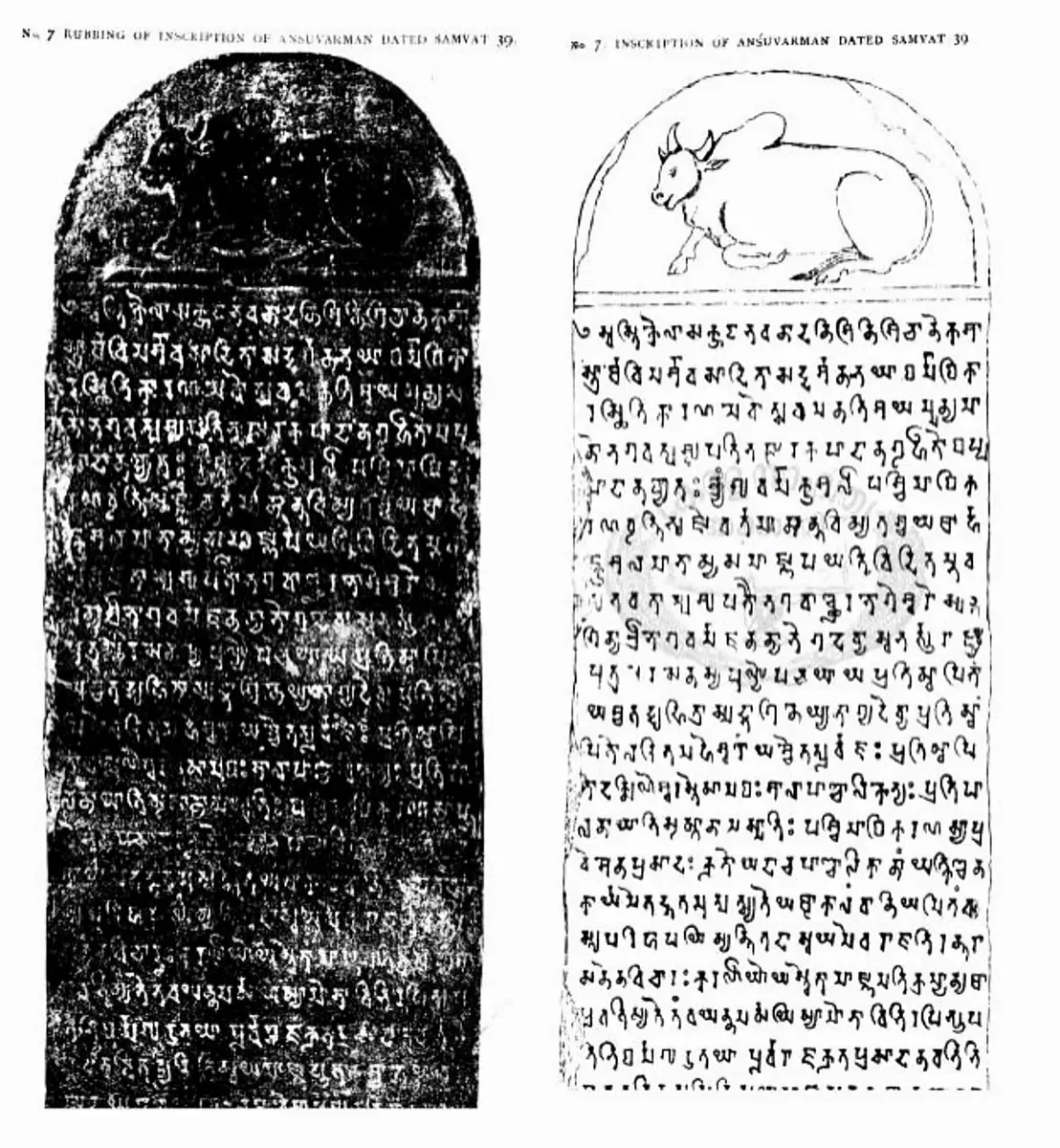
His palace was famous. A stone he set up in the village of Sanga calls it so lovely that it looked like a vermilion mark on the face of the earth, and people stared at it without blinking. Nobody has found it. Scholars have pointed to one site after another, among them a ruin-covered mound near Pashupati. A few years ago the Department of Archaeology searched again, and a survey under the ground at Handigaun found traces of a Licchavi town, but not the palace.
His fame went beyond the mountains, too. The Chinese pilgrim Xuanzang, whose journey to India and back took sixteen years, wrote a page about Nepal. Its king, he says, is a Licchavi, learned and a firm Buddhist, and “in recent times there was a king named अंशुवर्मा”, clever and learned, who wrote his own book on grammar, the science of sounds, and whose name was known far and near. Xuanzang even translates the name for Chinese readers: it means “armor of light”. Xuanzang probably never went to Nepal himself; he wrote from what he was told. Even so, within twenty years of his death, अंशुवर्मा was being talked about as a scholar-king in India.
Two palaces
On अंशुवर्मा’s later stones, the officer who carries out the order is the crown prince, Udayadeva, a Licchavi. No son of अंशुवर्मा appears as his heir. When अंशुवर्मा died, Udayadeva became king, and one order of his calls him king of great kings. His reign was short. By 624 there were two names at the top of the royal orders.
One was a Licchavi king, Dhruvadeva, who issued his orders from the old palace, मानगृह. The other was a noble, जिष्णुगुप्त (Jiṣṇugupta), who issued them from कैलासकूट, the palace अंशुवर्मा had ruled from, with the king’s name set first, as the stones have it. He was the grandson of भौमगुप्त, the noble of the generation before. For about twenty years the Valley had this arrangement: a king of the old family in one palace, and the real power in the other. After Dhruvadeva came another Licchavi king, and beside him another of the Gupta family.
Then, by 643, it was over. A new king, Narendradeva, was issuing orders by himself, from कैलासकूट. On one of his first stones he gave back a grant that भौमगुप्त had taken away long before, as if to undo that family’s rule. Nearly a century later, when a Licchavi king carved the family’s official tree at Pashupati (the one that starts with the sun, in Chapter 7), it went straight from Udayadeva to Narendradeva. अंशुवर्मा and the Gupta nobles aren’t in it at all.
The stones don’t say how Narendradeva came to power. The Chinese do. Narendradeva’s father, they say, was pushed off his throne by his own uncle, and the boy fled abroad. Tibet took him in, and later put him back on his father’s throne. One common reading puts the stones and the Chinese account together this way: Dhruvadeva, Udayadeva’s younger brother, urged on by जिष्णुगुप्त, rose against the king; Udayadeva fled with his family to Tibet; and Narendradeva was his son, who came home with Tibet’s help. It fits everything we have, but it is put together from two kinds of evidence, and neither tells the whole of it. The Chinese say only that the son fled, so whether Udayadeva himself went to Tibet, or was killed, or hid nearer home, historians still argue.
The road through the Valley
Why Tibet? Because the world around the Valley had changed. Early in the 600s, a king named Songtsen Gampo made the peoples of the Tibetan plateau into one strong kingdom, and it grew quickly. To the east, the Tang emperors had reunited China. In 641 the Tang emperor sent a princess, Wencheng, to marry Songtsen Gampo, and for some years the two powers were at peace. Now a road ran from China across Tibet, over the passes into the Kathmandu Valley, and down to India, and Chinese envoys began to use it, and so did Buddhist monks: one Korean monk of the 650s, a Chinese record says, “took the Tibetan road, passed through Nepal, and reached central India”.
The Valley sat on that road, and Narendradeva welcomed the travelers. Li Yibiao came through in the 640s, on his way to the great king Harsha in India. The Chinese histories describe the king who showed him the burning pond. He sat in a hall scattered with flowers and full of incense, his ministers on the floor around him and hundreds of armed men standing at his side. His palace had a tower seven stories high, roofed with copper tiles, its pillars decorated with pearls and jewels. At each of its four corners hung a copper tank, and water was forced up into it from golden dragons below and poured out of their mouths, so that it looked like a fountain. In 647, when the emperor had asked the countries that sent him gifts for their rarest plants, Narendradeva sent an envoy of his own to China with vegetables. The old Chinese word for one of them, bōléng, is the name of spinach. Berthold Laufer, a historian who searched the old Chinese books for the plants that came from the west, called it in 1919 the oldest dated record of spinach in China, and the oldest he knew of anywhere.
The next year the road brought a war. A Chinese envoy named Wang Xuance went to India with thirty horsemen, only to find that King Harsha had died. A minister, whom the Chinese call Aluonashun, had taken the throne, and he sent his soldiers against the envoys. Wang Xuance’s men fought until their arrows ran out, and were all captured. Wang himself slipped away at night and made for Tibet. Tibet gave him 1,200 picked soldiers, and Nepal more than 7,000 horsemen. With them he marched back down into India and fought for three days. The usurper fled, was caught, and was taken all the way to the emperor in China, where a stone statue of him was later set up at the emperor’s tomb. Nepal’s Grade 9 book says he was taken to Tibet and imprisoned there; the Chinese history says China. Either way, Nepali horsemen had ridden into India in a quarrel between China and an Indian king, and won.
Wang Xuance went west once more in 657, carrying a Buddha’s robe as a gift from his emperor to India. In the southwest of Nepal his party came to a burning pond and cooked rice over it, and he asked the king about it. Once, the king told him, a rod had struck a golden casket in the pond, and the harder a man pulled it, the deeper it sank. It held, people said, the crown of Maitreya, the Buddha who is still to come, and a fire serpent guarded it. The fire in the pond was the serpent’s fire.
Bhrikuti
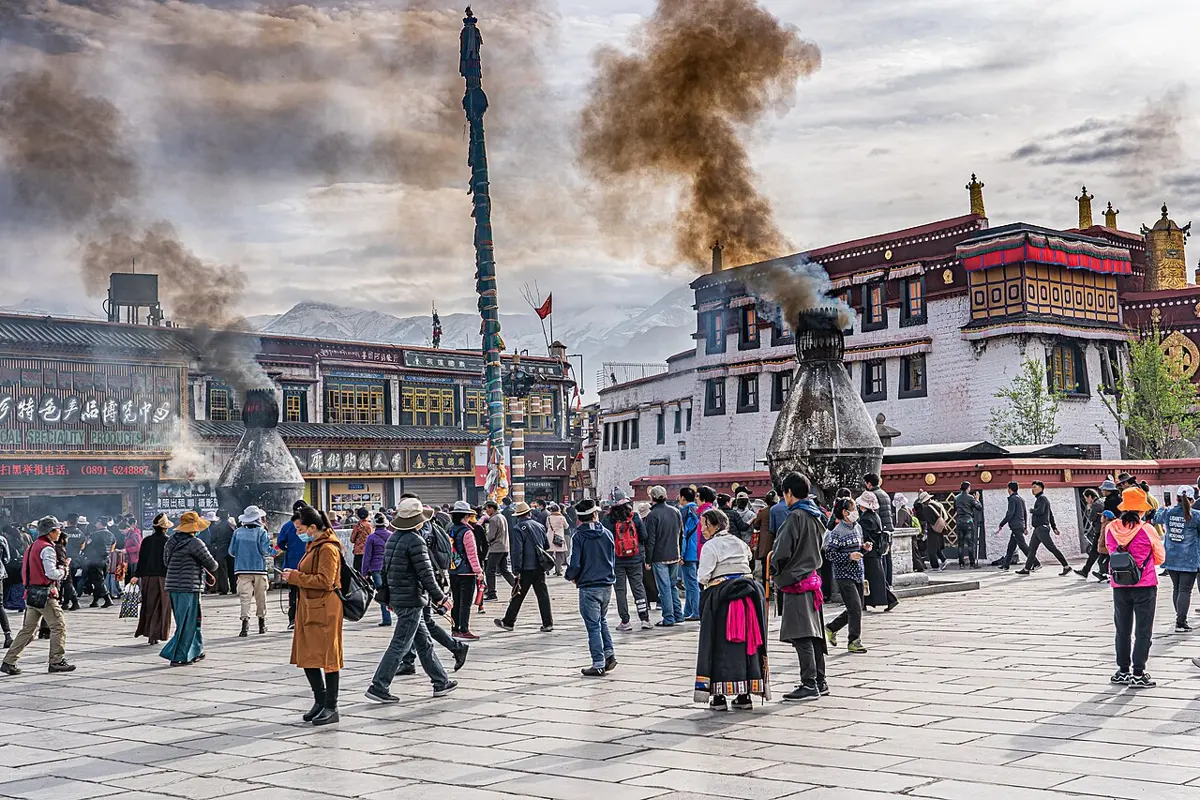
Tibetans tell the next part, and they have told it for centuries. Songtsen Gampo, they say, married two foreign princesses: Wencheng from China, and a princess from Nepal, whom the Tibetans call the Nepali queen, Tritsun, and Nepalis know as Bhrikuti. She brought with her an image of the Buddha, and for it the great temple of Lhasa, the Jokhang, was built. With the two queens, the story goes, Buddhism came to Tibet, and both are honored as forms of the goddess Tara. In Nepal she has become a symbol of the old friendship between the two countries.
How much of it can be checked? Less than most people expect. No Licchavi stone, and no other Nepali source, names her. The Chinese histories describe Narendradeva’s court in detail, and Wencheng’s wedding too, but they say nothing of a Nepali princess in Tibet. The Tibetan books that tell her story were written down centuries after her time. And they disagree about who her father was. They give him several different names. One of them, Özer Gocha, means “armor of rays” in Tibetan, which is the name अंशुवर्मा translated, the same way Xuanzang translated it into Chinese. So in some tellings, at least, she is his daughter. But अंशुवर्मा died in about 621, and the writers who have tried to date the marriage give years from the 620s to the 640s. Some Nepali historians think she was really Udayadeva’s daughter, Narendradeva’s sister, which would also explain why Tibet took the exiled family in. Others name other kings.
So nobody can say for certain who her father was, or show from the records of her own time that she lived. The memory of a Nepali queen in Tibet is old, it is held by the people she joined, and it may be true. What it isn’t is the kind of evidence a stone with a date is. Her story is best told as Tibet’s memory of her, as it is told here.
Reading an outsider’s report
The Chinese pages are a gift: without them we wouldn’t know of the burning pond, the seven-story tower, the spinach, or the horsemen who rode into India. But every report was made by somebody for some reason, and an outsider’s report has questions of its own.
Who wrote it, and for whom? The Chinese histories were put together centuries later from the court’s older records, by officials whose job was to note which countries sent presents and which obeyed. So they say that after Tibet restored Narendradeva, Nepal was “subject to Tibet”. Narendradeva’s own stones call him the supreme lord, king of kings, ruling “within the frontiers of Nepal”, and name no overlord. Each side wrote down what mattered to it, and the truth may lie anywhere between.
Did the writer see it, or hear it? Xuanzang, who wrote from what he was told, praised its king and called its people rough and untrustworthy, a judgment made from a distance. Do two reports agree? The older Chinese history says Narendradeva’s father was pushed off the throne; the newer one says he was killed. And who is telling the story of a war? The 7,000 horsemen, the three days of fighting and the thousands dead come from the winners, and no Indian record of the battle survives to check them against.
Yet outsiders notice what people at home take for granted. No Licchavi stone says that men in the Valley stretched their ear lobes with tubes of bamboo and horn until they reached the shoulders, and thought it handsome. The Chinese histories did. A Licchavi ruler had no reason to mention a pond that boiled and burned; a visitor had every reason. The stones and the strangers each see half the picture.
So the Valley in the 600s was ruled first by a great noble, अंशुवर्मा, who never quite called himself king, then by rival families sharing two palaces, and then by Narendradeva, a Licchavi who came home from exile with Tibet’s help. It sat on a new road between Tibet, China and India, and for the first time foreigners wrote it into their histories. What we know of it comes from two kinds of trace: the rulers’ own stones, which tell what they did and wanted remembered, and the reports of outsiders, which see what the stones leave out but carry their own questions. Bhrikuti belongs to a third kind, a people’s memory, kept in Tibet. The stones of these centuries have much more to say about how ordinary people lived, farmed, paid their taxes and shared their water, and that comes next.
Meanwhile, in the world: while अंशुवर्मा ruled the Valley, Muhammad began to preach in Mecca, in about 610, and within Narendradeva’s lifetime the armies of the new Muslim state had taken Egypt and brought down the empire of Persia.
Found a mistake? Please tell us.