
In the summer of 1774, a royal order went out from Kathmandu to the Limbu of the far eastern hills. Gorkha’s armies had just taken the last of the eastern kingdoms, and the order didn’t pretend otherwise. “We have conquered your country by dint of our valor,” it said. Then it turned. “But you belong to us.” The Limbu were pardoned all their “crimes”, and their customs and their rights were confirmed. They were to stay under their own chiefs, keep their land, held their own way as किपट (kipat), and “enjoy the land from generation to generation as long as it remains in existence.” The king even put a curse on his own family if he broke his word: “In case we confiscate your land, may our ancestral gods destroy our kingdom.” The pledge, it said, was being cut into a copper plate as well as written down.
It is a strange mix, a conqueror’s boast and a solemn promise in a few lines, and the two sides have remembered it differently ever since. The court’s paper reads like a pardon handed down by a winner. Limbu tradition remembers an agreement, made after years of hard fighting between Gorkha and the Limbu chiefs, especially those around Chainpur. It is called the नुनपानी सन्धि (Nunpani Sandhi), the salt-and-water treaty. A short history written in the Limbu language in 1843 remembers the war that came before it, too: how hard the Limbu fought in their hills, and the tricks, dishonorable ones in its eyes, that the Gorkha army used to split them. Later kings of Nepal confirmed the Limbu’s rights again and again, as late as 1961, so both sides took it seriously. What it meant, and what came of it, belongs to Chapter 21, where the peoples who were conquered tell these years in their own way.
The man in whose name it was written, Prithvi Narayan Shah, had six months to live. When he died, Gorkha’s kingdom ran from the Marsyangdi river, just west of Gorkha, to the hills of Ilam in the east. Twenty years later it reached past the Mahakali into Kumaon in the west and to the Teesta river in Sikkim in the east, more than 900 kilometers of mountains. The map shows the change: measured on it, roughly, the land the kingdom held grew almost three times over.
Strangest of all, most of this was done while the king on the throne was a small child. The men and women who did it were his uncle and his mother, and they spent much of the time quarreling with each other.
A king for three years
At the end of 1774 Prithvi Narayan went to Nuwakot, north-west of the Valley, to get ready for a war on the Chaubise, the small kingdoms west of Gorkha. He fell ill there. The healers could do nothing, and on his own orders he was carried down to Devighat, on the bank of the Trishuli, where he died in January 1775, aged 52.
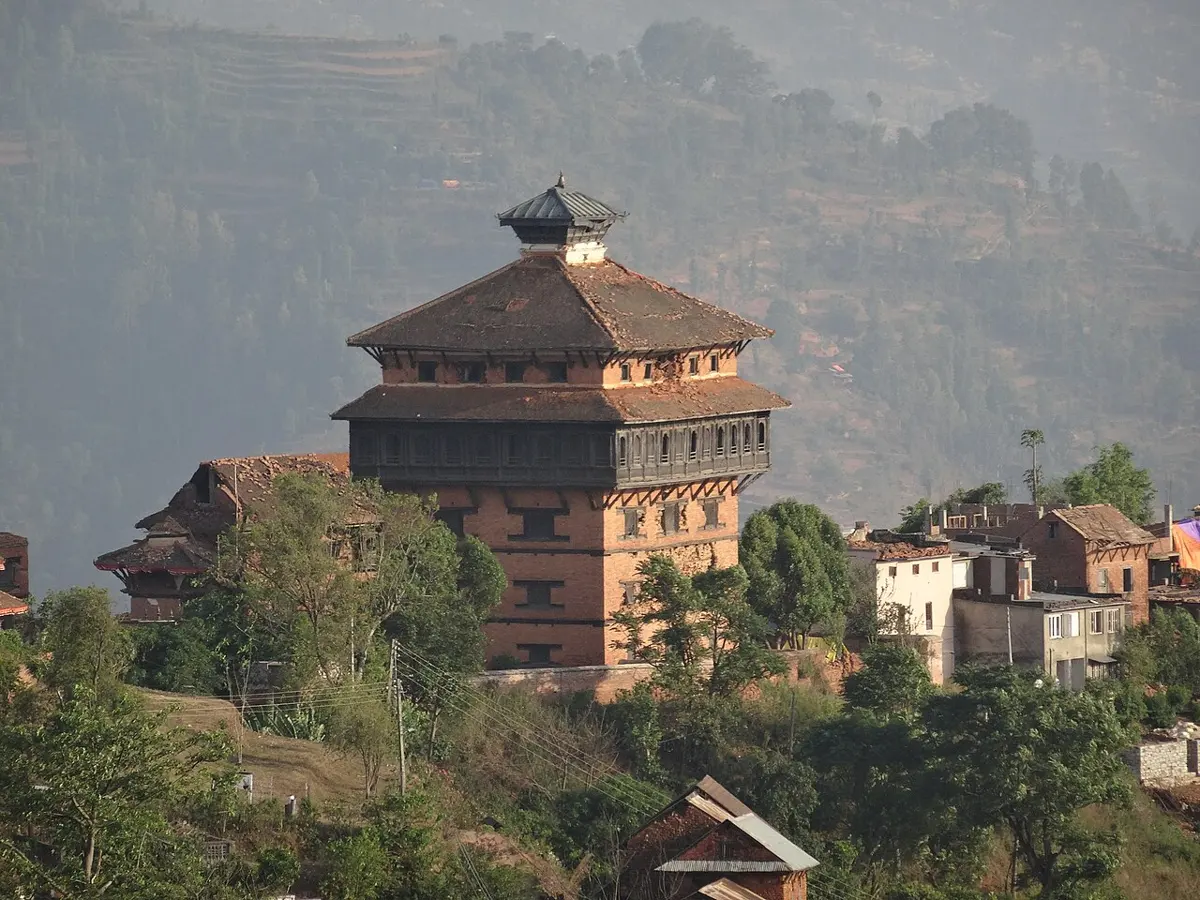
His eldest son, Pratap Singh Shah, became king. He knew Sanskrit well and wrote poetry, but his biographers don’t think much of his skill at ruling. He did one thing that lasted: his troops took Chitwan, the forested lowland between the hills and the plain, from Tanahun. His younger brother Bahadur Shah, about eighteen, was not so lucky. Accused of plotting against the new king, he was arrested while he was still mourning their father and sent out of the country. He went to Bettiah, a town just across the border in India, where a group of Italian priests had their mission. He made friends with them, and years later he gave a bell to their church at Patna.
Pratap Singh was king for less than three years. He died of smallpox in November 1777. His son, Ran Bahadur Shah, born in the summer of 1775, was two and a half.
The queen and the uncle
A child can’t rule, so someone has to rule for him, a regent. The first was the boy’s mother, Rajendra Laxmi. The obvious other choice was his uncle, Bahadur Shah, who came home from Bettiah. The two didn’t get on. He wanted to push the conquests on fast; she didn’t. Each, at one time or another, had the other locked up. In one of these turns Bahadur Shah had the queen’s minister, Sarvajit Rana, beheaded. That broke a rule Prithvi Narayan had kept, that a noble of the court was not to be put to death. In the end Bahadur Shah fled back to Bettiah, and the queen ruled.
The neighbors noticed. Over the winter of 1779–80, Tanahun, helped by Palpa and Parbat, beat a Gorkhali army at Jyamruk and drove it out of Tanahun. Then, early in 1782, Lamjung and Parbat attacked Siranchok, inside Gorkha itself. They were beaten back, and the queen wrote to Bahadur Shah at Bettiah to tell him so. Her letter says plainly why the neighbors had dared: Lamjung had attacked because it saw the split in the royal house.
It was the jolt Gorkha needed. Lamjung had been its enemy for two hundred years, and now Gorkha went after it. Bahadur Shah, even from Bettiah, had a hand in the campaign, and the queen’s commanders fought it. In the summer of 1782 they beat the armies of Lamjung and Parbat at Talughat, and that autumn they surrounded Lamjung’s capital from three sides. Its king fled north through Manang to Beni, in Parbat, to gather help. He came back in June 1784 with troops from Parbat, Kaski and five smaller kingdoms, and lost again, at Makaidanda. The king of Kaski had signed a treaty with Gorkha the year before, cut into copper; before the battle, under pressure from Parbat, he threw the copper plate into the Gorkhali camp. At the end of 1785 Gorkha took Sarangkot, the hill above Pokhara, and Kaski too was gone. Tanahun had been taken by then as well.
Rajendra Laxmi didn’t see Kaski fall. She died in July 1785, and Bahadur Shah, now 28, came back to rule for his ten-year-old nephew.
West to the Mahakali, and beyond
Bahadur Shah began with a wedding. Early in 1786 he married a daughter of Mahadatta Sen, the king of Palpa, the strongest of the western hill kingdoms, and made a deal with her father: Palpa would help Gorkha, and in return it would get the little kingdoms of Gulmi, Argha and Khanchi when they were taken. That is why Palpa is gray on the map. It wasn’t conquered at all; it stayed an ally until 1806, a story for Chapter 20.
With Palpa on its side, Gorkha swept through the Chaubise in 1786. Gulmi, Argha, Khanchi, Dhurkot, Isma, Pyuthan and the rest fell one after another, and by the end of the next year the frontier was on the Bheri river.
Beyond the Bheri lay the Baise, the twenty-two kingdoms of the Karnali, and the greatest of them was Jumla, whose king had once been their overlord. Bahadur Shah didn’t fight them all at once. First he made treaties of friendship with Jumla’s neighbors, Dullu, Achham, Doti and Kumaon, so that none of them would help it. Then, in July 1789, in the middle of the monsoon, a Gorkhali army under two commanders marched north-west through Parbat. Jumla’s army was made of farmers called up to fight, and as the weeks went by and Dashain came near, they drifted home. In mid-September 1789 the Gorkhalis took Chhinasim, Jumla’s capital, almost without a fight.
The friends were next. In 1790 Dullu, Achham and Doti were taken, and by the end of that year the kingdom reached the Mahakali. Small kingdoms such as Bajhang and Bajura were left with their own kings, paying Kathmandu. Not everyone accepted it. In April 1792 Achham rose in revolt, and when it was put down, seven or eight hundred of those who had fled were caught, beheaded and thrown into the river.
The Mahakali didn’t stop the army either. Across the river lay Kumaon, whose court was split, and a Kumaoni minister, Harsha Dev Joshi, invited the Gorkhalis in. Its capital, Almora, fell almost without a fight. From Kumaon the army turned on Garhwal, the next kingdom west, and took Garhwal’s capital, Srinagar, without a battle. But the hill fort of Langurgarh would not give in, and the army sat outside it. Exactly when all this happened is muddled in the records: Almora fell in 1790 by the British reckoning, and a year or more later in the fullest Nepali account.
Then, in July 1792, an order came from Kathmandu: come back at once. A Chinese and Tibetan army had crossed the mountains north of Kathmandu and was fighting its way south. That war is Chapter 19. The western commanders patched up a peace with Garhwal: its king, Pradyumna Shah, kept his throne and agreed to pay Kathmandu a yearly sum. The army marched home, and the westward push stopped for more than ten years.
East to the Teesta
All this time the east had a war of its own. Beyond the Mechi was Sikkim, which had sided with the Limbu chiefs who still fought Gorkha. In the autumn of 1788 the governor of Morang marched into Sikkim with about 6,000 men, 2,000 of them regular soldiers with muskets. After a hard fight the Gorkhalis won the first battle, most likely thanks to those muskets, and the army laid siege to Sikkim’s capital. But Sikkim’s raja got help from Bhutan and Tibet, and by December the Gorkhalis had been pushed back to their forts at Ilam. Then the Bhutanese went home, since their soldiers were unpaid and there was nothing to take, and by the spring of 1789 most of Sikkim’s people had submitted to Gorkha. The raja fled towards Tibet, and a Lepcha chief, next in rank to the raja, held on east of the Teesta. West of the river, the hills of Darjeeling included, the land was now Gorkha’s. How firmly it held them in those first years nobody recorded, but a dozen years later its soldiers were posted at Darjeeling and a Lepcha chief was collecting taxes for it, while the chief across the river kept raiding.
The Limbu were on both sides of this war. Some had come over to Gorkha and fought in its army, in the east and even in the west, against Lamjung and Tanahun, where they were rewarded with land; others, around Yangwarak in today’s Taplejung, fought on with Sikkim. Many people fled. The government took the land of those who ran and gave it to others, and pardoned others and gave them their land back. The east was conquered, but it wasn’t quiet.
Gorkha was also reaching north, over the mountains, into Tibet. In 1788, while one army was in Sikkim, another crossed into Kuti, a Tibetan town on the trade road from Kathmandu. That was the start of the trouble that brought the Chinese to Dhaibung four years later.
An army paid in land
How could a small kingdom, run by a child’s regents, keep armies in the field from Garhwal to the Teesta at once? Part of the answer is in how the soldiers were paid.
Nepal had very little money. Over much of the hills the land tax was paid in grain, and there was no good way to carry grain from a hundred villages to Kathmandu and then out again to the soldiers. So the kingdom didn’t try. It paid its soldiers and officers in land, a system called the jagir. A soldier was given the right to a piece of land’s rent, and he collected it himself. An English officer who visited in 1793 found that most of the army was paid this way, that the soldiers liked it best, and that they often settled their families on the land. A law of the same year said that land, not cash, was to be the usual pay. Each year the grants were handed out again, and moved about, so that no officer would grow too attached to one place.
For a kingdom at war, that mattered. A soldier paid in land needs land, and conquest supplies it. When Gorkha took a kingdom by force, land its old rulers had given away was often taken back, though seldom from those who had helped Gorkha, and handed out again as jagir, to pay for more soldiers. Historians of Nepal’s land see a loop here: the jagir gave nobles and soldiers a share in every new conquest, so each new valley could help pay for the men who would take the next one. Nobody wrote it down as a plan, but an army paid this way had good reason to keep going, and it did. The cost fell on the people who already lived on that land.
In 1794 Ran Bahadur Shah, now grown up, took power himself, and his uncle’s regency ended. Bahadur Shah was pushed aside, and a few years later he was arrested and locked in an old fort by the Bishnumati river in Kathmandu. Three months later he was dead. The fullest Nepali account says he was killed there one night in secret and cremated the next morning, so that it would look like a natural death. For nine years he had led the push that carried the kingdom to the Mahakali and beyond.
The kingdom that came out of these twenty years was big, quarrelsome at its center, and still hungry. It had a long border with Tibet, which it had just found was dangerous, and a longer one with the lands of the East India Company, which would soon be more dangerous still.
Between Prithvi Narayan Shah’s death in 1775 and Ran Bahadur Shah’s coming of age in 1794, the kingdom of Gorkha more than doubled, while its king was a child and his mother and uncle fought each other as hard as their neighbors. It won with soldiers paid in conquered land, with alliances that split its enemies, and with plain force where those failed. The Limbu were promised their land in an order both sides still remember, and the westward push stopped only when war came from Tibet.
Meanwhile, in the world: in 1775, the year Prithvi Narayan Shah died, Britain’s colonies in North America went to war against their king, and in 1783 Britain recognized them as an independent country, the United States. In July 1789, just as the Gorkhalis were marching on Jumla, a crowd in Paris stormed the Bastille, a royal fortress and prison, and the French Revolution began.
Found a mistake? Please tell us.