
Pick up a packet of cigarettes in any shop in Nepal and most of it isn’t packet at all. Since 2015 pictures of what tobacco does to the body have covered 90% of the front and the back, with five different pictures so that smokers don’t get used to one. When Nepal brought in the 90% rule, nowhere else in the world had warnings that large. In 2025 the government went further and called for the whole of both sides, the first country to do so, but the biggest cigarette maker took the rule to the Supreme Court, which ordered it held back, and as this is written it hasn’t come into force. The pictures are chosen to make you flinch.
Nobody would call a picture of a diseased body an argument. It doesn’t lay out reasons. It doesn’t say “therefore”. It goes straight past all that to a feeling, and it was designed to. Is that a trick, then? A government trying to frighten its own people?
Most of what moves people isn’t a reason at all, and that isn’t always bad. A reason bears on whether a claim is true. But people are also moved by a feeling, by what everyone else is doing, by what has always been done, by what is new, by what is natural, by someone to blame, by a comparison with something they already know. Courses in critical thinking call these appeals. An appeal can be fair or it can be a trick, and the same one can be either, so a list of “bad appeals” is no use. What helps is two questions. Does it bear on this claim, or on something else? And is it as big as the facts deserve, or bigger?
The packet passes both. The fear is about the very thing the packet is selling, and the danger is real and large: tobacco kills more than 75 Nepalis a day, and is behind about one death in eight among Nepali men. A picture that makes a smoker flinch is a feeling in proportion to the facts. It would be stranger if the packet looked cheerful.
Feelings that fit, and feelings that don’t
Feelings aren’t the enemy of thinking. Fear of a snake on the path is a good thing to have, and it works faster than any argument. A feeling goes wrong in two ways. It can be far bigger than the danger, or it can be pointed at the wrong thing. The second is where real harm is done, because a frightened crowd wants someone to blame, and anyone who hands it someone gets a hearing.
In the spring of 2020, as Covid-19 spread across the world and nobody yet knew how bad it would get, a story went round that the new 5G phone networks were spreading it. In Britain, in about two months, around ninety mobile phone masts were set on fire, many of them not even 5G, and engineers mending the networks were shouted at and threatened at work. The story failed the plainest test there is, and the World Health Organization said so: the virus was spreading in many countries that had no 5G networks at all. The fear was in proportion, because the virus was real and killing people everywhere. But it had been pointed at something that had nothing to do with it, and the facts that showed this were in plain sight. That is what a scapegoat is good for. It gives a frightened crowd a target.
Everyone, always, and brand new
In 1959 Elvis Presley’s record company put out a collection of his hits on a cover that announced: “50,000,000 Elvis Fans Can’t Be Wrong”. It sounds like the textbook example of following the crowd, and yet, about this claim, they couldn’t be very wrong. The question was whether people enjoy these songs, and fifty million people enjoying them is about the best evidence there could be. A crowd is a fair witness to what a crowd likes, and a queue outside a momo shop says something true about the momos. What a crowd can’t do is see things nobody in it can see. A million people who all believe a tea cures diabetes still haven’t watched a single cure happen, and in Kathmandu in December 2000 a whole city was sure of a sentence that was never said. So the question isn’t how many believe it, but whether the believers were in any position to know.
Tradition is the crowd stretched out over centuries, and it gets the same test. For more than two thousand years, from ancient times to the late 1800s, doctors treated the sick by letting out their blood. In December 1799 George Washington, the first president of the United States, woke with a throat infection and asked to be bled. He was bled again and again that day, by his estate manager and then his doctors, and by one modern doctor’s count about three and three-quarter liters were taken in nine or ten hours, more than half the blood in his body. Other counts are lower, but none is small. He died that night. In 1838, a lecturer to London’s Royal College of Physicians could still say that bloodletting, used wisely, was a remedy “it is hardly possible to estimate too highly”. All that time showed only that doctors kept doing it. It didn’t show that it helped, because for most of those centuries nobody had counted.
And yet tradition can hold real knowledge. In 1969 a Chinese scientist, Tu Youyou, was asked to find a new medicine against malaria. She began with the old books. Within three months she had gathered more than two thousand traditional recipes. By 1971 her team was working on one plant from them, qinghao, sweet wormwood, and getting nowhere. Then she read a line in a handbook of emergency remedies written by Ge Hong about 1,600 years earlier: a handful of qinghao, soaked in two liters of water, wring out the juice and drink it all. Soaked, not boiled. Perhaps heat was destroying the medicine. Her team made a cool extract, and on 4 October 1971 sample number 191 cleared malaria completely from infected mice. In 1972 it was given to malaria patients in Hainan and Beijing, and it worked. The drug that came from it, artemisinin, now saves more than 100,000 lives a year in Africa alone, and in 2015 she shared the Nobel Prize for it. The old book told her where to look. The tests told her she was right. That’s what a tradition is fair evidence for: a good place to start looking.
The opposite appeal, to whatever is newest, has its fair uses too. A new phone usually is better than the old one, because phones are improved each year and the improvements can be checked. For a medicine, “new” means only that there has been less time to find out what it does.
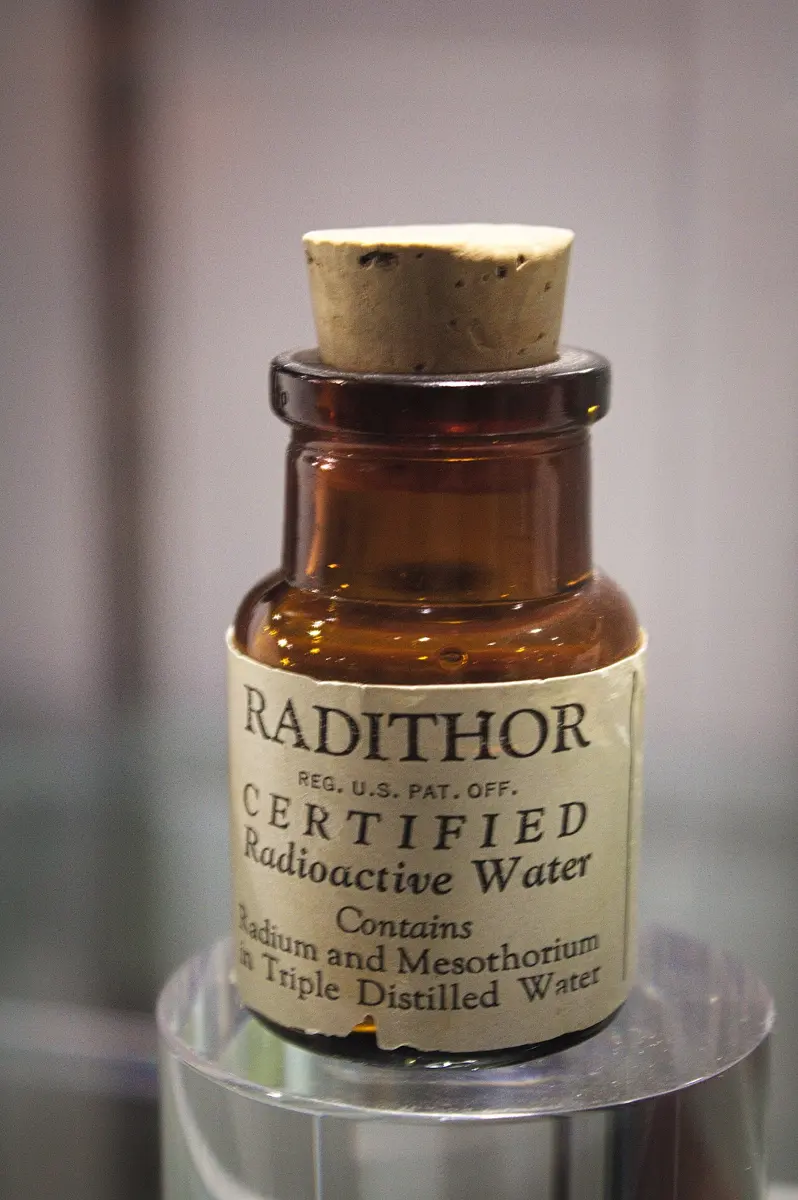
Radium shows both appeals at once, the new and the natural. Marie and Pierre Curie found it in 1898, and it was something new in science: an element that gave off energy all by itself. Then, in the early 1900s, scientists found that the waters of many famous health springs were slightly radioactive. To many people it seemed obvious that the radioactivity was what made them healthy. It was natural, it was the newest science, and spas added “radium” to their names. In New Jersey a man named William Bailey sold Radithor, water with radium dissolved in it, at a dollar for a small bottle, and guaranteed it “harmless in every respect”.
Eben Byers, a rich American industrialist who had once been his country’s amateur golf champion, hurt his arm in 1927. A doctor suggested Radithor. Byers believed it toned him up, and over the next two or three years he drank well over a thousand bottles, until his teeth began to fall out. When a lawyer from the government came to take his statement in 1931, he found that most of Byers’s jaw had been removed and that holes were forming in his skull. He died on 31 March 1932. Radium is perfectly natural. So is snake venom. Where a thing comes from says nothing about what it does inside you, and how new an idea is says nothing about whether it’s true.
Like something else
The last kind of appeal is the most useful and the hardest to judge: the analogy, which says that this is like that. An analogy can just make an idea clearer, or it can argue: you already accept something about that, so you ought to accept the same about this. It’s as strong as the likeness, and the likeness that counts is the one that matters for the point being made.
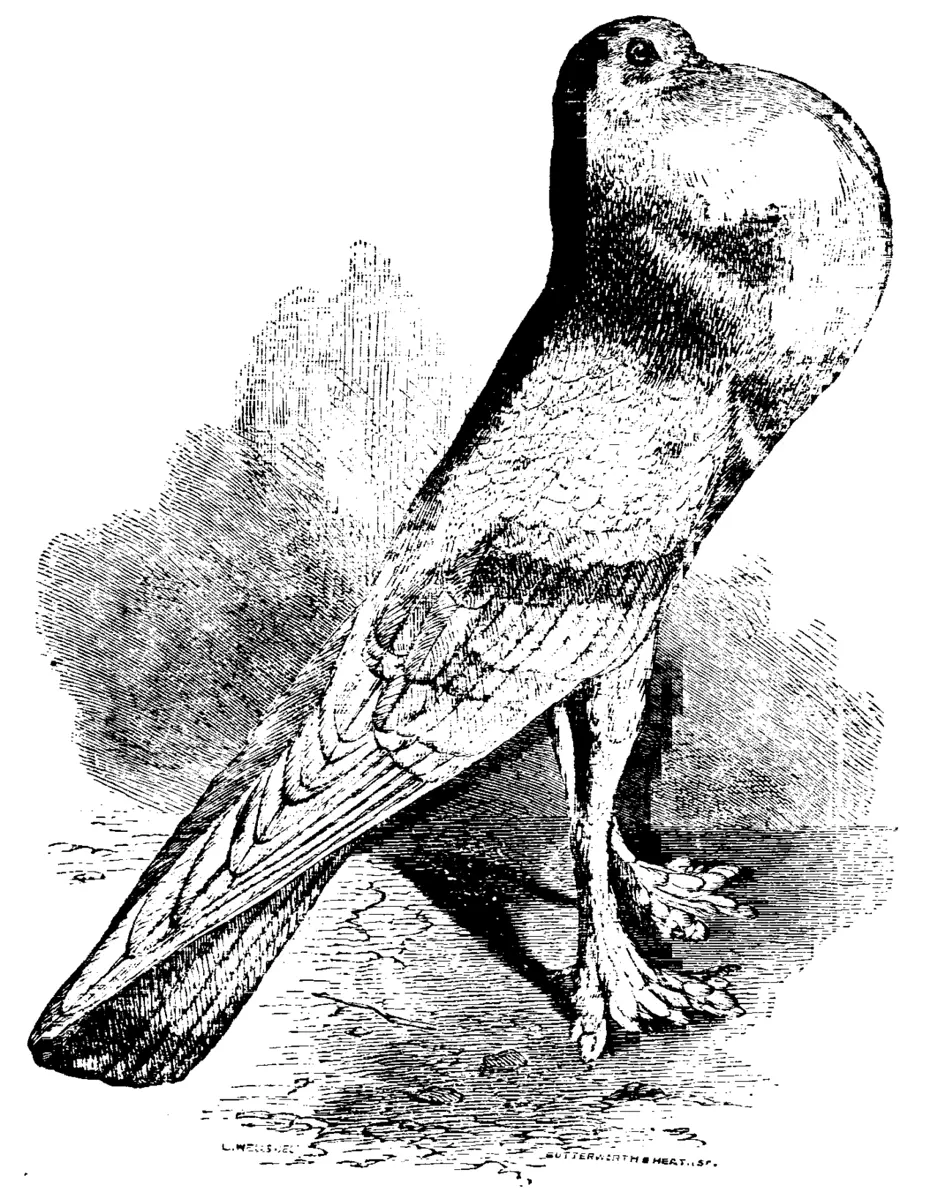
Charles Darwin built On the Origin of Species on an analogy, and he chose it with care. He took up pigeons. He kept every breed he could buy, and joined two of London’s pigeon clubs. The breeds astonished him. The pouter blows up its chest, he wrote, in a way that “may well excite astonishment and even laughter”. The fantail has thirty or even forty tail feathers, where every other member of the pigeon family has twelve or fourteen. Yet he was sure that all of them came from one wild bird, the rock pigeon, changed by breeders who chose, generation after generation, which birds would breed. Then came the analogy. “As man can produce and certainly has produced a great result by his methodical and unconscious means of selection, what may not nature effect?”
What makes it a good analogy is the next thing he did, which was to list how the two were different. A breeder can choose only by what he can see, Darwin wrote, while nature can act “on every internal organ”. A breeder chooses for his own good, nature only for the good of the creature itself. A breeder’s time is short, nature’s is whole ages of the Earth. Each difference turned out to make nature’s case stronger, not weaker. That’s how to test any analogy: say how the two things are alike, say how they differ, and ask whether the differences matter for the point. Some analogies, of course, are only there to amuse, a clever comparison or a play on words that wins a smile and holds nothing up.
Knowing the trick in advance
If these appeals work on people, can people learn to notice them? A team of psychologists from Cambridge and Bristol, working with Google’s Jigsaw unit, tried it. They made five short animated videos, each about a minute and a half long, on five tricks common in false posts: words chosen to stir up fear or outrage, arguments that contradict themselves, offering only two choices when there are more, scapegoats, and attacking the person instead of the point. Each video warned that someone might try the trick on you, explained it, and showed a harmless, funny example, one of them from the cartoon Family Guy. Nothing in them was about politics.
In six trials with about 6,500 Americans, people chosen at random to watch a video were better at spotting the trick in made-up social media posts afterward than people who watched an unrelated video. Then, in the study that took it out of the laboratory, two of the videos ran as advertisements on YouTube, where they were shown to about 5.4 million people in fifteen days, at about five American cents a view. Within a day, some viewers were asked a single question about a headline that used the trick, and so were similar people who hadn’t seen the ad. The viewers got about 5% more answers right. That’s much less than in the laboratory, and a little under the size the team had decided in advance would be worth having, but it came from a minute and a half of video, shown to millions.
What nobody knows yet is how long it lasts or how far it carries. The videos were made for Americans and tested on them. Later tests, by some of the same researchers, found that videos like these can still work a month later, though the effect fades as people forget what they learned, and that a short reminder helps it last. Reports of that work don’t all agree on how long, so a few weeks is the safe answer.
The team called their method inoculation, after a vaccine, which gives the body a weakened dose of a germ so that it’s ready for the real thing. That’s an analogy too, and it passes the test fairly well. Both work by a small, harmless dose in advance. Both wear off, and both are helped by a booster. The difference that matters is that a vaccine works while you sleep. This kind works only if you remember to ask.
So knowing the tricks doesn’t stop you feeling anything. The packet will still make you flinch, and it should. A crowd will still pull at you, and an old remedy will still feel safer than a new one. The question to ask of any of them is only whether it fits: whether the feeling, the crowd, the tradition or the comparison bears on this claim and is as big as the facts. Most of the time that question can be answered from the message itself. But a message is also sent by somebody, and who that somebody is often says more than anything in it.
Found a mistake? Please tell us.