
On Saturday, 30 June 1860, several hundred people gathered in a room of Oxford’s new museum to hear scientists argue about a book. Charles Darwin’s On the Origin of Species had come out seven months before, and the British Association for the Advancement of Science was holding its yearly meeting in the town. Samuel Wilberforce, the Bishop of Oxford, spoke against the book. In his speech he turned to the biologist Thomas Henry Huxley, who had said earlier in the meeting that having an ape for a grandfather would make no difference to his moral responsibility, and asked him something about his ancestors and apes.
Nobody took his words down exactly, and the people who were there remembered the question in different ways. One of them wrote to his brother that the bishop had asked whether Huxley preferred his descent from an ape to be on his father’s side or his mother’s. The famous version, through his grandfather or his grandmother, was printed nearly forty years later, and nobody knows whether the bishop really said it. Huxley’s own account is in a letter he wrote to a friend that September. He had listened carefully to the bishop, he wrote, but had been “unable to discover either a new fact or a new argument in it”, except for “the question raised as to my personal predilections in the matter of ancestry.” So he answered that. If the choice were between “a miserable ape for a grandfather” and a gifted, powerful man who used his gifts “for the mere purpose of introducing ridicule into a grave scientific discussion”, he said, he preferred the ape. The room, by his account, dissolved in laughter.
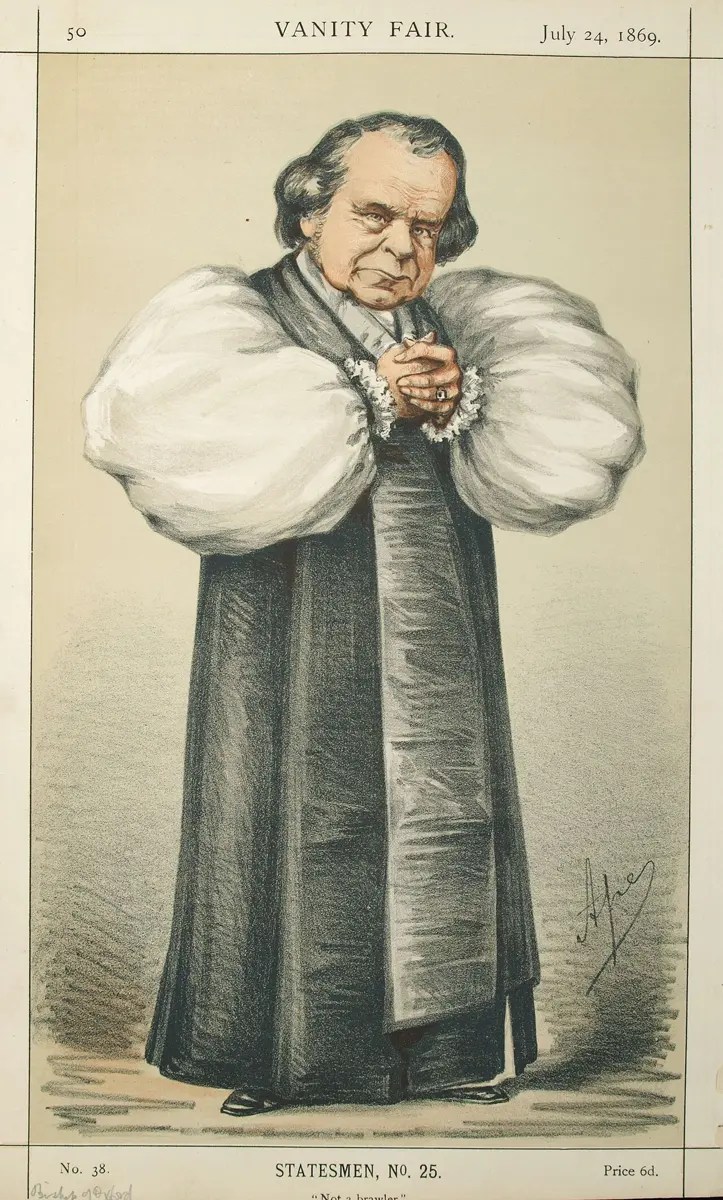
It’s a famous scene, and what’s missing from it is the point. The question that afternoon was whether living things change over generations by natural selection. A joke about Huxley’s grandmother couldn’t settle that, and neither could a joke back about the bishop. Each man had, for a moment, stopped talking about species and started talking about the other man.
An argument is a claim held up by reasons. Most broken arguments fail in one of a handful of ways, and the old books on logic give each a Latin name, dozens of them. It’s easier to sort them by what actually broke. An argument can change the subject, answering something other than the question. It can shrink the choices, pretending there are only two roads, or only one slope. It can go in a circle, so that the point holds itself up. It can lean on silence, treating “nobody has disproved it” as if that proved it. Or it can jump from too little: a few cases, or the handy ones, made to carry a claim about everything.
Each break comes with a question you can ask. Is this about the claim, or something else? Are those really the only ways it can go? Does any reason say more than the point itself? Has anyone looked? How many cases, and which ones? Those five questions catch most of the bad arguments you will ever meet.
Changing the subject
The commonest break is the one at Oxford. Instead of answering the reasons, an argument answers the person giving them. “Don’t listen to him about the new road, he failed his exams.” “She says the river is polluted, but she isn’t even from here.” This is called a personal attack, and its trouble is simple: a reason doesn’t become weaker because of who says it. If the road’s plan really does send trucks past the school, that’s true whoever points it out.
There’s one fair exception, and it matters. When a claim rests on someone’s word rather than on reasons you can check, who they are does count. A witness who wasn’t there, or who is paid by one side, gives weaker testimony. But once the reasons are on the table, the reasons are what need answering.
A close cousin is “you do it too.” A father who smokes tells his daughter not to start. “But you smoke!” she says. She has caught him out, and he may deserve it. But his smoking says nothing about whether smoking is harmful, and he may be the person best placed to know that it is. Someone who points out your own faults hasn’t answered your argument, only changed whose faults are being discussed.
The third way to change the subject is quieter, because it looks as if it’s answering. Someone says that students have too much homework. Someone else replies: “So you want students to stop learning?” That isn’t what was said. The reply has set up a weaker claim, one that’s easy to knock down, and knocked it down instead. This is called a straw man: a figure of straw, easy to knock over because it was never the real opponent. One is easy to make by accident, by hearing the most extreme version of what someone said. The cure is to ask whether the person would agree that this is what they meant. If they wouldn’t, the argument has changed the subject without anyone noticing.
Shrinking the choices
Nine days after the attacks of 11 September 2001, President George W. Bush of the United States spoke to both houses of Congress. “Every nation, in every region, now has a decision to make,” he said. “Either you are with us, or you are with the terrorists.”
As a warning to governments, it was clear. As an argument, it left out a place to stand. A country could be against the terrorists and still disagree with some of what America planned to do about them. The sentence offered two choices where there were at least three. That’s the shape of an either-or argument: it squeezes the world down to two options so that rejecting one seems to force you into the other. “Either we cancel the trip or someone will get hurt” leaves out going with more teachers. “Either you’re with us or against us” leaves out partly with you.
There’s a second form, which works the other way. It treats two things as rivals when both can be true. Is a student’s good result down to hard work or to a good teacher? Very often it’s both, and asking which one forces a choice nobody needs to make.
Sometimes there really are only two choices. A coin lands heads or tails. The question is never whether an argument offers two options, but whether two is really all there are.
The slippery slope shrinks the choices in time. It says that one small step will lead, step by step, to disaster, so the first step mustn’t be taken. On 7 April 1954, a reporter asked President Dwight Eisenhower why Indochina, then at war, mattered to America. Part of his answer has been quoted ever since. “You have a row of dominoes set up,” he said, “you knock over the first one, and what will happen to the last one is the certainty that it will go over very quickly.” If Indochina fell to communist rule, he went on, it might be followed by Burma, Thailand, “the Peninsula” and Indonesia, and the danger would reach Japan, Formosa (Taiwan), the Philippines, even Australia and New Zealand.
This idea helped carry the United States into the long war in Vietnam. In 1975 communist forces took South Vietnam, and Laos and Cambodia came under communist rule the same year. Whether the row stopped there because the dominoes were never really in a row, or because the war bought the countries beyond time to grow strong, has been argued ever since. Robert McNamara, who as America’s Secretary of Defense had run much of that war, said in 1995: “I think we were wrong.” Vietnam’s loss, he said, “didn’t lead” to communist control of Asia.
The argument over the dominoes was never about whether slopes exist. Some steps really do lead to others. The argument was over whether each step on this particular slope was likely. That’s the test for any slope. A slippery slope breaks when it states the steps without giving a reason for each, as if saying “and then” were enough. “If we let Grade 8 use phones in the library, soon everyone will use them in class and nobody will pass” has three steps and no reasons. Ask for the reason behind each step, and see which ones are left standing.
Going in a circle, and leaning on silence
Some arguments don’t break so much as never leave the ground. “This is the best coaching center, because no other center is as good.” The reason is the conclusion in other words. It sounds like support, and holds up nothing. Going in a circle like this has an old name, begging the question, which comes, by way of Latin, from Aristotle’s phrase for asking your listener to grant the very point you set out to prove. (Most people now say “that begs the question” to mean “that raises the question”, so the name confuses more than it helps.)
Circles in real life are rarely that short. They run through so many steps that nobody can see them closing. In December 2000, when a rumor that a film star had insulted Nepal set Kathmandu on fire, one politician was asked for proof that the star had said it. Among his reasons, the government had banned the star’s films, and that too, he said, proved it was true. But the ban had come because of the riots, and the riots because of the rumor. The proof was the claim itself, gone round the town and come back.
Leaning on silence is the opposite trouble. A circle has a reason that is really the conclusion. This kind has no reason at all, and treats the gap as one. “Nobody has proved my lucky pen doesn’t help in tests, so it helps.” Nobody has proved it doesn’t, because nobody has tried. The argument puts the work on the doubter, when it belongs to whoever is making the claim. If no one has shown something false, that leaves it unknown, not true.
But silence isn’t always empty. It depends on whether anyone has looked where the evidence would be. When the Nepali Times played the whole of the film star’s interview and found no mention of Nepal anywhere in it, that silence meant something. If the insult had been said, it would have been on the tape. A search that would have found a thing, and didn’t, is evidence that it isn’t there. “Nobody has disproved it” is no reason to believe. “People looked hard, in the place it would be, and found nothing” is a good reason to doubt.
Too little underneath
The last kind of break is the commonest in everyday talk. Two shops in Pokhara serve cold momo, so Pokhara’s momo are bad. One rude bus conductor, so the whole company is rude. This is a rash generalization, a claim about all of something built on a few cases. Its cousin, the sweeping generalization, runs the other way: it takes a rule that is true in general and forces it onto a case it doesn’t fit. “Students must come to school on time, so the boy with a high fever must come too.” Good rules have exceptions, and a sweeping argument forgets them.
The more cunning version doesn’t use too few cases. It uses the right ones, picked out of many. This is cherry-picking: choosing only the cases that support you, as if you had gone round a tree taking only the ripest fruit and then reported that all of its cherries were ripe.
In April 2006 a British newspaper ran an opinion piece by a geologist under the headline “There IS a problem with global warming... it stopped in 1998.” Its main evidence was that in the temperature record kept by the Climatic Research Unit at the University of East Anglia, the world’s average temperature had not risen from 1998 to 2005. That was true of the record he used. The trouble was the starting year. In 1997 and 1998 came one of the strongest El Niños on record, when unusually warm water spreads over the eastern half of the tropical Pacific, and 1998 became the hottest year that had ever been measured, with the El Niño as one of the reasons. Start a line at an unusually high point, and the years after it look flat, or even cooler, for a while.
The writer saw this objection coming. People who mocked him for judging the climate on eight years, he wrote, were happy to judge it on the 28 years from 1970 to 1998. It sounds like a fair point, but it isn’t the same thing. Twenty-eight years is long enough for a steady rise to show above the zigzag of single years. Eight years starting from a spike is not. In today’s version of the same record, every year since 2013 has been warmer than 1998, and the three warmest years by far are the last three. The cherries had been honestly counted. They had just been picked from one branch.
Here are all five kinds side by side, in arguments made up for this book.
A broken argument, a true claim
Back to Oxford, because the story has a twist. That same July, an unsigned review of Darwin’s book came out in the Quarterly Review, one of the most serious magazines in Britain. It was by Wilberforce. Darwin read it, and wrote to his friend Joseph Hooker that it was “uncommonly clever”: it “picks out with skill all the most conjectural parts, & brings forwards well all difficulties.” To Huxley he wrote that he had “chuckled much” at the way it made fun of him and his grandfather.
So the bishop who argued badly in the hall argued well enough on paper to impress the man he was arguing against. His joke about apes didn’t make him wrong about everything, and Huxley’s clever reply didn’t make Darwin right. What made the case for evolution was evidence, gathered over decades, not a good line at a meeting.
That’s the last thing to know about broken arguments. Spotting the break tells you that this argument doesn’t hold its claim up. It doesn’t tell you the claim is false. A true claim can be defended badly: a person can say that smoking is harmful because their uncle told them so, and still be right. A false claim can have a clever argument, and needs a better answer than a name for its fault. Shouting “straw man!” or “personal attack!” at every disagreement is its own way of changing the subject. The useful move is quieter: say what broke, then ask whether there is a better argument for the same claim, or against it.
Broken arguments at least look like arguments. Most of what moves people never pretends to be one. A crowd, a tradition, a frightening picture or a word like “natural” can push a person toward a belief without offering a single reason, and some of those pushes are perfectly fair.
Found a mistake? Please tell us.