
On 22 April 1983 the German news magazine Stern announced an astonishing find: Adolf Hitler’s diaries. There were about sixty small black notebooks, written in his own hand from 1932 to 1945, and the story of how they had survived was as good as the find. In the last days of the war, as Soviet troops closed in on Berlin, a plane had flown out carrying chests of Hitler’s private papers. It crashed in a forest near Dresden. Local people had taken the papers from the wreck, and they had been hidden in East Germany ever since.
Part of that was true. The plane really did crash, and Hitler’s own pilot later wrote that Hitler, on hearing of it, grieved for the servant on board, whom he had trusted with “extremely valuable documents”. Nobody knows what was in those chests. What Stern had bought, for 9.3 million German marks, was the work of Konrad Kujau, a dealer in Nazi souvenirs in Stuttgart, who had written the notebooks himself, a few a month, in cheap notebooks from East Berlin, splashing them with tea to make them look old. Two weeks after the announcement the German government’s archive declared them fakes. Its president called them grotesque and superficial.
How did a respected magazine, two famous historians and a row of handwriting experts get it so wrong? Not by believing everything. They checked. They just checked the wrong things, and they trusted the wrong people about what had been checked.
Five questions about a source
Most of what you know came from someone, and the question is how far to lean on each someone. Five things make a source stronger or weaker, and every one of them is something you already use without naming it.
Picture yourself in Beni in July, wanting to take a jeep up to Jomsom, and wondering whether the monsoon has closed the road. (The scene is made up.) A jeep driver who came down it this morning says it’s open. A lodge owner, who would like you to stay another night, says it’s blocked. Your uncle in Kathmandu says he read on Facebook that it’s fine. An engineer from the roads office, who wasn’t there today but has worked on that road for twenty years, says a stretch near Tatopani often slides after heavy rain like last night’s.
Whom do you believe? You’d probably lean on the driver, because he was there. That’s the first question: could this person know? People who study this call it the ability to see, though hearing, touching and having the records all count. Your uncle can’t see the road from Kathmandu.
You’d trust the lodge owner less, not because he’s a bad man but because he gains if you stay. That’s vested interest: something to win or lose by what you believe.
The engineer brings expertise: knowledge, training and experience that bear on this very question, not on questions in general.
Then there’s reputation, what the source has earned by being right before, or what goes with what they are: a doctor, a newspaper, a government office. And there’s neutrality: whether the person leans one way for reasons apart from money, out of loyalty, prejudice or the job they’ve been given.
Those five are about who is speaking. Two more questions are about what’s said, whoever says it. Is it plausible, likely to be true in itself? And does it fit the other evidence? A road that slid last night is plausible in July. A road the driver just came down fits the jeep standing in front of you, muddy to the doors.
None of the seven settles anything alone. Together they tell you roughly how far to lean, and the diaries failed nearly every one.
Who could see, and who gained
Start with the question that sank them: who had actually seen what?
When Hugh Trevor-Roper went to a Swiss bank to look at the diaries in April 1983, he was one of the best-placed people in the world to judge them. He was a historian at Cambridge, a specialist on Nazi Germany, and at the end of the war he had been the British intelligence officer sent to find out how Hitler died. His book on it, The Last Days of Hitler, had made his name. He was also a director of The Times, whose sister paper wanted to buy the serial rights. Stern had set the diaries out in the vault with other papers and Nazi souvenirs around them, and he was impressed by the sheer amount.
He was also told two things. He was told that the paper had been chemically tested and shown to be from before the war, and that Stern knew the identity of the officer who had rescued the papers from the plane. Neither was true. He could see the notebooks, but not the tests, which hadn’t been done, and not the source, whom only the reporter had dealt with. On the things that mattered most, the expert was taking someone’s word.
The handwriting experts were worse off still. Stern wanted secrecy above all, in case a rival heard of the scoop, so it sent them single pages rather than whole diaries. To compare them with, it gave them samples of Hitler’s handwriting, and some of those had come from the same dealer and were Kujau’s too. So when an American examiner reported that the two were written by the same hand, he was right. In part, the experts were comparing the forger’s writing with the forger’s writing, and of course it matched. Confirmations that all traced back to one man in Stuttgart were really one.
And the reporter who brought the diaries in, Gerd Heidemann, had never seen where they came from. He had found the graves of the plane’s crew, and he had a dealer who said the notebooks came from East Germany. When an old SS general, a friend of his, told him that some entries described visits to his regiment that couldn’t have happened as written, he decided that Hitler must have written down his plans instead of what he did.
The vested interests were everywhere, and they ran in one direction. Heidemann kept a large share of the money Stern gave him for the dealer, more than a million and a half marks by the reports of his trial, and in 1985 he and Kujau were both sent to prison for the fraud. The magazine had paid millions and hoped to earn them back by selling the rights to papers abroad. The editors, and the papers buying from them, wanted the scoop of their lives, and once they had paid for it, a doubt meant money lost.
Neutrality failed as well, and quietly. Heidemann was no neutral reporter where the Nazis were concerned. He had bought a yacht that once belonged to the Nazi leader Hermann Göring, and spent years among old Nazi officers, two of whom, former SS generals, were witnesses at his wedding. It doesn’t make him a liar. It makes him the last person to ask whether a great find about Hitler was too good to be true.
Reputation did the rest, and here is the uncomfortable part, because reputation is usually good evidence. Stern was a big, serious magazine known for its investigations. Trevor-Roper was famous for exactly this period. The American historian Gerhard Weinberg, who had written the standard guide to captured German documents, came to look on behalf of Newsweek, and found himself partly reassured by the fact that Trevor-Roper had been convinced. Each reputation leaned on the others, and underneath them all was one dealer. Weinberg did say, to his credit, that he would feel more comfortable if a German historian of the period who had already made his name had looked at it. Nobody had asked one. Two of the leading German historians, hearing the news, said at once that they doubted it.
Expertise, finally, is narrower than it sounds. Trevor-Roper knew Hitler’s last days better than almost anyone. He wasn’t an expert on paper, ink, bindings or handwriting, and the question was really about those. One of the handwriting examiners couldn’t read German. None of them specialized in Nazi documents. Each was an expert, just not in this.
What it said, apart from who said it
The two questions about the claim itself might have saved everyone, if anyone had asked them early.
Was it plausible that Hitler kept a diary for thirteen years? Historians who knew his habits objected at once. He dictated rather than wrote. Nobody close to him had mentioned a diary. And a bomb in July 1944 had hurt his arm, which would have made writing hard. Trevor-Roper had turned the question round the wrong way. “Who, I asked myself, would forge sixty volumes when six would have served his purpose?” A big pile looked like evidence of truth. In fact the forger had simply kept going, as long as he was paid, and once wrote three volumes in three days.
Did it fit the other evidence? The paper was checked at last, once the doubts were public. The government archive found polyester thread in a binding, which wasn’t made until after the war, glue with post-war chemicals in it, and a whitener in the paper that didn’t exist in Hitler’s time. Then came the giveaway. The diaries made the same mistakes as a book. Kujau had copied much of his material from a published collection of Hitler’s speeches and doings, and where that book had an error, so did Hitler’s “diary”. That collection put a crowd at a rally in Breslau at 500,000, where more reliable reports put it at about 130,000. The diary said 500,000 too. A man writing the night after a rally doesn’t copy a mistake from a book printed decades later.
At the press conference on 25 April, the noisiest moment came from David Irving, a British writer on Hitler, who called the diaries fabrications and was led out shouting for the ink to be tested. On the ink he was right. Within days he said he was coming to believe the diaries were genuine. In 2000 he sued an American historian and her publisher in London for calling him a Holocaust denier, and lost: the judge found it “incontrovertible that Irving qualifies as a Holocaust denier.”
In the end the matter wasn’t settled by anyone’s name, good or bad. It was settled by thread and paper, evidence that didn’t care who was asking.
Against their own interest
There was one more voice at that press conference, and it’s the most worth hearing.
By then Trevor-Roper had his doubts. He had questioned Heidemann for over an hour the day before and got a different story of where the diaries came from. With the world’s press watching, he stood up and said he was no longer sure. “I must have misunderstood,” he said. “The link between the airplane and the archive is not absolutely established.” And then, with some stumbling: “As a historian, I regret that the, er, normal method of historical verification, er, has, perhaps necessarily, been to some extent sacrificed to the requirements of a journalistic scoop.” It cost him dearly. He had already put his name to the diaries in print, and his reputation never fully recovered.
That is why such a statement is worth more than most. When people say what helps them, you can’t tell whether they believe it or just want it. When they say what hurts them, they have no reason to say it except that they think it’s true.
Science has a small version of this, and it happens more often than people think. In January 2020 the American chemist Frances Arnold, who had won the Nobel Prize in Chemistry fifteen months before, told the world that she and her colleagues were withdrawing a paper they had published in the journal Science. When the work was repeated, it didn’t give the same results. “It is painful to admit,” she wrote, “but important to do so. I apologize to all.” She added that she had been busy when it was submitted and hadn’t done her job well. Nobody forced her to say that. Every scientist who read it learned something about the paper, and something about her.
Compare it with a denial. When a film star is accused of insulting Nepal and says he never did, his denial is true or false, but it’s weak evidence either way, because he would say the same thing in both cases. What settled the matter in December 2000 was the recording of the show, a source with every ability to see and no interest to protect. A statement against interest is the opposite of a denial: almost the only reason to make it is that it’s true.
Experts, not authorities
There’s an old way of settling a question, which is to ask who has the right to say. The priest, the king, the professor, the boss. The astronomer Carl Sagan, writing in 1995 about the habits of thought that keep people from being fooled, put the alternative in a line: “in science there are no authorities; at most, there are experts.”
The difference is in why you listen. An authority is believed because of who they are, and their word is meant to end the question. An expert is believed because of what they know, about this question, and only as far as the evidence they can point to, which anyone can check. An expert is wrong now and then, and says so, like Frances Arnold.
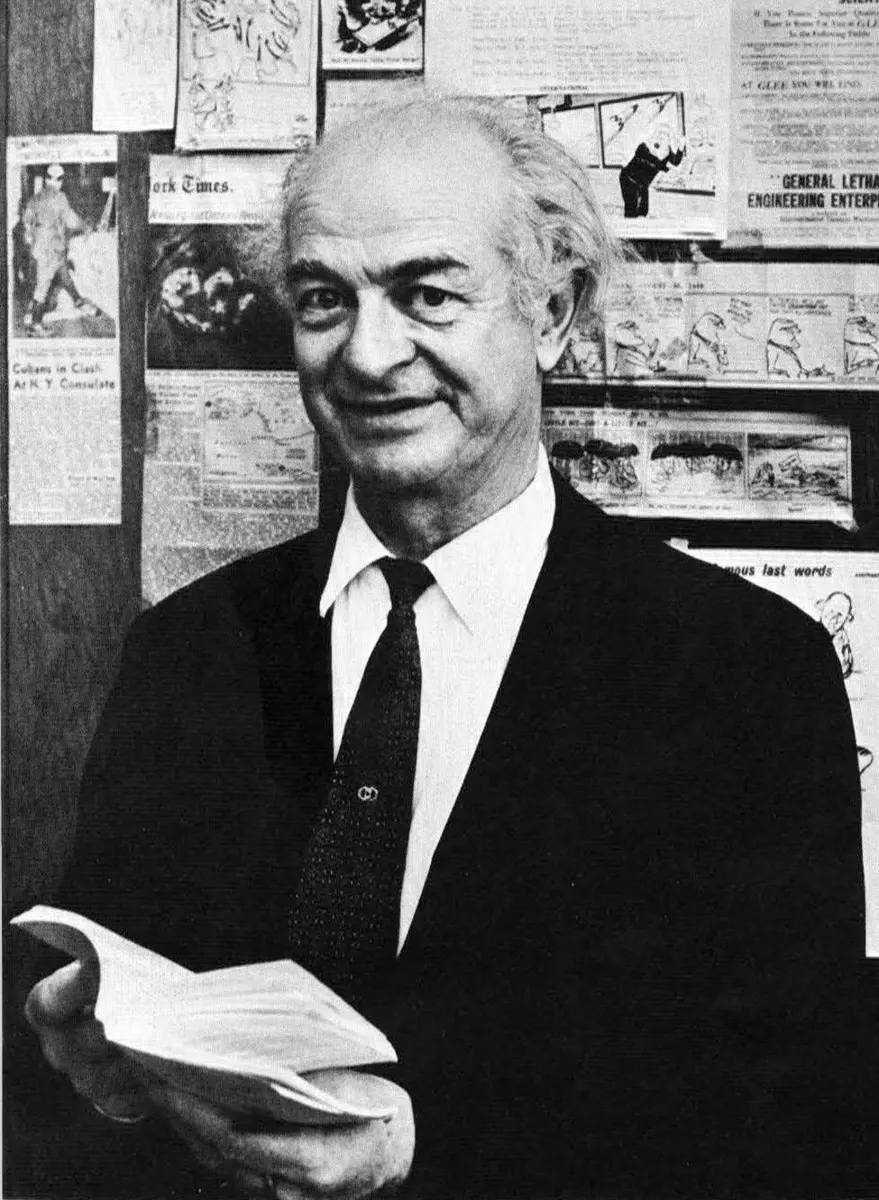
Few people show the line better than Linus Pauling. He was one of the great chemists of the twentieth century, and he won the Nobel Prize in Chemistry in 1954 for his work on how atoms bond together, and then the Nobel Peace Prize in 1962 for his campaign against nuclear weapons. In 1970 he published Vitamin C and the Common Cold, which said that large doses of vitamin C would prevent colds and help cure them. It sold widely. Scientists and doctors criticized it, and Pauling went on to claim that vitamin C helped against cancer too.
On the chemistry of the bond, few people alive could have argued with him. On colds, he was a brilliant man outside his own field, and his prizes didn’t carry over. What did carry over was that his claim could be tested, and it was, many times, in fair trials of the kind that toss a coin and give the other group a dummy pill. When the trials were pooled in 2013, about 11,000 ordinary people taking vitamin C every day caught colds about as often as those taking a dummy. Their colds were a little shorter, by about 8% in adults. Taking it once a cold had started made no clear difference. A trial at the Mayo Clinic in 1979 found no effect on cancer. So Pauling wasn’t entirely wrong, but he was far more sure than the evidence allowed. The trials settled the question that the Nobel Prizes couldn’t.
There’s a trap on the other side, and it matters. Weighing the source isn’t the same as answering the claim. A seller praising his own goods may be telling the truth, and a man you dislike may be right about the ink. Attacking the person instead of the claim is a well-known way of arguing badly. What the five questions give you is a sense of how far to lean before you know more, which is all most of us ever have. When better evidence turns up, a fair test or a page of paper under ultraviolet light, it outweighs everyone’s reputation, including the expert’s.
So the diaries failed nearly every test a source can fail, and the paper settled what the people could not.
Most sources you meet won’t be forgers, and most of the time a good reputation and a real expert are exactly what they seem. The questions aren’t meant to make you doubt everyone. They’re meant to tell you whom to lean on more, and when a whole tower of trust is standing on one person you haven’t met.
There’s a further catch, though. Even an honest source, who saw what they say, can mislead you by what they don’t say. The jeep driver tells you about the road he came down. He doesn’t mention the drivers who turned back.
Found a mistake? Please tell us.