
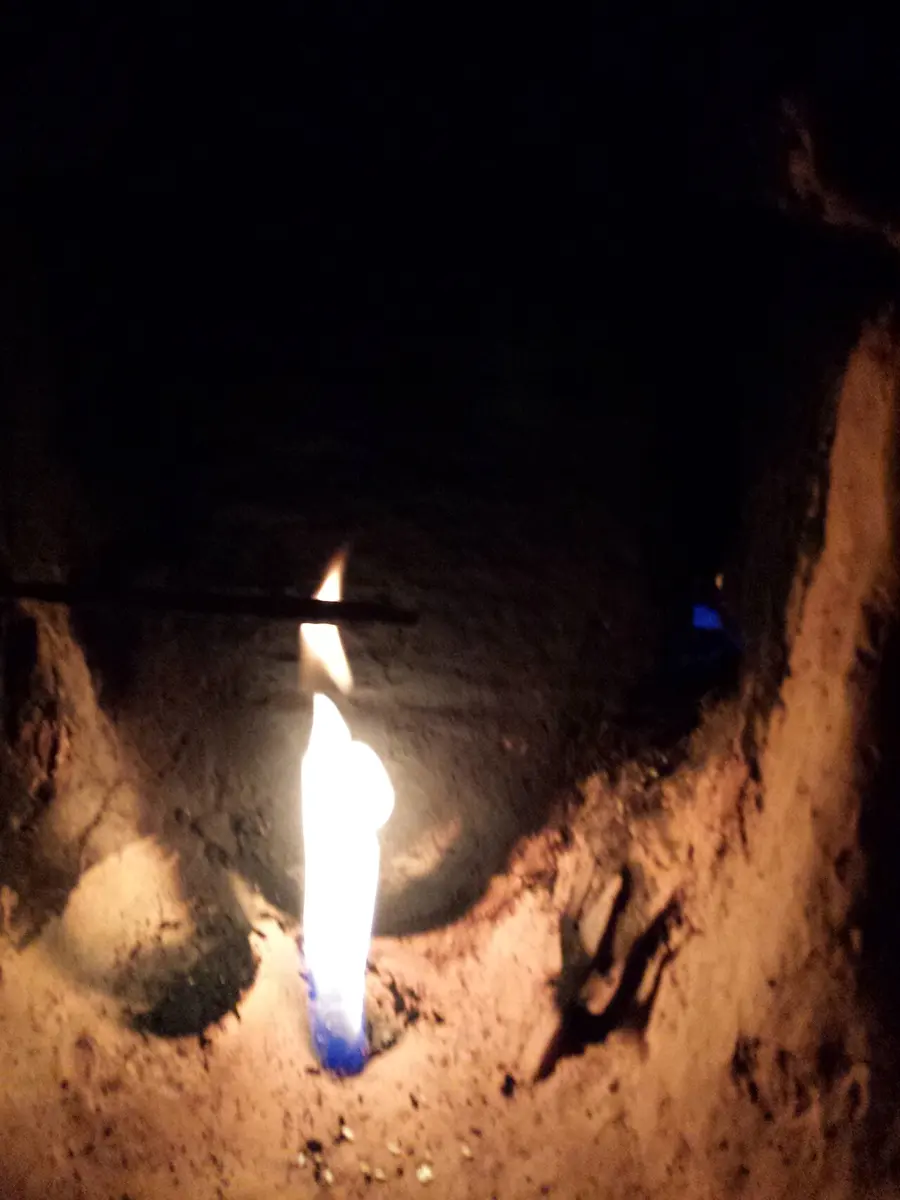
At three temple sites in Dailekh, in western Nepal, flames rise from the ground, and they have been burning for a long time. Geologists see in them natural gas, and in places crude oil, seeping up from the rocks below. They have been looking for where it comes from since the 1980s.
Not a mineral, but counted as one
A mineral, to a geologist, is a naturally occurring, inorganic solid with a definite chemical composition and an ordered internal structure. Petroleum (crude oil) and natural gas are not solids, and they are organic. So they are not minerals in the strict sense. Mining laws and departments use the word more loosely: Nepal’s Department of Mines and Geology lists petroleum and natural gas among its fuel minerals, and runs the search for them.
The methane dissolved in the groundwater under Kathmandu Valley is a natural gas too (see Kathmandu’s lake-bed clay).
The seeps
Oil and gas seep out along a stretch of about 14 km at Padukasthan, Shirasthan and Nabhisthan in Dailekh, and gas burns there continuously. Gas alone seeps at Muktinath in Mustang. A seep shows that oil or gas has formed somewhere below; it does not show how much there is, or whether it is trapped in a place a well can reach.
Nepal’s search for petroleum
| When | What | Source |
|---|---|---|
| 2036 BS (about 1979–80) | aeromagnetic survey of about 48,000 km² of southern Nepal, with World Bank help | PEPP |
| 2039 BS (about 1982–83) | the Petroleum Exploration and Promotion Project set up in the Department of Mines and Geology | PEPP |
| 2039–2041 BS | 1,251 line-km of seismic survey, by the French company CGG, with World Bank support | PEPP |
| 2041–2042 BS | photogeological map of about 60,000 km² of the Terai, Churia and part of the Mahabharat range | PEPP |
| — | Shell/Triton surveyed Block 10 (Biratnagar) and drilled a test well to 3,520 m: it was dry | Kaphle 2020 |
| 1998 and 2004 | Texana Resources (USA) took Blocks 3 and 5; Cairn Energy (UK) Blocks 1, 2, 4, 6 and 7 | Kaphle 2020 |
| 2013 | the companies were reluctant to explore extensively; the government cancelled the agreements and both left | Kaphle 2020 |
| March 2016 | Nepal and China agree to a preliminary study at Dailekh | Kathmandu Post 2026 |
| 2019 | a formal agreement worth Rs 2.4 billion; a seismic survey of 400 km² around the seeps | Kathmandu Post 2026; Kaphle 2020 |
| 11 May 2023 | drilling begins at Jaljale, Bhairavi Rural Municipality-1, Dailekh, by CNPC Xibu Drilling Engineering, a Chinese state company, with the China Geological Survey | Kathmandu Post 2025, 2026 |
The blocks. The Terai and the Churia hills are made of sedimentary rocks in which petroleum can form, so the Project divided 44,220 km² of them, from west to east, into ten exploration blocks of about equal size, offered to international oil companies by bidding. The Project reports US$2,060,553 earned by the government from data sales, land leases and fees.
The Jaljale well: what was found
| Date | Figure | Who said it |
|---|---|---|
| 19 June 2025 | drilled to 4,013 m; a preliminary estimate of 112 billion cubic meters of gas | Dinesh Kumar Napit, deputy director general, Department of Mines and Geology, to the Kathmandu Post: “We found a significant amount of gas … this opens the way for commercial testing.” |
| 12 February 2026 | 80.7 billion cubic meters of gas, in the China Geological Survey’s report to the Department | the Kathmandu Post |
So far the drilling has been within about 3 km of the seeps at Shirasthan, Nabhisthan and Padukasthan.
What is not yet known
- Whether it can be produced. Before any production, the well must be tested for the gas’s quality, how fast it flows, and whether it needs special methods to extract. The Department’s spokesperson Dharmaraj Khadka said in February 2026 that the condition of the gas and the right technology were not yet determined.
- Agreements. The next phase needs further agreements between the governments of Nepal and China; Nepal has asked China to carry out the well testing.
- The size. The two estimates differ (112 and 80.7 billion cubic meters), and both are estimates of gas in the ground, not of gas that can be taken out.
In short
Where these facts come from
- Petroleum Exploration and Promotion Project, Introduction and Petroleum exploration blocks, Department of Mines and Geology.
- Kaphle K.P., Mineral resources of Nepal and their present status, Nepal Geological Society, 2020.
- Gautam K.P., Over 112 billion cubic metres of natural gas found in Dailekh, preliminary report shows, The Kathmandu Post, 19 June 2025.
- Gautam K.P., 80.7 billion cubic metres of natural gas confirmed in Dailekh, The Kathmandu Post, 12 February 2026.
- King H.M., What is a mineral?, Geology.com.