
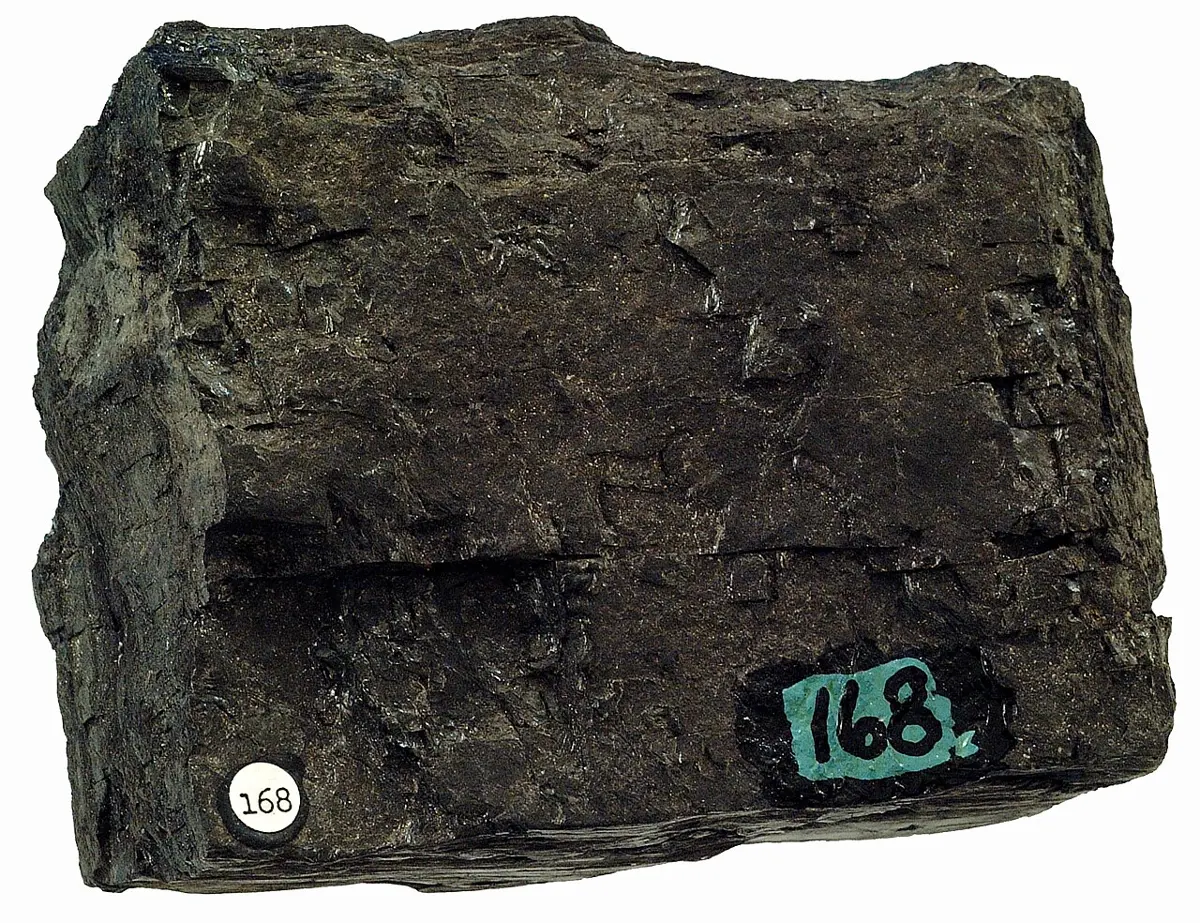
Pick up a lump of coal and you are holding a swamp. The black rock is made of plants that grew, died and were buried millions of years ago. Coal is organic: it was made by living things. That is why geologists do not call it a mineral, although miners and governments do. In Nepali it is कोइला.
How coal forms
- A swamp. Plants grow in a swamp; when they die, they fall into the standing water. Swamp water has little oxygen, so the plants do not fully rot.
- Peat. Over a long time, plant debris piles up into a thick layer called peat.
- Burial. Mud or sand, often brought by a flooding river, buries the peat. Burial, pressing and slow chemical change (coalification) turn it into coal, a rock, richer and richer in carbon.
- The ranks of coal. The deeper and longer it is buried, the higher its rank: lignite (soft and brown, sometimes still with plant shapes you can see), then sub-bituminous, bituminous (the commonest kind) and anthracite, the highest rank.
| Rank | What it is like |
|---|---|
| Peat | partly rotted plant debris |
| Lignite | the lowest rank of coal; “brown coal” |
| Bituminous | banded black coal; 77 to 87% carbon; the commonest rank |
| Anthracite | the highest rank |
Coal in Nepal
Nepal’s coal is low to medium grade and comes in four kinds of rock of different ages:
| Kind | Where | Use |
|---|---|---|
| Peat and lignite, the youngest | Kathmandu Valley | mined and burned in brick kilns, with firewood (see Kathmandu’s lake-bed clay) |
| Siwalik coal | small, scattered seams in the Churia hills | not worth mining |
| Eocene coal | irregular seams in quartzite at Tosh, Siuja, Azimara and Abidhara in Dang, and a few places in Salyan, Rolpa, Pyuthan and Palpa | 11 small mines |
| Gondwana coal | named among Nepal’s coal-bearing rocks | no mine reported |
In 2018 the Department of Mines and Geology had also issued 4 prospecting licenses for coal. Nepal’s coal output was only about 11,522 tonnes in 2018, which the geologist K.P. Kaphle calls insignificant.
In short
Where these facts come from
- Kaphle K.P., Mineral resources of Nepal and their present status, Nepal Geological Society, 2020.
- King H.M., Coal and What is a mineral?, Geology.com.
- कोइला in the Nepali Brihat Shabdakosh (Nepal Academy).