
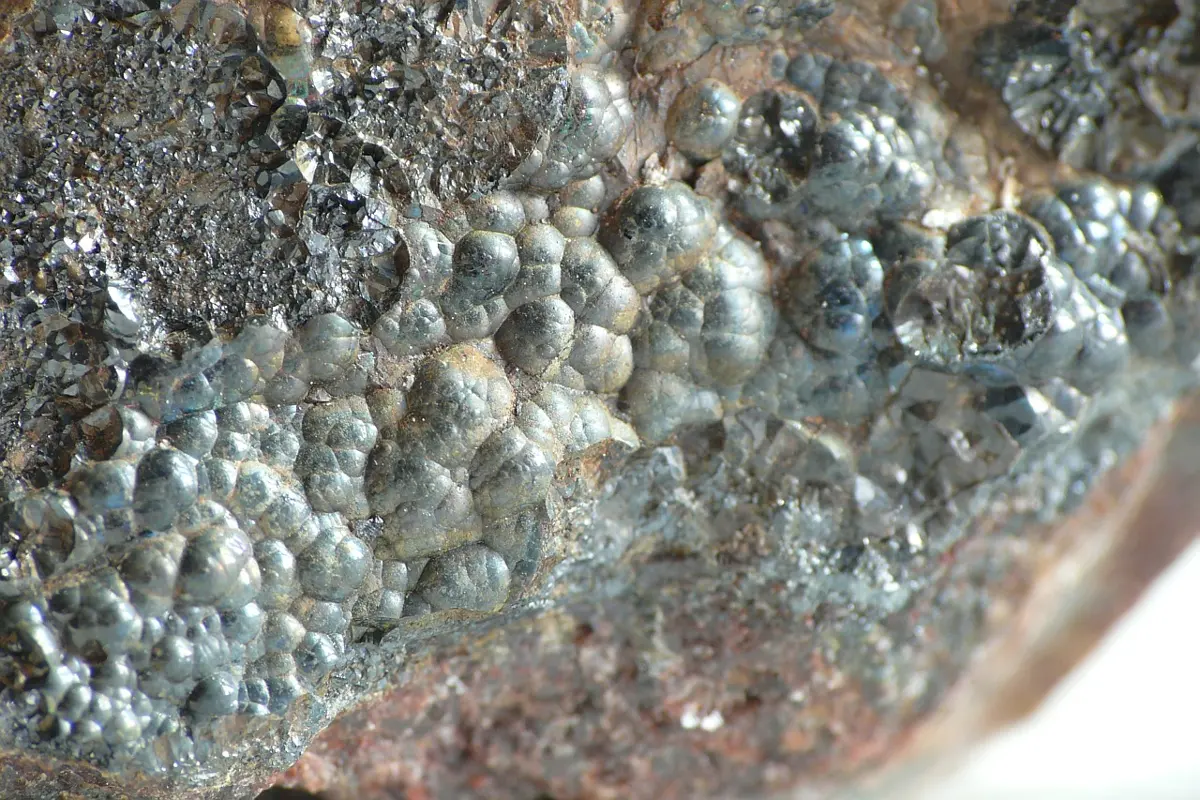
In 2014, geologists of Nepal’s Department of Mines and Geology surveying Upper Mustang with radiation counters found rocks near Lomanthang giving off unusually strong radiation. By the Department’s own estimates, it is the largest of Nepal’s known uranium prospects.
Uranium and uraninite
Uranium is a heavy, radioactive metal: its atoms slowly break down (decay), giving off radiation, and turn into other elements. Its main ore is the mineral uraninite:
| Property | Uraninite |
|---|---|
| Formula | UO₂ (uranium oxide) |
| Hardness | 5 to 6 |
| Density | 10.63 to 10.95 times as heavy as water when fresh, as low as 6.5 when weathered: very heavy for a stone |
| Color | usually gray to black |
| Special property | radioactive |
The old name pitchblende was used for uraninite and other heavy black materials into the early 1900s. Working on pitchblende, Marie and Pierre Curie discovered the elements radium and polonium.
How geologists find it
Radiation cannot be seen, but instruments can count it. Nepal’s geologists have used a Geiger–Müller counter (in the 1980s), scintillation counters and gamma-ray spectrometers, whose readings also separate the radiation of uranium, thorium and potassium.
Walking the ground with these, the “ground radiometric survey”, shows where the radioactive beds are. It cannot say how much uranium there is: that needs samples analyzed in a laboratory and holes drilled into the beds.
Uranium in Nepal
| Prospect | District | Rock | Found |
|---|---|---|---|
| Tinbhangale | Makwanpur | sandstone of the Middle Siwalik (Churia), with coal seams | 1980s |
| Bangabagar–Baghgoth, Gorang | Baitadi | white quartzite with gold-bearing quartz veins; schist | 1990s and 2000–01 |
| Lomanthang | Mustang | siltstone and sandstone of the Thakkhola Formation | 2014 |
| Ampipal | Gorkha | a body of nepheline syenite with radioactive magnetite; more thorium than uranium | 2016–17 |
The geologist K.P. Kaphle also lists radioactive minerals from Sindhuli, Chitwan and Kathmandu.
Lomanthang: the figures, and who gave them
| Who, when | What they said |
|---|---|
| D.R. Khadka, Department of Mines and Geology, Annual Report No. 11, 2019 | Three prospects in about 100 km² of the Thakkhola sediments; a radioactive zone of about 6 km². A “speculative” resource from the surface readings: about 128,660 tonnes of uranium in the report’s summary, but about 12,850 tonnes (7,091 + 5,759) in the same report’s table. The two differ by ten times, and the report does not explain why. |
| Dharma Raj Khadka, senior geologist, in Onlinekhabar, 30 June 2016 | The uranium is of “high quality”; a preliminary survey had found it spread over about 30 km²; Nepal had no law to mine it. |
| K.P. Kaphle, Nepal Geological Society, 2020 | The grade and tonnage of the prospects have not been confirmed by drilling. |
| Foreign Minister Khanal, in Kantipur, 17 Asar 2083 (1 July 2026) | No agreement has been reached with anyone to mine uranium in Mustang. |
For the smaller prospects, the 2019 report gives speculative resources of about 47 tonnes (Tinbhangale), 212 tonnes (Bangabagar–Baghgoth) and 13 tonnes (Gorang).
So: radioactive beds are certainly there, but Nepal has no proven uranium reserve. A “speculative” resource is an estimate made from the surface, before any drilling. The 2019 report itself says that more detailed exploration, with laboratory analyses, is needed to turn these resources into reserves, and a feasibility study after that.
What uranium is used for
Uranium is the main fuel of nuclear power, and it is used in nuclear weapons. Geologists also use its slow, steady decay to find the ages of rocks.
Safety and the law
Nepal regulates radioactive substances under the Radioactive Substances (Utilization and Regulation) Act, 2077 (2020).
In short
Where these facts come from
- Khadka D.R., Status of uranium and thorium prospects in Nepal, in Annual Report No. 11, Department of Mines and Geology, 2019.
- Kaphle K.P., Mineral resources of Nepal and their present status, Nepal Geological Society, 2020.
- Government team confirms existence of fossil fuel, uranium deposits in Mustang, Onlinekhabar, 30 June 2016.
- No agreement has been reached with anyone for uranium mining in Mustang: Foreign Minister Khanal, Kantipur, 1 July 2026.
- Nepal Law Commission, Radioactive Substances (Utilization and Regulation) Act, 2077.
- Anthony J.W. et al., Uraninite, Handbook of Mineralogy, Mineralogical Society of America.
- King H.M., Uraninite, Geology.com.