
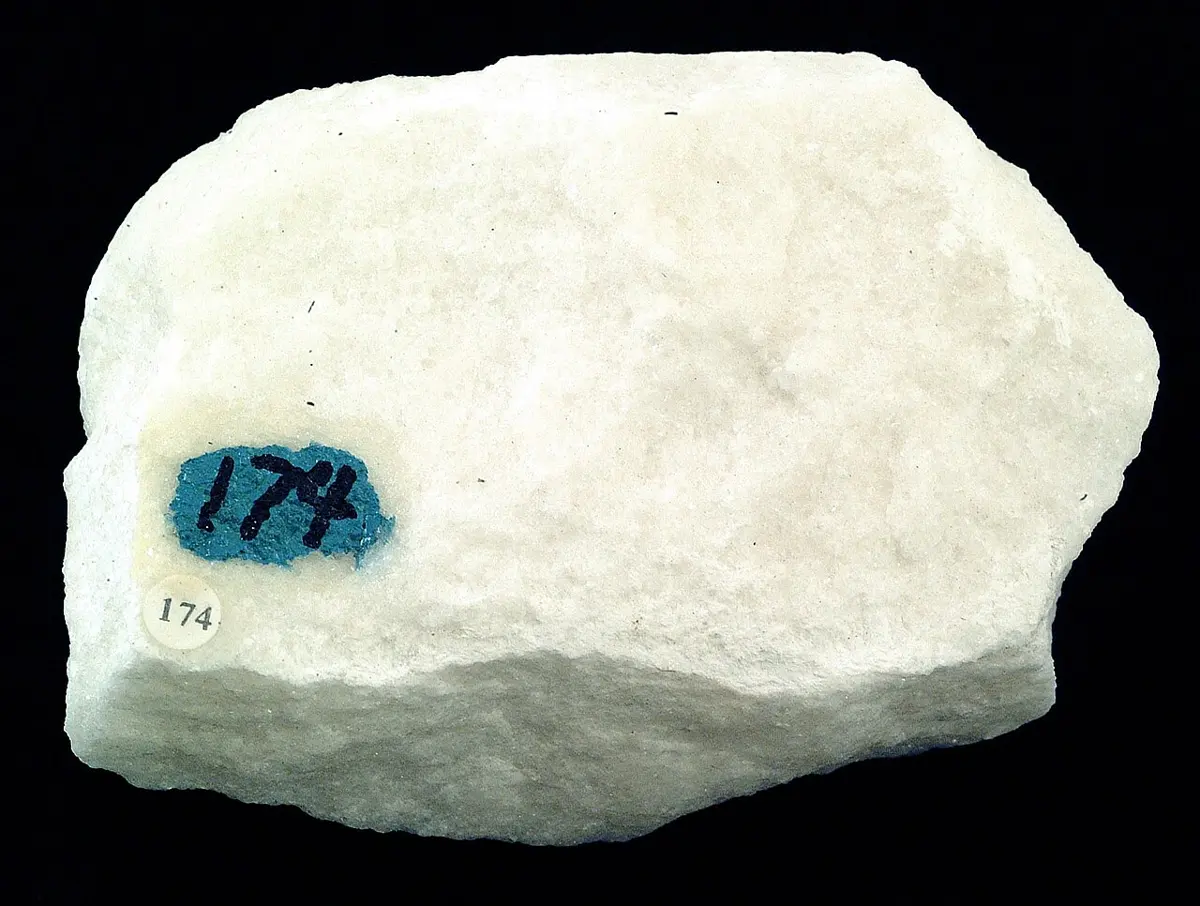
Turn a piece of white marble in the sun and it sparkles, as if dusted with sugar. Each sparkle is light flashing off a tiny face of a calcite crystal. Marble is limestone that has been cooked and squeezed until its calcite regrew as a mass of interlocking crystals. In Nepali it is सङ्गमरमर.
What marble is
Marble is a metamorphic rock: a rock changed by heat and pressure without melting. It is made mostly of calcite (CaCO₃), like the limestone it came from, and may contain a little clay, mica, quartz, pyrite, iron oxides or graphite. Marble made from dolomite is called dolomitic marble.
| Property | Marble |
|---|---|
| Main mineral | calcite (or dolomite, in dolomitic marble) |
| Hardness | about 3, like calcite: a steel nail scratches it |
| Acid | fizzes, like limestone |
| Look | a mass of interlocking crystals; no fossils left |
| Color | white when pure; gray, pink, yellow, bluish or black with impurities |
How marble forms
Most marble forms where plates collide and great areas of crust are heated and squeezed, as in the Himalaya. Some forms where hot magma bakes the limestone next to it. As the rock heats, the small grains and fossil shells of the limestone recrystallize, and the calcite grows into larger, interlocking crystals. The fossils disappear. The stronger the heating, the larger the crystals.
Marble in Nepal
- Godavari, Lalitpur: a deposit of pink, gray and white marble, about 1.63 million tonnes (the Department of Mines and Geology lists it as 652,000 cubic meters). Godavari Marble Industries, built on it, could make about 80,000 square meters of polished slabs a year and was making 50,000 to 70,000, with chips and aggregate as by-products. In 2020 the geologist K.P. Kaphle reported that the mine had been shut for about ten years, for environmental and legal reasons.
- Anekot, Kavre: Everest Marble works this deposit.
- Chhatre Deurali, Dhading: Nawadurga Marble Industry has opened a quarry and begun production.
In 2018 the Department had issued 3 mining licenses and 1 prospecting license for marble, and two of them were producing; Nepal’s whole output that year was only 888 square meters.
Marble matters for Nepal’s gems, too: the rubies of Dhading and Ganesh Himal grew in lenses of dolomitic marble (see Ruby and sapphire).
What marble is used for
Floors, walls, steps, monuments and sculpture; crushed marble as aggregate; and the purest, ground to powder, in antacid tablets for indigestion.
How does marble differ from the limestone it came from?
Pick an answer to see why.
In short
Where these facts come from
- Kaphle K.P., Mineral resources of Nepal and their present status, Nepal Geological Society, 2020.
- Ghimire R.P., Mineral resources, mining and investment opportunities in Nepal, in Annual Report No. 11, Department of Mines and Geology, 2019.
- King H.M., Marble and Calcite, Geology.com.
- सङ्गमरमर in the Nepali Brihat Shabdakosh (Nepal Academy).