
Limestone and dolomite: the rocks of cement
चुनढुङ्गा · Old seabeds that build new houses
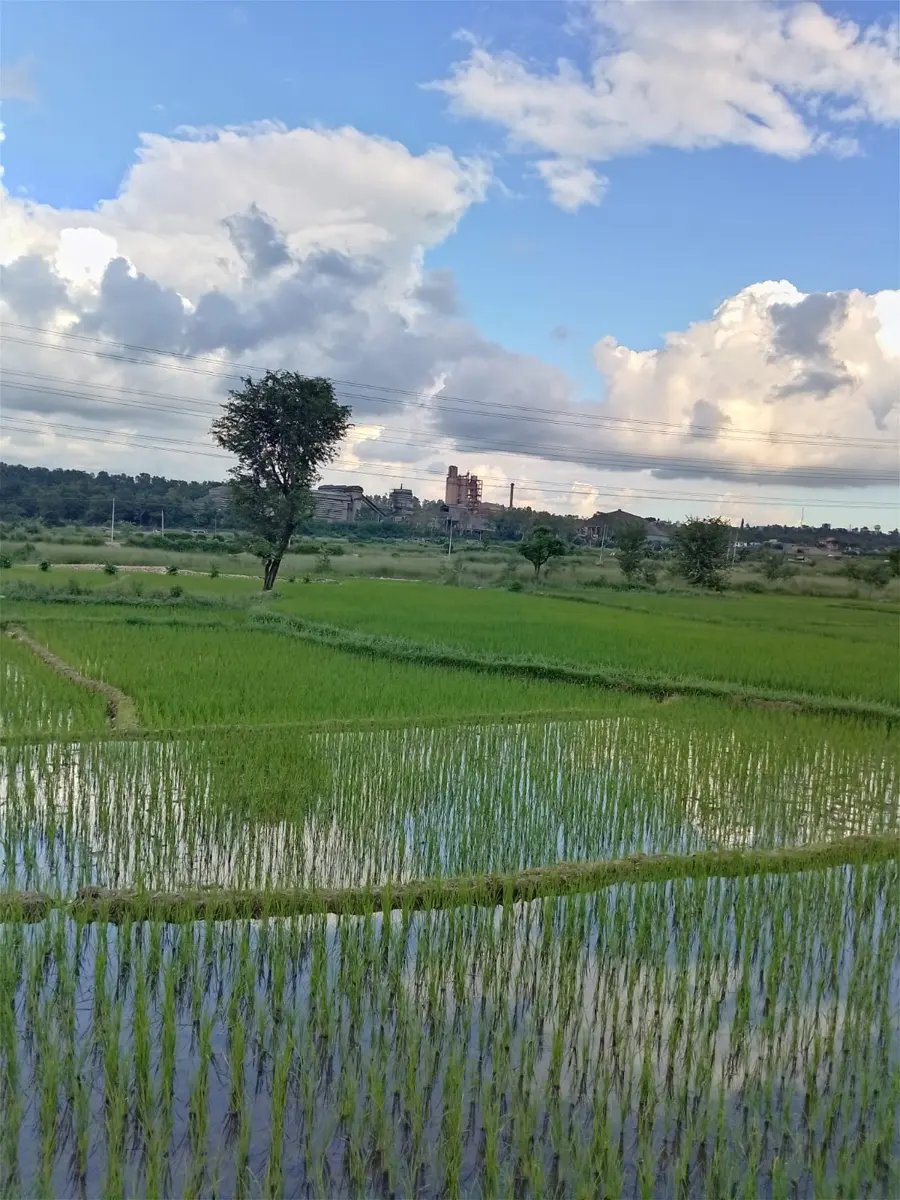
The concrete in a new house, the plaster on its walls, the lime spread on an acid field: all of it began as limestone, चुनढुङ्गा. Nepal has a great deal of it: the Department of Mines and Geology calls limestone by far the country’s most important mineral resource. In 2018 Nepal quarried about 6.6 million tonnes of it.
Limestone
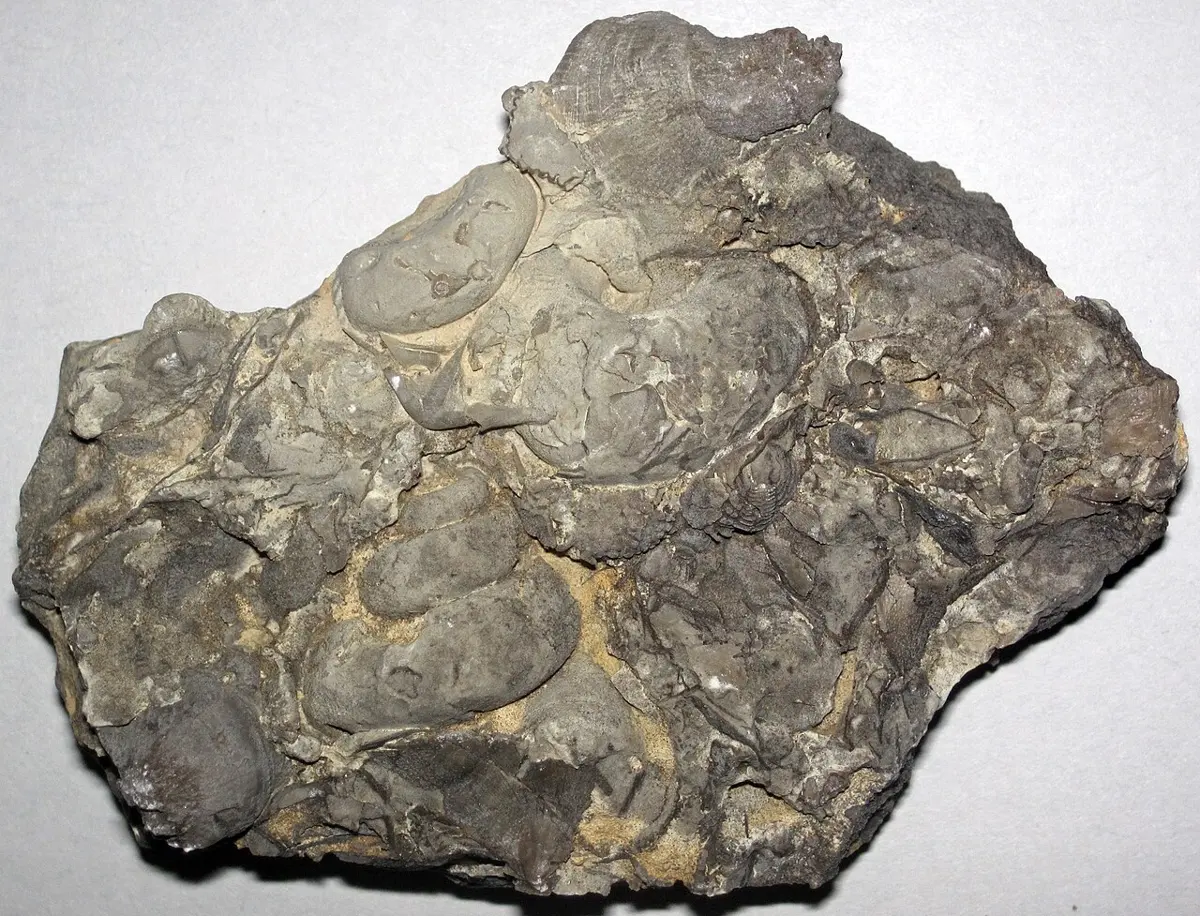
Limestone is a sedimentary rock made mainly of calcite, calcium carbonate, CaCO₃ (see Calcite). Most limestone is biological: in warm, shallow seas, corals, shellfish and algae make shells and skeletons of calcium carbonate. When they die, the debris piles up on the seafloor, and calcium carbonate coming out of the water cements it into rock. Some limestones are full of fossils; others are so fine-grained that no shells can be seen. Limestone can also form in caves, as stalactites and stalagmites.
Dolomite
Dolomite is both a mineral and a rock. The mineral is calcium magnesium carbonate, CaMg(CO₃)₂; the rock made of it is also called dolostone. Dolomite is thought to form when limy mud or limestone is changed after it is laid down by groundwater rich in magnesium, which swaps some of the calcium for magnesium.
| Limestone | Dolomite | |
|---|---|---|
| Main mineral | calcite, CaCO₃ | dolomite, CaMg(CO₃)₂ |
| Hardness of the mineral | 3 | 3.5 to 4 |
| Cold dilute hydrochloric acid | fizzes strongly | fizzes weakly, more when powdered or warm |
| Vinegar | a slow fizz, best seen with a hand lens | a fainter fizz |
Limestone and dolomite in Nepal
The limestone and dolomite of Nepal lie mainly in the Lesser Himalaya, the middle hills.
Limestone. Over 1.3 billion tonnes of cement-grade limestone is already known there, and geologists think there may be more than 2.5 billion tonnes. The Department of Mines and Geology gives a proven reserve of 1.5 billion tonnes. Some of the main deposits:
| Part of Nepal | Deposits |
|---|---|
| East | Nigale (Dhankuta); Sindhali, Galtar, Chuladhunga (Udayapur) |
| Center | Bhainse, Okhare, Majuwa (Makwanpur); Jogimara, Beldada (Dhading); Chovar (Kathmandu); Bhattedanda (Lalitpur); Lamatar, Balthali (Kavre); Kakaru Khola (Sindhuli) |
| West | Waling (Syangja); Jyamire, Koldanda, Masyam (Palpa); Narapani (Arghakhanchi); Arung Khola (Dang); Kajeri (Salyan); Chaukune (Surkhet); Diyarigad (Baitadi) |
On these deposits more than 27 cement factories were producing in 2020, enough to meet about 80% of Nepal’s cement demand, and more were being built. The Department has issued 58 mining licenses and 178 prospecting licenses for limestone to private companies.
Dolomite. Geological mapping suggests a possible 5 billion tonnes of dolomite, mainly in the Mahabharat range, from Dhankuta and Udayapur in the east to Baitadi and Darchula in the west, with some in the Higher Himalaya and the Tethys Himalaya.
What they are used for
- Limestone: Portland cement (fired in a kiln with crushed shale), lime, agricultural lime, flux in making iron and steel, poultry feed, leather making, and crushed stone for roads and concrete.
- Dolomite: a special (Sorel) cement, refractories (materials that stand great heat), high-magnesium lime, flux for iron and steel, fertilizer, acid water treatment; on farms as a soil conditioner and a livestock feed additive; and crushed for road paving.
In short
Where these facts come from
- Kaphle K.P., Mineral resources of Nepal and their present status, Nepal Geological Society, 2020.
- Kaphle K.P., Gypsum prospects in Nepal and their importance in mineral industries, especially in Portland cement production, Bulletin of the Nepal Geological Society 35, 2018.
- Ghimire R.P., Mineral resources, mining and investment opportunities in Nepal, in Annual Report No. 11, Department of Mines and Geology, 2019.
- Anthony J.W. et al., Calcite and Dolomite, Handbook of Mineralogy, Mineralogical Society of America.
- King H.M., Limestone, Dolomite and The acid test, Geology.com.