
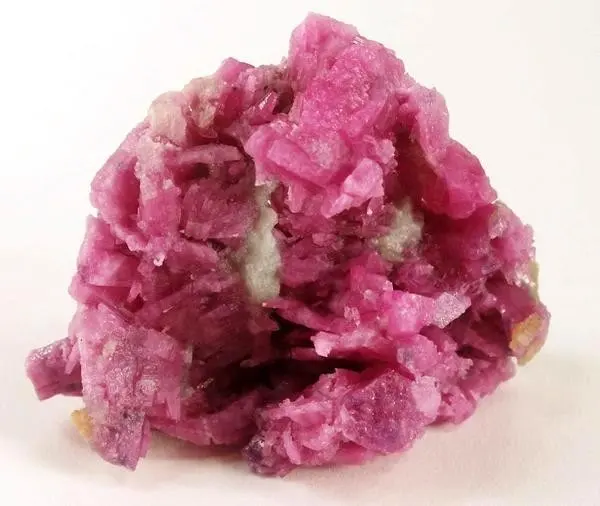
A ruby is red and a sapphire is blue, and in Nepali they have different names, माणिक and नीलम. But to a geologist they are one mineral, corundum, colored by a pinch of different elements. Nepal has both, in the high hills north of Kathmandu.
What corundum is
Corundum is aluminium oxide, Al₂O₃.
| Property | Corundum |
|---|---|
| Formula | Al₂O₃ |
| Hardness (Mohs) | 9: only diamond is harder |
| Density | 3.98 to 4.10 times as heavy as water |
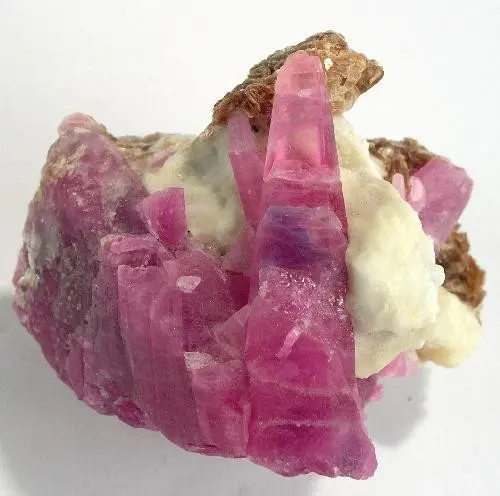
| Crystals | six-sided columns, sometimes tapering to a point |
| Luster | glassy to almost diamond-like |
| Color | colorless or gray when pure; red, pink, blue, yellow, green, violet with traces of other elements |
The color comes from tiny amounts of other elements in the crystal: chromium makes corundum red, and then it is called ruby; iron and titanium together make it blue, and then it is sapphire. Corundum of any other color is called a “fancy sapphire”.
How rubies and sapphires form
Corundum grows in rocks changed by heat and pressure, in schist, gneiss and marble; some of the finest rubies and sapphires grew in marble, along the edges of bodies of magma. Others weather out of basalt lava and are found in the soil and gravel below.
In Nepal they grow in lenses of sugary-grained dolomitic marble, folded and squeezed among the high-grade metamorphic rocks close to the Main Central Thrust, the great fault along which the deep-buried rocks of the Higher Himalaya were pushed up.
Ruby and sapphire in Nepal
Gem-quality but generally small crystals of light red to red ruby and light to dark blue sapphire are known from:
- Ruby Valley in Dhading: Chumar, Ruyil, Shelghar, Pola and Shongla;
- the Lari / Ganesh Himal area in Rasuwa.
The geologist K.P. Kaphle wrote in 2020 that in places local people were mining them illegally and haphazardly, destroying a precious resource of the country, and that the Department of Mines and Geology should act.
Nepal’s rules
Nepal’s Mines and Minerals Regulation puts diamond, ruby, sapphire, emerald and corundum in its top group of gem minerals, “very important minerals”. To mine or prospect for any gem mineral you need a license from the Department of Mines and Geology. And since the start of fiscal year 2072/73 BS, Nepal has banned exporting gem minerals in raw form: only cut, polished and other value-added gems may leave the country.
No diamond has been recorded in Nepal, and emerald is very rare.
What corundum is used for
- Gems: ruby and sapphire, for rings, crowns and jewelry.
- Abrasives: corundum’s hardness makes it an excellent grinding and polishing material, once used in grinding wheels. Industry now relies more on synthetic corundum, made from bauxite.
Why is a ruby red?
Pick an answer to see why.
In short
Where these facts come from
- Kaphle K.P., Mineral resources of Nepal and their present status, Nepal Geological Society, 2020.
- Ghimire J.R., An overview of precious and semi-precious stones in Nepal: opportunity and challenges, in Annual Report No. 11, Department of Mines and Geology, 2019.
- Anthony J.W. et al., Corundum, Handbook of Mineralogy, Mineralogical Society of America.
- King H.M., Corundum, Geology.com.
- माणिक and नीलम in the Nepali Brihat Shabdakosh (Nepal Academy).