
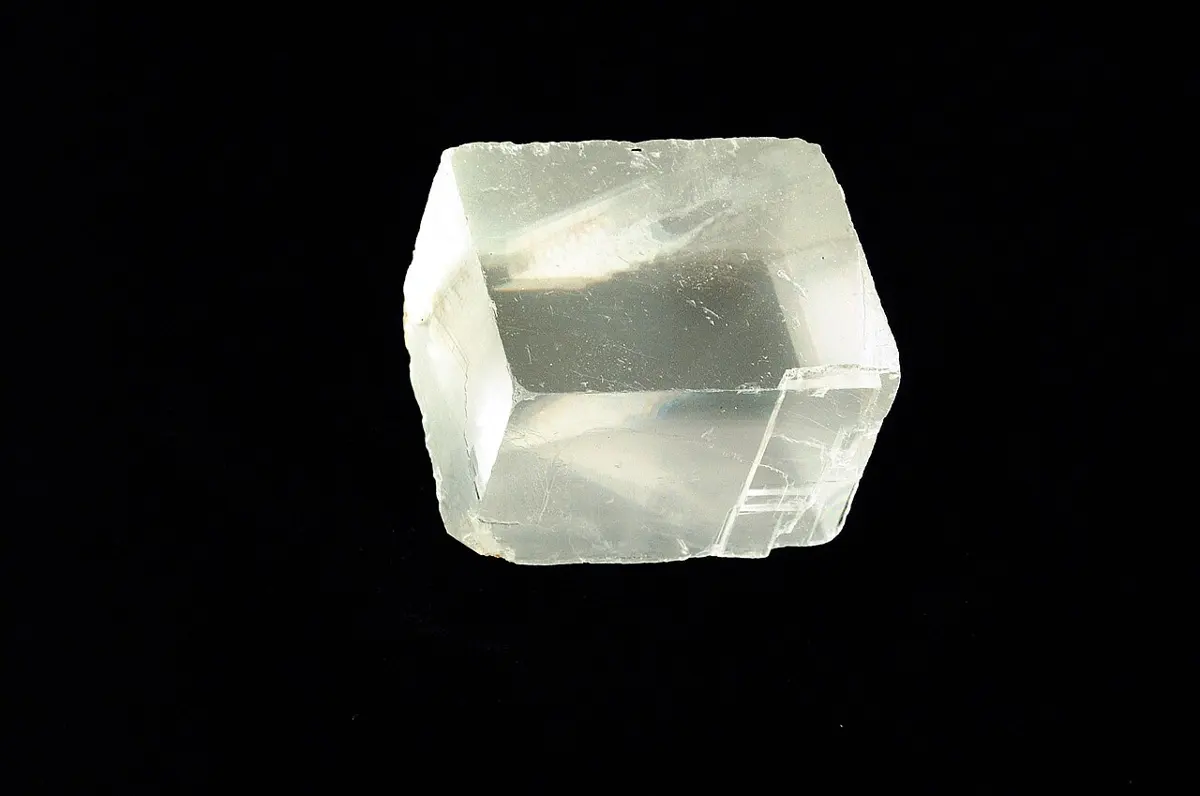
Every bag of cement in Nepal begins with a rock made of one mineral. That rock is limestone, and the mineral is calcite. Heat and pressure turn the same mineral into marble; dripping water builds it into the icicle shapes that hang in caves. Hold a clear piece over a word and you will see two words.
What calcite is
Calcite is calcium carbonate, CaCO₃: calcium joined to carbonate (one carbon and three oxygen atoms).
| Property | Calcite |
|---|---|
| Formula | CaCO₃ |
| Hardness (Mohs) | 3: a steel nail scratches it; a fingernail (2 to 2.5) does not |
| Density | 2.71 times as heavy as water |
| Cleavage | perfect in three directions, not at right angles, so it breaks into slanted boxes (rhombohedra) |
| Luster | glassy |
| Color | colorless or white; often tinted gray, yellow, pink or brown |
| Test | fizzes strongly in cold dilute hydrochloric acid |
Two of everything
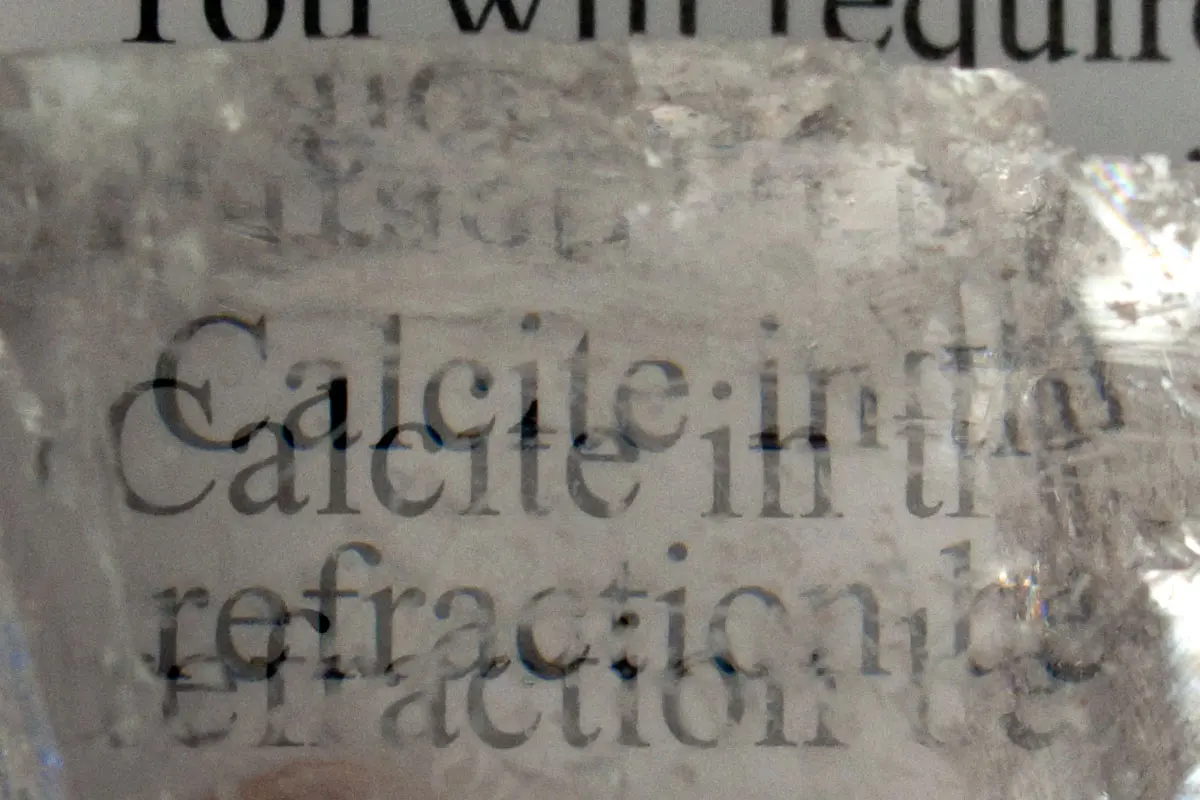
A clear crystal of calcite, called Iceland spar, splits light into two rays that bend by different amounts. Put it on a page and every letter shows twice. This double refraction made Iceland spar useful in microscopes, in prisms that sort light into polarized beams.
The acid test
Calcite reacts with acid and gives off bubbles of carbon dioxide gas. Geologists put a drop of dilute hydrochloric acid on a rock: on calcite the whole drop erupts with bubbles. Dolomite, its close cousin, fizzes only weakly unless it is powdered or the acid is warm; magnesite hardly at all.
How calcite forms
- In the sea: shells and skeletons of sea creatures are made of calcium carbonate. Piled up over millions of years, they become limestone.
- In caves: water that has dissolved some limestone drips from a cave roof. When a drop evaporates instead of falling, the calcium carbonate it carried is left behind, building stalactites hanging down and stalagmites growing up.
- In veins: water seeping through cracks leaves white calcite behind.
- By heat and pressure: when limestone is buried and heated, its calcite grows into larger crystals, and the rock becomes marble.
Calcite in Nepal
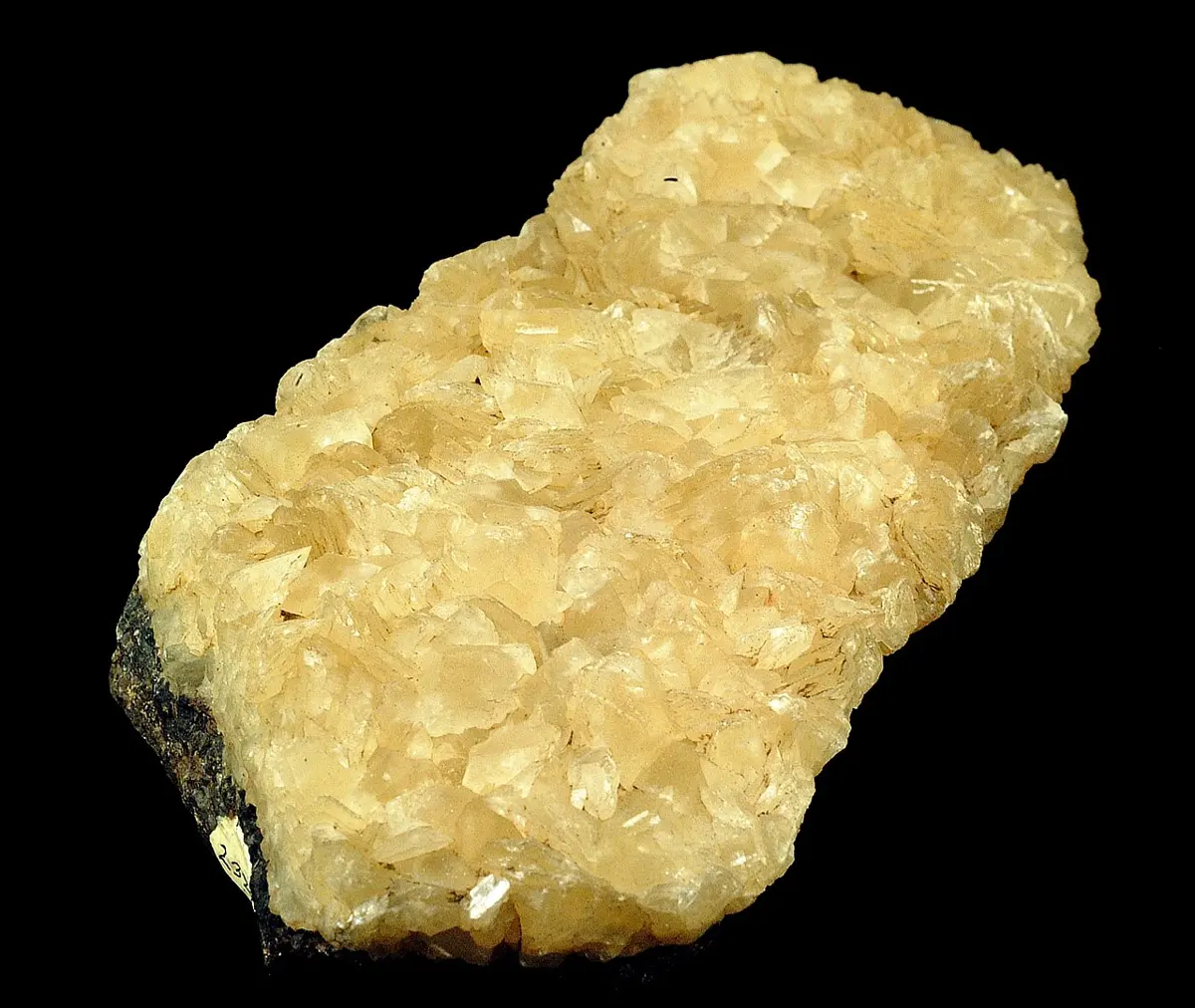
Calcite is everywhere in Nepal’s limestone, dolomite and marble, but big deposits of pure calcite crystal are not known. The geologist K.P. Kaphle, formerly of the Department of Mines and Geology, records small veins and lenses in carbonate rocks, stalactites and stalagmites, and crusts of pointed crystals called dog-tooth spar in some limestone caves. In 2020 one small calcite mine was being developed at Nibuwagaon in Makwanpur. The Department counted one mining license and one prospecting license for calcite in 2018.
What calcite is used for
- Cement and lime: calcite, mostly as limestone, is the main raw material of cement and of quicklime.
- Soil: crushed limestone neutralizes acid soils.
- Building and carving: as marble.
- Optics: clear Iceland spar for polarizing prisms.
A white crystal in a rock is scratched by a steel nail, splits into slanted boxes, and a drop of acid fizzes hard on it. What is it?
Pick an answer to see why.
In short
Where these facts come from
- Kaphle K.P., Mineral resources of Nepal and their present status, Nepal Geological Society, 2020.
- Ghimire R.P., Mineral resources, mining and investment opportunities in Nepal, in Annual Report No. 11, Department of Mines and Geology, 2019.
- Anthony J.W. et al., Calcite, Handbook of Mineralogy, Mineralogical Society of America.
- King H.M., Calcite, The acid test for carbonate minerals and rocks, Limestone and Mohs hardness scale, Geology.com.