
चुत्रो: the thorny shrub with yellow wood
चुत्रो · Berberis aristata, B. asiatica · A thorny shrub of the barberry family
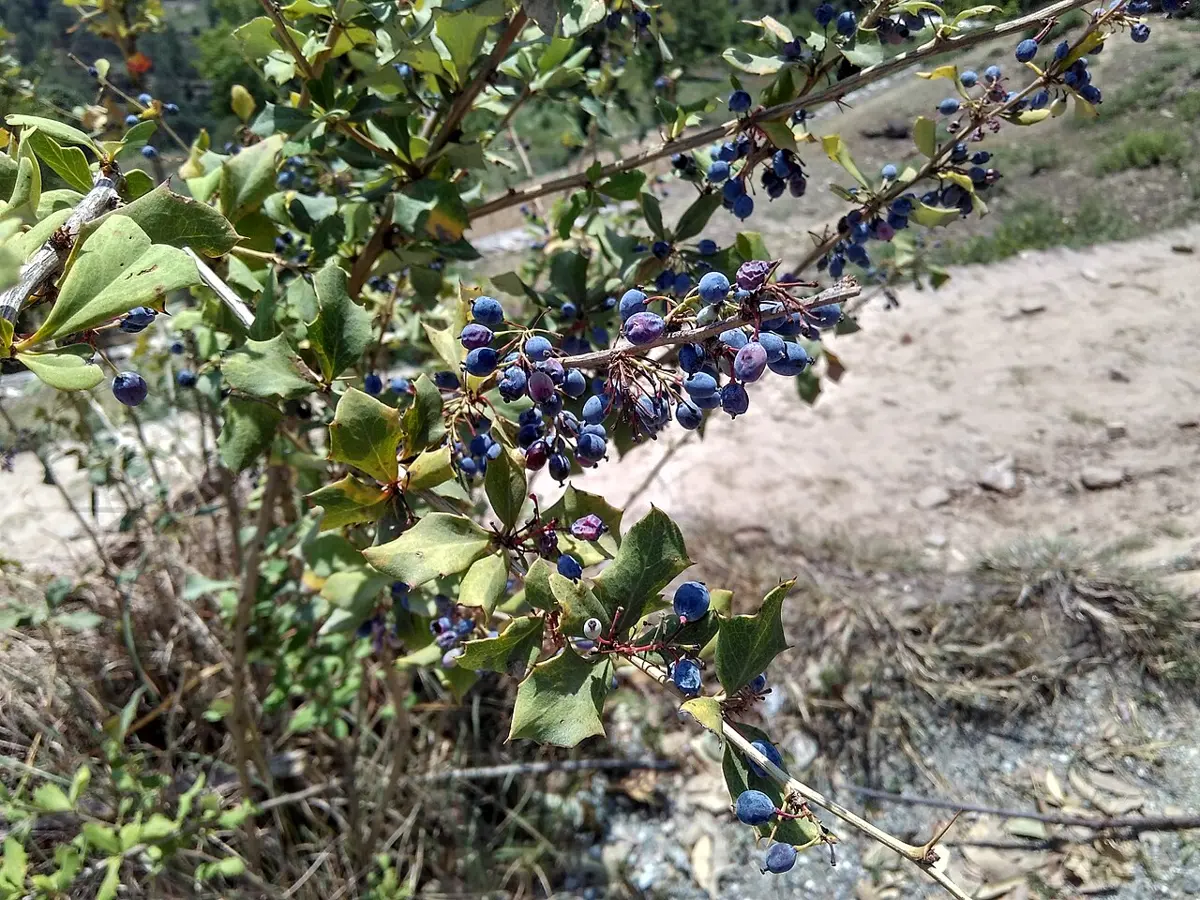
On a walk up a hill above the valley, you push past a scruffy, thorny bush by the trail and a thorn catches your sleeve. If it is early summer, the bush may be hung with little blue-black berries, dusty-looking like grapes, sweet and a little sour. The bush is चुत्रो (chutro), and if someone snaps a dry stem, you will see something surprising inside: wood as yellow as turmeric.
This page is about that bush: how to know it, why its wood is yellow, the old eye medicine boiled from its roots, what tests in people have found about its yellow chemical, and why that chemical needs care.
How to know it
चुत्रो is a spiny shrub, up to about 4 or 5 meters tall. Look for:
- the spines: usually in threes, strong and sharp, 1 to 2 cm long, where the leaves join the stem;
- the leaves: small, oval, 2 to 6 cm long, leathery, often with a few spiny teeth along the edge; the two kinds below shed them every year;
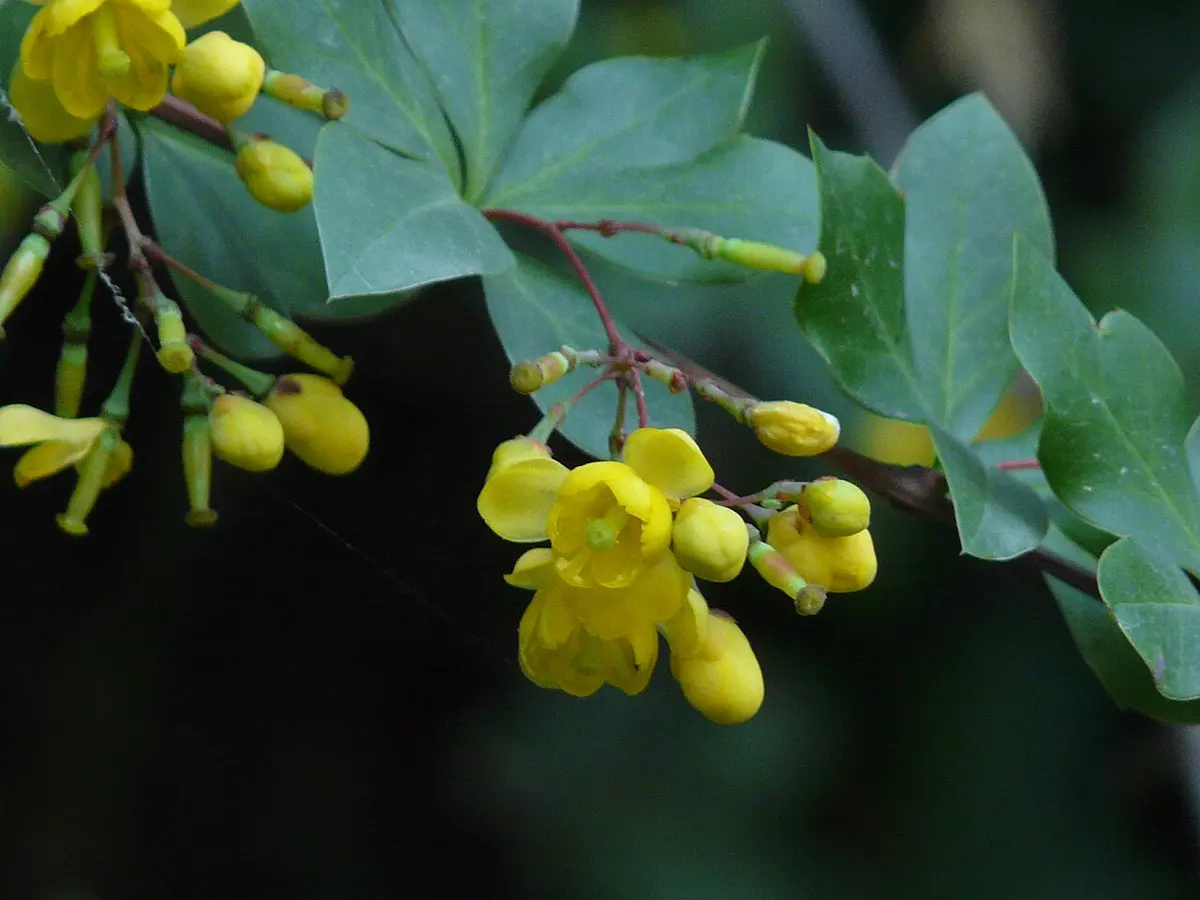
- the flowers: bright yellow, about 1 cm across, a dozen or more on each short spike;
- the berries: oval, 7 to 10 mm long, green turning dark purple or black, with a pale, powdery bloom;
- the wood: usually yellow, from the root to the stems.
One name, many bushes
Here is the catch. Nepal has 21 species of Berberis (barberry), and in Nepali, all of them are commonly called चुत्रो. Two are the ones most used and talked about:
| Berberis aristata | Berberis asiatica | |
|---|---|---|
| Height | up to 5 m | up to 4 m |
| Leaves | only slightly leathery, dark green above | leathery, with a clear net of veins, whitish underneath |
| Flowers in | April to July | February to May |
| Berries | oblong, dark purple to black | rounder, dark purple, with a whitish bloom |
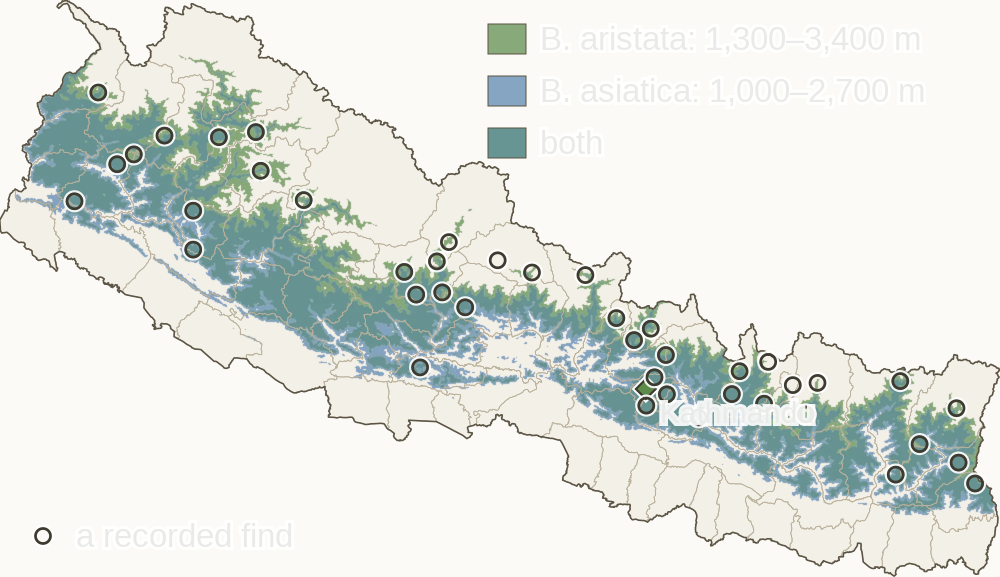
| Altitude | about 1,300 to 3,400 m | about 1,000 to 2,700 m |
| Where in Nepal | west, center and east | west and center |
Even in the market, the root sold as medicine may be any of several species. One study compared four Berberis species used as दारुहरिद्रा (daruharidra, “tree turmeric”, its Sanskrit name) with samples bought in herb markets in India: some samples were a mix of stems and roots of two different species, and one was a mix of three species, with some pieces that matched none of the four.
Where it grows
Both grow in forest clearings, forest edges, beside roads and trails and on disturbed ground: the kind of place where a forest has been opened up. Different barberries cover Nepal from 1,000 meters (B. asiatica) up to 4,700 meters, from the wet east to the dry land north of the Himalaya.
The yellow chemical, and the plant’s clever trick
The yellow of the wood comes from berberine and its relatives, alkaloids (plant chemicals that contain nitrogen) of a bright yellow kind. There is far more of it in some parts than in others: young, growing shoots of barberries have been measured at about 0.04% berberine on average, young roots at about 1.4%. The root is the richest part.
Berberine kills bacteria. But bacteria fight back. Many have tiny pumps in their outer skin that throw harmful chemicals out as fast as they get in, and berberine is just the kind of chemical these pumps throw out best.
In 2000, chemists studying barberry plants found something remarkable. Several barberries make a second chemical, with a long name: 5’-methoxyhydnocarpin. On its own it does nothing to the bacteria. But it jams their pumps. With it, berberine built up inside a common germ, Staphylococcus aureus, and worked far better than alone. The plant makes both the weapon and the tool that switches off the germ’s defense.
Traditional uses
In tradition, the wood and root of चुत्रो are boiled down into a thick, dark extract called रसाञ्जन (rasanjan), also known as rasaut, which the Nepali dictionary describes as an eye medicine made by cooking चुत्रो’s wood and roots. The name rasaut has been explained as “concentrated juice”, and the extract became famous for eye diseases and slow-healing sores.
Studies of the herbs people use in Nepal record:
- in Baitadi, Darchula and Dadeldhura in the far west, the root bark extract for sore, red eyes (conjunctivitis), a use people there agreed on completely;
- in Rasuwa, a paste of the inner bark for rheumatism and a paste of the pith for the eyes;
- in Kavrepalanchok, the root boiled for five minutes in about half a liter of water and drunk for fever, toothache, red eyes, mouth infections and diarrhea;
- across Nepal, extracts of the stem and root for jaundice, malarial fever, diarrhea and stomach ulcers.
The berries are eaten fresh, made into अचार (achar, pickle), and sometimes into home-made alcoholic drinks.
These are the uses of a living tradition, passed down in families and by traditional healers. Whether a use works is a separate question, which only careful tests in people can answer.
What science has tested
- Germs in a dish: berberine and Berberis extracts kill bacteria and other germs in the laboratory. That fits the tradition of using चुत्रो for sore eyes and infected sores, but killing germs in a dish is not the same as curing an infection.
- Purified berberine for blood sugar: this is where it has been tested most in people. A 2022 review of 37 trials with 3,048 people with type 2 diabetes found that berberine lowered blood sugar a little (the long-term measure, HbA1c, by about 0.6 percentage points on average). The reviewers rated the evidence moderate: almost all trials were in China, many were short and not well reported, and there are few large, high-quality trials.
- Berberine for weight loss: sold as a supplement for this; the United States health agency NCCIH says the evidence is not conclusive.
- रसाञ्जन for the eyes: we found no trials in people.
So: some evidence for one purified chemical, for one condition, in trials of uneven quality. Not a reason to take it, and nothing about home remedies made from the plant.
Plenty of it, for now
Unlike many herbs on this list, the two main चुत्रो species are not threatened:
- the IUCN Red List rates Berberis aristata Least Concern; B. asiatica has not been assessed, and botanists who studied all of Nepal’s barberries proposed Least Concern for both;
- they thrive on disturbed ground, which people make plenty of.
But the part that is sold is the root and its bark. In the far west, where चुत्रो is traded in Baitadi, Dadeldhura and Darchula, children are among those who collect it.
Your friend says, “चुत्रो berries are safe to eat, so चुत्रो root medicine must be safe for my baby sister’s jaundice.” What is wrong with this?
Pick an answer to see why.
See it at the Science Playground
Our exhibit Medicinal and Culinary Herbs of Nepal shows dried herbs and spices used in Nepal. On a walk in the hills around the valley, look for चुत्रो beside the trails: spines in threes, yellow flowers in spring, blue-black berries in summer. More plants in Herbs of Nepal.
Where these facts come from
- Adhikari B., Pendry C.A., Pennington R.T. and Milne R.I., A revision of Berberis s.s. (Berberidaceae) in Nepal, Edinburgh Journal of Botany, 2012.
- Srivastava S. et al., A review on biological and chemical diversity in Berberis (Berberidaceae), EXCLI Journal, 2015.
- Srivastava S. and Rawat A.K.S., Quality evaluation of Ayurvedic crude drug Daruharidra, its allied species, and commercial samples from herbal drug markets of India, Evidence-Based Complementary and Alternative Medicine, 2013.
- Stermitz F.R. et al., Synergy in a medicinal plant: antimicrobial action of berberine potentiated by 5’-methoxyhydnocarpin, a multidrug pump inhibitor (abstract), PNAS, 2000.
- Xie W. et al., Glucose-lowering effect of berberine on type 2 diabetes: a systematic review and meta-analysis, Frontiers in Pharmacology, 2022.
- National Center for Complementary and Integrative Health (NCCIH), Berberine and weight loss: what you need to know, 2023.
- Kunwar R.M. et al., Medicinal plants, traditional medicine, markets and management in far-west Nepal, Journal of Ethnobiology and Ethnomedicine, 2013.
- Uprety Y. et al., Indigenous use and bio-efficacy of medicinal plants in the Rasuwa District, Central Nepal, Journal of Ethnobiology and Ethnomedicine, 2010.
- Ambu G. et al., Traditional uses of medicinal plants by ethnic people in the Kavrepalanchok District, Central Nepal, Plants, 2020.
- Berberis aristata: IUCN Red List category and Berberis asiatica, GBIF (from the IUCN Red List), checked November 2026.
- चुत्रो and रसाञ्जन in the Nepali Brihat Shabdakosh (Nepal Academy).