
सुनपाती: the incense rhododendron
सुनपाती · Rhododendron anthopogon · A small, scented alpine shrub, rhododendron family
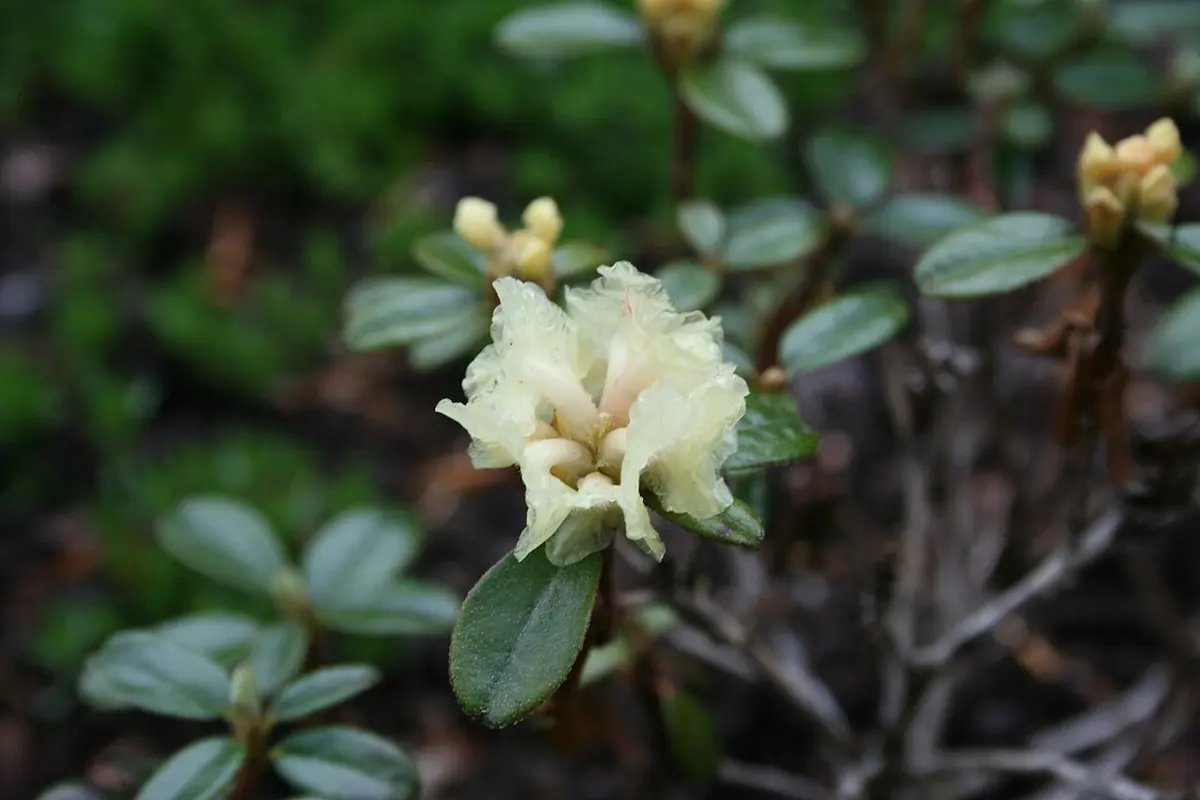
In Buddhist monasteries and homes of the Himalaya, the day often begins with incense smoke carried from room to room. Part of that smoke may be सुनपाती (sunpati), a small shrub of the high slopes whose dried leaves have been burnt as incense since long ago.
You probably know its big cousin. लालीगुराँस (lali gurans), Rhododendron arboreum, is Nepal’s national flower, and it grows into a tree. सुनपाती is a rhododendron too, but it grows only up to about knee or waist height, and it lives far higher, above the trees.
How to know it
सुनपाती is Rhododendron anthopogon, of the rhododendron family (Ericaceae). Look for:
- the shape: a small shrub, up to 1 meter tall, closely and intricately branched, often lying along the ground or bending up from it;
- the leaves: small, dark green, oval, and aromatic: rub one between your fingers and it smells;
- under each leaf: a dense layer of tiny, overlapping scales, dark reddish-brown or yellow-brown, in two or three tiers. Botanists call them glandular scales;
- the flowers: dense clusters of 4 to 6 small pink or pale yellow flowers, from April to June;
- the fruits: in July and August.
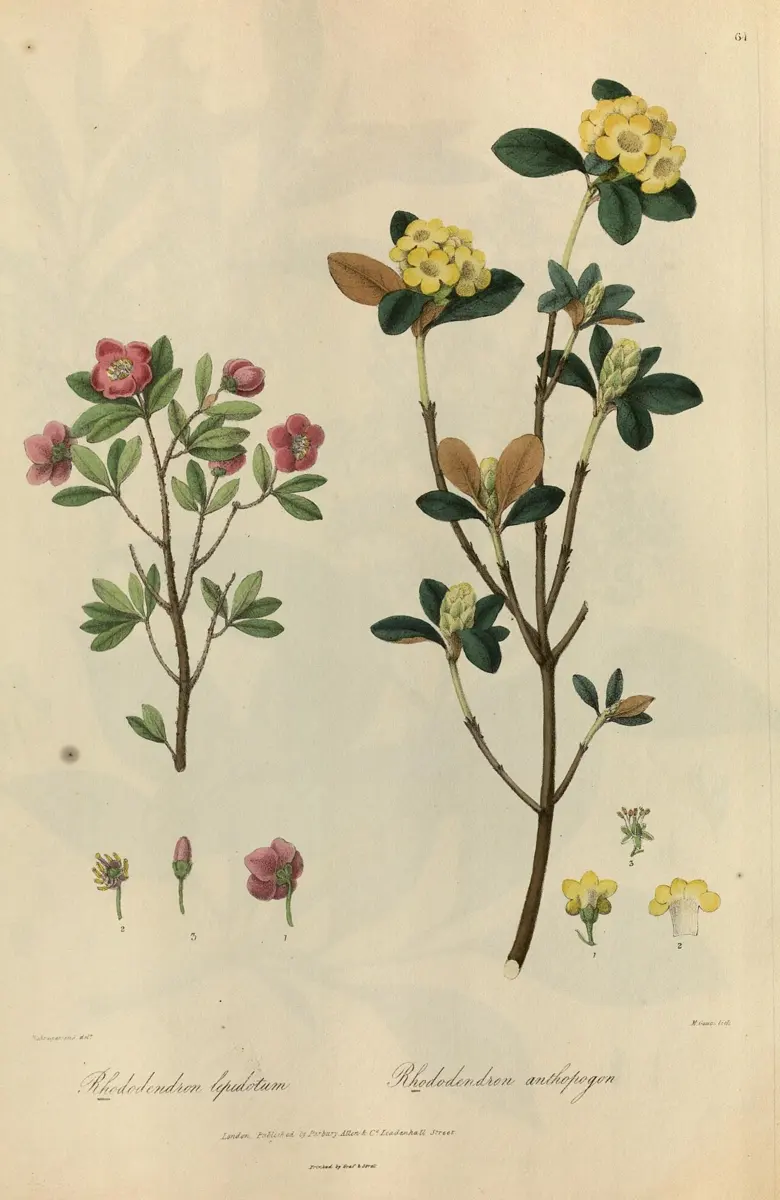
It has two subspecies: R. anthopogon subsp. anthopogon and subsp. hypenanthum. Other small rhododendrons grow in the same shrubland, such as R. lepidotum, so it is worth looking closely at the leaves and flowers.
Where it grows
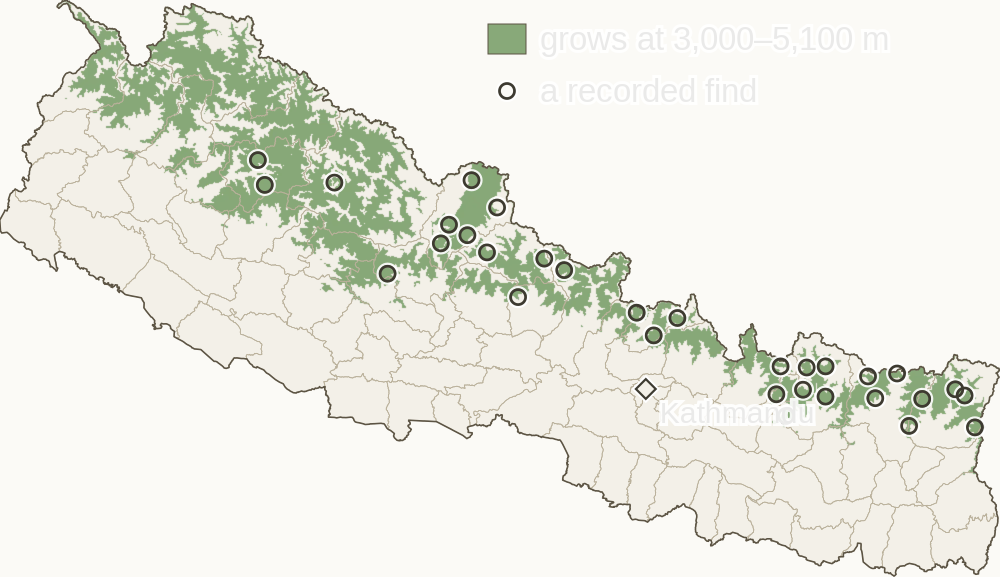
सुनपाती grows across the Himalaya, from Pakistan through India, Nepal and Bhutan to south-east Tibet and China. It lives on open, moist alpine slopes from about 3,000 to 5,100 meters: rocky and grassy slopes and alpine meadows. In Nepal it grows naturally in nineteen high-mountain districts. Above about 3,800 meters it forms knee-high shrubland together with other dwarf rhododendrons.
Distilling an oil where water boils at 88 °C
In the Gaurishankar Conservation Area, between Dolakha and Solukhumbu, people from the villages of Gumdel and Kyama harvest सुनपाती and juniper and distil their scented oils. A study published in 2025 recorded how:
- A collector with a permit from the conservation area cuts leafy branches on the slopes. The harvest and distilling run from October to December. In the past, the plants were cut while they flowered; now the harvest waits until October, so the flowers can be pollinated and set seed first.
- The branches are carried in baskets to a 1,000-liter still at about 3,500 meters, heated by a wood fire.
- Steam from a tank of boiling water below rises through the packed leaves and carries their scented oil with it. The steam is cooled back into liquid, and the oil is separated from the water.
- It takes 15 to 24 hours.
Why so long? Partly because the furnace is inefficient, and partly because of the altitude. At 3,500 meters the air presses down less, so water boils at about 88 °C, not 100 °C. The steam is cooler and thinner, and it carries the oil out more slowly.
And the oil is precious: 100 kg of leaves give only about 300 g of oil (a yield of 0.3%). Its main scented chemicals are α-pinene (about 23%) and β-pinene (about 11%).
Traditional uses
सुनपाती is a sacred plant in the Himalaya, used with juniper:
- its withered or dried leaves are burnt as incense (धूप, dhup), mixed with juniper, in Buddhist monasteries across the Himalaya and in Hindu ceremonies;
- in a household गुम्बा (gumba, a Buddhist temple) in the Gaurishankar area, a लामा (lama, a Buddhist teacher and priest) burns सुनपाती and juniper together in a censer each morning and carries the smoke through every room of the house, to purify it;
- in Solukhumbu, its leaves and flowers are burnt as incense with other herbs;
- in Rasuwa, its flower is chewed for stomach ache, in tradition.
What science has tested
- The oil in the laboratory: in the 2025 study, the oil of सुनपाती moderately blocked two enzymes of the nervous system in test tubes (acetylcholinesterase and butyrylcholinesterase). Other laboratory studies, summed up in the same paper, found that its oil or extracts acted against some bacteria and fungi. These are tests on enzymes and microbes, not on people.
- In people: we found no trials.
- How strong the evidence is: only in the laboratory; not tested in people.
Trade and protection
In Gaurishankar, distilling its oil is a village enterprise, and its leaves are a sacred incense. The study there noted that local healers collect it with care, moving their harvest to October so the plants can set seed, but that concerns are emerging about the effect of tourism and illegal collection. We found no Red List category for it at the IUCN, and no reliable price.
Why do the collectors in Gaurishankar now wait until October to cut सुनपाती?
Pick an answer to see why.
See it at the Science Playground
Our exhibit Medicinal and Culinary Herbs of Nepal shows dried herbs and spices used in Nepal. More plants in Herbs of Nepal.
Where these facts come from
- Cornara L. et al., Investigation of the potential anxiolytic effects of essential oils derived from two sacred plants of tantric Buddhism: Rhododendron anthopogon D.Don and Juniperus indica Bertol, BMC Complementary Medicine and Therapies, 2025.
- Ghimire M. et al., Clinical characteristics and outcomes of patients with wild honey poisoning: a five-year retrospective study from Nepal, BMC Emergency Medicine, 2026.
- Uprety Y. et al., Indigenous use and bio-efficacy of medicinal plants in the Rasuwa District, Central Nepal, Journal of Ethnobiology and Ethnomedicine, 2010.
- Department of Plant Resources, Plants of Nepal: fact sheet, Government of Nepal, 2012 (archived copy).
- सुनपाती in the Nepali Brihat Shabdakosh (Nepal Academy).