
सतुवा: the herb that takes eight years
सतुवा · Paris polyphylla · A forest herb with one flower on a ring of leaves, Melanthiaceae family
Think of the slowest thing you have ever waited for: a bus in the rain, the results after an exam, the mango tree your grandfather planted that took years to give fruit. Now think of a plant whose seed, after it falls, waits through two winters before it even shows its first leaf, and which needs about eight years before its root is big enough to sell.
That plant is सतुवा (satuwa). It grows in the shady forests of Nepal’s hills, and its knobbly underground stem is now one of the most valuable herbs carried out of those forests. This page is about how to know it, why it grows so slowly, what tradition uses it for, what science has tested, and why being slow and valuable at the same time is a dangerous mix for a plant.
How to know it
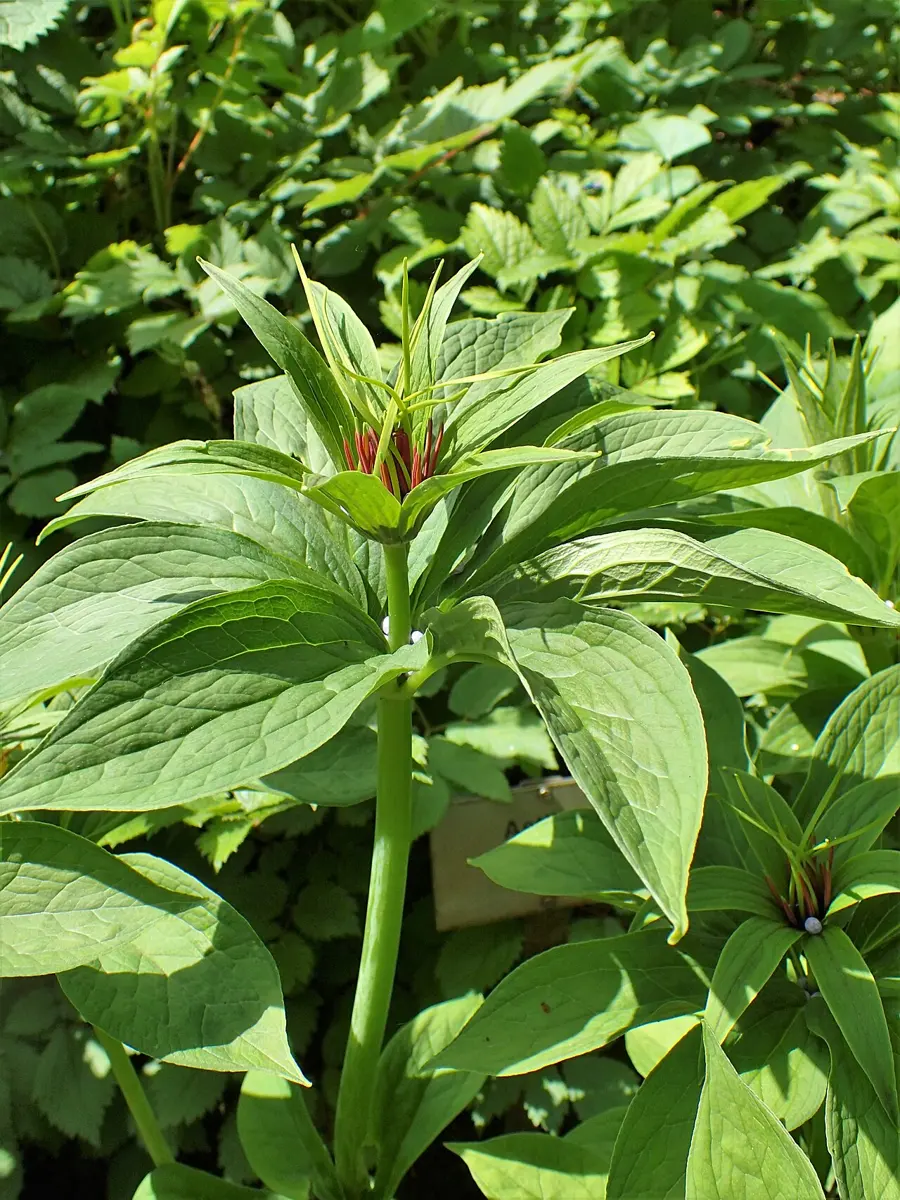
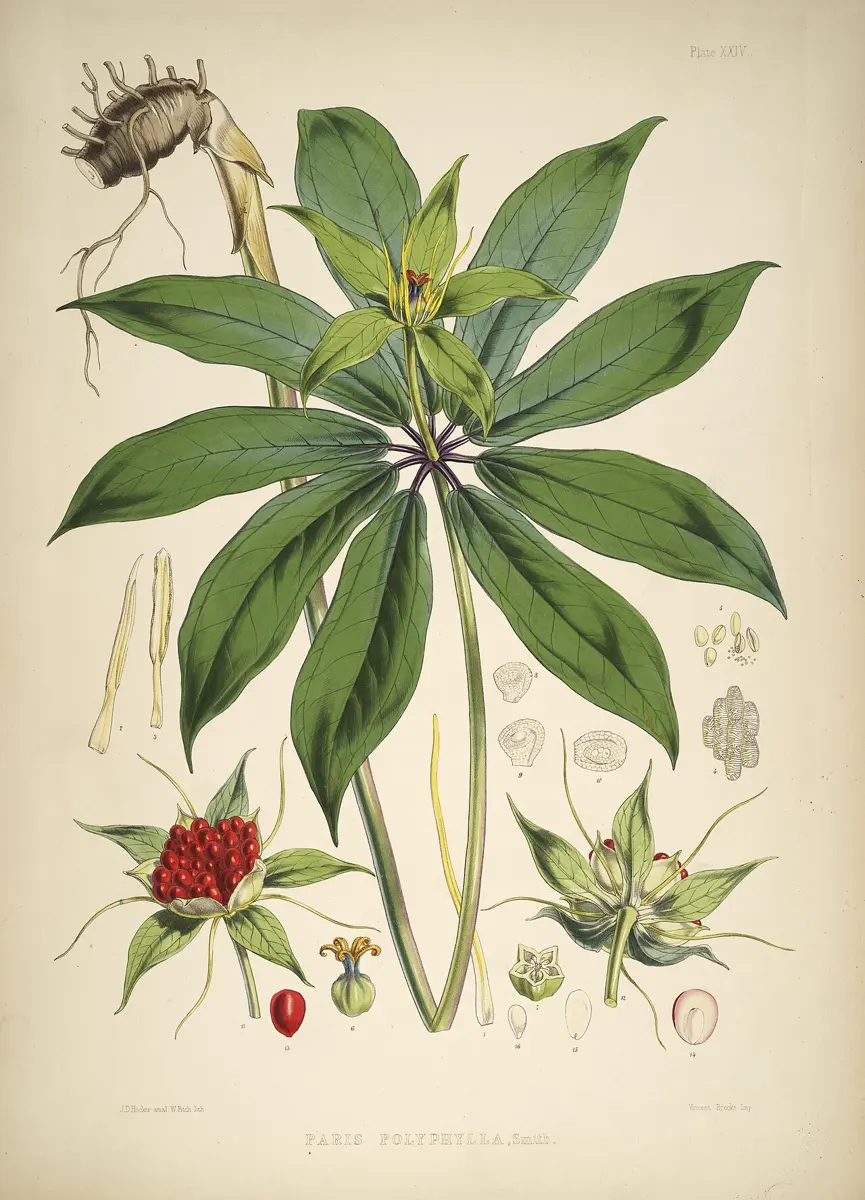
सतुवा is a perennial herb: its leaves and stem die back each winter, and it grows again each spring from a thick, creeping underground stem (a rhizome). It is easy to recognize once you have seen one. Look for:
- one straight stem, up to about 50 cm, sometimes taller;
- a single ring of 4 to 9 leaves at the top of the stem, like the spokes of an umbrella, each lance-shaped, pointed and about 10 to 16 cm long;
- one flower, on a short stalk rising from the middle of the ring;
- in the flower, an outer star of green, leaf-like parts and an inner ring of thin, thread-like parts, yellow or yellowish green, with the stamens and a round ovary in the center;
- the fruit: a round, fleshy capsule about 2.5 cm across, which splits open to show seeds covered in a bright red, juicy coat.
It flowers from about March to April; the fruit opens later in the year, and the seeds fall close to the parent plant.
The name सतुवा has other meanings too. The big Nepali dictionary lists three words spelled सतुवा: one means सातु (satu), the flour of roasted grain, one is a Kirat family name, and one is this plant, described as a plant whose flowers stand on a stalk and are yellowish green in the middle. In Sanskrit it is called हैमवती (haimavati, “of the Himalaya”); people who speak Tamang, Sherpa and Kham have their own names for it.
Where it grows
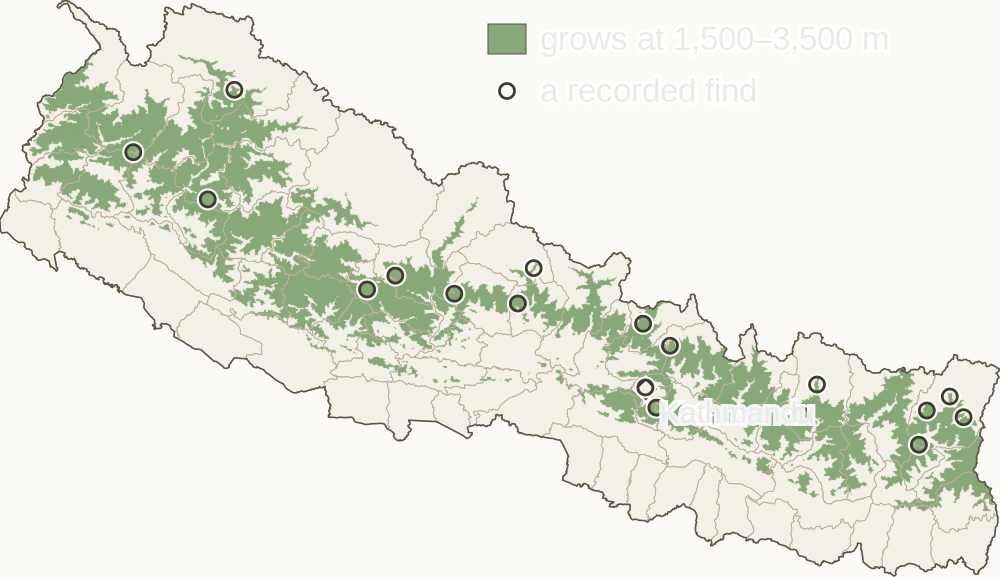
सतुवा grows from China, Taiwan and Indochina to India, Bhutan and Nepal. In Nepal, a nationwide survey (2016 to 2019) found it in 51 districts of the mid-hills and mountains, from about 1,500 to 3,500 meters, below the treeline.
It is a plant of old, undisturbed forest: under oak, laurel and rhododendron, in patches of bamboo and along streams, where the canopy above is thick and the soil stays moist. It grows in clumps, and even in good forest it is thinly spread: the same survey counted on average fewer than one plant in every ten square meters.
A seed that waits two winters
Why does सतुवा take so long? The answer starts inside its seed.
When the red seed falls, the embryo inside it, the baby plant, is tiny and not yet fully formed: it is only a small cluster of cells inside a big store of food. Before the seed can sprout, the embryo has to grow inside the seed, and that takes time. Scientists in China who followed the seeds of a Chinese variety closely found that:
- it took about 8 months before the first root poked out of the seed;
- it took about 10 months more before the first leaf came up;
- so it took about 18 months, through two winters, from seed to a seedling with one single leaf. Botanists call this “double dormancy”: the root and the shoot each have their own waiting period.
Even then, the plant is far from grown. In the first and second years it has only that one leaf. Only from the third year does it make a full ring of three to five leaves. Planted in a field, it needs as long as eight years before the rhizome is big enough to harvest.
Saving time in a laboratory
The same scientists found a way round the wait. They grew a mass of cells from a chosen plant in a dish, and coaxed those cells into many tiny embryos, each a copy of the parent. These grew into plantlets with no dormancy at all, ready for soil in five months instead of eighteen. They followed the plantlets for five years in a greenhouse, and by then the rhizomes of most of the chosen plants held enough of the plant’s main chemicals to pass China’s official standard for the medicine.
Traditional uses
सतुवा has been part of home medicine in Nepal for a long time. A review of 86 studies of the herbs people use across Nepal counted 190 reports of what सतुवा is used for, in at least 26 different ways. The most common uses, in tradition, are:
- for stomach ache and worms, the most reported use of all: the rhizome is given to get rid of intestinal worms;
- on cuts and wounds;
- for fever;
- against snakebite, insect stings and poisons.
Some examples from the studies:
- in Rasuwa, a paste of the root is taken for fever, vomiting and worms;
- in the far west (Baitadi, Darchula and Dadeldhura), people named it for snakebite;
- older studies record it used against worms in the Kathmandu valley itself, Bhaktapur included.
In China, the rhizomes of Paris plants are a main raw material of Yunnan Baiyao and Gongxuening, well-known Chinese medicines used to stop bleeding in women’s illnesses.
What science has tested
The rhizome is rich in a group of chemicals called steroidal saponins; the best known of them are named polyphyllins. Chemists have found many of them, and they are what China’s official book of medicines measures to judge the quality of the rhizome.
- In the laboratory and in animals, extracts and polyphyllins have been tested against cancer cells, worms, bacteria and more, and many studies found some effect. Polyphyllin D is one of those studied for cancer, in cells and in animals.
- In people: we found no trials in people showing that it treats any illness.
- How strong the evidence is: not tested in people. Interesting chemistry, which is where research starts, not where it ends.
Trade: from Nepal’s forests to China
Before 2000, सतुवा was mostly used at home, and only small amounts were sold, mainly to India. Then demand from China grew, and so did the trade:
- the official trade records showed the most dried rhizome traded from Nepal in 2011, 2012 and 2013: about 58, 41 and 45 tonnes;
- about two thirds of it goes to China, often through Kathmandu airport or the northern border districts; the rest to India and Nepal’s own markets;
- researchers believe much more is traded than the records show, because a lot of it crosses the borders illegally.
Why China? The Chinese medicine industry uses more than 3,000 tonnes of the raw plant a year, and by 2019 the price of the rhizome in China had risen about 100 times in 30 years, to about 650 yuan a kilogram. In Nepal, a 2017 news report from Bhojpur gave सतुवा’s price as Rs 10,000 a kilogram, against Rs 6,000 for चिराइतो (chiraito, the bitter herb on its own page).
Too valuable for its own good
Harvesters usually pull up the whole plant to get the rhizome, and the high price drives people to dig plants too early, before they are mature. Together with forests being cleared and broken up, this has made सतुवा scarce in many places:
- the IUCN Red List rates Paris polyphylla Vulnerable;
- it is also counted as vulnerable in Nepal, India, Vietnam and China;
- Nepal’s government has listed it among the medicinal plants it gives priority to for development, alongside about twenty others.
The answer, say the researchers, is to protect it in the forests and farm it outside them. That has begun: farmers in 16 districts have started growing it. In the hills of Bhojpur, one farmer planted 150,000 saplings one year and 250,000 the next, and ran his own nursery. Grown on a farm, at about 1,800 to 3,500 meters, सतुवा can earn a family money without being dug out of the forest.
A community forest group wants सतुवा in its forest for the next generation, and some income now. Which plan fits what the researchers recommend?
Pick an answer to see why.
See it at the Science Playground
Our exhibit Medicinal and Culinary Herbs of Nepal shows dried herbs and plant products used in Nepal’s kitchens and traditional remedies. Look for the knobbly roots, and see the other pages of Herbs of Nepal.
Where these facts come from
- Kunwar R.M. et al., Distribution, use, trade and conservation of Paris polyphylla Sm. in Nepal, Global Ecology and Conservation, 2020.
- Wang M. et al., Clonal propagation and assessment of biomass production and saponin content of elite accessions of wild Paris polyphylla var. yunnanensis, Plants, 2023.
- Deb C.R., Jamir S.L. and Jamir N.S., Studies on vegetative and reproductive ecology of Paris polyphylla Smith: a vulnerable medicinal plant, American Journal of Plant Sciences, 2015.
- Thapa C.B. et al., Bioactive secondary metabolites in Paris polyphylla Sm. and their biological activities: a review, Heliyon, 2022.
- Wang W. et al., Hepatocellular toxicity of Paris saponins I, II, VI and VII on two kinds of hepatocytes (abstract), Cells, 2019.
- Himalayan paris (Paris polyphylla), ICIMOD database of plants of the Himalaya, checked November 2026.
- Uprety Y. et al., Indigenous use and bio-efficacy of medicinal plants in the Rasuwa District, Central Nepal, Journal of Ethnobiology and Ethnomedicine, 2010.
- Kunwar R.M. et al., Medicinal plants, traditional medicine, markets and management in far-west Nepal, Journal of Ethnobiology and Ethnomedicine, 2013.
- Rai B., Higher returns prompt farmers to grow herbs, The Kathmandu Post, 2017.
- World Health Organization, Snakebite envenoming, fact sheet, checked November 2026.
- Paris polyphylla: IUCN Red List category, GBIF (from the IUCN Red List), checked November 2026.
- सतुवा in the Nepali Brihat Shabdakosh (Nepal Academy).