
सर्पगन्धा: the root that became a medicine
सर्पगन्धा · Rauvolfia serpentina · A small shrub of the dogbane family, Apocynaceae
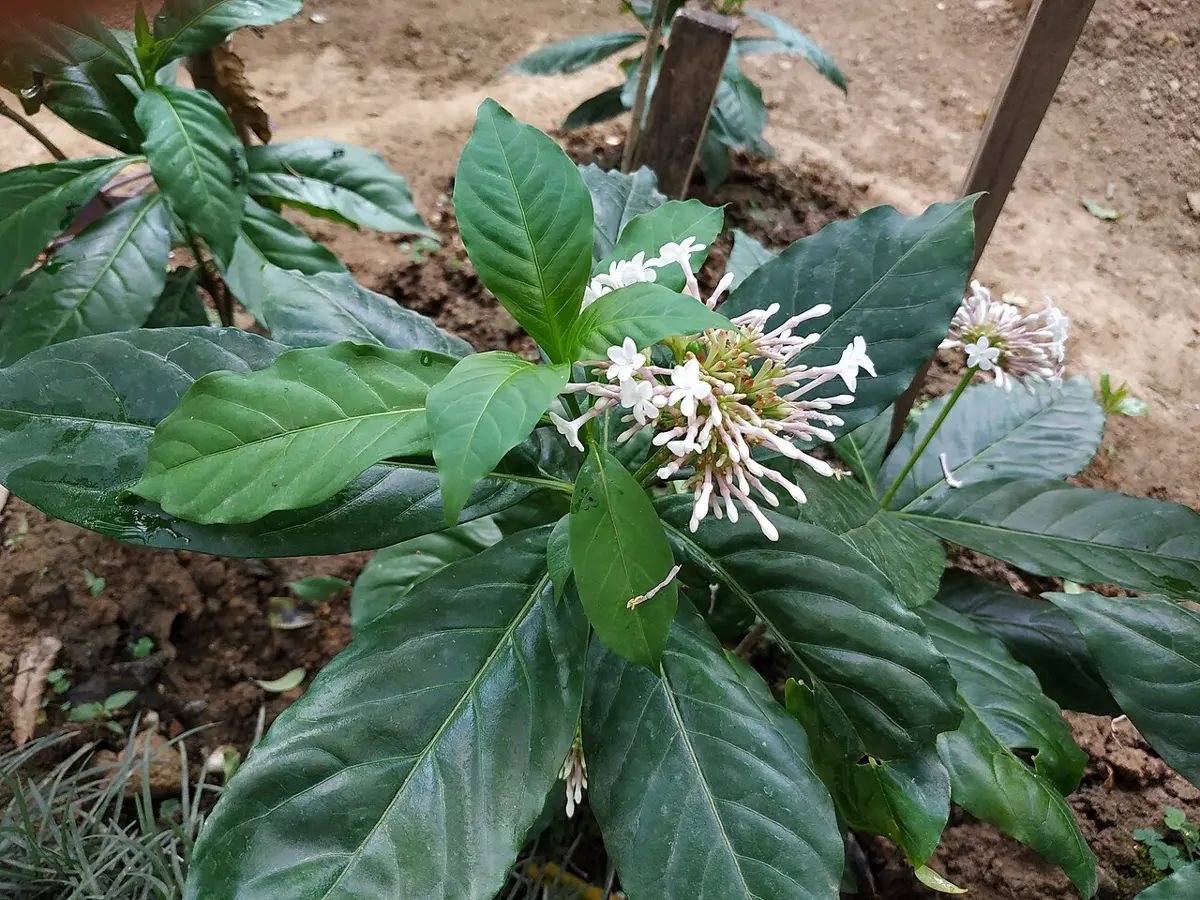
Ask a grandparent who takes tablets for high blood pressure what they take, and the answer will be a modern medicine with a long name. But one of the very first medicines for high blood pressure, used across the world in the 1950s, came from a small shrub of Nepal’s lowland forests: सर्पगन्धा (sarpagandha).
Its root holds chemicals strong enough to become prescription drugs. That is the reason for this page’s most important message, which comes after the story: this is a plant whose root must never be used as a home remedy.
Names
सर्पगन्धा joins two Sanskrit words: सर्प (sarpa, “snake”) and गन्ध (gandha, “smell”). In Nepali it is also called चाँदमरुवा (chandmaruwa); the Chepang call it chyarangro, and the Tharu baruwa, dhaldhaliya or pagalbuti. In English it is Indian snakeroot or serpentine root.
How to know it
सर्पगन्धा is a small, upright evergreen undershrub, usually 20 cm to 1 m tall. Look for:
- leaves in rings of three or four near the top of the stem, oval and pointed, about 7 to 13 cm long, dark glossy green above and paler below;
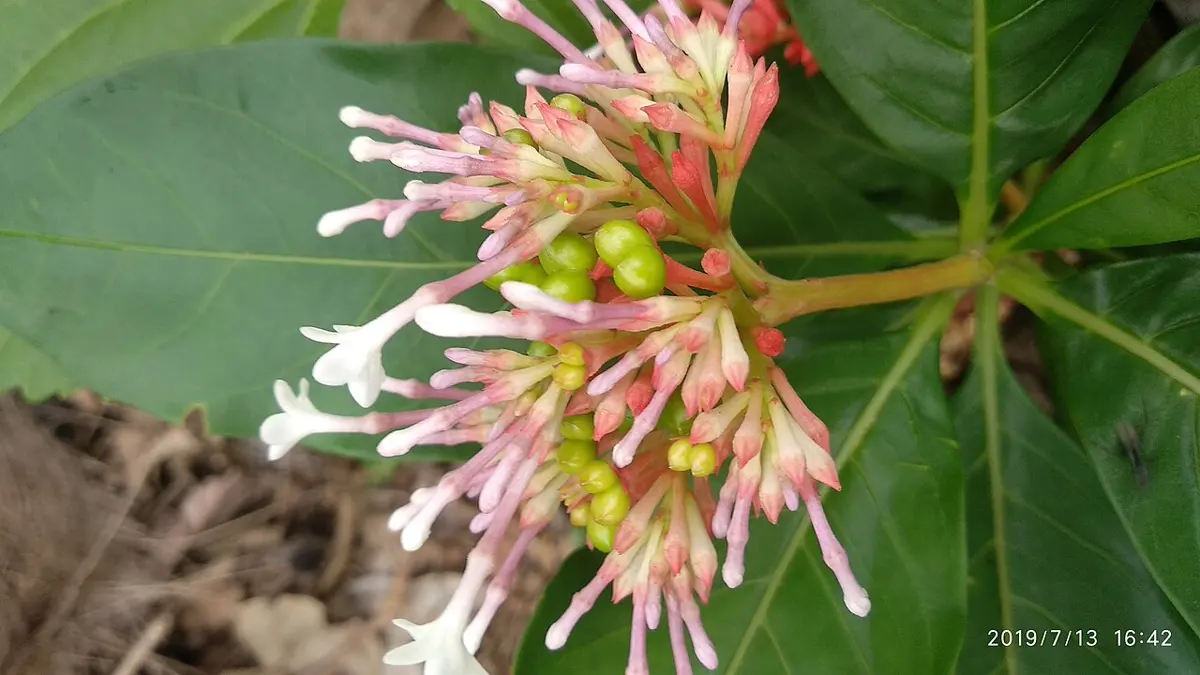
- flowers in a cluster at the top: thin white flowers with a slender tube that is often mauve or red, on red flower stalks;
- small berries, shiny black when ripe, often in pairs;
- a thick, twisted root, 15 to 30 cm long, whose inside is pale yellow and very bitter.
It flowers from about May to September and fruits from July to November.
Where it grows
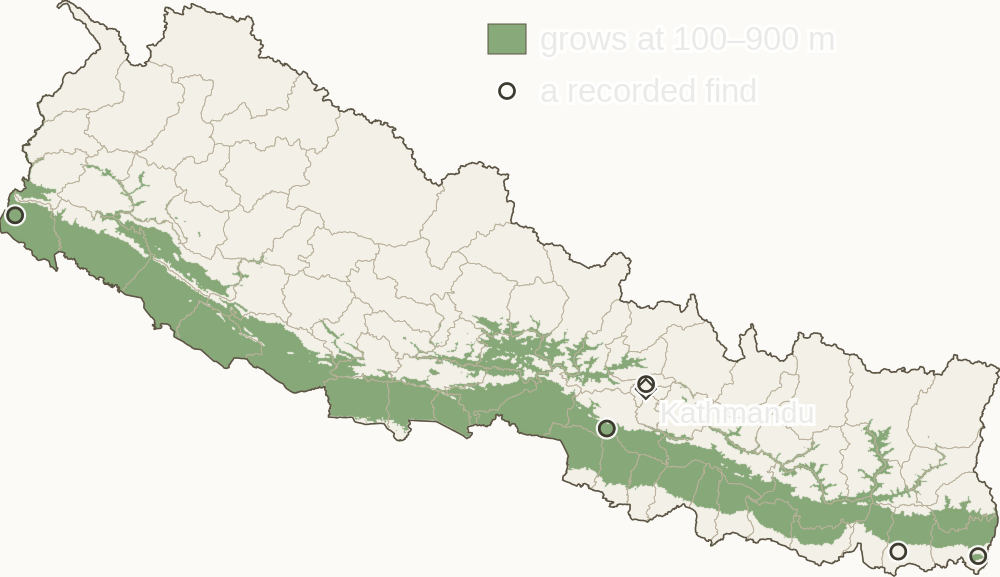
In Nepal it grows in the tropical and subtropical belt, from east to west, at about 100 to 900 meters, in moist, shady places in forests that are growing back: often under sal, harro, barro, asna, sissoo and khayar trees. It has been reported from 17 districts, among them Chitwan, Makwanpur, Banke, Bardia, Morang, Ilam, Sindhuli and Tanahun. Farmers have started growing it in Jhapa and Sarlahi.
From a forest root to a world medicine
How does it work? Nerve cells store messenger chemicals, such as noradrenaline, dopamine and serotonin, in tiny bags inside them. Reserpine blocks the pumps that fill those bags (scientists call them VMATs). The stores run empty, and the nerves that tighten blood vessels have less to send, so blood pressure falls. But the same emptying happens in the brain.
Traditional uses
Studies of the herbs used by Nepal’s communities record many uses of the root, each in tradition:
- by the Tharu of Dang, a root paste for diarrhea in cattle;
- in Chitwan, root juice for high blood pressure, worms and snakebite, and the stem for stomach pain;
- by the Darai of Chitwan, for stomach troubles and malaria fever; by the Chepang of Makwanpur, for malaria fever;
- by the Limbu of Morang, for fever and blood pressure; by the Satar of Morang and Jhapa, the root and leaves for snakebite.
The use for blood pressure is the one science later confirmed, for the pure drug. The use for snakebite has not been shown to work: a snakebite needs a hospital and antivenom, fast.
What science has tested
- Reserpine for high blood pressure: tested and it works. A Cochrane review (2016) of 4 trials with 237 people found that reserpine lowered the top blood-pressure number by about 8 mmHg more than a dummy pill, about as much as other first-choice medicines. The trials didn’t report enough to judge its side effects well.
- Reserpine and depression: a systematic review (2022) of 35 studies found the results mixed: some reported low mood with reserpine, others did not, and most studies were weak. The link is taken seriously but not settled.
- Today: reserpine is a second-line medicine, used rarely, and only on a doctor’s prescription.
Protection and trade
सर्पगन्धा has been dug out of Nepal’s forests faster than it grows back:
- the IUCN Red List rates it Near Threatened worldwide; in 2001, assessments for Nepal rated it endangered (IUCN’s Red Data Book) and critically endangered (CAMP);
- it is on CITES Appendix II: its trade between countries needs permits;
- Nepal bans the export of the raw root collected from the wild (the ban doesn’t apply to farmed roots); processed products may be exported with the Department of Forests’ permission;
- it is one of the Department of Plant Resources’ 12 medicinal plants prioritized for developing farming methods, and one of the 30 for research and development.
Nepal’s own market uses more than 30 tonnes of raw root a year (a 2004 estimate). The government charges a royalty of Rs 50 a kilogram on roots collected from the wild.
The Department of Plant Resources’ guide to good collection says: dig roots only from mature plants, leave the small and tender roots in the soil to grow again, keep at least a fifth of the plants at each site, and come back to the same place only every four to five years.
A collector finds a patch of सर्पगन्धा in a forest. Which way of digging follows the Department of Plant Resources’ guide?
Pick an answer to see why.
See it at the Science Playground
Our exhibit Medicinal and Culinary Herbs of Nepal shows dried herbs and spices used in Nepal. More plants in Herbs of Nepal.
Where these facts come from
- Department of Plant Resources, Quality standards, good agricultural and collection practice (GACP) of Rauvolfia serpentina, 2013.
- Rauvolfia, Flora of China vol. 16, 1995.
- Roy P., Global pharma and local science: the untold tale of reserpine, Indian Journal of Psychiatry, 2018.
- Lasker Foundation, Rustom Jal Vakil: 1957 Albert Lasker Clinical Medical Research Award.
- Shamon S.D. and Perez M.I., Reserpine for lowering blood pressure, Cochrane review, 2016.
- Strawbridge R. et al., The effects of reserpine on depression: a systematic review, Journal of Psychopharmacology, 2022.
- Rijntjes M. and Meyer P.T., No free lunch with herbal preparations: lessons from a case of parkinsonism and depression due to herbal medicine containing reserpine, Frontiers in Neurology, 2019.
- Department of Plant Resources, Plants of Nepal: fact sheet, 2012.
- Rauvolfia serpentina: IUCN Red List category, GBIF (from the IUCN Red List), checked November 2026.
- Rauvolfia serpentina, Species+ (CITES listings), checked November 2026.
- सर्पगन्धा, चाँदमरुवा, सर्प and गन्ध in the Nepali Brihat Shabdakosh (Nepal Academy).