
कुरिलो: the herb whose leaves are not leaves
कुरिलो · Asparagus racemosus · A spiny climbing shrub of the asparagus family
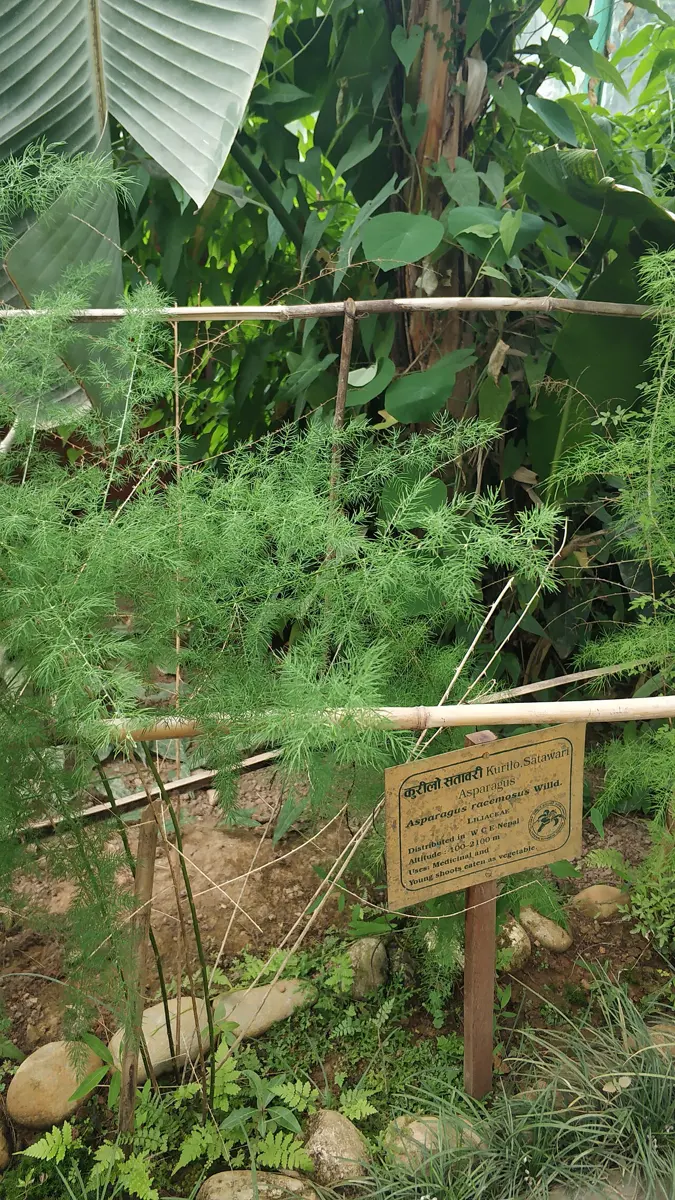
In spring, vegetable sellers sometimes have bundles of thin green shoots, a little like pencils with pointed tips. Fried with garlic, they are a treat, and some families give them to people who are ill. They are called कुरिलो (kurilo). Some are garden asparagus, grown for its shoots, but the name also covers a wild cousin whose roots are among the most traded herbs of Nepal.
This page is about that plant: how to know it, where it grows, the surprise hidden in its “leaves”, what tradition uses it for, what scientists have found, and why farmers in the Terai now grow fields of it.
Which कुरिलो?
The name कुरिलो covers more than one plant. Nepal has about ten kinds of Asparagus, wild and grown. This page is about Asparagus racemosus, the one used as a medicine, also called शतावरी (shatavari). Nepal has two forms of it, one in the east and one in the west.
Some of the others:
- Asparagus officinalis, the garden asparagus of Europe, grown in Nepal for its shoots as a vegetable;
- Asparagus adscendens, A. filicinus and A. penicillatus, wild kinds; A. adscendens and A. penicillatus are now being tried as crops too, because they have medicinal value as well;
- other species grown in gardens and homes as ornamental plants.
Collectors tell two kinds of कुरिलो apart by the root. रानी कुरिलो (rani kurilo, “queen kurilo”) or पोथी कुरिलो (pothi kurilo, “female kurilo”) has short, thick roots, under about 15 cm: that is the one wanted. भाले कुरिलो (bhale kurilo, “male kurilo”) has long, thin roots, over 30 cm, and is not.
The name शतावरी is Sanskrit. The Department of Plant Resources explains it as शत (shata, “a hundred”) and वरी, “one that cures disease”; another reading is “a hundred roots”, because one plant may have dozens of finger-shaped roots.
How to know it
कुरिलो is an evergreen climbing shrub, about 1.5 to 3 meters, that scrambles over other plants. Look for:
- spines: sharp, downward-curved spines at the base of the branches; on the main stems they can be about 2 cm long;
- the “leaves”: green needles, slightly curved like a sickle, about 1.5 to 2 cm long, in little bunches;
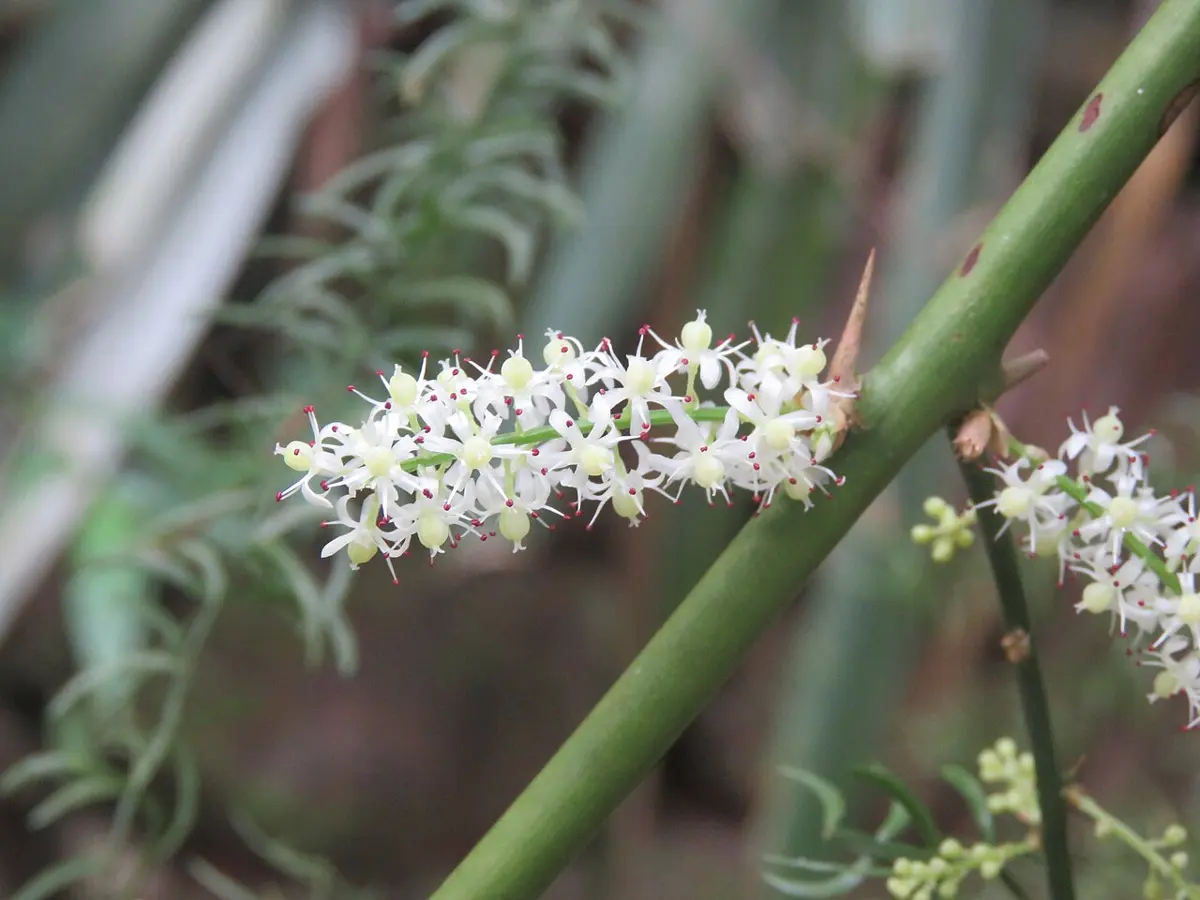
- the flowers: tiny, white and sweet-smelling, only 2 to 3 mm, along short sprays;
- the fruits: small berries, green at first, red when ripe, each usually with one black seed;
- the roots: a bunch of 10 to 100 pale, finger-shaped, swollen roots under the ground.
It flowers from about Baisakh to Asoj (April to October), and the fruits ripen in Bhadau and Asoj (August to October).
Where it grows
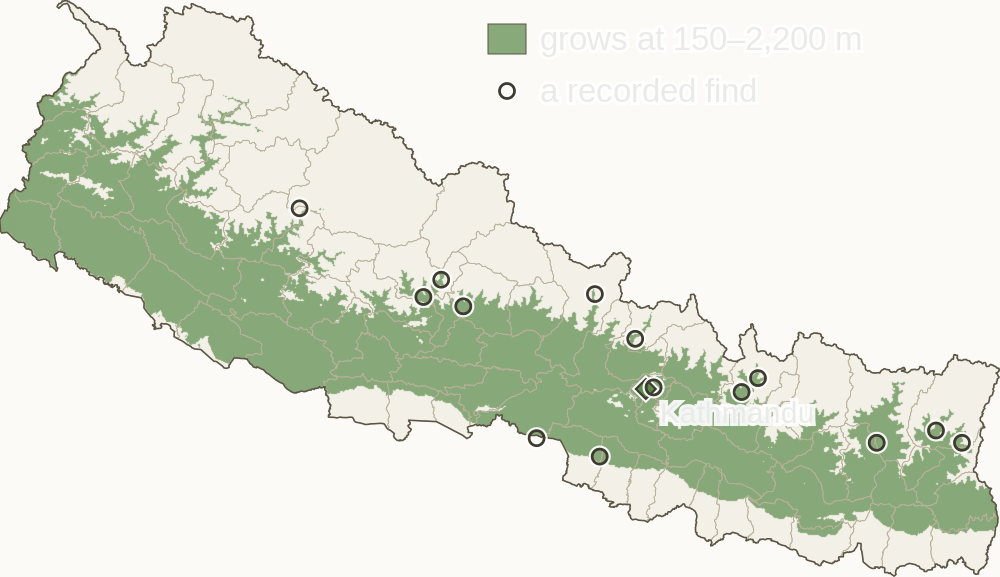
In Nepal, कुरिलो grows wild from about 150 to 2,200 meters, in the forests of the Terai, the Churia hills and the middle hills. It likes open, sunny places or light shade, in sandy soil that doesn’t stay waterlogged, often under sal, sissoo, harro and barro trees. It has become rare in the wild, because so much has been dug up carelessly.
Leaves that are really stems
Here is the surprise. Those green needles are not leaves at all. Botanists call them cladodes: they are tiny flattened side stems that have taken over the leaf’s job of catching sunlight and making food.
So where are the real leaves? Look closely where a bunch of needles joins the stem. There is a tiny brownish scale: that is the true leaf. It is not green and makes no food. And in कुरिलो, the base of that little leaf grows a spur that hardens into a spine. The spines that catch your sleeve are the leftovers of its leaves.
The asparagus shoots sold as a vegetable are the same idea in another form: a young stem pushing up, with the small scale leaves pressed against it near the tip.
Traditional uses
कुरिलो is a food, a medicine and part of custom:
- the young shoots are eaten as a vegetable or soup; the dictionary notes they are given especially to the sick;
- the roots are used as a tonic in tradition, and in Ayurveda;
- in the far west and in Kavre, the roots are used to increase milk: for new mothers, and for buffaloes (in Kavre, root juice mixed with corn flour, given for two or three days);
- in Kavre, root juice is drunk for jaundice; in Rasuwa, a paste of the root is taken for fever, stomach ache and diarrhea;
- on Shrawan Sankranti, in the custom of लुतो फाल्ने (luto phalne, throwing out लुतो, scabies), a कुरिलो plant is burned in the fire; in Sudurpashchim, mourners coming back from a funeral step on a कुरिलो plant, so that, in belief, the spirit doesn’t follow them home.
These are uses handed down in families and villages; they are not proof that the plant works.
What science has tested
The best-studied question is the one tradition cares about most: does it help mothers make more milk?
A Cochrane review (2020) gathered 41 trials with 3,005 mothers, testing medicines and natural products, शतावरी among them, given to increase breast milk. Its conclusion for the natural products: they may increase milk a little, but the evidence is very uncertain, and the risks are not known.
So, in plain words: some weak evidence, not proven. Many of the other claims (a tonic, for the stomach, for fever) have been tested only in the laboratory or in animals, if at all.
Farming and trade
Because the wild plants were being dug out, the government made कुरिलो a priority: it is on the Department of Plant Resources’ lists of medicinal plants for research and development and for developing farming methods. Banke, Surkhet, Kailali and Kanchanpur are the districts where farming is pushed most, and it is now grown in many districts of the Terai and middle hills.
What the Department’s farming guide (2075 BS) says about the crop:
| When to dig the roots | about 3 years after planting, in Phagun and Chait |
| Fresh roots from one plant, at 3½ years | 3 to 5 kg |
| Dried roots from one plant, when it grows well | 100 to 150 g |
| Price, 2016 | Rs 400 a kilogram |
| Price, at the time of writing (2075 BS) | Rs 600 to 900 a kilogram |
| Nepal’s production a year (ITC’s record) | about 300 tonnes |
| World demand a year | about 4,000 tonnes, only half of it met |
Prices in Nepal follow the market in Delhi. Forests in the western Terai alone have kurilo on 3,805 hectares and could give about 33 tonnes a year.
The IUCN Red List has not evaluated Asparagus racemosus.
Why does the government want farmers to grow कुरिलो, rather than just collect it from forests?
Pick an answer to see why.
See it at the Science Playground
Our garden has an asparagus in The Lily Family, as the Book Has It; which species it is hasn’t been confirmed. Look for the green needles and find the tiny true leaves. Our exhibit Medicinal and Culinary Herbs of Nepal shows dried herbs and spices used in Nepal. More plants in Herbs of Nepal.
Where these facts come from
- Department of Plant Resources, असल खेती तथा संकलन अभ्यास पुस्तिका: सतावरी (Asparagus racemosus, GACP monograph), 2075 BS.
- Chen X. and Tamanian K.G., Asparagus, Flora of China vol. 24, 2000.
- Ambu G. et al., Traditional uses of medicinal plants by ethnic people in the Kavrepalanchok District, Central Nepal, Plants, 2020.
- Kunwar R.M. et al., Medicinal plants, traditional medicine, markets and management in far-west Nepal, Journal of Ethnobiology and Ethnomedicine, 2013.
- Uprety Y. et al., Indigenous use and bio-efficacy of medicinal plants in the Rasuwa District, Central Nepal, Journal of Ethnobiology and Ethnomedicine, 2010.
- Foong S.C. et al., Galactagogues (medicines) for increasing breast milk production, Cochrane review, 2020.
- Department of Plant Resources, Plants of Nepal: fact sheet, 2012.
- Asparagus racemosus: IUCN Red List category, GBIF (from the IUCN Red List), checked November 2026.
- कुरिलो and शतावरी in the Nepali Brihat Shabdakosh (Nepal Academy).