
तेजपात: the leaf that smells of cinnamon
तेजपात · Cinnamomum tamala · An evergreen tree of the laurel family, Lauraceae
Next time there is dal at home, look in the pot before it is served. Often a stiff, dry, olive-green leaf is floating in it, put in with the spices at the start and taken out before eating. Nobody eats it, but the dal would smell flatter without it. That leaf is तेजपात (tejpat).
This page is about the tree behind it: how to know it, where it grows, why one tree’s leaves can smell quite different from another’s, and why tejpat is one of Nepal’s trade goods.
How to know it
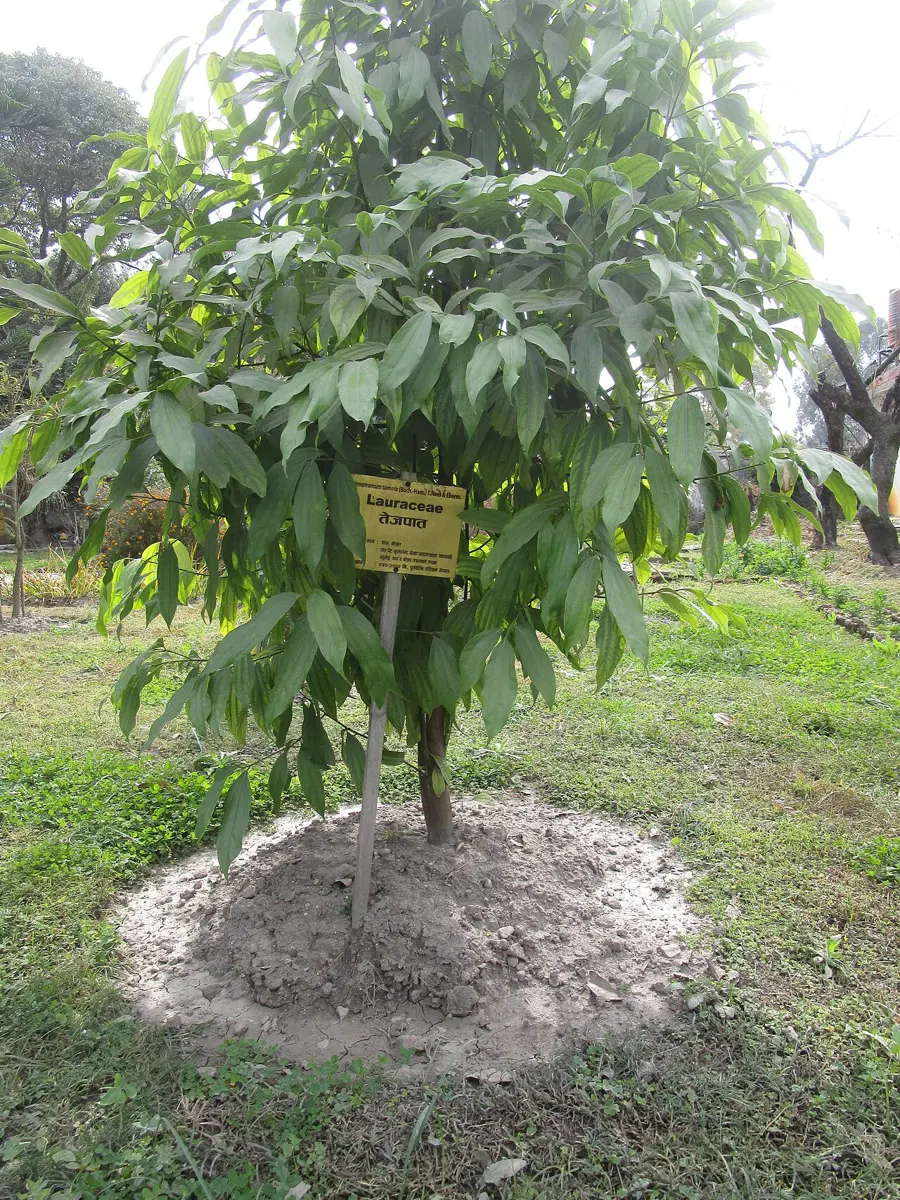
तेजपात is an evergreen tree, 15 to 20 meters tall when grown, with dark brown, wrinkled, fragrant bark. Look for:
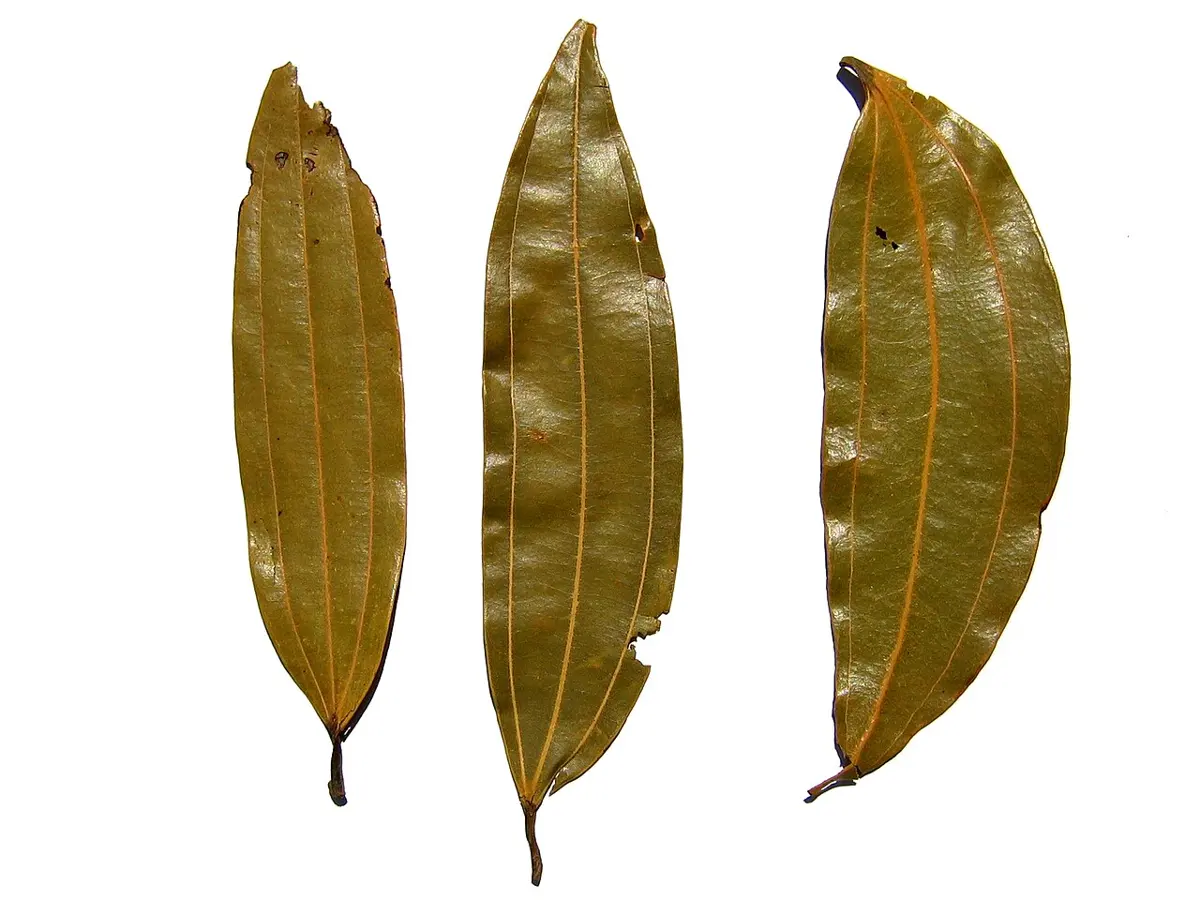
- the leaves: stiff and leathery, 10 to 15 cm long and 3 to 6 cm wide, shiny above and paler, bluish, beneath, with a pointed, often curved tip;
- three veins: the best clue. Three strong veins start together near the base of the leaf and run almost side by side to the tip. Most leaves have one main vein with side veins branching off it;
- young leaves: bright pink in spring;
- the flowers: small and pale yellow, in branched clusters, in March and April;
- the fruits: small, fleshy black fruits 1 to 1.2 cm long, each sitting in a little cup, in April and May.
Which plant is “tejpat”?
This page is about Cinnamomum tamala, a tree of the laurel family (Lauraceae). Its names in Nepali include तेजपात, दालचिनी (dalchini) and सिन्काउली (sinkauli); Newar speakers call it तेजपात too, and the Sanskrit name is तमालपत्र (tamalapatra). In English it is called Indian bay leaf or cinnamon leaf.
It is a close cousin of the trees that give true cinnamon, and the names get mixed up. The name दालचिनी is used for this tree’s bark as well, and in trade its bark is sold in place of the bark of Cinnamomum zeylanicum, the true cinnamon of Sri Lanka. So the “dalchini” in a shop may be either.
Where it grows
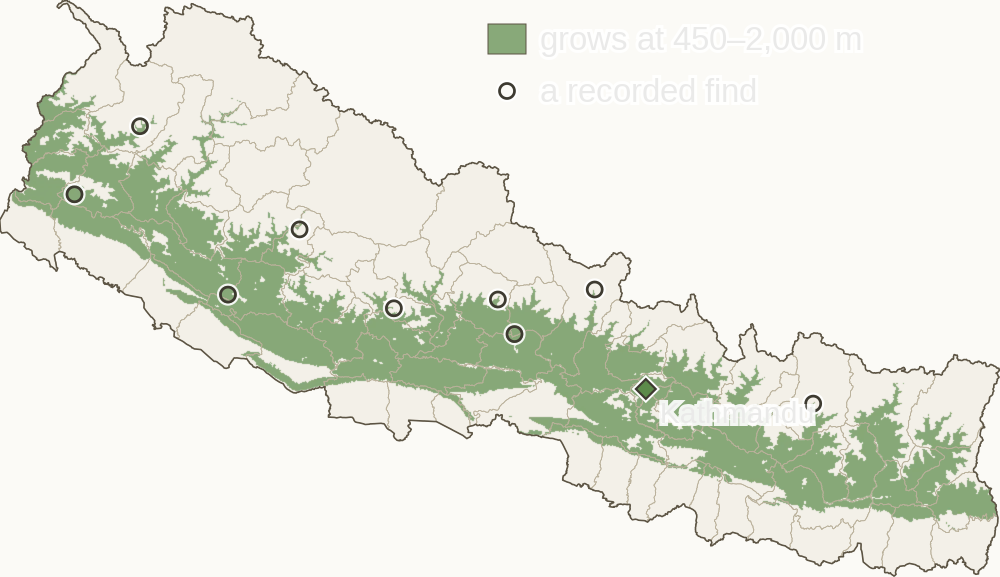
In Nepal, तेजपात grows from west to east at 450 to 2,000 meters, in the Chure hills and the Mid-Hills, in forests and on farmland. It is harvested commercially in 33 districts. Palpa and Udayapur are known for planting it as a crop, and it is one of the main forest products of Gulmi, Arghakhanchi and Palpa.
It likes moist, shady places and slightly acid, sandy soil rich in rotting leaves, often on north-west-facing slopes, with trees such as sal (साल), जामुन (jamun, a purple-fruited tree) and हर्रो (harro). Farmers in the Mid-Hills have been planting and tending it since the early 1960s.
One tree, different smells
Crush a fresh तेजपात leaf and smell it. Then do the same with a leaf from another tree, in another district. They may not smell the same.
The smell comes from an essential oil in the leaf, a mixture of many small molecules that float into the air. Chemists measure the mixture by boiling leaves with water, collecting the oil that comes over with the steam, and separating it into its parts in a machine called a gas chromatograph.
When chemists at Amrit Campus, Tribhuvan University, did this with leaves from Budhanilkantha in 2019, they found 18 compounds. Two led:
| Compound | Share of the oil | What it is known for |
|---|---|---|
| linalool | 54% | used in perfumes and flavors |
| cinnamaldehyde | 16% | the smell that gives cinnamon its flavor |
| cinnamyl acetate | 6% |
Fresh leaves gave only about 0.5% of their weight as oil: half a gram from 100 grams of leaves.
Other studies found other mixtures. Oil from trees at a Plant Resources office at Hetauda had linalool as its largest part too (41%); from a botanical garden at Hetauda, eucalyptol was the largest part; from another, cinnamyl acetate. In oil from some trees in India, cinnamaldehyde was the largest part (38 to 45%). Trees from north-east India gave an oil rich in eugenol, and oil from Mizoram was two-thirds linalool.
Plants of one species that make different mixtures like this are called chemotypes. Trees of different genetic lines differ, and so do the region, the height above the sea, the season and the weather. For a tejpat farmer it matters: the Department of Plant Resources advises choosing mother trees with a lot of oil and the wanted chemicals, and growing new trees from them.
The Amrit Campus team also tested the oil on germs in laboratory dishes: it held back the yeast Candida albicans and Shigella dysenteriae, a bacterium that causes dysentery. That is a test in a dish, not a medicine.
Traditional uses
तेजपात is first of all a spice: leaves and bark go into curries, meat, vegetables and pickles. In tradition, it is also used:
- for nausea and vomiting, and for colic and diarrhea, from the leaves and bark;
- in Ayurveda, in medicines for cough, piles, loss of appetite and skin trouble, among others;
- as an ingredient of many Ayurvedic preparations, among them च्यवनप्राश (chyavanprash).
Leaves, stem bark and root bark also go into perfumes, soap and toothpaste, and the oil distilled from the leaves is sold abroad. In the past, farmers lopped the branches simply for fodder and green manure.
What science has tested
- In the laboratory and in animals: extracts of the leaf, and its oil, lowered blood sugar in rats with diabetes; the oil and extracts held back some bacteria and fungi in dishes.
- In people: a large review of the cinnamon trees’ research (2021) lists no studies of Cinnamomum tamala in people. The human trials of “cinnamon” for blood sugar used other species.
- How strong the evidence is: not tested in people as a medicine. Enjoy it as a spice, and don’t treat diabetes or any illness with it: that needs a doctor.
From the hills to India
Many hill families sell dried leaves, bark and oil for cash. The Department of Plant Resources’ guide to growing tejpat (2015) gives these figures from earlier studies:
| Figure | Who gave it | |
|---|---|---|
| Dried leaves | Rs 40 to 70 a kilogram | HPPCL and ANSAB, 2014 |
| Leaf oil | Rs 6,000 to 7,000 a kilogram | HPPCL and ANSAB, 2014 |
| Exported to India | about 2,100 tonnes a year | Choudhary and others, 2011 |
| Grown in Udayapur alone | about 900 tonnes | as quoted in the guide |
Leaves are picked from October to February (the guide says their quality is better in winter) by breaking off young branches from the lower two-thirds of a tree four or five years old. Bark is stripped in March and April. A ten-year-old tree gives about 13 kg of dried leaves and 12 kg of dried bark a year.
To keep the trees healthy, leaves are picked from a young tree once a year and from an old one every second year, without stripping bark or damaging the branches. Worldwide, Cinnamomum tamala is not threatened: the IUCN Red List rates it Least Concern.
A family has tejpat trees on their land. Which way of harvesting keeps them giving leaves for years?
Pick an answer to see why.
See it at the Science Playground
Our exhibit Medicinal and Culinary Herbs of Nepal shows dried herbs and spices used in Nepal. Bring a dried तेजपात leaf from home and look for its three veins. More plants in Herbs of Nepal.
Where these facts come from
- Department of Plant Resources (Ministry of Forests and Soil Conservation), Good Agricultural and Collection Practices (GACP) of Cinnamomum tamala, Government of Nepal, 2015.
- Tandukar P., Das N., Pathak I. and Gautam D.R., GC-MS profiling and bioactivities of essential oil and extracts of Cinnamomum tamala leaves from Kathmandu valley, Nepal, Amrit Research Journal, 2022.
- Singh V. et al., Direct analysis in real time by mass spectrometric technique for determining the variation in metabolite profiles of Cinnamomum tamala genotypes, The Scientific World Journal, 2012.
- Sharifi-Rad J. et al., Cinnamomum species: bridging phytochemistry knowledge, pharmacological properties and toxicological safety for health benefits, Frontiers in Pharmacology, 2021.
- Cinnamomum tamala: IUCN Red List category, GBIF (from the IUCN Red List), checked November 2026.
- तेजपात in the Nepali Brihat Shabdakosh (Nepal Academy).