
रिट्ठो: the fruit that makes soap
रिट्ठो · Sapindus mukorossi · A deciduous tree of the soapberry family, Sapindaceae
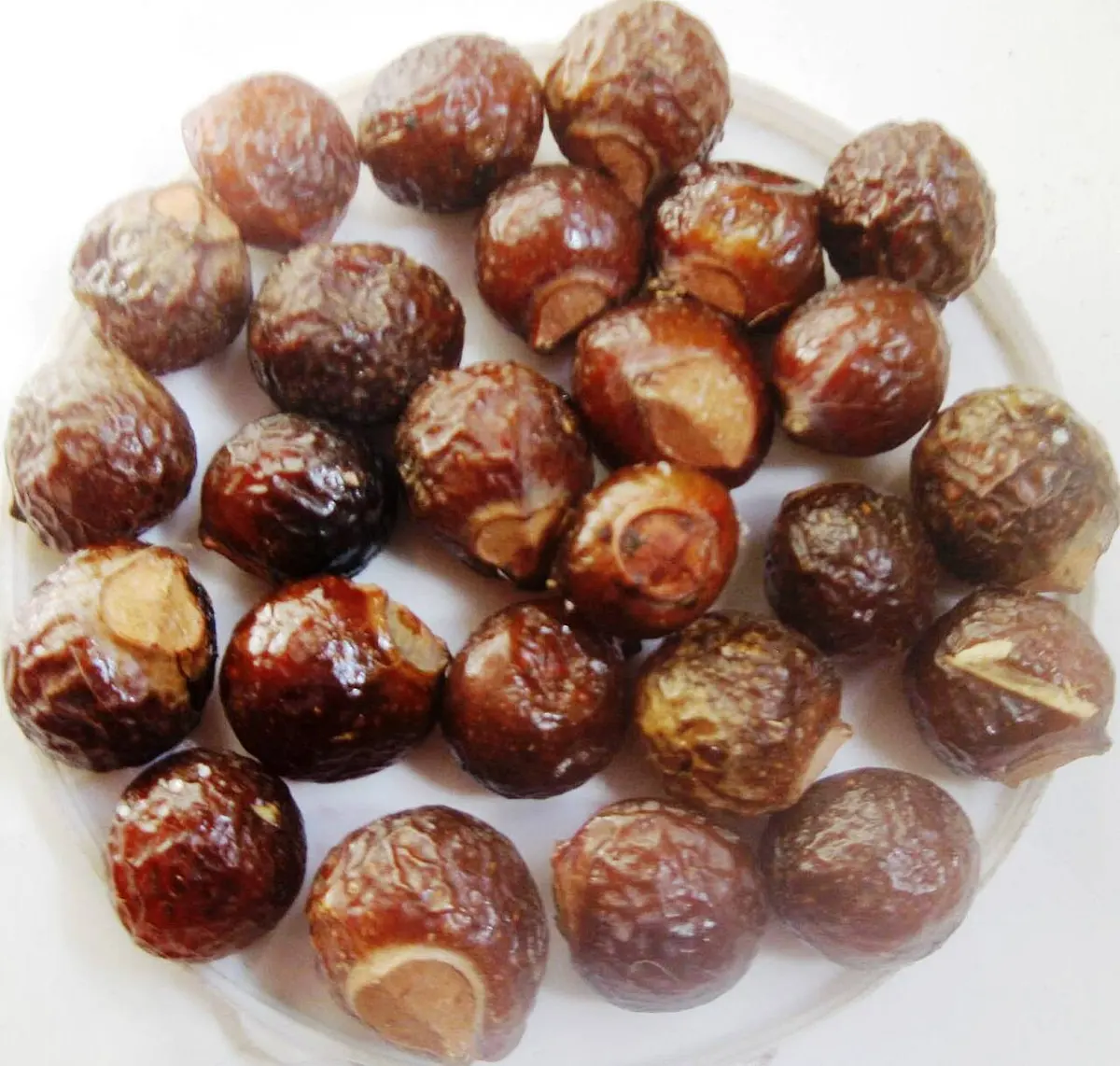
Your shampoo bottle and the bar of soap by the tap were made in a factory. But people in Nepal have long washed hair and clothes with something that grows on a tree: the dry brown husks of रिट्ठो (rittho, soapnut). Shake them in water and you get foam.
This page is about that tree: how to know it, why its fruit lathers, what it is used for, why it is not food, and why the far west sends hundreds of tonnes of it to market.
How to know it
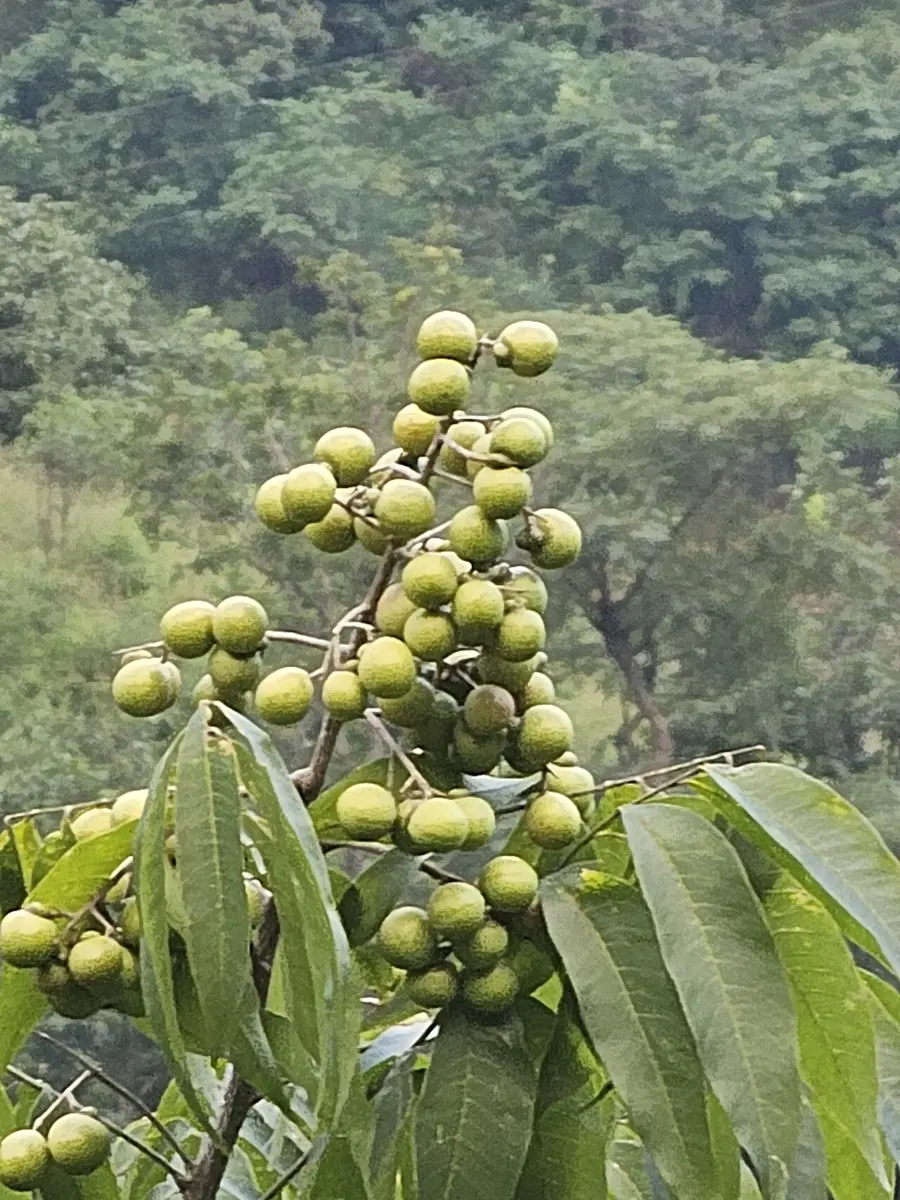
रिट्ठो is a tree, usually 12 to 15 meters tall, sometimes 20. It drops its leaves in winter. Look for:
- the leaves: long, made of 6 to 12 leaflets (sometimes 4 or 16), each 6 to 20 cm long, pointed and often a little curved like a sickle;
- the flowers: small, in May and June;
- the fruits: round, about 2 cm across, formed in July and August and ripe by November and December: green at first, then a wrinkled brown husk around one hard black seed.
The Nepali Brihat Shabdakosh gives a second meaning for रिट्ठो: the dark center of the eye, the pupil. Perhaps the round black seed suggested it; the dictionary doesn’t say.
Which plant is “rittho”?
This page is about Sapindus mukorossi, of the soapberry family (Sapindaceae). The whole genus is known for making soap. Other Sapindus species grow elsewhere in Asia, in the Americas and on Pacific islands, and some botanists once lumped several of them into one species, S. saponaria.
Where did the tree first come from? A 2024 revision of the genus says its homeland is presumably southeastern China, and that people growing it for a very long time explain why it is found across the rest of Asia; among the specimens it examined are two collected at Silgadhi, Doti, in 1967. A 2013 study of medicinal plants in Nepal’s far west, on the other hand, calls it indigenous to western Nepal. So whether the tree is truly wild in Nepal’s hills, or came with people long ago, is still an open question.
Where it grows
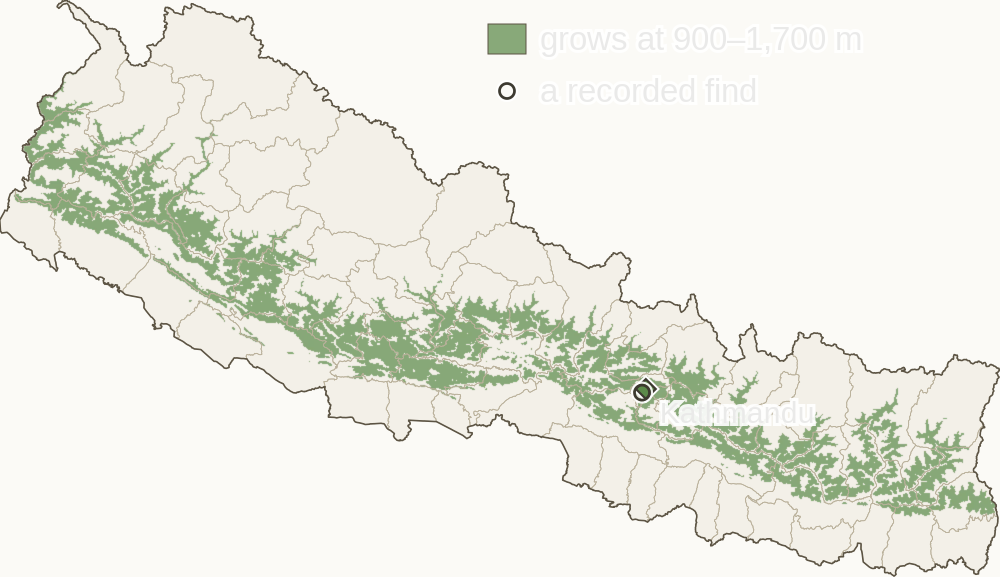
In Nepal, रिट्ठो grows in the lower foothills and the mid-hills, at about 900 to 1,700 meters, in forests and on farmland, mostly in Sudurpashchim, Karnali and Lumbini provinces. It is planted and found in plenty in the far west: Baitadi, Darchula and Bajhang. In Darchula and Baitadi every household grows at least a couple of trees. A tree starts bearing fruit after 9 or 10 years and can give 30 to 35 kg of fruit a year. Studies of plant use also record it in Lalitpur, Bhaktapur, Nuwakot, Ramechhap and Makawanpur.
Across the border in India, it grows in the foothills from about 200 to 1,500 meters.
How a fruit makes soap
The lather comes from chemicals called saponins. In रिट्ठो they are kept in the husk of the fruit, about 10 to 11.5% of the whole fruit’s weight.
A saponin molecule has two ends:
- one end is a group of sugars, which love water;
- the other end is a bulky, ring-shaped part, which avoids water.
A molecule like this is a surfactant (from “surface-active agent”), the same kind of molecule as in soap and shampoo. Shaken in water, saponins lower the water’s surface tension and hold up a foam. On greasy dirt, surfactants work the way soap does: the water-avoiding ends dig into the grease, the water-loving ends stay in the water, and the grease is lifted off in tiny wrapped droplets called micelles (see how soap does it in Grade 10 Science, Explained).
In one laboratory test, soapnut saponins started forming micelles at about a third of a gram in a liter of water; other studies found different amounts. Compared with a common factory detergent, one study found soapnut foam about two-thirds as high; another found it more stable.
Traditional uses
रिट्ठो is first of all a natural soap. In tradition it is used:
- for dandruff and hair problems: in the far west of Nepal, one of the uses people named most often;
- to wash silk and wool, and by jewelers to clean ornaments;
- to get rid of head lice;
- across Bagmati Province, its lather for burns and hair, and as soap and an insecticide; its wood for timber and fuel.
Ayurveda describes it as emetic: something that makes a person vomit. That is a warning in itself.
What science has tested
- As a cleaner: well tested in the laboratory. Its saponins are real surfactants, and they are being studied for natural shampoos and detergents.
- On skin: in one test, 30 people had a soapnut saponin solution held on their skin, and none reacted. A rabbit skin test found no irritation.
- As a medicine: its saponins have been studied in the laboratory, but it has not been tested in people as a medicine.
Trade from the far west
रिट्ठो is one of the plant products Nepal exports most, by weight:
| Figure | Who gave it | |
|---|---|---|
| Exported from Nepal (an estimate) | 1,300 to 2,550 tonnes a year | Pyakurel and others, 2022 |
| Traded from Nepal’s part of the Kailash Sacred Landscape (far west), at home and abroad | about 500 tonnes a year | the same study |
| Traded from Baitadi district, 2014/15 | 356.5 tonnes, the most of any plant | Pyakurel and others, 2017 |
| Average price in Baitadi, 2014/15 | Rs 14.75 a kilogram | the same study |
So the soapnut trade is about large amounts at a low price. In Baitadi, more than 82% of the district’s medicinal and aromatic plants went on through Nepalgunj to India; some soapnut also went to Kathmandu. The oil in the seeds is not yet traded from Nepal.
Which part of the रिट्ठो fruit does the washing?
Pick an answer to see why.
Worldwide, Sapindus mukorossi is not threatened: the IUCN Red List rates it Least Concern.
See it at the Science Playground
Our exhibit Medicinal and Culinary Herbs of Nepal shows dried herbs and spices used in Nepal. Look at a dried रिट्ठो fruit from the market at home. More plants in Herbs of Nepal.
Where these facts come from
- Sochacki M. and Vogt O., Triterpenoid saponins from washnut (Sapindus mukorossi): a source of natural surfactants and other active components, Plants, 2022.
- Franck A.R., Revision of Sapindus sect. Sapindus (Sapindaceae), including the description of three new species, Phytotaxa 648, 2024, read in its treatment of S. mukorossi on Plazi (the paper itself is for subscribers).
- Pyakurel D., Bhattarai (Sharma) I. and Ghimire S.K., Trade and conservation of medicinal and aromatic plants in western Nepal, Botanica Orientalis, 2017.
- Pyakurel D. et al., Trade potentiality of oils extracted from Prunus davidiana, Sapindus mukorossi and Zanthoxylum armatum in Kailash Sacred Landscape, Nepal, Environmental Challenges, 2022.
- Kunwar R.M. et al., Medicinal plants, traditional medicine, markets and management in far-west Nepal, Journal of Ethnobiology and Ethnomedicine, 2013.
- Subedi D. et al., Current outlook of ethnobotany in Bagmati Province, central Nepal, Journal of Plant Resources (Department of Plant Resources), 2025.
- Sapindus mukorossi: IUCN Red List category, GBIF (from the IUCN Red List), checked November 2026.
- रिट्ठो in the Nepali Brihat Shabdakosh (Nepal Academy).