
लोठ सल्लो: the yew behind a cancer drug
लोठ सल्लो · Taxus wallichiana, T. contorta, T. mairei · An evergreen conifer of the mountain forests, yew family
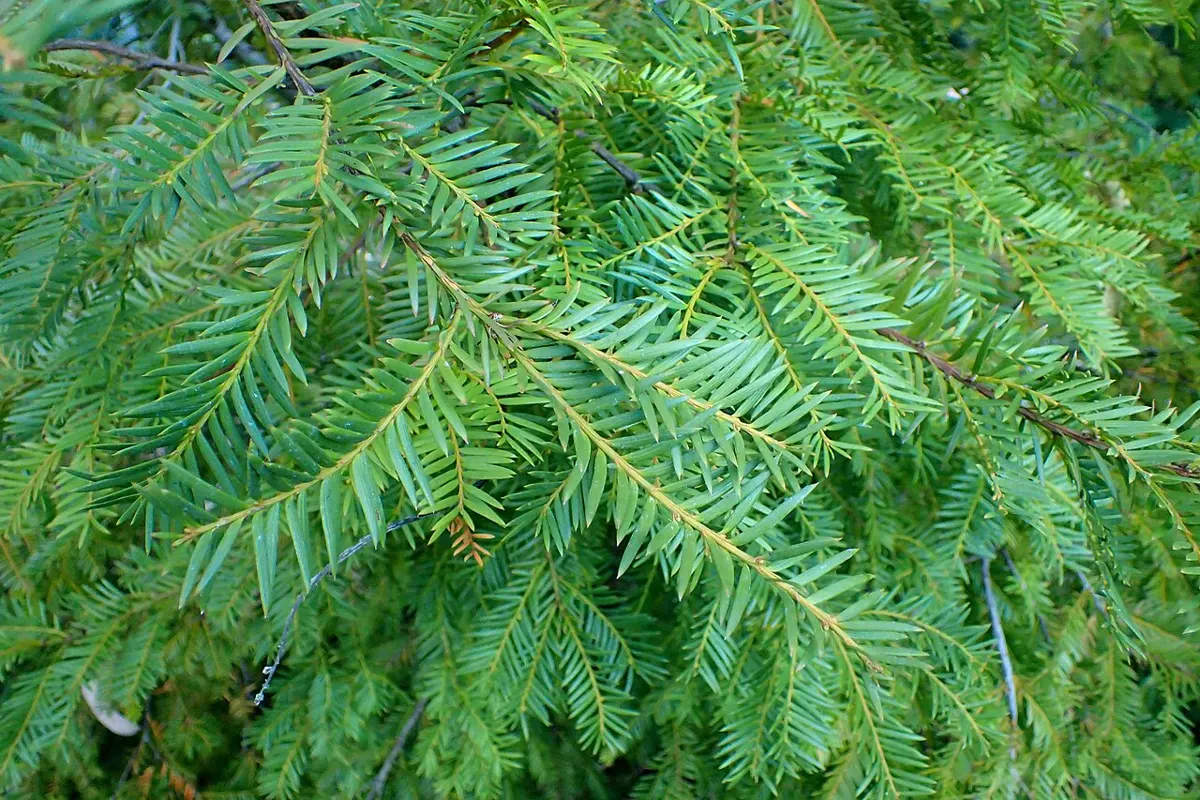
In science class this week you draw a cell dividing in two, its chromosomes pulled apart. One of the most used cancer drugs, paclitaxel (sold first as Taxol), works by jamming exactly that step, and it is given for cancers of the breast, the ovary and the lungs. Few people know that it was found in the bark of a yew tree, and that Nepal’s forests hold three kinds of yew, called लोठ सल्लो (loth sallo, often written lauth salla).
This page is about those trees: how to know them, where they grow, how a chemical in their leaves stops cancer cells dividing, why the same trees are poisonous, and why so many were stripped that Nepal now protects them.
How to know it
लोठ सल्लो is an evergreen conifer, a cone-bearing tree, though it bears no woody cones. Look for:
- the leaves: flat, narrow and pointed, a little curved, dark green, lined up in two rows, one on each side of the twig, like the teeth of a comb;
- the size: a long-lived tree, from a small tree under taller ones to a tall tree in old forest (the East Himalayan yew up to 30 meters);
- male and female trees: each yew tree is either male or female; only the female trees bear seeds;
- the seed: one black seed sitting in a fleshy cup called an aril, green when young and turning bright red as it ripens, from September to November.
One name, three trees
Botanists long disagreed about how many kinds of yew grow in the Himalaya. In 2012, a team who compared the trees’ leaves, their DNA and the climates they grow in showed that Nepal has three species, and that people call all three लोठ सल्लो:
| Where in Nepal | Height | How to tell | |
|---|---|---|---|
| West Himalayan yew, Taxus contorta | the north side of the Annapurna and Manaslu ranges, west and central Nepal, about 1,900 to 3,300 m | up to 14 m | leaves mostly straight, coming off the twig in all directions |
| East Himalayan yew, Taxus wallichiana | south of the Dhaulagiri and Annapurna ranges, from eastern Baglung to the east, about 1,900 to 2,700 m | up to 30 m | narrow leaves in two neat rows, tapering to a long point |
| Maire’s yew, Taxus mairei | the Mahabharat range: Kavre, Sindhuli and Makwanpur, about 1,500 to 2,000 m | up to 20 m | broader leaves, shiny underneath, with a blunter tip |
The two Himalayan species meet only at a small point in northern Rasuwa and Sindhupalchok. Maire’s yew, a tree mostly of southern China, was found in Nepal only with that study.
A forest guide in Kavrepalanchok shows you a yew with broad, curved leaves that are shiny underneath. Which yew is it most likely to be?
Pick an answer to see why.
Where it grows
All three grow in the shade of taller trees: in forests of oak, hemlock, fir, pine, maple and rhododendron, often on moist slopes, along humid riversides and in gullies. The West Himalayan yew stands the cold best. When the big trees above a yew are cut, the yew is suddenly in full sun: its leaves scorch, the soil dries out, and the tree weakens.
Maire’s yew grows lowest, in the broadleaved forests of the Mahabharat range, where more people live and more land is farmed, and that is one reason it is the rarest of the three.
Why it matters: a drug from a tree
Before a cell divides in two, it builds a scaffold of tiny tubes called microtubules, which pull its two copies of the chromosomes apart. Paclitaxel sticks to the building blocks of these tubes and makes them join up and stay joined, so the scaffold can’t do its work. The cell gets stuck halfway through dividing, and dies. Cancer cells divide again and again, so they are hit hardest.
There was one big problem: a yew holds very little of it. Even the best tree has only about 0.01 to 0.05% paclitaxel, and taking the bark kills the tree. One estimate: about 10,000 kg of leaves and bark of a Chinese yew are needed for 1 kg of paclitaxel.
Today most paclitaxel is made in a cleverer way. Factories take a similar chemical, 10-DAB, from yew leaves, which grow back, and finish the job in the laboratory: this half-made-in-the-lab drug is about four-fifths of the market. About a tenth comes from yew cells grown in tanks, with no tree at all.
- How strong the evidence is: strong for the purified drug, which has been tested in large trials of patients and is given by specialist cancer doctors, in carefully measured doses, in hospital. This says nothing about the tree’s leaves or bark taken as a home remedy, which are poisonous (below).
Poisonous: look, don’t taste
Traditional uses
People in Nepal have used yews for a long time, and studies of how they use them record:
- across Nepal, in a study of ten ethnic and caste groups from west to east, 45 uses: medicine for stomach troubles, coughs and colds, and bone and muscle problems, the red fruit eaten, the wood for tools and farm implements, and timber;
- in Rasuwa, juice of the leaves drunk for breathing problems; people there ranked it 11th among their most important medicinal plants;
- in the west, bark stripped from the trunk to make tea, which harms the tree;
- the wood, strong and long-lasting, for door frames, furniture and gates, and burned as incense, धूप (dhup); the inner bark gives a red dye used in Brahmin ceremonies;
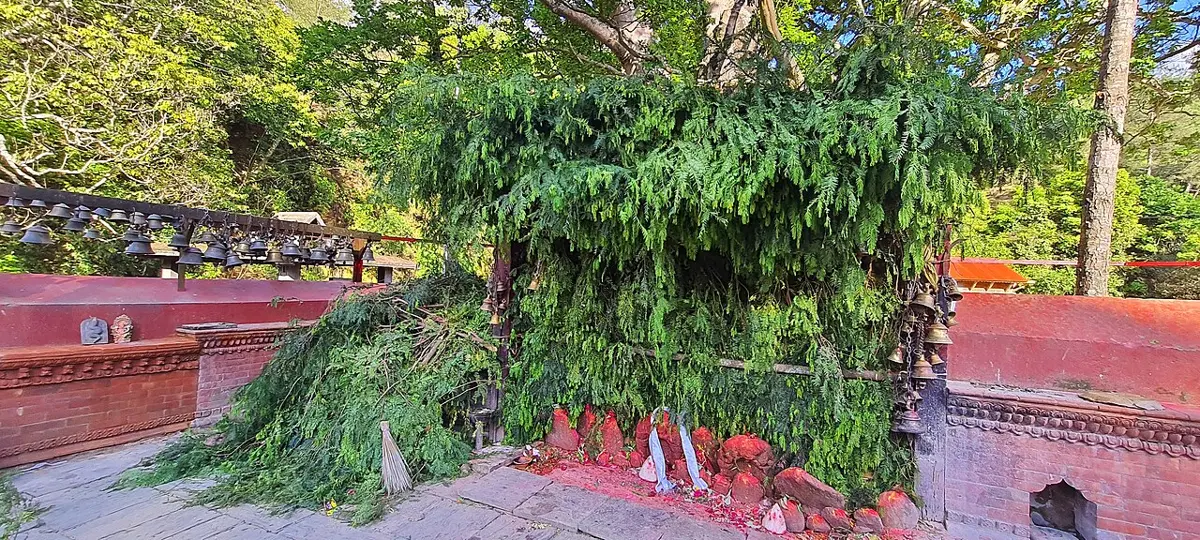
- the leafy twigs in temple festivals (see the photo above).
These are uses passed down in families and by traditional healers. They are part of the story of the tree, and the plant is poisonous: none of them has been tested as safe.
What science has tested
- The purified drug, paclitaxel: strong evidence from many large trials in people, as a cancer medicine given by doctors. It is still a powerful drug with side effects, used only under specialist care.
- Extracts of the Himalayan yew’s leaves or bark: tested in the laboratory and in animals (for pain, fever, swelling and germs), with some effects found; not tested in people.
- Home remedies of yew leaves or bark: not tested, and the plant is poisonous.
Stripped, then protected
The world’s demand for paclitaxel brought collectors to Nepal’s yews. Leaves were cut for the drug, trees were felled for timber and firewood or stripped of bark, and forests were cleared for farms and roads. Across the Hindu Kush Himalaya, harvesting and local cutting have harmed up to 90% of wild yew populations.
| IUCN Red List (world) | Nepal’s own assessment (2018) | |
|---|---|---|
| West Himalayan yew | Endangered | Endangered |
| East Himalayan yew | Endangered | Endangered |
| Maire’s yew | Vulnerable | Critically Endangered |
- Since 1995 the Himalayan yew has been listed in Appendix II of CITES, the world agreement on trade in endangered species: its leaves, bark and extracts cross borders only with permits.
- Nepal forbids felling any yew, and its list of protected plants bans exporting the Himalayan yew without processing (farmed trees excepted).
- In 2019 a newspaper reported a notice in the Nepal Gazette banning all import and export of the three yews. Later government records still describe permits for trading yews, so the rules may have changed since: the ban’s exact terms are best checked with the Department of Forests.
- Some yews grow in community-managed forests, where they are cut regularly for leaves to make the drug.
See it at the Science Playground
A yew grows in our garden, in Medicinal Plants, labeled Lauth Salla (Himalayan Yew). Look at the leaves in two rows and at how it likes the shade, and compare them with the table above. Don’t pick or taste it: it is poisonous. Our exhibit Medicinal and Culinary Herbs of Nepal shows dried herbs and spices used in Nepal. More plants in Herbs of Nepal.
Where these facts come from
- Poudel R.C. et al., Using morphological, molecular and climatic data to delimitate yews along the Hindu Kush-Himalaya and adjacent regions, PLoS ONE, 2012.
- Hughes K., Poudel R.C., Lamichhane D. and Watson M., Conservation collections at the National Botanic Garden of Nepal: the Franklinia Taxus Project, Sibbaldia, 2023.
- Thomas P. and Gao L., Taxus wallichiana, Threatened Conifers of the World, Royal Botanic Garden Edinburgh, 2018.
- Poudel R.C. et al., Yews (Taxus) along the Hindu Kush-Himalayan region: exploring the ethnopharmacological relevance among communities of Mongol and Caucasian origins (abstract), Journal of Ethnopharmacology, 2013.
- Uprety Y. et al., Indigenous use and bio-efficacy of medicinal plants in the Rasuwa District, Central Nepal, Journal of Ethnobiology and Ethnomedicine, 2010.
- Juyal D. et al., Ethnomedical properties of Taxus wallichiana Zucc. (Himalayan yew), Journal of Traditional and Complementary Medicine, 2014.
- National Cancer Institute, Paclitaxel (Taxol), cancer.gov.
- Zhang S. et al., Research advances in clinical applications, anticancer mechanism, total chemical synthesis, semi-synthesis and biosynthesis of paclitaxel, Molecules, 2023.
- Schreiber N. et al., Cardiogenic shock due to yew poisoning rescued by VA-ECMO: case report and literature review, Channels, 2022.
- Paudel K., Rare anti-cancer tree on verge of extinction, Nepali Times, 2020.
- Govt prohibits export, import of various goods, The Himalayan Times, 2019.
- Department of Plant Resources, Population status of mostly traded CITES listed plant (final draft report), 2078 BS (archived copy).
- World Trade Organization, Nepal: non-automatic import licensing of forest products, quantitative restrictions database, notified 2022.
- Taxus wallichiana, Species+ (CITES listings), checked November 2026.
- Department of Plant Resources, Plants of Nepal: fact sheet, Ministry of Forests and Soil Conservation, 2012 (archived copy).
- Taxus wallichiana, T. contorta and T. mairei: IUCN Red List categories via GBIF (1, 2, 3), checked November 2026.
- लोठ सल्लो in the Nepali Brihat Shabdakosh (Nepal Academy).
- Bajrabarahi temple photo and its description, Wikimedia Commons.
