
पुदिना: why mint feels cold
पुदिना · Mentha spicata and other mints · Creeping, scented herbs of the mint family (Lamiaceae)
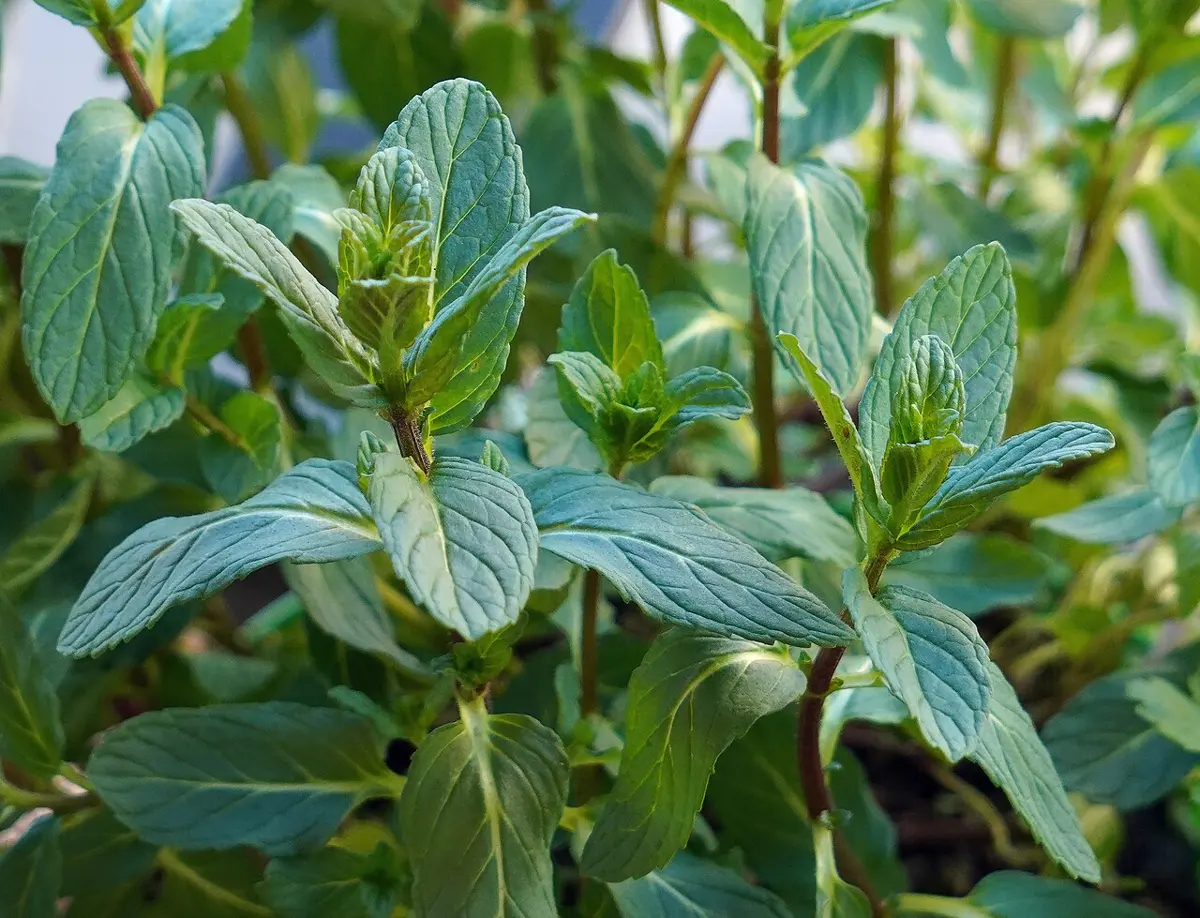
A spoon of पुदिनाको चटनी (pudinako chatani, mint chutney) with momo, a glass of mint tea, a mint sweet after a meal: your mouth feels cool, even though nothing cold has touched it. Breathe in through your mouth and the air feels colder still.
Nothing has cooled down. Your nerves have been tricked. This page is about the herb that plays the trick: how to know it, which mints grow in Nepal, and the science of the trick, which won a Nobel Prize in 2021.
Which mint?
पुदिना (pudina) is not one plant. The genus Mentha has about 18 to 24 species and 11 named hybrids, and their naming is so tangled that more than 3,000 names have been published for mints since 1753; many are sold by their smell rather than by species.
The mints you are most likely to meet in Nepal:
| Mint | What it is | In Nepal |
|---|---|---|
| Spearmint, Mentha spicata | the usual kitchen mint; its smell comes from carvone | about 1,800 to 2,700 m in the floras’ records, and grown in gardens |
| Corn mint, Mentha arvensis | very rich in menthol; grown for mint oil | about 400 to 2,500 m |
| Horse mint, Mentha longifolia | a wild mint, an ancestor of spearmint | about 400 to 4,500 m |
| Peppermint, Mentha × piperita | a sterile hybrid of spearmint and water mint, rich in menthol | not in the Himalayan floras’ list for Nepal |
Names change from place to place too. The dictionary gives बाबरी (babari) as another name for पुदिना, and people in Mahankal, in the hills of Lalitpur, call spearmint बाबरी. The Tharu near the Koshi River call corn mint Satya jiwan. This page is mostly about spearmint, the पुदिना of our garden.
How to know it
Spearmint is a herb up to 0.5 to 1 meter tall, spreading 1 to 1.5 meters wide. Look for:
- the leaves: 5 to 9 cm long and 1 to 3 cm wide, with toothed edges, in pairs along the stem, sweet-smelling when rubbed;
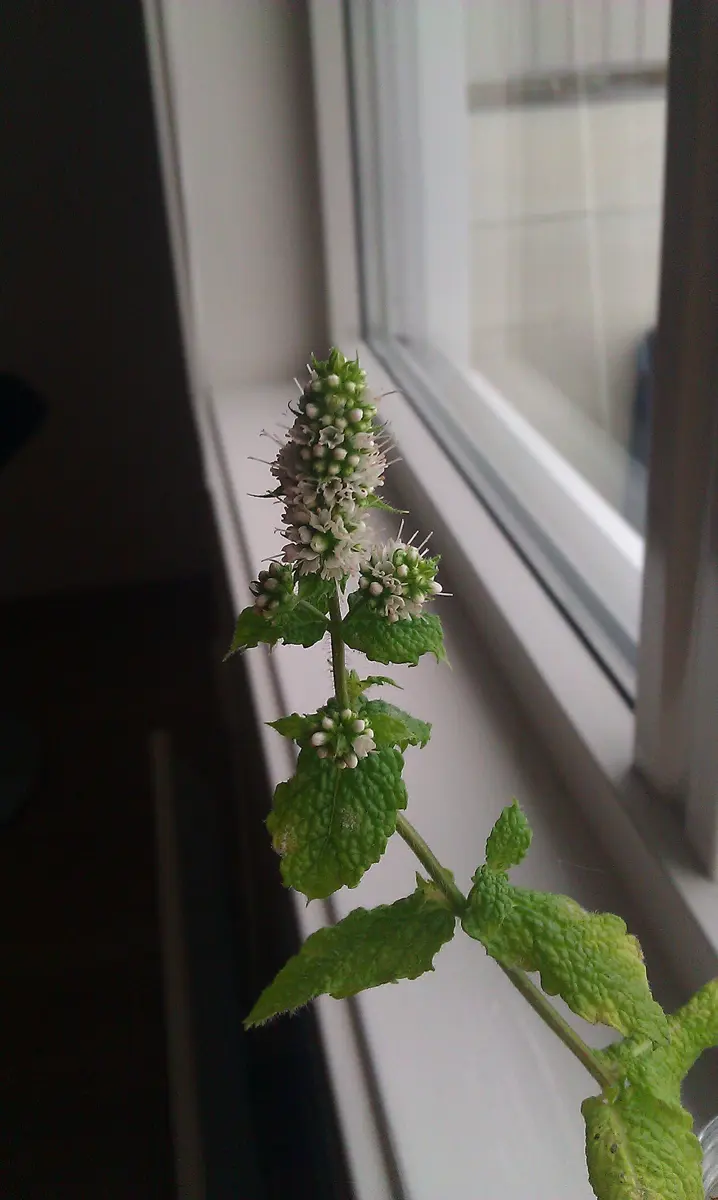
- the flowers: tiny, 2 to 3 mm, light purple, in slender spikes at the tips of the stems, in summer;
- the way it spreads: its roots creep through the soil, so one plant soon becomes a patch. In damp ground it can take over a bed.
Where it grows
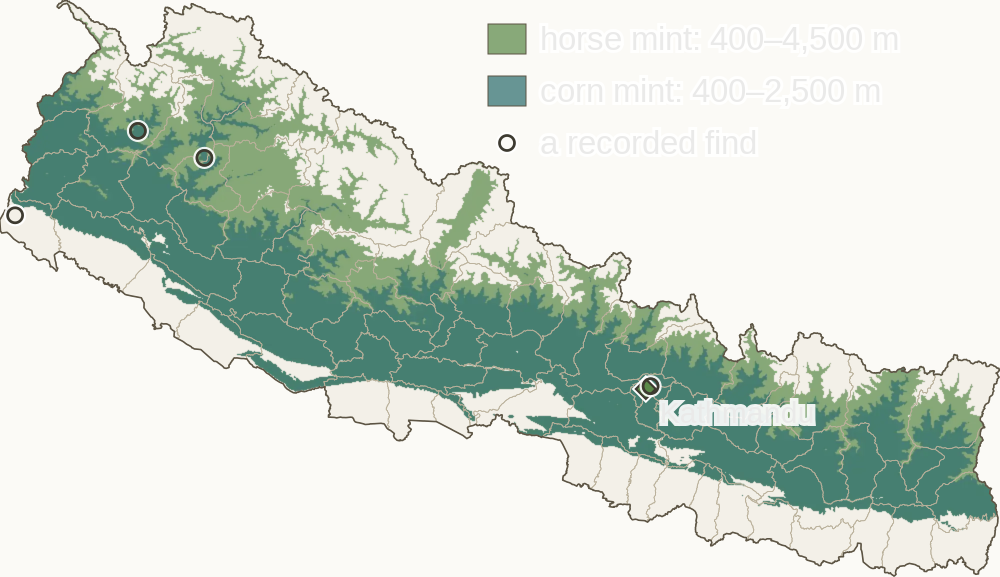
Mints like moist soil. In Nepal, the floras of the Himalaya record corn mint from about 400 to 2,500 meters and horse mint from 400 meters right up to 4,500 meters; spearmint is grown in kitchen gardens too.
The cold that isn’t there
Your skin and mouth have nerve cells that sense temperature. In their outer skin sit tiny gates, ion channels, that open at certain temperatures and let charged particles flow in, which makes the nerve send a signal to the brain.
In 2002, the scientist David Julius and his team went looking for the gate that senses cold. Their clue was menthol, the chemical in peppermint and corn mint that makes things feel cool. They found a channel in nerve cells that opens both when it touches menthol and when it gets cool or cold. They called it CMR1, the cold and menthol receptor; today it is called TRPM8. Ardem Patapoutian’s team found the same channel, independently, also by using menthol.
So menthol doesn’t cool anything. It opens the same gate that cold opens, and the brain, getting the same signal, reports “cold”. In 2021 Julius and Patapoutian shared the Nobel Prize in Physiology or Medicine for discovering the sensors for temperature and touch. (Julius found the sensor for heat by using another kitchen chemical: capsaicin, the bite of chili.)
Spearmint is different
Here is a twist. Spearmint’s smell comes mainly from carvone, not menthol; it is peppermint, corn mint and some horse mints that are rich in menthol. So the “mint” smell of your chutney and the mint of a cough sweet come mostly from different molecules.
Traditional uses
In Nepal mint is first of all food: chutney, pickle and tea. Studies of the plants people use record:
- spearmint leaves as juice or tea for stomach pain, gas and nausea, and in pickle, in Mahankal, Lalitpur, where people ranked it among the plants they valued most;
- corn mint leaves for indigestion, among the Tharu near the Koshi River.
What science has tested
- Menthol and the cold sense: very well studied; the discovery of TRPM8 won the Nobel Prize (above).
- Peppermint oil for irritable bowel syndrome (a long-lasting gut problem with pain and bloating): some evidence. The US National Center for Complementary and Integrative Health says a small amount of research suggests capsules of peppermint oil, coated to open in the gut, may ease the symptoms in adults; a 2022 review of 10 studies found them better than a dummy pill, with more mild side effects such as heartburn.
- Mint leaves as a medicine: we found no trials of the leaves themselves; the tests are of peppermint oil.
Mint oil farms of the Tarai
In the far-western Tarai, mint has become a cash crop. In Kailali in 2024, 152 farmers were growing mint for oil, which the Herbs Production and Processing Company at Tikapur was buying at Rs 1,400 a liter. The paper reported that 3 to 5 liters of oil can be distilled from the mint of one कट्ठा (kattha) of land.
In Banke, farmers near the forests of the Tarai found another reason to plant it: wild animals don’t eat it, so a mint field is not raided by rhinos and wild boars, and it even helps keep them off the fields beyond it.
Worldwide, corn mint is the big menthol crop: it brought in 60% of the money from mint oil in 2018.
Protection
Mints are common: the IUCN Red List rates spearmint, corn mint and horse mint Least Concern.
See it at the Science Playground
Spearmint grows in our garden, in the bed called Food Plants: Which Part Do We Eat?. Rub a leaf and smell it, and look for the runners spreading through the bed. Our exhibit Medicinal and Culinary Herbs of Nepal shows dried herbs and spices used in Nepal. More plants in Herbs of Nepal.
Where these facts come from
- Fuchs L.K. et al., Genetic manipulation of biosynthetic pathways in mint, Frontiers in Plant Science, 2022.
- Royal Horticultural Society, Mentha spicata.
- The Nobel Prize in Physiology or Medicine 2021: press release, Nobel Assembly at Karolinska Institutet, 2021.
- McKemy D.D., Neuhausser W.M. and Julius D., Identification of a cold receptor reveals a general role for TRP channels in thermosensation, Nature, 2002 (abstract).
- National Center for Complementary and Integrative Health, Peppermint oil, updated May 2025.
- Bhatt A., Timalsina B. and Ghimire N.P., Ethnobotanical knowledge and plant use patterns among the major ethnic communities of Mahankal Rural Municipality, Lalitpur District, Ethnobotany Research and Applications, 2026.
- Kutal D. et al., Ethnobotanical knowledge of Tharu people living nearby Koshi River and Koshi Tappu Wildlife Reserve, eastern Nepal, Journal of Ethnobiology and Ethnomedicine, 2026.
- Herbs production attracts farmers in Kailali, The Himalayan Times, 10 March 2024.
- Mentha: a conservation incentive, Republica (undated).
- Mentha in Nepal: occurrence records, GBIF (the Database of Vascular Plants of Himalaya for M. arvensis, M. spicata and M. longifolia, and iNaturalist), checked November 2026.
- IUCN Red List categories of Mentha spicata, Mentha arvensis and Mentha longifolia, GBIF, checked November 2026.
- पुदिना and बाबरी in the Nepali Brihat Shabdakosh (Nepal Academy).