
दुबो: the grass you can’t get rid of
दुबो · Cynodon dactylon · A creeping grass of the grass family (Poaceae)
At lunch break the school ground is full of running feet. In front of the goal the grass has been worn down to bare soil, but around the edges a low grass keeps creeping back over the mud. Pull at one of its thin stems lying on the ground and it doesn’t come up alone: a whole string of little plants comes with it, each one rooted at a joint. Weed it out of the flower bed on Saturday, and by the next month it is back.
That stubborn grass is very likely दुबो (dubo). It grows on football grounds and lawns, along field edges and roadsides, and between the stones of a courtyard. It is also the grass offered in worship. This page is about how to know it, why it is so hard to get rid of, what tradition uses it for, and what science has tested.
How to know it
दुबो is Cynodon dactylon, called Bermuda grass in English, and in Sanskrit दूर्वा (durva). A study of the Tamang community in Makawanpur recorded it as सेते दुबो (sete dubo, white dubo). The big Nepali dictionary describes it as a creeping grass with green, long, thin leaves and four spikes, which puts down roots at every joint. Look for:
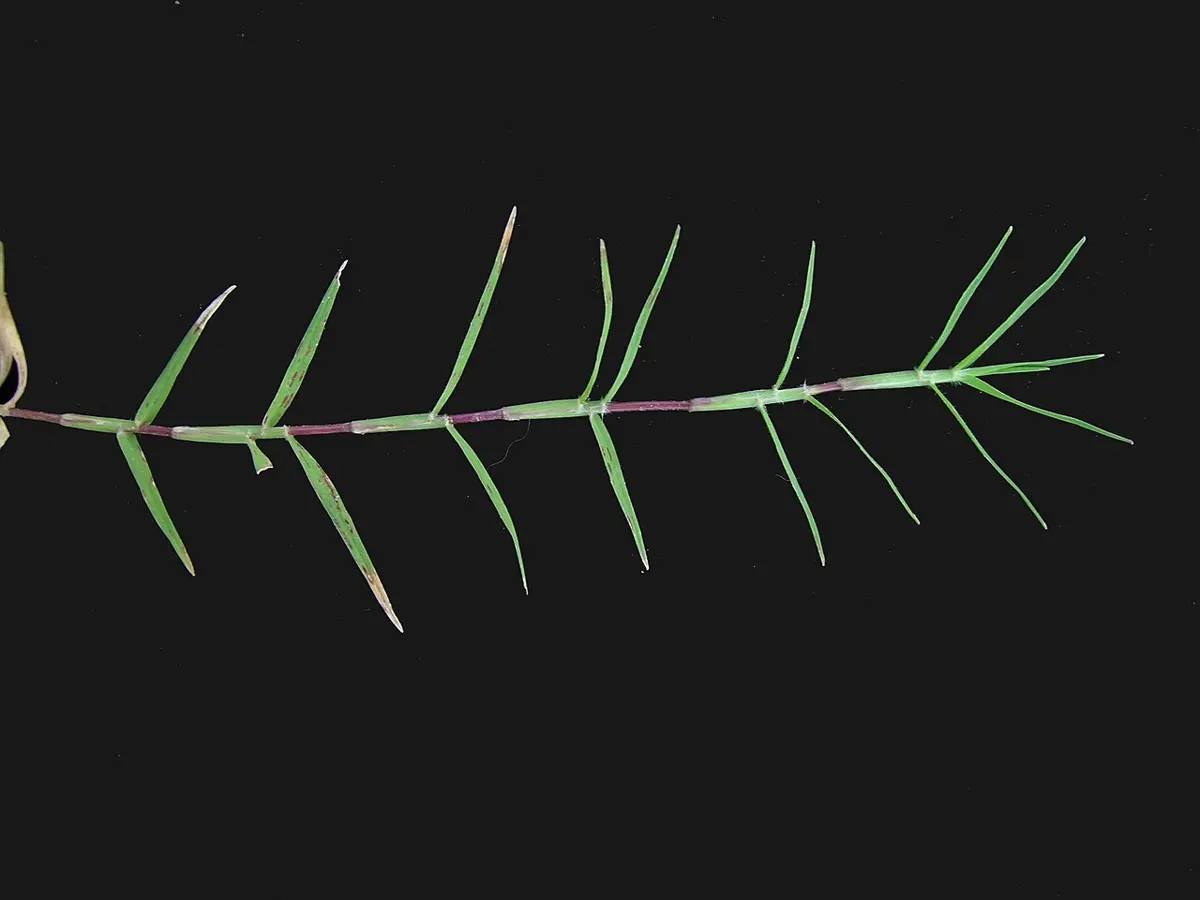
- runners on the ground: thin stems (stolons) that creep along the surface, usually 0.5 to 1.5 meters long, rooting at their joints;
- stems under the ground (rhizomes), which you only see when you dig;
- a low mat: the leafy mat is usually 10 to 40 cm high;
- the leaves: short and narrow, 2 to 20 cm long and 2 to 6 mm wide, often a little blue-green; where the leaf meets the stem there is a tiny fringe of hairs;
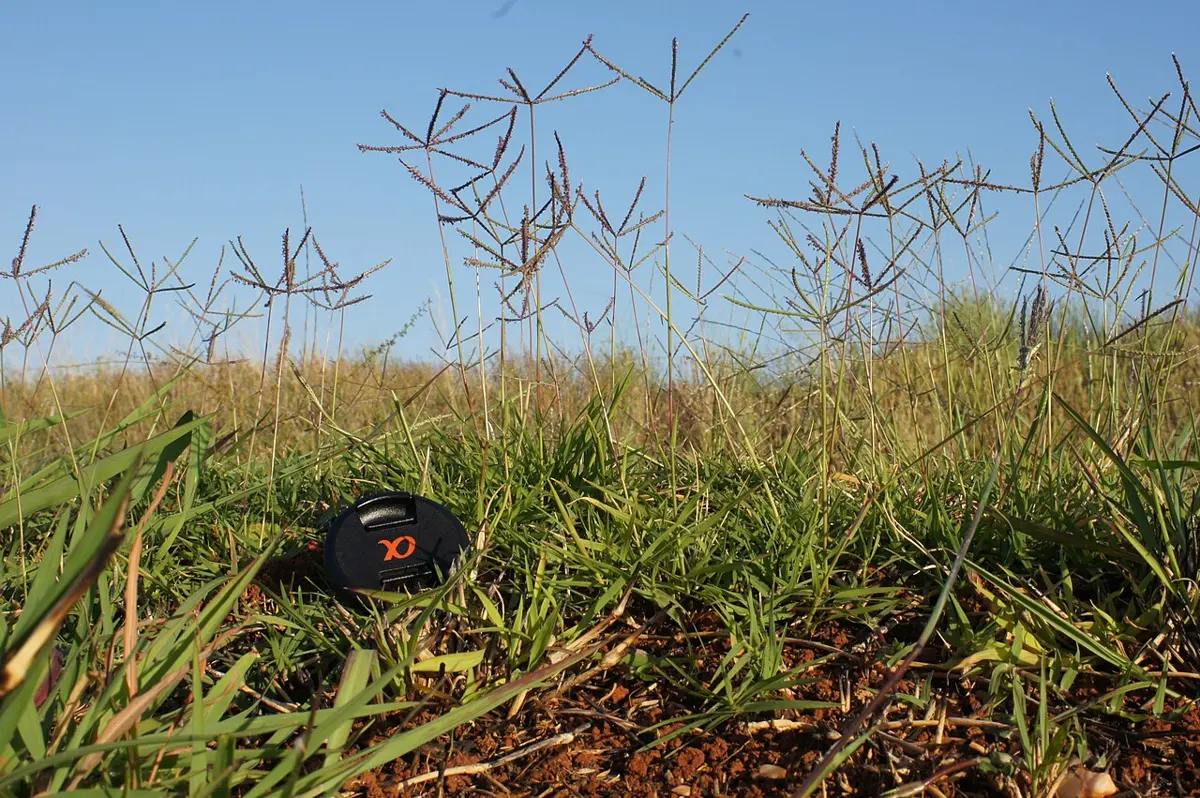
- the flowers: a thin stalk ending in 3 to 9 slender spikes, each 3 to 10 cm long, all spreading from one point like the fingers of a hand.
You find a low grass with a stalk that ends in four thin spikes spread out like fingers, and runners that root at their joints. What is it most likely to be?
Pick an answer to see why.
Where it grows
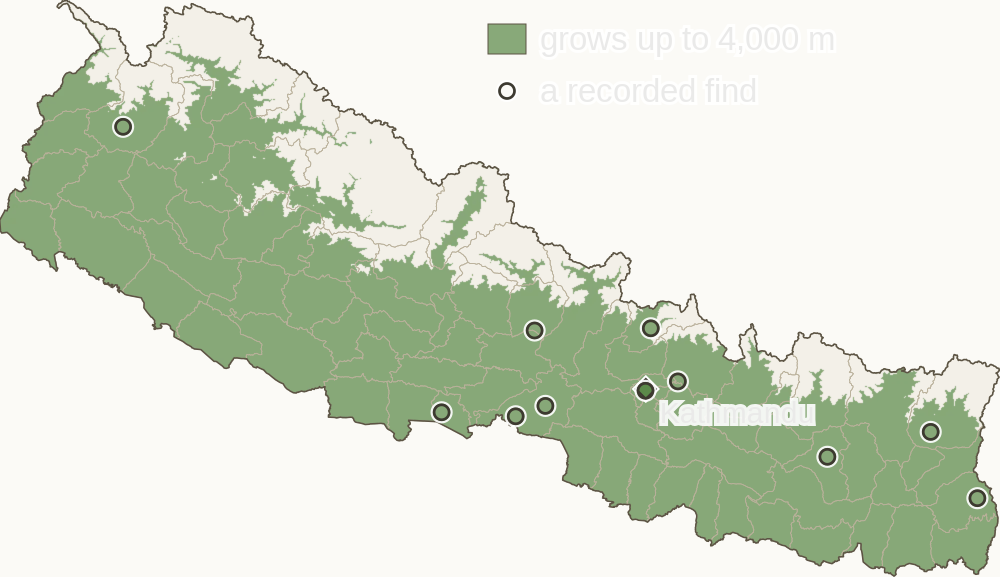
दुबो grows in warm places all round the world, roughly between 45° south and 45° north of the equator. In Nepal it grows from the Terai to the high hills:
- in Rupandehi, in the Terai at about 105 to 258 meters, a study found it wild and easy to find;
- in Makawanpur, the Tamang study recorded it from 100 to 3,000 meters, common everywhere in the district;
- a feed guide of the FAO and French research institutes says it grows up to 4,000 meters in the Himalaya.
It likes sun and copes with poor soil, sandy or clay, acid or alkaline. What it can’t stand is shade: under a thick tree it fades away.
Why you can’t get rid of it
Weed scientists call दुबो one of the worst grass weeds in the world. It is a weed of about 40 crops in more than 80 countries. Three tricks keep it alive.
1. Every piece can grow again. Most new plants don’t come from seeds but from broken pieces of runners and underground stems. In one experiment, a piece of underground stem with just four joints, buried 6 cm deep in spring, grew 1 to 2 meters of runners and 30 to 70 cm of new underground stem in four weeks. So digging or ploughing a field often chops दुबो into many small pieces, and each piece can become a new plant.
2. Its food store is underground. Its underground stems can go as deep as 1 meter, below where a plough reaches. When the top is grazed, trampled or frozen, the plant grows back from them. It can survive up to seven months of drought, resting until rain comes, and several weeks under water.
3. It is a “C4” plant. Most plants make their food by a route called C3. About 3% of plant species, many of them grasses, use a different route called C4, and दुबो is one of them. A C4 leaf first catches carbon dioxide and pumps it into special cells around its veins, where the sugar-making enzyme can work fast without being slowed by oxygen. Because it collects carbon dioxide so well, a C4 plant can keep its leaf pores (stomata) more closed and lose less water. This is why C4 plants do best in heat and bright sun, and why दुबो grows fast in summer and stops in the cold.
In worship and in tradition
The Nepali dictionary says दुबो is offered like flowers to Ganesh, Lakshmi and other gods, and grown to make lawns and gardens beautiful. A review of Nepal’s sacred plants lists it as the plant of Ganesh, and among the plants needed, whole, at all Hindu festivals. That is how most people in Nepal know it.
Studies of the plants people use as medicine have recorded दुबो as:
- a paste of the plant on cuts and wounds, in Rupandehi, where it was one of the plants people named most often (27 mentions);
- a root drink with sugar for bleeding piles and indigestion, and the plant’s juice as ear drops for earache, also in Rupandehi;
- the juice of the whole plant on skin wounds, among the Tamang of Makawanpur.
In Ayurveda, a review lists a paste of the grass for wounds, swelling and skin troubles, and its juice for urinary problems and bleeding. These are uses of a living tradition, passed down in families and by healers. Whether a use works in the body is a separate question, which only careful tests in people can answer.
Farmers know it in another way too: it is a fodder grass that stands up to heavy grazing and is cut for animals or made into hay, and its mat of roots holds soil in place.
What science has tested
- The plant’s chemistry: chemists have found flavonoids, phenolic acids, alkaloids, glycosides, vitamin C and beta-carotene in it, as in many green plants.
- Health effects: a review of the research lists tests of its extracts in the laboratory and in animals, mostly rats and mice: for example on blood sugar in diabetic rats, on liver damage, on kidney stones and on fits. Many found some effect.
- In people: a 2014 review of the research lists no trials in people, and we found none. As far as we could find, the uses above are not tested in people.
A weed, a lawn, a holy grass
दुबो is far from rare: the Makawanpur study found it common everywhere in the district, and it is a weed in more than 80 countries. The same toughness makes it three things at once:
- a weed that farmers fight in their fields;
- a lawn and sports grass, because trampling and mowing don’t kill it;
- a holy grass, offered to the gods.
See it at the Science Playground
Our exhibit Medicinal and Culinary Herbs of Nepal shows dried herbs and spices used in Nepal. As for दुबो itself, you will hardly need to look for it: follow a runner on your own school ground. More plants in Herbs of Nepal.
Where these facts come from
- Heuzé V. et al., Bermuda grass (Cynodon dactylon), Feedipedia (INRAE, CIRAD, AFZ and FAO), 2015.
- Cornell University, College of Agriculture and Life Sciences, Weed profiles: Bermudagrass, checked November 2026.
- Sapkota N., Dongol B.R. and Bhuju D.R., Weed species composition and growth in wheat field of mountain ecosystem Khokana, Lalitpur, Nepal, Botanica Orientalis, 2010.
- Luitel D.R. et al., Medicinal plants used by the Tamang community in the Makawanpur district of central Nepal, Journal of Ethnobiology and Ethnomedicine, 2014 (its Additional file 2).
- Singh A.G., Kumar A. and Tewari D.D., An ethnobotanical survey of medicinal plants used in Terai forest of western Nepal, Journal of Ethnobiology and Ethnomedicine, 2012.
- Shendye N.V. and Gurav S.S., Cynodon dactylon: a systemic review of pharmacognosy, phytochemistry and pharmacology, International Journal of Pharmacy and Pharmaceutical Sciences, 2014.
- Sales C.R.G. et al., Improving C4 photosynthesis to increase productivity under optimal and suboptimal conditions, Journal of Experimental Botany, 2021.
- WHO/IUIS Allergen Nomenclature Sub-Committee, Cyn d 1, checked November 2026.
- Niroula G. and Singh N.B., Religion and conservation: a review of use and protection of sacred plants and animals in Nepal, Journal of Institute of Science and Technology (Tribhuvan University), 2015.
- दुबो and दूर्वा in the Nepali Brihat Shabdakosh (Nepal Academy).