
बोझो: the swamp root that keeps weevils away
बोझो · Acorus calamus · A grass-like plant of wet ground, sweet flag family (Acoraceae)
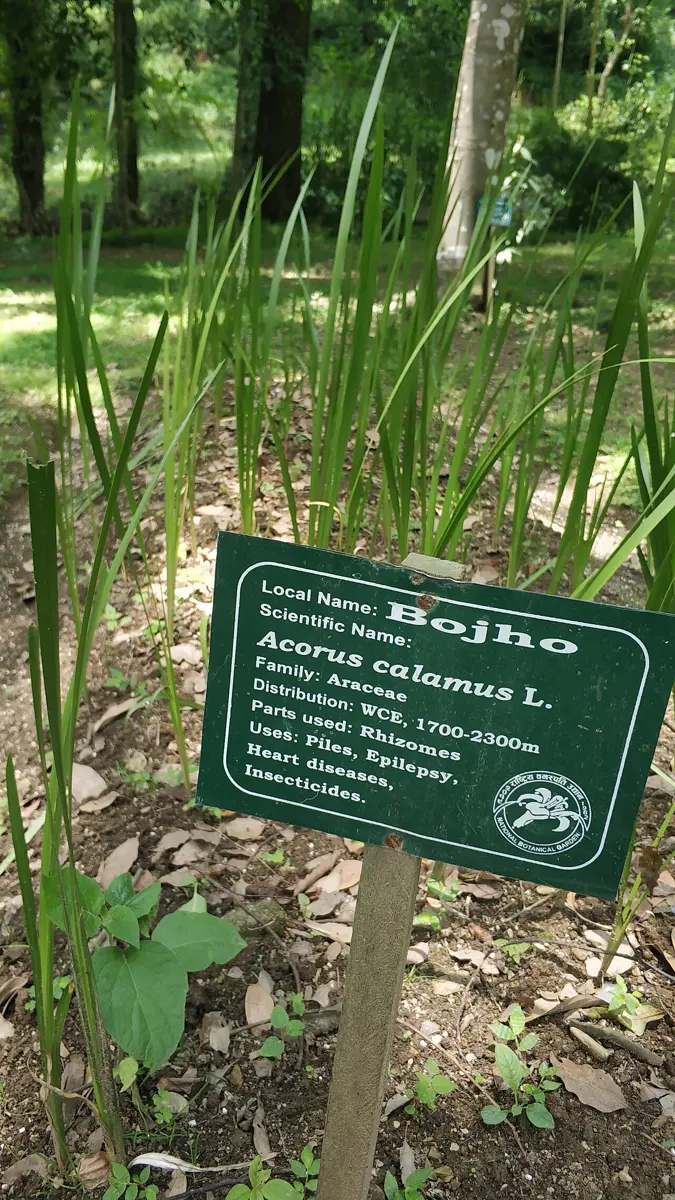
Have you seen a small cloth bundle tied on a thread round a baby’s neck? In many Nepali homes it is a लडी (ladi), and the dictionary lists what may be sewn inside it: ज्वानो (jwano, ajwain seeds), garlic, and a piece of a scented root called बोझो (bojho). The same root is chewed by grandparents for a sore throat.
This page is about that root and the plant it comes from: how to know it, where it grows, the chemistry that makes it useful against insects, and why food and medicine regulators keep a close eye on it.
How to know it
बोझो looks like a big grass or a young iris, but it isn’t either. It is a perennial of wet ground, up to about 1.2 meters tall. Look for:
- the leaves: long, narrow and upright, about 1 cm wide (0.7 to 1.7 cm), each with a clear raised vein down the middle; the edges are often a little wavy;
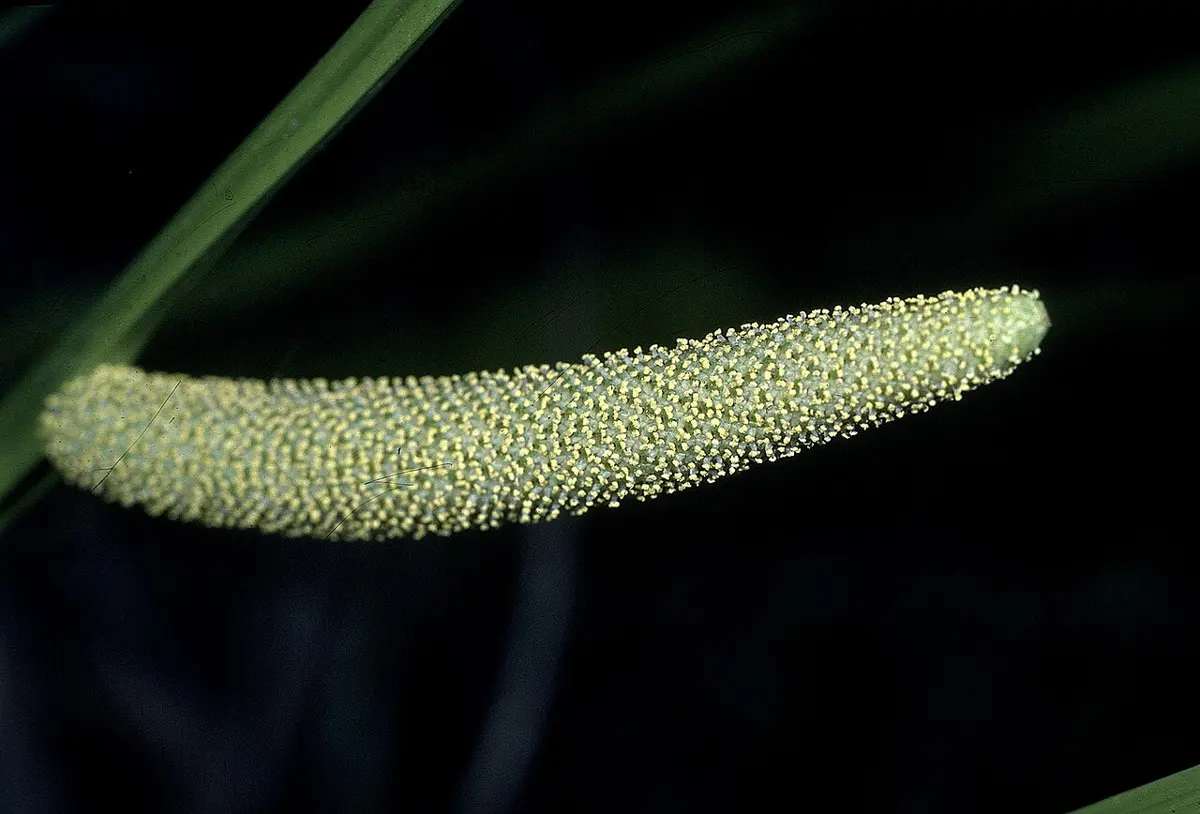
- the flower spike: a green-brown, finger-like spadix, about 5 to 9 cm long, covered in tiny bumps, which sticks out sideways from what looks like a leaf;
- the rhizome: a thick creeping stem under the mud, up to 2.5 cm across, brown, pinkish or purplish outside and white inside, with many roots;
- the smell: the leaves and the rhizome smell pleasant and lemony when crushed.
The dictionary describes it the same way: a plant of marshy ground with long leaves, a flower shaped like a small maize cob, and a scented root used in medicines for the throat.
Where it grows
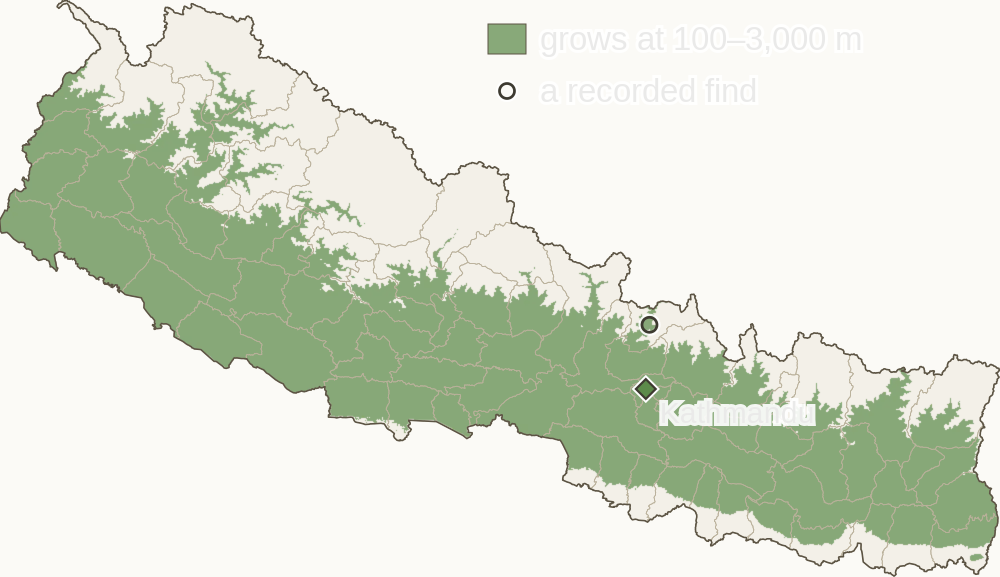
बोझो grows near swamps, rivers, lakes and marshes. One study gives its range in Nepal and India as up to about 2,000 meters; a database compiled from the floras of the Himalaya gives 100 to 3,000 meters in Nepal. Botanists have collected it in Nepal at Taplejung (1,500 m), Jiri (1,900 m), above Yamphudin (2,040 m) and on the Langtang trail from Syabrubesi (2,400 m).
It is one of the most widely used herbs in the country: a 2022 count of the medicinal plants used in each district found बोझो used in 56 of Nepal’s 77 districts, second only to घोडताप्रे (ghodtapre).
One plant, three kinds
Here is the surprise. Acorus calamus comes in kinds that look much alike but have different numbers of chromosome sets in their cells: two sets (diploid), three (triploid) or four (tetraploid). And the number of sets decides how much of one chemical, β-asarone (beta-asarone), the plant makes.
The European Medicines Agency collected the measurements, and a 2026 review of the plant says where each kind grows:
| Kind of Acorus calamus | Where it grows | β-asarone in the rhizome’s oil |
|---|---|---|
| Diploid (2 sets) | North America | not detected |
| Triploid (3 sets) | Europe | 9 to 19% |
| Tetraploid (4 sets) | Asia | 85 to 95% |
The plants of Asia, with the most sets, make by far the most. Nepal’s बोझो makes a lot too: oil distilled from rhizomes collected at Daman, Makwanpur, was 79.7% β-asarone, close to the Asian figures. The same review adds that many plants of the Indian subcontinent are triploid yet rich in β-asarone, so the number of sets is a strong guide, not a rule.
What β-asarone does to insects
Farmers in Nepal lose much of their stored maize to the maize weevil, a small beetle whose young eat the grain from inside. In 2020 and 2021, scientists at the National Entomology Research Center, Khumaltar, tested बोझो oil on it. They dried and powdered rhizomes from their own field, boiled the powder in water and collected the oil that came off with the steam: 100 g of powder gave 1.67 g of oil.
- The stronger the oil, the faster the weevils died.
- At a 10% mixture, the oil drove away 98.75% of the weevils within a day.
- Maize treated with the oil lost less weight and was less damaged than untreated maize.
The scientists also warned that maize treated this way is not yet fit to eat, because of β-asarone: it needs residue tests first.
Why the oil is restricted
β-asarone is what makes बोझो work against insects, and it is also the reason for strict rules about it.
Traditional uses
बोझो has a long place in the medicine of South and East Asia. In Ayurveda its rhizome has been used as a “brain tonic”, and for coughs, fever, diarrhea and many other complaints. Studies of the herbs people use in Nepal record it as:
- the rhizome for cough, colds and throat pain, in Rasuwa, where people ranked it among their sixteen most important medicinal plants;
- the raw rhizome taken by mouth, in Mahankal Rural Municipality, in the hills of Lalitpur;
- a plant collected and sold in Baitadi and Dadeldhura, in the far west;
- chewed for coughs, in Nepal, as one review notes.
The baby’s लडी has a close cousin far to the east: in Manipur, in India, fresh rhizomes are hung round newborns’ necks to keep away coughs and fevers. And because of its scent the rhizome goes into incense and perfumes.
These are uses of a living tradition. Whether a use works, and whether it is safe, is a separate question that only careful tests can answer.
What science has tested
- On insects: good evidence, in the laboratory, that the oil kills and repels stored-grain beetles (above).
- On memory and the nerves: a 2026 review of the research on Acorus calamus and memory found studies only in the laboratory, in animals and on computers. Its authors say clinical trials in people are still needed.
- As a medicine in people: not tested in proper trials. Against that, the harm of β-asarone in animals is well documented (above).
Protection and farming
बोझो is not threatened worldwide: the IUCN Red List rates Acorus calamus Least Concern. In Nepal it is collected from the wild and also grown, as at Khumaltar. We found no reliable recent figure for its price or how much is traded.
A shopkeeper says a few drops of बोझो oil in a glass of water will cure a cough. What is the best answer?
Pick an answer to see why.
See it at the Science Playground
Our exhibit Medicinal and Culinary Herbs of Nepal shows dried herbs and spices used in Nepal. More plants in Herbs of Nepal.
Where these facts come from
- Tamang R. et al., Acorus calamus L. for cognitive enhancement: a systematic review of its ethnobotanical practices and scientific evidence, Chemistry & Biodiversity, 2026.
- Aryal S. et al., Insecticidal toxicity of essential oil of Nepalese Acorus calamus against Sitophilus zeamais, Heliyon, 2023.
- Aryal S., Chiluwal K. and Poudel A., Oil composition of sweet flag (Acorus calamus) and its toxicity against the maize weevil, Nepal Agriculture Research Journal, 2026.
- European Medicines Agency, Committee on Herbal Medicinal Products, Public statement on the use of herbal medicinal products containing asarone, 2005.
- 21 CFR 189.110: Calamus and its derivatives, US Code of Federal Regulations (Legal Information Institute copy).
- Regulation (EC) No 1334/2008 on flavourings, Annex III, European Union (the UK National Archives’ copy, which keeps the same Annex III entry for β-asarone).
- Kunwar R.M. et al., Ethnomedicinal landscape: distribution of used medicinal plant species in Nepal, Journal of Ethnobiology and Ethnomedicine, 2022.
- Uprety Y. et al., Indigenous use and bio-efficacy of medicinal plants in the Rasuwa District, Central Nepal, Journal of Ethnobiology and Ethnomedicine, 2010.
- Kunwar R.M. et al., Medicinal plants, traditional medicine, markets and management in far-west Nepal, Journal of Ethnobiology and Ethnomedicine, 2013.
- Bhatt A., Timalsina B. and Ghimire N.P., Ethnobotanical knowledge and plant use patterns among the major ethnic communities of Mahankal Rural Municipality, Lalitpur District, Ethnobotany Research and Applications, 2026.
- Acorus calamus in Nepal: occurrence records, GBIF (herbarium specimens, and the Database of Vascular Plants of Himalaya), checked November 2026.
- Acorus calamus: IUCN Red List category, GBIF (from the IUCN Red List), checked November 2026.
- File:Bojho.jpg, Wikimedia Commons (place and height of the photo).
- बोझो, पटेर and लडी in the Nepali Brihat Shabdakosh (Nepal Academy).
