
निम: the bitter tree that insects avoid
निम · Azadirachta indica · A tree of the mahogany family, Meliaceae
Before toothbrushes reached every village, many people in Nepal and India started the day by chewing the end of a twig until it frayed into a brush, and scrubbing their teeth with it. The Nepali word for such a twig is दतिवन (datiwan), and the Brihat Shabdakosh names the trees it comes from: निम first. In the Terai of Rupandehi, people still use a young निम (nim, neem) stem as a toothbrush.
Every part of this tree is bitter: the leaves, the fruit, the wood. Its bitterness hides one of the most interesting chemicals in the plant world, one that can stop an insect from eating, and even from growing up. This page is about the tree, that chemical, and what is and isn’t known about its uses.
How to know it
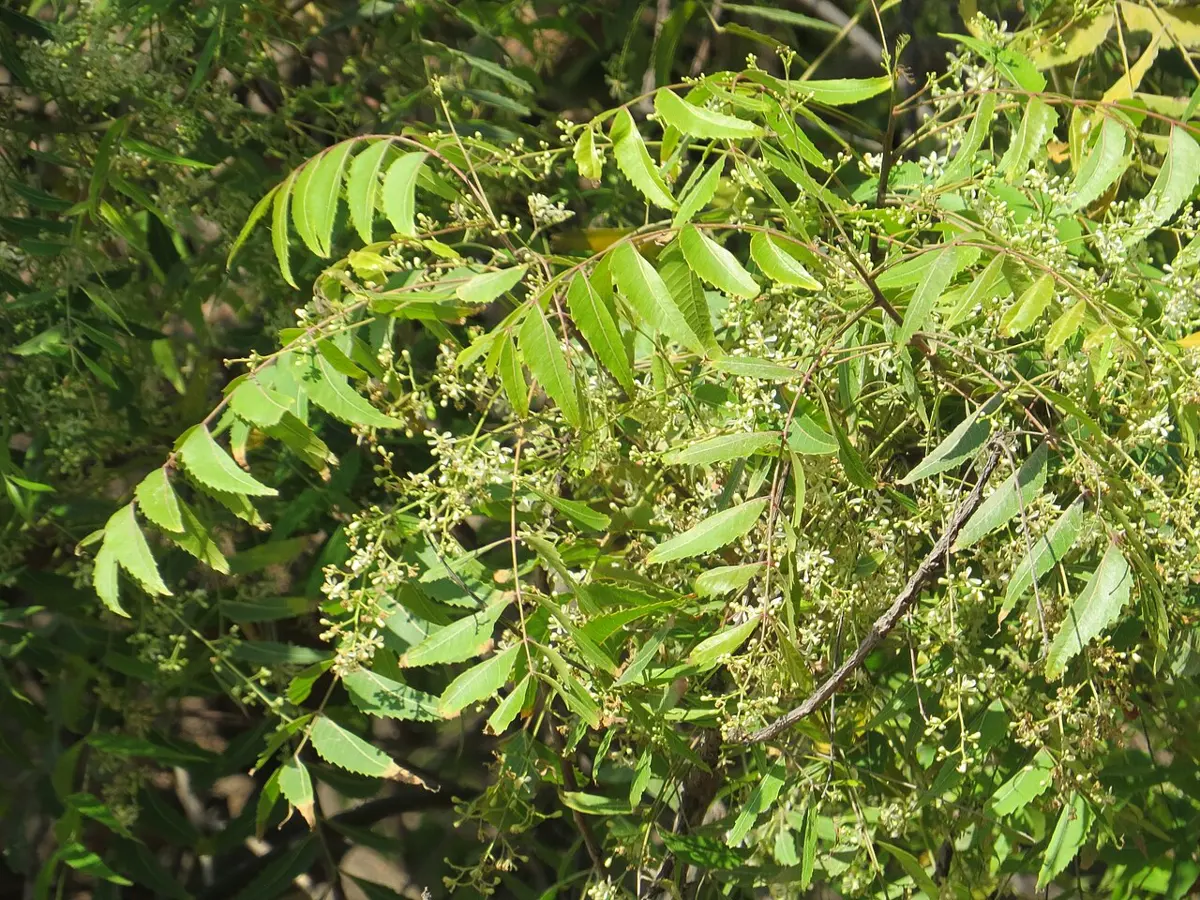
निम is a small to medium-sized tree, usually evergreen, up to about 15 meters tall (rarely 30), with a large, round crown. It can live for more than 200 years. Look for:
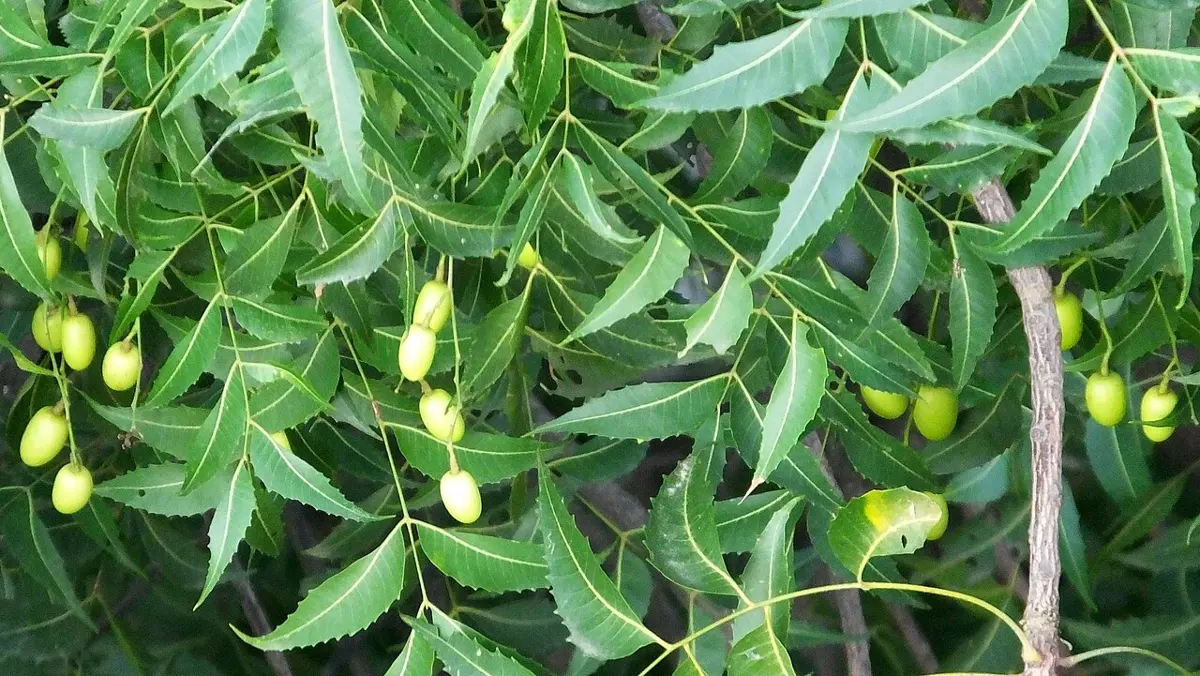
- the leaves: long and feathery, 20 to 40 cm, each made of 8 to 19 leaflets; the leaflets are glossy, toothed, pointed, often a little curved, and lopsided at the base;
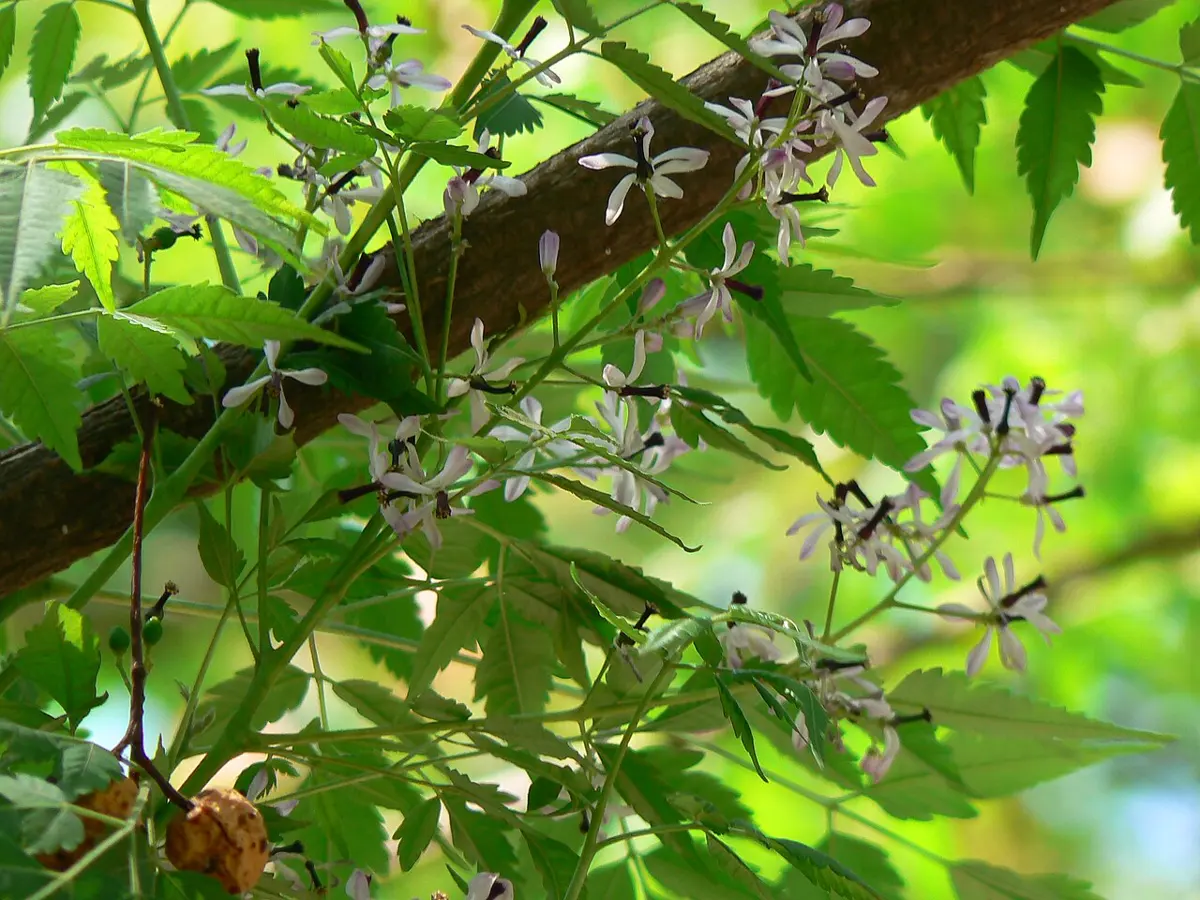
- the flowers: small, white or pale yellow and slightly sweet-scented, in loose sprays up to 30 cm long;
- the fruit: an oval berry with one seed, 1 to 2 cm long, greenish, turning yellow when ripe; birds and bats eat the pulp and spread the seeds;
- the bark: dark gray, deeply cracked in old trees, with a sticky, bad-smelling sap.
The Nepali dictionary describes निम as a tree with leaves like those of बकाइनु (bakainu), whose fruit, leaves and wood are all bitter. The two are easily confused.
Two trees by a Terai road both have long leaves made of many toothed leaflets. One has sprays of small white flowers; the other has lilac-purple flowers. Which is निम?
Pick an answer to see why.
Where it grows
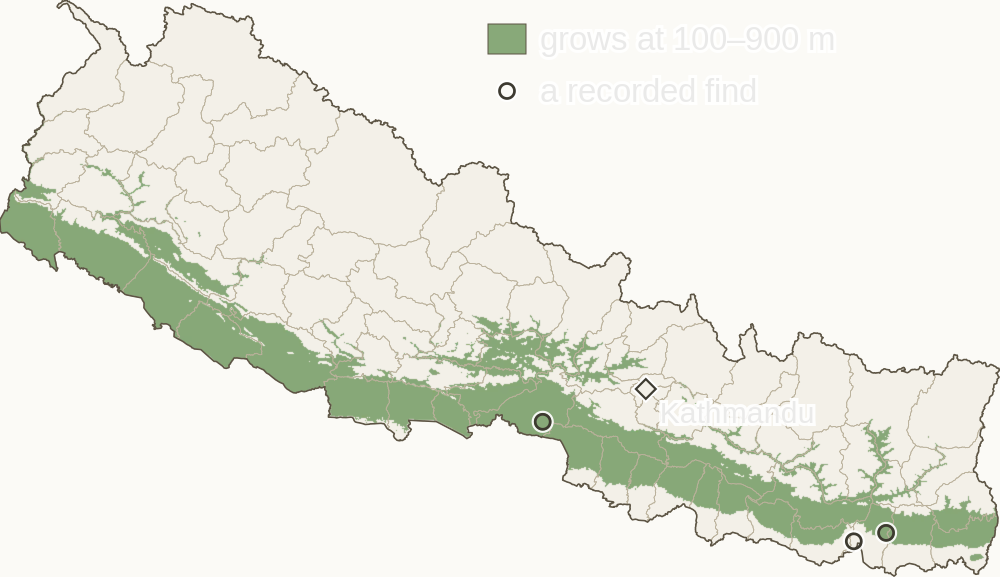
Nepal’s national register of medicinal plants records निम from about 100 to 900 meters, in the west, center and east: the Terai and the low hills. Was it always here? Kew’s world checklist of plants counts neem as brought in to Nepal, not native, and an international tree database agrees; the checklist gives its native home as further east, from Assam and Bangladesh to Myanmar, Thailand and Vietnam. Planted here, it now also grows by itself: in Rupandehi it is found both wild and planted.
It is said to grow “almost anywhere” in the lowland tropics, where rain is about 400 to 1,200 mm a year. It grows well even on shallow, stony, sandy soil, but dies quickly in waterlogged ground, and needs plenty of light.
Azadirachtin: the chemical that stops insects
निम’s most famous chemical is azadirachtin. Extracts can be made from leaves and other parts, but the seeds hold the most. Tests have shown effects on about 300 kinds of insects: beetles, cockroaches, flies, bugs, aphids, termites, moths, grasshoppers, fleas and thrips.
What makes it remarkable is that it doesn’t kill most insects outright. It changes what they do and how they grow:
- Stop eating: many leaf-eating insects avoid plants treated with neem, or stop eating after one taste. It has proved an antifeedant on about 100 kinds of insects.
- Can’t grow up: azadirachtin acts like one of the insect’s own hormones. It can stop a larva molting, so it never becomes a pupa, and it lowers egg-laying and hatching.
- Gentle on helpers: used on crops, it protects leaves without harming honeybees and other pollinators much.
Farmers make a simple “neem tea”: dried seeds are crushed and soaked in water overnight, and the liquid is sprayed on crops. But sunlight and heat break azadirachtin down quickly, so one spraying protects for only about a week.
Traditional uses
In the Terai, निम is one of the best-known medicinal trees. In a study in Rupandehi, 76% of the people interviewed named it, and they described:
- fresh leaves eaten to “purify the blood” and control blood sugar;
- a boiled-leaf wash for the skin, for scabies;
- a young stem as a toothbrush, for tooth problems;
- a paste of tender twigs put on wounds to help them heal.
Nepal’s national register of medicinal plants lists many more uses of the bark, leaves, flowers and fruit, for coughs, fever, skin diseases and worms, and calls निम an excellent botanical pesticide. Its Sanskrit name is निम्ब (nimba). Neem oil is also made into soaps and cosmetics, and its wood resists termites.
What science has tested
- On insects: strong. Azadirachtin and neem extracts have been tested on hundreds of insect species, and neem pesticides are sold under many brand names in India.
- On skin and disease in people: a 2021 review by two dermatologists notes that neem is used widely as a medicine in India without evidence that it works, and that the scarcity of human trials keeps its place in medicine unclear. There have been small studies: one of 50 people with psoriasis (44 finished it), who took neem leaf capsules or dummy capsules alongside a skin ointment, reported neem useful, but the reviewers count one small trial as not enough evidence; neem with turmeric was tried for scabies in a small pilot study. Most research is still in the laboratory and in animals.
- Against mosquitoes: a 20% neem oil was less effective, and protected for a shorter time, than DEET, the usual repellent. With too little evidence, it is not recommended for protection against diseases that mosquitoes carry.
- How strong the evidence is: strong as an insect pest control; for people’s health, little evidence.
Protection
निम is not threatened: the IUCN Red List rates it Least Concern. It is planted widely as a shade tree along roads and in villages, and as a windbreak.
See it at the Science Playground
निम isn’t in our garden yet. Our exhibit Medicinal and Culinary Herbs of Nepal shows dried herbs and spices used in Nepal. More plants in Herbs of Nepal.
Where these facts come from
- Orwa C. et al., Azadirachta indica, Agroforestree Database 4.0, World Agroforestry Centre, 2009.
- IUCN Nepal, National Register of Medicinal and Aromatic Plants (revised and updated), 2004: Neem, page 129.
- Singh A.G., Kumar A. and Tewari D.D., An ethnobotanical survey of medicinal plants used in Terai forest of western Nepal, Journal of Ethnobiology and Ethnomedicine, 2012.
- Gopinath H. and Karthikeyan K., Neem in dermatology: shedding light on the traditional panacea, Indian Journal of Dermatology, 2021.
- Dhongade R.K., Kavade S.G. and Damle R.S., Neem oil poisoning, Indian Pediatrics, 2008.
- Azadirachta indica: IUCN Red List category, GBIF (from the IUCN Red List), checked November 2026.
- Azadirachta indica: distribution, GBIF, from the World Checklist of Vascular Plants (Royal Botanic Gardens, Kew), checked November 2026.
- निम, बकाइनु and दतिवन in the Nepali Brihat Shabdakosh (Nepal Academy).