
घिउकुमारी: the plant that breathes at night
घिउकुमारी · Aloe vera · A succulent herb of the aloe family, Asphodelaceae
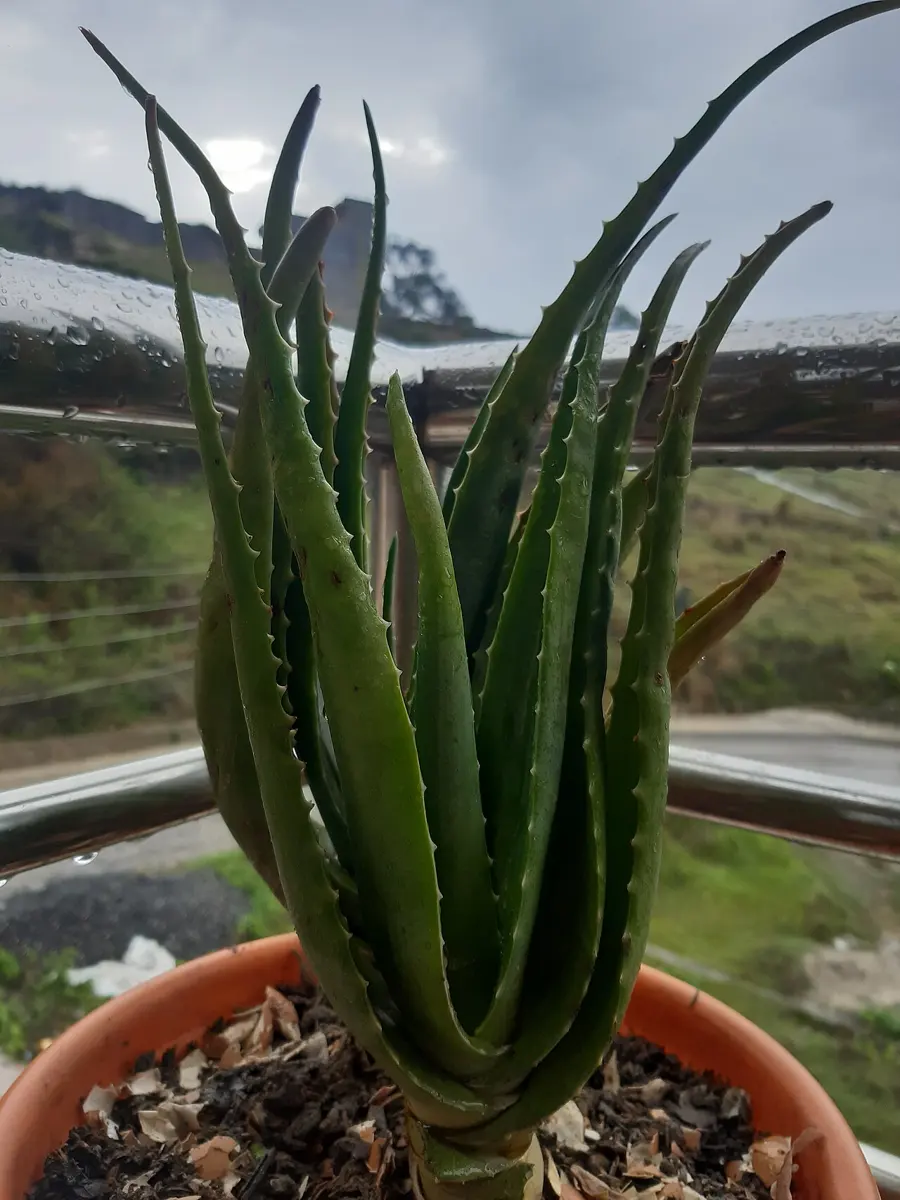
Look along the windowsills and rooftops of any lane in the valley and you will probably find a pot of घिउकुमारी (ghiukumari, aloe vera): thick, grey-green leaves with little teeth along the edges, standing up like a fan. Break a leaf and a clear, slippery jelly oozes out. Its name begins with घिउ (ghiu), ghee.
This page is about the plant in the pot: how to know it, what is inside a leaf, the clever trick it uses to save water, what it is used for, and what science has and hasn’t found.
How to know it
घिउकुमारी is a succulent: a plant that stores water in thick, juicy leaves. It has no stem, or only a very short one, and grows 60 to 100 cm tall. Look for:
- the leaves: thick and fleshy, green to grey-green, in a rosette from the base, with small teeth along the edges;
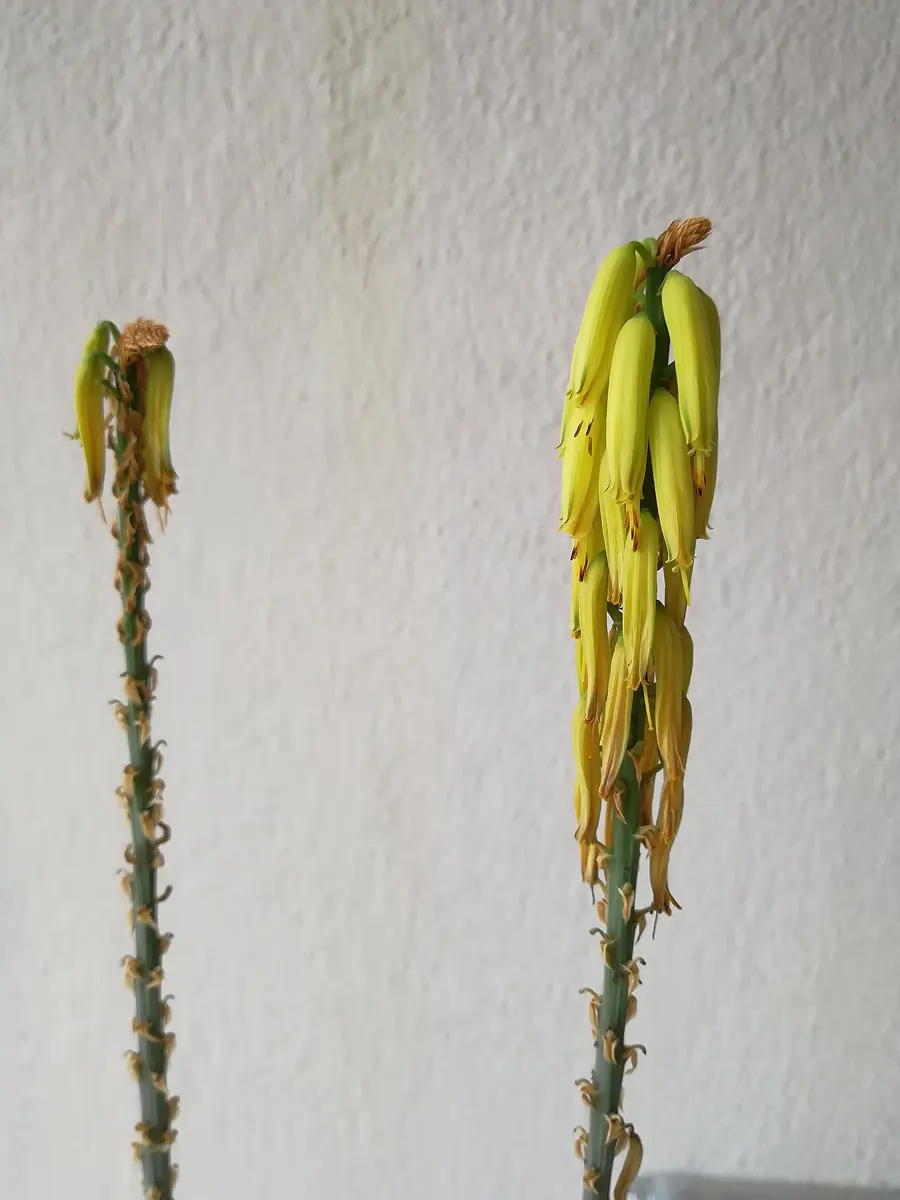
- the flowers: yellow and tube-shaped, hanging from a tall spike that rises above the leaves;
- the gel: inside a broken leaf, a clear jelly.
In Bhardew village, Lalitpur, it was recorded flowering and fruiting from March to December.
Which plant is “ghiukumari”?
This page is about Aloe vera, of the family Asphodelaceae. The Nepali Brihat Shabdakosh gives घिउकुमारी as the Nepali name for aloe vera; in the Terai, Tharu speakers call it ghrit kumari. Other aloes are grown in pots too, and they can look alike, so a plant sold as “aloe” isn’t always Aloe vera.
Its wild home is far from Nepal: North Carolina State University’s plant guide gives it as the Arabian Peninsula, and checklists of introduced plants give the Arabian Peninsula or parts of North and East Africa.
Where it grows
In Nepal, घिउकुमारी is mostly planted, in home gardens and pots. Studies of plant use in Bagmati Province record it in Bhaktapur, Lalitpur, Nuwakot, Sindhuli, Sindhupalchok, Dhading, Makawanpur and Chitwan, and in Bhardew it is grown in home gardens. It is also grown in the Terai.
Inside a leaf
A leaf cut across has four parts, numbered as in the drawing below:
- the skin (the cuticle) on the outside;
- a thin green layer, where the leaf makes its food by photosynthesis;
- in the middle, the big clear inner tissue: the gel;
- small tubes (vascular bundles), which carry water and food.
The leaf’s outer layer, just under the skin, also holds a different juice, the latex.
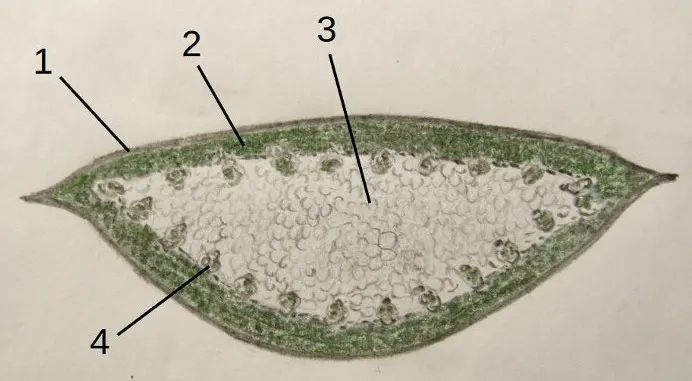
The gel comes from the inner tissue, the latex from the outer layer. The difference matters, as you will see below.
A plant that breathes at night
Leaves have tiny pores called stomata. Through them, carbon dioxide gets in for photosynthesis, and water vapor gets out. That is the problem for a plant of hot, dry places: open the pores in the heat of the day to catch carbon dioxide, and it loses its water.
घिउकुमारी has a way round this. It is one of the plants that use CAM (crassulacean acid metabolism, named after the family Crassulaceae, of Kalanchoe). In CAM plants, like pineapple and aloe vera, the stomata open only during the night, to prevent water loss. Here is how:
- at night, when it is cool, the pores open. The leaf takes in carbon dioxide and stores it as malic acid inside its cells;
- by day, the pores close. The malic acid gives up its carbon dioxide inside the closed leaf, and the leaf uses sunlight to turn it into sugar.
So the leaf collects its carbon dioxide in the dark and uses it in the light. The acid builds up overnight, so the leaves become sour by morning. The cost: a CAM plant can store only as much carbon dioxide each night as its cells hold, so it grows slowly. (More in Grade 12 Biology, Explained.)
Traditional uses
Studies of plant use in Nepal record घिउकुमारी used, in tradition:
- on the skin, for burns and burnt wounds: the gel laid on the skin, in Bhardew, in the Terai of Rupandehi and across Bagmati Province;
- by mouth, the peeled leaf eaten raw for stomach trouble and high blood pressure (Bhardew), or the pulp given for lung and stomach disorders (Rupandehi);
- for jaundice, weakness, worms, skin allergies and more, across Bagmati Province.
What science has tested
The United States’ National Center for Complementary and Integrative Health (NCCIH) sums up the studies (2025):
| Use | What the studies found |
|---|---|
| Gel on burns | some evidence: may help burns heal faster and hurt less |
| By mouth, for blood sugar | a few small studies suggest it may lower blood sugar; there has been little research |
| The latex, as a laxative | taken by mouth it can cause stomach pain, cramps and diarrhea; in 2002 the United States told makers to take it out of laxatives sold without a doctor’s note, because its safety hadn’t been shown |
See it at the Science Playground
Our garden has an aloe, labelled “Aloe sp.”: a cousin of Aloe vera, not Aloe vera itself. Look at its thick, toothed leaves, and compare them with a घिउकुमारी plant at home. More plants in Herbs of Nepal.
Where these facts come from
- Gautam R.S., Shrestha S.J. and Shrestha I., Some ethnomedicinal plants of Bhardew village, Lalitpur district, Nepal, Patan Prospective Journal, 2022.
- Subedi D. et al., Current outlook of ethnobotany in Bagmati Province, central Nepal, Journal of Plant Resources (Department of Plant Resources), 2025.
- Singh A.G., Kumar A. and Tewari D.D., An ethnobotanical survey of medicinal plants used in Terai forest of western Nepal, Journal of Ethnobiology and Ethnomedicine, 2012.
- Matthews J.S.A., Engineering photosynthesis, nature’s carbon capture machine, PLoS Biology, 2023.
- Science Playground, Grade 12 Biology, Explained: Photosynthesis (CAM).
- National Center for Complementary and Integrative Health, Aloe vera, updated February 2025.
- North Carolina State University Extension, Aloe vera, North Carolina Extension Gardener Plant Toolbox, checked November 2026.
- Aloe vera: native range, GBIF (from the Checklist of introduced taxa in Cyprus and DAISIE, the inventory of alien species in Europe), checked November 2026.
- घिउकुमारी in the Nepali Brihat Shabdakosh (Nepal Academy).