
How did people build temples like the Nyatapola, five storeys of heavy brick and timber, more than three hundred years ago, with no engines and no electricity? With ramps, levers, ropes, pulleys and wedges: simple machines, driven by nothing but human muscle.
You use them every day without noticing: the handle of a door, a knife, a screw, the pedals of a bicycle, the pulley over a well. This unit shows what each one does, and how to put numbers on how much it helps: its mechanical advantage, velocity ratio and efficiency. And it answers a puzzle: if a machine lets a small force lift a big load, are you getting something for nothing?
Simple machines
Many tools make our work easier: screws, pulleys, the wheel and axle, scissors, the jack used to lift a vehicle, sickles and axes. None of them needs electricity, diesel or petrol: human force is enough. Simple tools like these, which help us do work more easily, more comfortably or faster, are called simple machines.
By their structure there are four basic types of simple machine: the lever, the pulley, the wheel and axle, and the inclined plane. The wedge and the screw are special forms of the inclined plane.
Mechanical advantage
A simple machine can magnify a force. In Figure 8.1, a lever lifts a load of 600 N with an effort of only 300 N: the load is twice the effort.
The ratio of the load lifted to the effort applied is the mechanical advantage (MA) of the machine:
For the lever, MA = 600 N ÷ 300 N = 2. Mechanical advantage is a ratio of two forces, so it has no unit.
Velocity ratio
Look again at Figure 8.1. The effort end has to move twice as far as the load end. The velocity ratio (VR) of a machine is the ratio of the velocity of the effort to the velocity of the load:
The effort and the load move for the same time, so velocity ratio is also the ratio of the distances they move:
For the lever in Figure 8.1, the effort moves 2 times as far as the load, so VR = 2. Velocity ratio is a ratio of two velocities (or two distances), so it too has no unit. The same two formulas give the MA and VR of every simple machine.
A machine lifts a 500 N load with an effort of 125 N. What is its mechanical advantage?
Pick an answer to see why.
To lift a load by 0.5 m, the effort of a machine must move 3 m. What is its velocity ratio?
Pick an answer to see why.
- Pulley
To raise a flag without a pulley you would have to climb the pole and pull it up. The pulley at the top of a flagpole turns the direction of your force round: you pull down, and the flag goes up.
A pulley is a wheel that turns freely on an axle, with a groove round its rim for a rope. It is made of plastic, wood or metal. The effort is applied at one end of the rope and the load is attached to the other. Pulleys are used to lift buckets of water from a well, to raise flags, to lift building materials up tall buildings, in cranes, and in lifts.
There are three kinds of pulley system:
- A fixed pulley is fixed to a rigid support. It doesn’t move up or down, but turns freely. It is used to change the direction of the force.
- A movable pulley moves up and down with the load. It doesn’t change the direction of the force, but it halves the effort needed.
- A combined pulley (a pulley system or block and tackle) has at least one fixed and one movable pulley. The more pulleys it has, the less effort is needed, so the mechanical advantage increases with the number of pulleys.
Velocity ratio of a pulley system
In a single movable pulley, the load hangs in a loop of rope, held up by two segments of rope. To raise the load by 1 m, both segments must get 1 m shorter, so you must pull 2 m of rope. The effort distance is twice the load distance: the velocity ratio of a single movable pulley is 2.
In a single fixed pulley, the rope moves just as far on the effort side as on the load side, and the load is held by one segment: its VR is 1. In general,
Mechanical advantage of a pulley system
As for every machine, . For example, if a pulley system lifts a load of 200 N with an effort of 50 N,
With this pulley system, an effort of 50 N lifts a load four times as large.
With no friction, a single fixed pulley would need an effort exactly equal to the load (MA = 1). Because of friction, the effort is a little more than the load, and MA is a little less than 1. So why use it? Because it changes the direction of the force: it is much easier to pull down, using your own weight to help, than to lift a load straight up.
A block and tackle has 3 rope segments holding up its lower block. What is its velocity ratio?
Pick an answer to see why.
- Inclined plane
A sloping surface used to raise a heavy load to a height with less effort is called an inclined plane. A plank leaning on a truck, a ramp, a sloping path and a staircase are all inclined planes.
When a load is pulled up an inclined plane, the effort moves along the sloping length l of the plane, while the load rises only through its height h. So:
For the same height, a longer plane makes a smaller angle with the ground: the slope is gentler, and less effort is needed to push or pull a load up it. The effort distance grows, so the velocity ratio increases as the length of the plane increases. That is why mountain roads have so many bends: they make the road longer and gentler, so that vehicles can pull heavy loads up it.
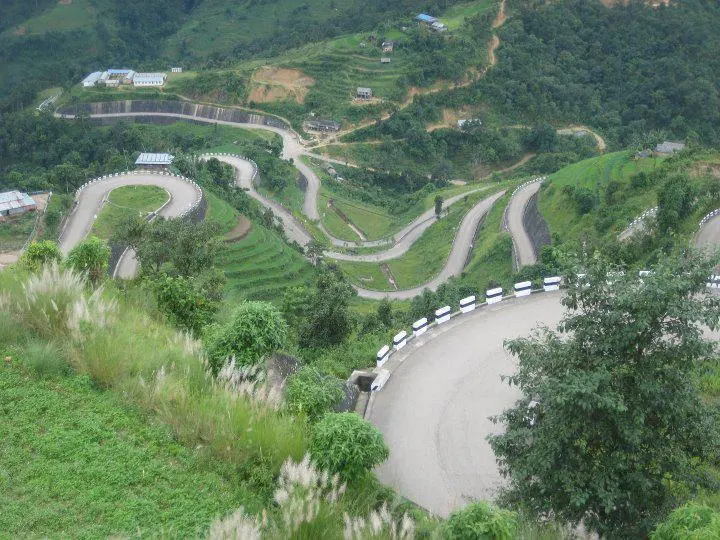
Two ramps both rise 1 m. Ramp A is 2 m long and ramp B is 4 m long. Which is true?
Pick an answer to see why.
2 (a) Wedge
We cut fruit with a knife, chop vegetables on a chulesi, and split wood with an axe. Each of these tools is a wedge. Look at its edge: it is made of two inclined planes meeting at a sharp edge.
A wedge is a tool with a broad, flat surface at one end and a sharp edge at the other, where two inclined planes meet. It works on the principle of the inclined plane, so it is a special form of the inclined plane. The sharp edge makes it easy to push in, and the sloping faces push the material apart, against the friction and toughness of the material (the load).
When the wedge is driven all the way in:
- the effort moves through the length (depth) of the wedge, H: this is the effort distance;
- the material is pushed apart by the width (thickness) of its broad end, L: this is the load distance.
So a long, thin wedge has a large VR: that is why a sharp knife with a thin blade cuts more easily than a blunt, thick one.
2 (b) Screw
We join pieces of wood with screws, lift a heavy vehicle with a jackscrew, and fasten sheets of metal with nuts and bolts. Look closely at a screw (Figure 8.5): it has a sharp thread winding round and round it. The thread is an inclined plane wound in a spiral round a cylinder, like a mountain road winding round a hill; so a screw is called a spiral inclined plane, and it is a special form of the inclined plane.
The distance between two neighboring threads is called the pitch (P). Each time the screw is turned once, it goes into the material (or moves up, in a jackscrew) by one pitch.
In one full turn, if the effort is applied at a distance R from the screw’s axis (the radius of the screwdriver’s handle, or the length of a jack’s handle; for a screw turned by its head, the head’s radius):
- effort distance = the circumference of that circle = 2πR;
- load distance = how far the screw goes in = the pitch P.
The velocity ratio depends on the pitch: the smaller the pitch, the larger the VR, and the easier it is to turn the screw. A longer handle helps in the same way.
Draw it: A screw
- Wheel and axle
A lattai (latai) winds up kite string; a doorknob turns a latch; bicycle pedals turn the chain wheel. These are all examples of a wheel and axle: two cylinders of different sizes fixed on the same axis, so that they turn together. The bigger one is the wheel and the smaller one the axle. When a load hanging from the axle is lifted by an effort applied to the wheel, the force is magnified.
In one turn, the rope unwinds from the wheel by one circumference of the wheel, and winds on to the axle by one circumference of the axle. So the effort moves through the circumference of the wheel, and the load through the circumference of the axle:
where R is the radius of the wheel and r the radius of the axle. The velocity ratio of a wheel and axle is the ratio of the radius of the wheel to the radius of the axle.
A wheel and axle is also called a continuous lever. Seen from the end (Figure 8.6), the center of the axis O is the fulcrum, the effort acts at A on the wheel, and the load at B on the axle, as on the two arms of a lever. But this lever can turn all the way round, 360°, and as it turns, a new point of the wheel becomes A and a new point of the axle becomes B, over and over: a lever that never runs out of swing.
Magnifying force, or gaining speed
A wheel and axle can be used either way round:
- Effort on the wheel, load on the axle: the effort moves farther than the load, so the machine magnifies force. A driver’s small force on the steering wheel turns the heavy front wheels of a bus. A bigger steering wheel makes the effort distance bigger and the force needed smaller, which is why buses and trucks have bigger steering wheels than cars (power steering now helps them too).
- Effort on the axle, load on the wheel: the load moves farther than the effort in the same time, so the machine increases speed. Flying a kite, you turn the lattai by its thin axle (the stick) with small movements of your hands, and the wide drum (the wheel) winds the string in quickly.
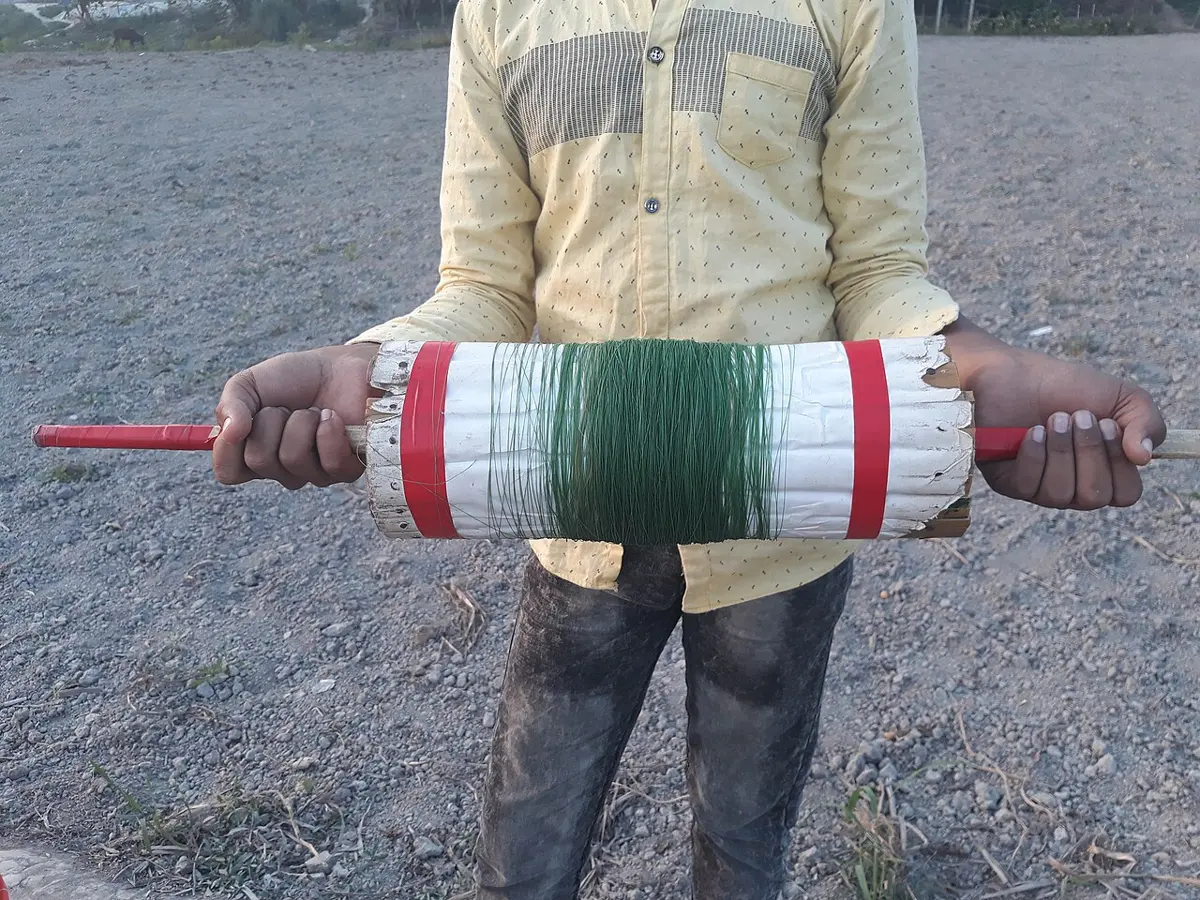
A screwdriver with a thick handle turns a screw more easily than one with a thin handle. Why?
Pick an answer to see why.
Complex machines
Some work is too complicated for a single simple machine: factories make complicated products, large trucks carry heavy loads, bulldozers dig the ground. For such work, simple machines of different kinds are combined into a complex machine (or compound machine). Complex machines do work with less effort, in less time and with ease.
Efficiency
In Activity 8.2 you worked out the output work and the input work of each pulley system. Their ratio tells us how much of the energy we put into a machine goes into the useful job. If it is 75%, then 75% of the energy we put in lifts the load, and the other 25% is wasted, mostly by friction, which turns it into heat and sound.
- The output work is the work the machine does on the load: output work = load × load distance.
- The input work is the work done by the effort on the machine: input work = effort × effort distance.
The ratio of the output work to the input work, as a percentage, is the efficiency (η, the Greek letter eta) of the machine:
Put in the output and input work:
In every real machine, the output work is less than the input work. For the efficiency to be 100%, all the input work would have to become output work; but friction between the moving parts (and, in a pulley system, lifting the movable pulleys themselves) always uses some of it. So the efficiency of a real machine is always less than 100%, and its MA is always less than its VR. Oiling and greasing the moving parts reduces friction and raises the efficiency a little.
Perfect machine
A machine in which the output work equals the input work would have an efficiency of 100%. Such an imaginary machine is called a perfect machine (or ideal machine). In a perfect machine, MA = VR. A machine with no friction at all is impossible in practice, so a perfect machine is impossible too, although a good lever or a well-oiled pulley comes close.
The efficiency of a machine is 75%. What does this mean?
Pick an answer to see why.
Exercise
1. Choose the best answer
a. Why is a single fixed pulley used, even though it gives no mechanical advantage?
Pick an answer to see why.
b. What is the velocity ratio of a pulley system of three pulleys?
Pick an answer to see why.
c. A wooden plank 6 m long is used to load goods into a truck 2 m high. What is the velocity ratio of this inclined plane?
Pick an answer to see why.
d. What is the efficiency of a perfect machine?
Pick an answer to see why.
e. Which simple machines make up a wheelbarrow with a single wheel?
Pick an answer to see why.
2. Give the differences between
A pulley and a wheel and axle
Answer
VR and MA
Answer
A jackscrew and an axe
Answer
Input work and output work
Answer
3. Give reasons
Winding roads are made in hilly regions.
Answer
A crane is a complex machine.
Answer
No machine has 100% efficiency.
Answer
The mechanical advantage of a real machine is always less than its velocity ratio.
Answer
The wheel and axle is called a continuous lever.
Answer
4. Answer the following questions
What is a simple machine? Give its advantages.
Answer
What is a complex machine? Describe it with an example.
Answer
Define an inclined plane, with examples.
Answer
What is a wedge? Explain its importance with examples.
Answer
What is a screw? Give examples of its use in daily life.
Answer
Describe the types of pulley, with labeled diagrams.
Answer
Describe how to find the MA and VR of a screw and of a wedge, with diagrams.
Answer
How can the MA and VR of an inclined plane be increased? Give examples.
Answer
The efficiency of a machine is 75%. What does this mean?
Answer
A perfect machine is practically impossible. Explain why.
Answer
Explain, with a diagram, how to find the velocity ratio of a wheel and axle.
Answer
Name the simple machines that make up each of these complex machines:
- i.sewing machine
- ii.stapler
- iii.bicycle
- iv.domestic flour mill
Answer
5. Solve these numerical problems
A box of mass 90 kg is pulled 20 m up an inclined plane to a height of 5 m with a force of 300 N along the slope. Find the MA, VR and efficiency of the inclined plane. (Take g = 10 m/s².)
Answer
The figure shows a pulley system of four pulleys. Its efficiency is 80%.
- i.How much effort is needed to lift a load of 1000 N?
- ii.Find its mechanical advantage.
- iii.Find the input work and the output work when the load is lifted 6 m.
Answer
In a wheel and axle, the radius of the wheel is 20 cm and that of the axle 5 cm. An effort of 250 N lifts a load of 500 N. Find its MA, VR and efficiency.
Answer
A wooden block is split with a wedge 6 cm wide and 12 cm long (deep). An effort of 300 N overcomes a resistance (load) of 500 N. Find its MA, VR and efficiency.
Answer
Quiz yourself: Force, Motion and Machines, Grades 5–10 →
Practice every question in the book, and keep track of the ones you miss →
A companion to your textbook, not a replacement for it: study from the book your school uses, and where the two differ, follow your teacher. Found a mistake? Please tell us.