
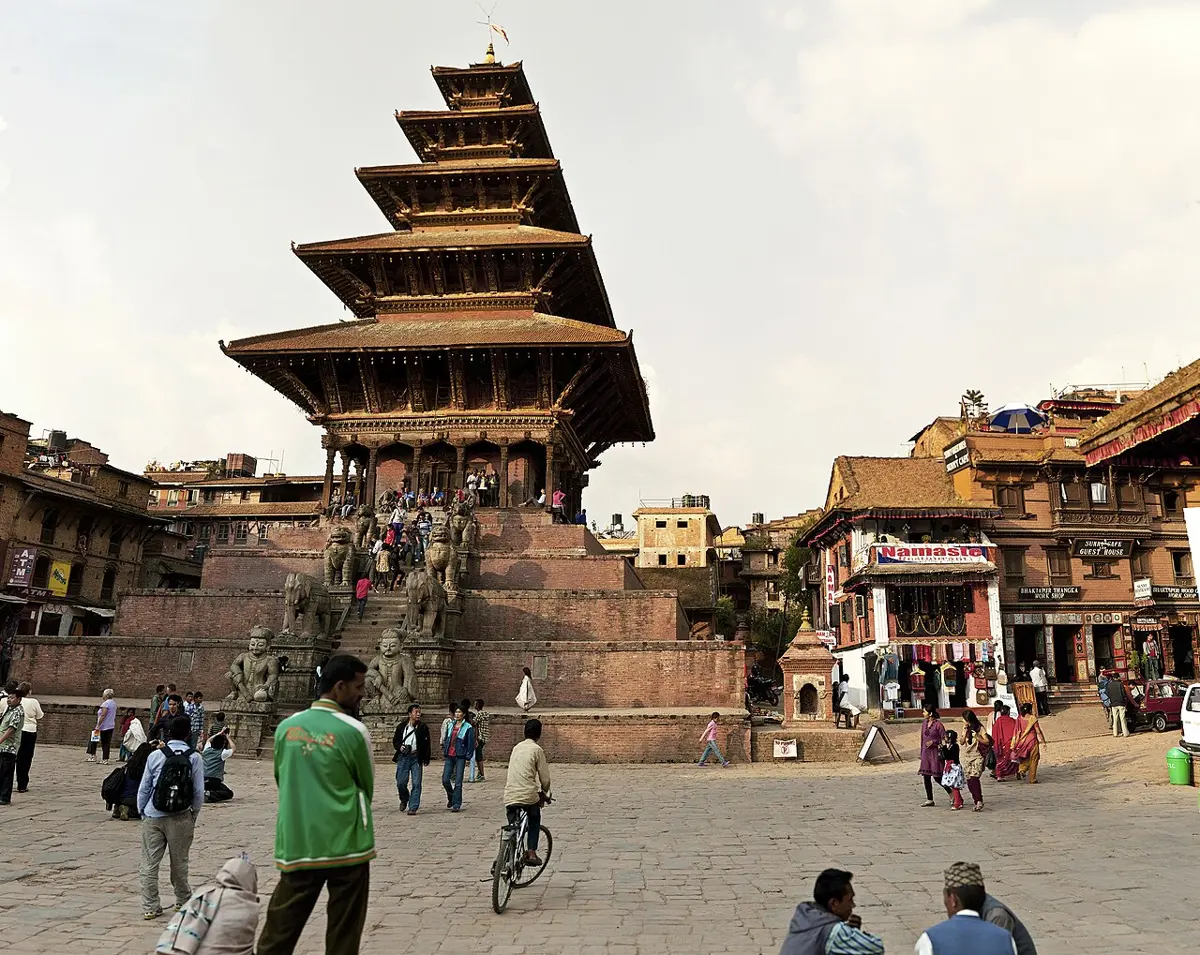
Open a map on a phone and press on the Nyatapola temple in Bhaktapur. The app gives its position as two angles: 27°40′19′′ N, 85°25′41′′ E. The first says how far north of the equator the temple is, the second how far east of a line through Greenwich, in London. Both are angles measured at the center of the Earth, in degrees (°), minutes (′) and seconds (′′).
So how far is Bhaktapur from the equator, in kilometers? The map gives an angle, and you want a length along the curved surface of the Earth. To get from one to the other you need a new way of measuring angles, the radian, in which an angle and the arc it cuts off are linked by one short formula. In Back to the map you will work out the distance, and find how many meters one second of latitude is on the ground.
This unit begins with three ways of measuring an angle: degrees, grades and radians. Then it builds on the sine, cosine and tangent of Grade 9 Math to six ratios and the rules that link them, and finally gives a meaning to the sine or cosine of any angle at all, even 870° or −1200°.
2.1 Measurement of angles
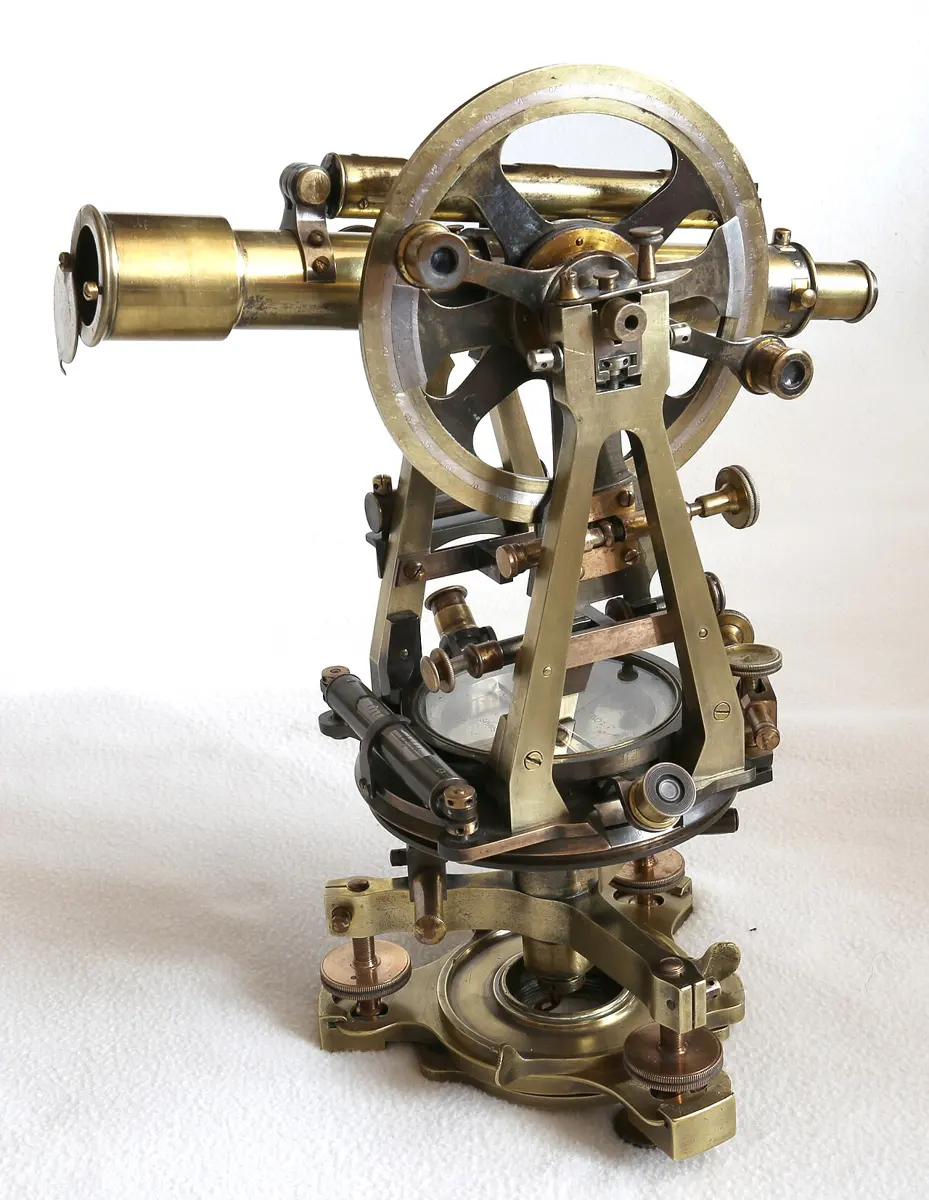
Trigonometry is the branch of mathematics about the sides and angles of triangles and how they are related. Its name is Greek, trigonon “triangle” and metron “measure”. The Greek astronomer Hipparchus (about 190–120 BC) is called its father, because he made the first known table of what we now call trigonometric ratios, to work out where the Sun and Moon would be.
Trigonometry began with astronomy and with mapping the land, and it is still used wherever something can’t be measured directly: physics, navigation, engineering, surveying for bridges and roads, and finding the height of a building or a mountain from the ground.
Before we can use angles we must agree how to measure them. There are three systems: degrees, grades and radians.
2.1.1 Sexagesimal and centesimal systems
a. Sexagesimal system
When a line turns from its starting position all the way round once, it turns through 360 degrees, 360°. A quarter turn, a right angle, is 90°. Each degree is cut into 60 minutes (′) and each minute into 60 seconds (′′). Because everything is counted in sixties, this is the sexagesimal system, from the Latin for “sixtieth”.
| 1 complete turn | 360° |
| 1 right angle | 90° (degrees) |
| 1° (degree) | 60′ (minutes) |
| 1′ (minute) | 60′′ (seconds) |
b. Centesimal system
In the centesimal system (from the Latin for “hundredth”) a complete turn is 400 grades, 400ᵍ, so a right angle is exactly 100ᵍ. Each grade is cut into 100 centesimal minutes (′) and each of those into 100 centesimal seconds (′′). Everything goes in hundreds, like metric units.
| 1 complete turn | 400ᵍ |
| 1 right angle | 100ᵍ (grades) |
| 1ᵍ (grade) | 100′ (minutes) |
| 1′ (minute) | 100′′ (seconds) |
The same signs ′ and ′′ are used in both systems, so always look at whether the angle starts with ° or ᵍ: 30°20′ and 30ᵍ20′ are different angles, and their minutes are different sizes.
Which of these is the same angle as 1 complete turn?
Pick an answer to see why.
2.1.2 Conversion between sexagesimal and centesimal systems
One right angle is both 90° and 100ᵍ, so 90° = 100ᵍ. Everything else follows from that.
| From degrees to grades | From grades to degrees |
|---|---|
| 90° = 100ᵍ | 100ᵍ = 90° |
A grade is a little smaller than a degree, so the same angle is always a bigger number of grades than of degrees.
When an angle has minutes and seconds, first make it a decimal in its own system, then convert, then turn the decimal part back into minutes and seconds.
Exercise 2.1 (A)
Question 1
Fill in the blanks.
1 right angle = …… (degrees)
Answer
1 right angle = …… (grades)
Answer
2 right angles = …… (grades)
Answer
200ᵍ = …… (degrees)
Answer
1° = (……)ᵍ
Answer
1ᵍ = (……)°
Answer
Question 2
Convert into sexagesimal seconds.
35′
Answer
50′40′′
Answer
30°40′50′′
Answer
55°30′10′′
Answer
10°25′48′′
Answer
55°56′28′′
Answer
Question 3
Define the sexagesimal and centesimal systems. Where are they used? How is one converted into the other? Explain with examples.
Answer
Question 4
Convert into sexagesimal measure (degrees, minutes and seconds).
30ᵍ20′10′′
Answer
25ᵍ15′10′′
Answer
45ᵍ35′25′′
Answer
30ᵍ12′
Answer
26ᵍ15′′
Answer
47ᵍ48′49′′
Answer
Question 5
Convert into centesimal measure (grades, minutes and seconds).
25°45′30′′
Answer
30°15′15′′
Answer
49°50′25′′
Answer
44°35′25′′
Answer
80°50′20′′
Answer
76°26′33′′
Answer
Question 6
Convert into degrees.
50ᵍ
Answer
80ᵍ
Answer
130ᵍ
Answer
160ᵍ
Answer
70ᵍ
Answer
250ᵍ
Answer
Question 7
Convert into grades.
50ᵍ40′8′′
Answer
40ᵍ32′33′′
Answer
56ᵍ85′50′′
Answer
45ᵍ35′′
Answer
37ᵍ50′
Answer
98ᵍ42′37′′
Answer
Question 8
Convert into grades.
45°
Answer
270°
Answer
18°
Answer
36°
Answer
108°
Answer
54°
Answer
Question 9
In a right-angled triangle, one angle is 60°.
What is the angle (in degrees) that makes the triangle right-angled?
Answer
What is the largest angle of a right-angled triangle, in grades?
Answer
Find the remaining angle in degrees.
Answer
Question 10
The three angles of a triangle are in the ratio 1 : 2 : 3. Find each angle in degrees.
Answer
Question 11
The three angles of a triangle are in the ratio 2 : 3 : 4.
Find them in degrees.
Answer
Find them in grades.
Answer
Question 12
The angles of a triangle are in the ratio 5 : 7 : 8.
Find them in degrees.
Answer
Find them in grades.
Answer
Question 13
The four angles of a quadrilateral are in the ratio 3 : 4 : 5 : 6.
Find them in degrees.
Answer
Convert the smallest and largest angles into grades and find their difference.
Answer
Question 14
In a triangle, one angle is 72°. The other two are in the ratio 1 : 3.
Find the other two angles in degrees.
Answer
Find all the angles of the triangle in grades.
Answer
What would the other two angles be in degrees if their ratio were 1 : 5?
Answer
Question 15
Two angles of a triangle are in the ratio 3 : 4 and the third angle is 60ᵍ.
How many degrees are there in 60ᵍ?
Answer
Find all three angles of the triangle in degrees.
Answer
What type of triangle is it, by its angles? Give a reason.
Answer
Question 16
One acute angle of a right-angled triangle is of a right angle.
Write a right angle in degrees.
Answer
How many degrees are of a right angle?
Answer
Find the other acute angle in grades.
Answer
Question 17
The sum of two angles is 100° and their difference is 20ᵍ.
How many grades make 1°?
Answer
Find the two angles in degrees.
Answer
Find the two angles in grades.
Answer
Question 18
The sum of two angles is 45° and their difference is 30ᵍ.
How many degrees make 1ᵍ?
Answer
Find the two angles in degrees.
Answer
Find the two angles in grades.
Answer
2.1.3 System of circular measure
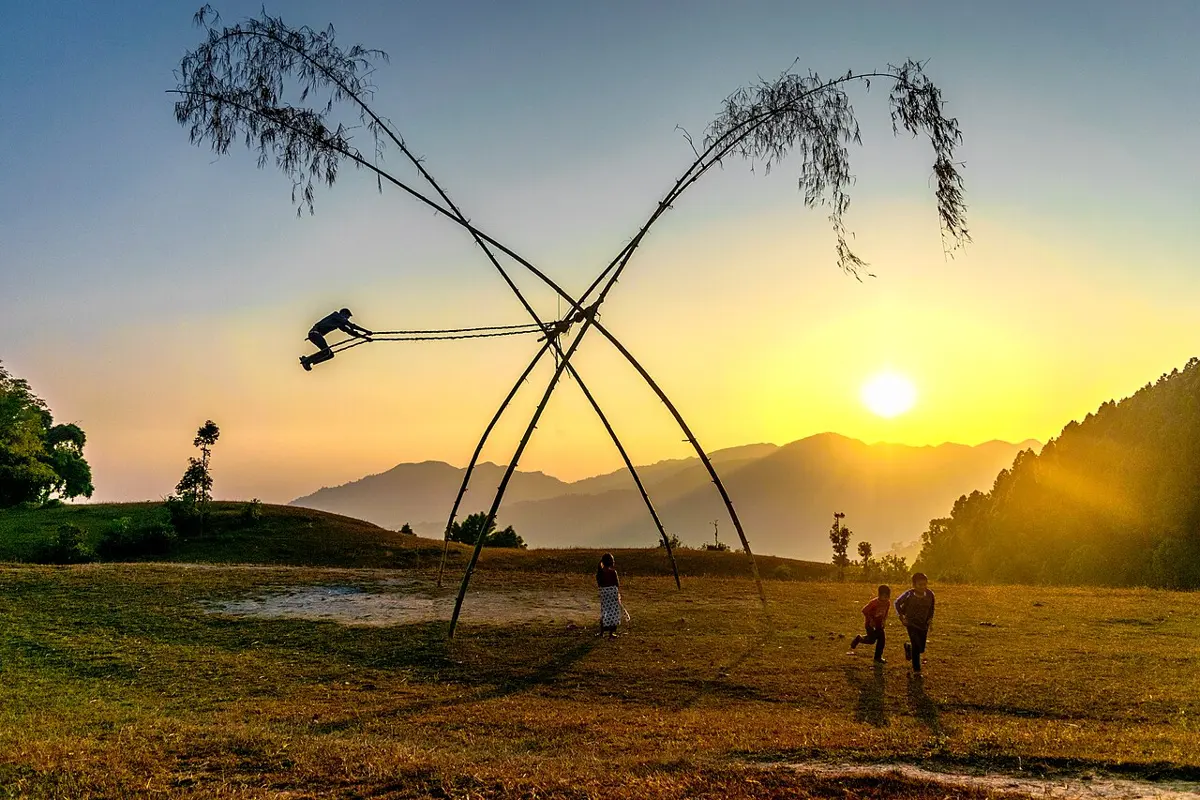
The degree and the grade are man-made: someone chose 360 or 400 parts. The circular measure uses the circle itself. In it, angles are measured in radians, written ᶜ (for “circular”) or rad.
Radian: one radian (1ᶜ) is the angle made at the center of a circle by an arc as long as the circle’s radius.
The whole circumference is , which is radius-lengths. So the angle of a complete turn is radians: 360° = 2πᶜ, and a straight angle is 180° = πᶜ. Here , often taken as in calculations.
2.1.4 Theorems on radian measure
Two facts about radians are proved as theorems.
Theorem 1: A radian is a constant angle. (It is the same angle in every circle.)
Proof. Take a circle with center O and radius OA = r. Mark B on the circle so that the arc AB = r; then ∠AOB = 1ᶜ, by the definition of a radian. Extend AO to C, so that AC is a diameter.
The arc ABC is half the circumference: . And ∠AOC is a straight angle, 180°.
In a circle, central angles are in the same ratio as their arcs:
The radius has canceled: whatever the circle, and since 180° and are both constants, one radian is a constant angle. Proved.
Worked out, . (With , .)
2.1.5 The relationship among arc length, radius and central angle
Theorem 2: In a circle of radius r, an arc of length l makes a central angle
Proof. Take a circle with center O and radius OA = r. Mark B on it so that arc AB = r, so ∠AOB = 1ᶜ. Mark C so that the arc ABC = l, and let ∠AOC = θ.
Central angles are in the ratio of their arcs:
Proved. In words:
This is why radians matter. In degrees the same fact needs a clumsy factor, ; in radians it is just l = rθ. Measuring the angle in radians is measuring it in radius-lengths of arc.
Converting to and from radians
From 180° = 200ᵍ = πᶜ:
An arc of 6 cm on a circle of radius 4 cm makes what angle at the center?
Pick an answer to see why.
Back to the map
The map gave the Nyatapola’s latitude as 27°40′19′′ N. Latitude is the angle at the center of the Earth between the equator and the place, measured along a line of longitude: a central angle of a circle whose radius is the Earth’s radius, about 6,371 km. The distance from the equator is the arc, so l = rθ, with θ in radians.
First the angle in degrees: .
In radians: .
The arc: km.
So Bhaktapur is about 3,077 km north of the equator, measured along the Earth’s surface. (The Earth isn’t a perfect ball, so a surveyor would get a few kilometers more, but the method is the same.)
How far is one second of latitude on the ground? radians, so
A second of latitude is about 31 m: the length of a long school building. That is why a map app that gives seconds can tell one end of Durbar Square from the other, and why positions for very exact work are given in decimals of a second.
Two towns are on the same line of longitude, 1° of latitude apart. About how far apart are they? (Take the Earth’s radius as 6,371 km.)
Pick an answer to see why.
Exercise 2.1 (B)
Question 1
Fill in the blanks.
2 right angles = …… radians
Answer
200 grades = …… radians
Answer
πᶜ = …… degrees
Answer
1 radian = …… degrees
Answer
1° = …… radians
Answer
1ᵍ = …… radians
Answer
Question 2
What is a radian?
Answer
Question 3
What is the circular measure system? In what unit are angles measured in it?
Answer
Question 4
In , what do l and r stand for?
Answer
Question 5
Look back at the activities “Degrees, grades and radians side by side” and “Do arcs grow with their angles?” (Activities 2 and 3 of the textbook).
What do you conclude from Activity 2?
Answer
What do you conclude from Activity 3?
Answer
Question 6
Convert into radians.
30°
Answer
45°
Answer
50ᵍ
Answer
70ᵍ
Answer
120°
Answer
150ᵍ
Answer
Question 7
Convert into degrees.
Answer
Answer
Answer
Answer
Answer
Answer
Answer
Answer
Answer
Question 8
Convert into grades.
Answer
Answer
Answer
Answer
Answer
Answer
Question 9
A right-angled triangle ABC is given.
How many degrees is ∠ABC?
Answer
What is of ∠ABC in radians?
Answer
What is 40% of ∠ABC in radians?
Answer
Question 10
One angle of a right-angled triangle is 60°.
Write the relationship between degrees and radians.
Answer
Find the other angles in radians.
Answer
What is the difference between the acute angles, in radians?
Answer
Question 11
One acute angle of a right-angled triangle is 50°.
Find the other acute angle in radians.
Answer
What is the difference between the acute angles, in radians?
Answer
What is one third of a straight angle, in radians?
Answer
Question 12
The difference between the acute angles ∠QPR and ∠PRQ of the right-angled triangle PQR is . Find all its angles in grades.
Answer
Find all the angles of the equilateral triangle ABC in circular measure.
Answer
Question 13
Find the angle between the hour hand and the minute hand of a clock at each time, in circular measure.
4:00
Answer
1:30
Answer
6:45
Answer
3:30
Answer
Question 14
Take in this question and the ones after it.
An arc of 44 cm makes an angle of 60° at the center. Find the radius.
Answer
An arc of 18 cm makes an angle of 81° at the center. Find the radius.
Answer
An arc of 15 cm makes an angle of at the center. Find the radius.
Answer
Question 15
Find the angle in degrees made at the center by an arc of 11 cm in a circle of radius 18 cm.
Answer
What angle (in degrees) does an arc of 3.8 cm make at the center of a circle of radius 7.254 cm?
Answer
Question 16
A clock’s minute hand is 3 cm long. How far does its tip move in 20 minutes?
Answer
Question 17
A cow is tied to a peg with a rope 10 m long. With the rope kept tight, the cow walks round until the rope has turned through .
Convert to degrees.
Answer
How far does the cow walk?
Answer
Question 18
A goat is tied to a peg with a rope 14 m long. With the rope kept tight, it walks round until the rope has turned through 70° at the peg.
Convert 70° to radians.
Answer
How far does the goat walk?
Answer
If the goat walks twice as far, what angle (in degrees) does the rope turn through?
Answer
Question 19
A pendulum swings through 20.5 cm from its mean position, turning through 5°. Find the length of the pendulum.
Answer
Question 20
Dil walks along a circular path at 100 m a minute. In 36 seconds he turns through 56° about its center.
How far does Dil walk in 36 seconds?
Answer
Find the radius of the path.
Answer
Find the circumference of the path.
Answer
Question 21
If D, G and C are the degree, grade and radian measures of the same angle, prove that .
Answer
2.2 Identities of trigonometric ratios
In Grade 9 Math you met the sine, cosine and tangent of an angle in a right-angled triangle. Why do those ratios matter? Because they depend only on the angle, not on the size of the triangle: every right-angled triangle with a 30° angle has its side opposite 30° exactly half its hypotenuse, whether it is drawn in a notebook or laid out across a valley. So one measured angle and one measured length give all the others. That is how the surveyors found Everest’s height.
In a right-angled triangle the sides are linked by Pythagoras’ theorem, . The ratios of the sides are linked too, by rules that hold for every angle. Those rules are the identities of this section.
2.2.1 The six trigonometric ratios
| Ratio | Name | Short |
|---|---|---|
| sine | sin θ | |
| cosine | cos θ | |
| tangent | tan θ | |
| cosecant | ||
| secant | ||
| cotangent |
The first three are the basic trigonometric ratios; the last three are their reciprocals (upside-downs).
The names are worth knowing. “Co-” is short for complement: the cosine of θ is the sine of its complement, 90° − θ, and the same for cotangent and cosecant (you will prove this in 2.4.3). “Tangent” and “secant” are the Latin for “touching” and “cutting”: on a circle of radius 1, they are the lengths of a line that touches the circle and a line that cuts through it.
2.2.2 Identities of trigonometric ratios
An identity is an equation that is true for every value of its letter, like . Trigonometric identities are true for every angle (where both sides are defined).
Reciprocal relations. What is ? From the definitions, . In the same way and .
So sin and cosec, cos and sec, tan and cot are reciprocals of each other.
Quotient relations. Divide the top and the bottom of by h:
Do the same with :
| Quotient relations | |
|---|---|
2.2.3 Pythagoras relations
Take the right-angled triangle BET, with the right angle at E and the reference angle θ at T. Then p = BE, b = ET, h = BT, and by Pythagoras’ theorem .
a. Prove that .
. Divide both sides by :
. Proved. ( means .)
b. Prove that .
. Divide both sides by :
since and . So . Proved.
c. Prove that .
. Divide both sides by :
since and . So . Proved.
Each of the three can be turned round in two more ways:
| Identity | ||
|---|---|---|
Which of these is not an identity?
Pick an answer to see why.
Algebra with trigonometric ratios
A ratio such as sin A behaves like a letter in algebra: like terms are added, brackets multiplied out, expressions factorized, by the same rules. Only the identities are new.
To prove an identity, start from one side (usually the more complicated one) and change it, step by step, using the definitions and identities, until it becomes the other side. Never move terms across the equals sign, as if it were an equation to solve: that assumes what you are trying to prove.
Exercise 2.2 (A)
Question 1
Fill in the blanks.
in terms of sin θ = ……
Answer
tan θ in terms of = ……
Answer
cos θ in terms of = ……
Answer
in terms of tan θ = ……
Answer
sin θ in terms of = ……
Answer
in terms of cos θ = ……
Answer
in terms of sin θ and cos θ = ……
Answer
tan θ in terms of sin θ and cos θ = ……
Answer
Question 2
Write the quotient relations.
Answer
Question 3
Write any three trigonometric identities.
Answer
Question 4
List all the trigonometric relations that come from Pythagoras’ theorem.
Answer
Question 5
Simplify.
tan θ + 3 tan θ
Answer
Answer
Answer
Answer
sin θ − 4 sin θ
Answer
7 tan A − 2 tan A
Answer
Answer
Answer
sin θ − 4 sin θ + 20 sin θ
Answer
8 tan A − 2 tan A + 12 tan A
Answer
Answer
Answer
Question 6
Multiply.
( sin A + sin B)( sin A − sin B)
Answer
(1 − cos θ)(1 + cos θ)
Answer
(1 + sin θ)(1 − sin θ)
Answer
Answer
Answer
Answer
Question 7
Factorize.
Answer
Answer
Answer
Answer
Answer
Answer
Question 8
Prove that:
Answer
Answer
Answer
tan θ cos θ = sin θ
Answer
Answer
Answer
Question 9
Prove that:
Answer
Answer
Answer
Answer
Answer
Answer
Answer
Answer
Question 10
Prove that:
Answer
Answer
Answer
Answer
Answer
Answer
Answer
Answer
2.2.4 Typical patterns of identities
Some identities don’t give way to the definitions alone. They need a trick from algebra: multiplying by a conjugate, , or , or replacing a 1 by . Study how each example below gets started: that first move is the part to learn.
To prove , what is the best first step?
Pick an answer to see why.
Exercise 2.2 (B)
Question 1
Prove that:
Answer
Answer
Answer
Answer
Answer
Answer
Answer
Answer
Answer
Answer
Answer
Answer
Question 2
Prove that:
Answer
Answer
Answer
Answer
Question 3
Prove that (θ and A acute):
Answer
Answer
Answer
Answer
Answer
Answer
Question 4
Prove that:
Answer
Answer
Answer
Answer
Question 5
Prove that:
Answer
Answer
Answer
Answer
Answer
Answer
The textbook prints a minus sign between the two fractions, , and that doesn’t work: at A = 60°, , the printed left side is , while . With a plus sign, as here, it is true.
Answer
Answer
Question 6
Prove that:
Answer
Answer
Answer
Answer
Question 7
Prove that:
Answer
Answer
Answer
Answer
Question 8
Prove that (two fractions and are equal when ad = bc, with b and d not zero):
Answer
Answer
Answer
Answer
Answer
Answer
Question 9
Prove that:
Answer
Answer
Answer
Answer
Question 10
Prove that:
Answer
Answer
Answer
Question 11
Prove that:
Answer
Answer
2.3 Conversion of trigonometric ratios
Can one ratio be turned into another? Yes: conversion means writing a ratio in terms of a different ratio of the same angle. The angle doesn’t change; only the way it is described does. It is like giving a price in rupees or in paisa.
Why bother? Because a problem often gives one ratio and asks about another. A ramp’s slope (its tangent) may be known when its angle’s sine is needed; in the exam, is given and cos θ is asked. Conversion answers it in two ways:
- a.with the identities: reciprocal, quotient and Pythagoras relations, such as , , ;
- b.with Pythagoras’ theorem on a right-angled triangle whose sides are chosen to fit the given ratio.
If (θ acute), what is tan θ?
Pick an answer to see why.
Exercise 2.3
Question 1
What is meant by the conversion of trigonometric ratios?
Answer
Question 2
Convert every trigonometric ratio of θ into cos θ.
Answer
Convert every trigonometric ratio of α into tan α.
Answer
Convert every trigonometric ratio of θ into .
Answer
Convert every trigonometric ratio of α into .
Answer
Question 3
Which is right when is converted into sin A?
Pick an answer to see why.
Question 4
Which is right when is converted into ?
Pick an answer to see why.
Question 5
If :
Which are the other trigonometric ratios?
Answer
Find their values.
Answer
Question 6
Find the values of the other trigonometric ratios.
Answer
Answer
Answer
Answer
Question 7
If , find .
Answer
If , find .
Answer
If , find 5 cos θ + 4 tan θ.
Answer
If , find .
Answer
If , find 13 cos θ + 24 tan θ.
Answer
Question 8
If and (A and B acute), find:
sin A cos B + cos A sin B
Answer
cos A cos B + sin A sin B
Answer
sin A cos B − cos A sin B
Answer
cos A cos B − sin A sin B
Answer
Answer
Answer
Question 9
(with m > n > 0).
Find cos A.
Answer
Find sin A and tan A.
Answer
Question 10
If , prove that .
Answer
If , prove that .
Answer
If , prove that .
Answer
Question 11
If 4 cos θ + 3 sin θ = 5, prove that .
Answer
If 12 sin θ = 13 − 5 cos θ, find tan θ and .
Answer
If 8 sin θ − cos θ − 4 = 0, prove that (θ acute).
Answer
If 3 sin A + 4 cos A = 5, prove that .
Answer
2.4 Trigonometric ratios of any angle
So far every angle has been inside a right-angled triangle, so less than 90°. But angles in the world are often bigger: a door opens to 120°, a wheel turns 400°, a clock’s hand turns backwards when you set it. A triangle can’t have a 150° angle in it beside a right angle, so what could mean? This section gives every angle, of any size and either direction, its six ratios, and shows that they are always the ratios of an acute angle with the right sign.
Positive and negative angles
An angle is made by a rotating line turning about a point from an initial line. Anticlockwise turns are positive, clockwise ones negative. (Why anticlockwise? Because then turning from the positive X-axis takes you first to the positive Y-axis, the way the quadrants are numbered.)
Quadrants
| Quadrant | Where | Angles (turning anticlockwise from OX) |
|---|---|---|
| First | between OX and OY (XOY) | 0° to 90° |
| Second | between OY and OX′ (X′OY) | 90° to 180° |
| Third | between OX′ and OY′ (X′OY′) | 180° to 270° |
| Fourth | between OY′ and OX (XOY′) | 270° to 360° |
2.4.1 Trigonometric ratios of angles in all quadrants
So give P its coordinates, P(x, y), with OM = x along the X-axis and MP = y, and OP = r, which is always positive (). The ratios of the angle θ = ∠POM are defined as
For an acute angle this is exactly the old definition (y = p, x = b, r = h). For bigger angles, x and y can be negative, and so can the ratios. Since r is always positive, the sign of each ratio is decided by the signs of x and y, and so by the quadrant:
| First quadrant | Second quadrant | Third quadrant | Fourth quadrant |
|---|---|---|---|
| x +, y + | x −, y + | x −, y − | x +, y − |
| All ratios positive | sin and cosec positive, the rest negative | tan and cot positive, the rest negative | cos and sec positive, the rest negative |
Read anticlockwise from the first quadrant the positive ones are All, Sin, Tan, Cos. Starting from the fourth quadrant they spell CAST, the CAST rule. Some remember it as “All Students Take Chocolate”, quadrant by quadrant.
In which quadrant are sin θ and cos θ both negative?
Pick an answer to see why.
2.4.2 Trigonometric ratios of a negative angle (−θ)
Let OP make the angle θ with OX, with P(x, y) in the first quadrant (so x and y are both positive), on a circle of radius OP = r. Drop PM to OX and carry it on to meet the circle again at P′. P′ is P’s mirror image in the X-axis: P′(x, −y), and the angle ∠P′OX is −θ, the same size turned clockwise.
From the definitions, with and :
| In short | ||
|---|---|---|
| sin (−θ) = − sin θ | cos (−θ) = cos θ | tan (−θ) = − tan θ |
2.4.3 Trigonometric ratios of (90° − θ)
In the right-angled triangle OMP, with ∠POM = θ and the right angle at M, the third angle is ∠MPO = 90° − θ (the angles add to 180°).
From θ: hypotenuse OP, perpendicular PM, base OM. From 90° − θ, at P: hypotenuse OP, perpendicular OM, base PM. The two angles swap perpendicular and base, so
and in the same way , , .
Another way, by reflection. Reflect P(x, y) in the line y = x: its image is P′(y, x), and ∠P′OY = ∠POX = θ, so ∠P′OX = 90° − θ.
Then and , and the other four follow as quotients and reciprocals.
| In short | ||
|---|---|---|
This is the “co” of cosine: the cosine of an angle is the sine of its complement (), and the same for cotangent and cosecant.
2.4.4 Trigonometric ratios of (90° + θ)
Turn P(x, y) a further 90° anticlockwise about O. Its image is P′(−y, x) (as in rotation in Grade 9 Math), at ∠P′OX = 90° + θ.
| In short | ||
|---|---|---|
2.4.5 Trigonometric ratios of (180° − θ)
Reflect P(x, y) in the Y-axis: its image is P′(−x, y), and ∠P′OX′ = θ, so ∠P′OX = 180° − θ.
| In short | ||
|---|---|---|
So : the question at the start of this section has its answer.
2.4.6 Trigonometric ratios of (180° + θ)
Turn P(x, y) through 180° about O: its image is P′(−x, −y), at ∠P′OX = 180° + θ.
| In short | ||
|---|---|---|
The rest can be found the same way, with a drawing, or more quickly from the rules already proved, since 270° = 180° + 90° and 360° = 270° + 90°.
2.4.7 Trigonometric ratios of (270° − θ)
, so
2.4.8 Trigonometric ratios of (270° + θ)
, so
2.4.9 Trigonometric ratios of (360° − θ)
, so
(360° − θ ends exactly where −θ does, so these are the ratios of −θ.)
2.4.10 Trigonometric ratios of (360° + θ)
A full turn brings the rotating line back where it was, so 360° + θ ends where θ ends and has the same ratios. Functions that repeat like this are called periodic.
and the same for cosec, sec and cot. (Through the rules: .) So any number of full turns can be taken away: .
A rule for (n × 90° ± θ)
All of these follow one pattern. Write the angle as , with θ acute.
When n is even (0, 2, 4, …: the angles −θ, 180° ± θ, 360° ± θ) the ratio keeps its name:
; ; ; ; .
When n is odd (1, 3, 5, …: the angles 90° ± θ, 270° ± θ) the ratio changes to its co-ratio: sin ↔ cos, tan ↔ cot, sec ↔ cosec.
; ; ; ; ; .
In both cases the sign is the sign of the original ratio in the quadrant where ends, by CAST (pretending θ is a small acute angle).
For example, : n = 3 is odd, so sin becomes cos. 270° − θ is just short of 270°, in the third quadrant, where only tan and cot are positive, so sin there is negative. So .
Here, for reference, are the ratios of the standard angles from Grade 9 Math; every angle in this section comes back to one of them.
| θ | 0° | 30° | 45° | 60° | 90° |
|---|---|---|---|---|---|
| sin θ | 0 | 1 | |||
| cos θ | 1 | 0 | |||
| tan θ | 0 | 1 | not defined |
What is ?
Pick an answer to see why.
Worked examples
Exercise 2.4
Question 1
Fill in the blank: sin (−θ) = ….
Answer
tan (−θ) = ….
Answer
….
Answer
….
Answer
….
Answer
….
Answer
….
Answer
….
Answer
….
Answer
Question 2
Match each ratio on the left with its value on the right.
| − cos A | |
| cos A | |
| tan A | |
Answer
Question 3
Explain the CAST rule with the help of a diagram.
Answer
Question 4
Find the value of .
Answer
Answer
Answer
Answer
Answer
Answer
Answer
Answer
Answer
Question 5
Prove that .
Answer
Prove that , where .
Answer
Prove that .
The textbook prints the last term as “”, with a stray θ after cot that makes it a product, and then the two sides aren’t equal (at θ = 45° the left side is about −3.36). Without the stray θ, as here, it holds.
Answer
Prove that .
Answer
Question 6
Prove that .
Answer
Prove that .
Answer
Prove that .
Answer
Question 7
Simplify .
Answer
Simplify .
Answer
Simplify .
Answer
Simplify .
Answer
Simplify .
Answer
Simplify .
Answer
Question 8
Prove that .
Answer
Prove that .
Answer
Prove that .
Answer
Prove that .
Answer
Prove that .
Answer
Prove that .
Answer
Question 9
Find the value of .
Answer
Answer
Answer
Answer
Answer
Question 10
Prove that .
Answer
Prove that .
Answer
Prove that .
Answer
Prove that .
Answer
Prove that .
Answer
Question 11
Prove that .
Answer
Prove that .
Answer
Prove that .
Answer
Question 12
Find x if .
Answer
Find x if .
Answer
Find x if .
Answer
Find x if .
Answer
Find x if .
Answer
Practice every question in the book, and keep track of the ones you miss →
How the exam asks it
Grade 9’s final exam follows CDC’s Specification Grid and Model Question for Optional Mathematics, Grade 9 (2082). There, Trigonometry is 17 marks:
| Where | Questions | Marks | Levels |
|---|---|---|---|
| Group A, multiple choice | 3 | 3 × 1 | knowledge, application, higher ability |
| Trigonometry’s own questions | 3 (with parts) | 9 | knowledge 2, understanding 2, application 4, higher ability 1 |
| A question joining areas | 1 (with parts) | 5 | understanding 2, application 2, higher ability 1 |
In the grid’s model paper the multiple-choice questions ask the right way to turn 56° into radians (× ), cos θ when sin θ is given, and A when (, so A = 60). Then come three short questions: (write as a ratio of an acute angle; find the fourth-quadrant angle with the same cosine as 74°, which is 286°); the rationalizing factor of , as one ratio, and the proof (Exercise 2.2 (B)); and cos θ and 13 cos θ + 24 tan θ from (Exercise 2.3). The long question is the arc below.
Where these facts come from
- The Nyatapola’s position (the opening, Back to the map): Wikipedia, “Nyatapola”, read November 2026; the Earth’s mean radius, 6,371 km: Wikipedia, “Earth radius”, read November 2026.
- Base 60 and the Babylonians (2.1.1): Wikipedia, “Sexagesimal”, read November 2026.
- Grades and the metric system, and the DRG key (2.1.1): Wikipedia, “Gradian”, read November 2026.
- The Great Trigonometrical Survey, its theodolites, Radhanath Sikdar and Everest’s 29,002 ft (the Everest story): Wikipedia, “Great Trigonometrical Survey”, “Radhanath Sikdar” and “Mount Everest”, read November 2026; the instrument makers: “Troughton & Simms”, read November 2026.
- Roger Cotes and the radian, and James Thomson’s name for it in 1873 (2.1.5): Wikipedia, “Radian” and “Roger Cotes”, read November 2026.
- Python’s
math.sintakes radians (2.1.5): Python documentation, “math — Mathematical functions”, read November 2026. - jya, jiba, sinus (2.2): Wikipedia, “Sine and cosine”, Etymology, read November 2026.
- Hipparchus and the first table of chords (2.1): Wikipedia, “Hipparchus”, read November 2026.
- The exam’s Trigonometry questions (For the exam, How the exam asks it): CDC, Specification Grid and Model Question, Optional Mathematics, Grade 9 (2082), its table and model question paper.
A companion to your textbook, not a replacement for it: study from the book your school uses, and where the two differ, follow your teacher. Found a mistake? Please tell us.