
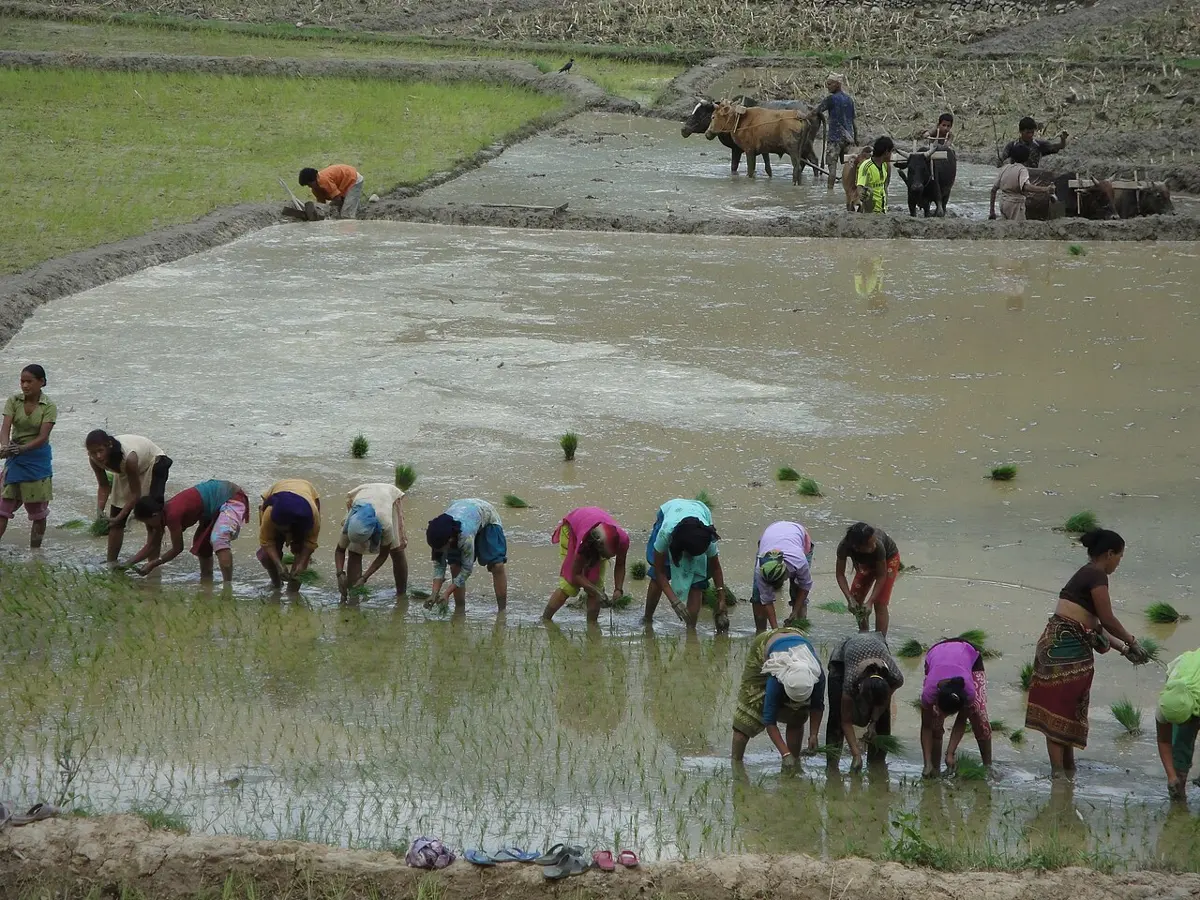
After the 2015 earthquake, neighbors in Bigu, in northern Dolakha, rebuilt each other’s houses by parma: you work on my house, then I work on yours. A two-room stone house took about 10 masons and laborers about 20 days, and its owner then owed the group that many days of work.
Now suppose only 8 people can come, because it is planting time. How many days will the house take? And if the rains are 10 days away, how many people are needed? This unit gives you a method for such questions, and tells you when more of one thing means more of another, and when it means less. In Back to Bigu you will answer both.
Figures: NSET-Baliyo Ghar’s report from Bigu, June 2018.
6.0 Review
Two quantities can be tied together in these two ways.
Direct variation: when one quantity increases, the other increases by the same factor, and when one decreases, the other decreases by the same factor. Three times the hours, three times the distance.
Indirect variation (also called inverse variation): when one quantity increases, the other decreases by the same factor, and the other way round. Twice the people, half the days.
There is a quick test for a table of numbers. In direct variation the ratio of the pair stays the same: 100 ÷ 2 = 150 ÷ 3 = 50. In indirect variation the product stays the same: 10 × 16 = 20 × 8 = 160.
Which table shows direct variation?
Pick an answer to see why.
6.1 Application of direct variation
The unitary method (ऐकिक नियम) is a simple idea: find the value of one, then use it to find the value of as many as you want. “One” can be one pencil, one person, one day, or one person for one day.
There is a second way to answer e., without stopping at one pencil, and it is the one that will carry three quantities later. Make a table with the case you know on top and the case you want below, calling the unknown x. Draw an arrow beside each column: in the x column it points up, away from x, and in a column that varies directly with x it points the same way.
So 12 pencils cost Rs 180, the same as before. What it says: 12 pencils are of 8 pencils, so the price must be of Rs 120.
An equation that says two ratios are equal is a proportion. Some teachers draw both arrows down and write it . That is the same equation, and cross-multiplying gives 8x = 12 × 120. What matters is that both ratios are taken the same way.
Three quantities
The arrow table does the same work in one step. More people earn more, so people and income are in direct variation. More days earn more, so days and income are too. For a. and b., with the income wanted, every arrow points the same way. For a., the case wanted is 1 person for 1 day.
For b., 15 people for 10 days:
For c., the people stay at 10 and the days are wanted, so now x is in the Days column, and each column is judged against the days. More income takes more days, so that arrow points the same way as x’s. More people would take fewer days, so that arrow points the opposite way, though here both rows say 10, so its ratio is 1.
Why can we multiply the ratios? Change one thing at a time. Going from 10 people to 15 makes the income of what it was, Rs 2,40,000 in 20 days. Then going from 20 days to 10 makes that of itself, Rs 1,20,000. Each column is one multiplier on the amount you started with.
6 people earn Rs 18,000 in 5 days. Which line gives what 4 people earn in 10 days?
Pick an answer to see why.
6.2 Application of indirect variation
A job is a fixed amount of work. Measure it in person-days: one person working for one day is 1 person-day. The job in the Review was 10 × 16 = 160 person-days, and it stays 160 person-days however you share it out. That is why people and days are in indirect variation: their product is the job.
Back to Bigu
A house takes about 10 × 20 = 200 person-days. Share them out differently below.
Now the two questions from the start have answers.
With 8 people, the house takes 25 days, since 200 ÷ 8 = 25. To finish in 10 days, 20 people are needed, since 200 ÷ 10 = 20. The “about” in the report carries through: these are plans, not promises, and “When does the method lie?” at the end of this section shows why.
Three quantities again
With the arrow table, x’s arrow points up as before. Fewer people must work more hours, so people and hours are in indirect variation, and that arrow points the opposite way. The same goes for days and hours.
So the 7 people must work 10 hours a day. For b., the hours are the same in both rows, so that column’s ratio is 1, and days are wanted:
The people, the hours a day and the days of a job are all in indirect variation with one another, two at a time. More people, fewer hours a day. More hours a day, fewer days. More people, fewer days. Their product, 10 × 14 × 8 = 1,120 person-hours, is the job.
Rice in a store lasts 6 people for 30 days. How long does it last if 3 more people join?
Pick an answer to see why.
Real jobs mix the two kinds. A longer drain needs more people, but more days need fewer. Decide each column on its own.
Where this is used
- Sharing out work. Parma groups count days of work, and anyone who plans a building job does the same sum: how many person-days, so how many people for how long.
- Food for a crowd. Food in an emergency is planned this way: the World Food Programme and UNHCR use 2,100 kcal a person a day as their starting figure, so the food needed varies directly with the people and with the days.
- Money. Nepal Rastra Bank fixes ₹100 = Rs 160 Grade 10: Currency and Exchange Rate, so Nepali rupees and Indian rupees are in direct variation: at that rate ₹2,500 is Rs 4,000 on any day.
- Science. In a wire at a fixed temperature Grade 9: Ohm’s law, the current varies directly with the voltage.
How the exam asks it
Grade 8’s final exam follows CDC’s specification grid for Mathematics, Grades 6–8. Arithmetic is 14 marks in three questions, each built around a real setting with parts at different levels. CDC’s teachers’ guide asks for problems of up to three quantities. The grid’s Grade 8 model paper has no workers-and-days question, but it uses the value of one:
| Part | Level | Marks | What it asks |
|---|---|---|---|
| 4b | application | 1 | a family uses 8,520 liters of water at 30 paisa a liter; what do they pay? |
That is 8,520 × 0.30 = Rs 2,556. A longer question would look like this one of our own, with marks in the shape of the paper’s 5-mark questions.
Exercise 6
Question 1
Write D for direct variation and I for indirect variation for each pair.
The length of a circle’s diameter and its circumference.
Answer
The number of students in a hostel and the number of days a fixed store of food lasts.
Answer
The principal and the interest earned, for a fixed time and a fixed rate of interest.
Answer
A vehicle’s speed and the distance it travels in a fixed time.
Answer
A vehicle’s speed and the time it takes to cover a fixed distance.
Answer
Question 2
4 dozen pens cost Rs 576. How many pens can be bought with Rs 228?
Answer
Question 3
An athlete runs 18 km in 45 minutes. Estimate the time the athlete takes to run 30 km.
Answer
Question 4
A loaded truck covers a distance in 6 hours at 48 km per hour. If its speed falls to 36 km per hour, how long will it take to cover that distance?
Answer
Question 5
20 workers can finish a job in 15 days. How many workers must be added to finish it in 12 days?
Answer
Question 6
12 workers take 14 days to finish a job. If more workers are added to make 21 in all, how many days will the job take?
Answer
Question 7
A barrack has food for 200 soldiers for 30 days. How many soldiers must be moved elsewhere so that the food lasts 40 days?
Answer
Question 8
A motorcycle takes 6 hours to cover a distance at 30 km per hour. What must its speed be to cover the same distance in 5 hours, and how much faster is that?
Answer
Question 9
3 chairs and 4 tables cost Rs 7,540 in all. If one chair costs Rs 220, find the price of one table.
Answer
Question 10
5 cows and 2 oxen cost Rs 1,35,000 in all. If one ox costs Rs 17,500, find the price of one cow.
Answer
Question 11
4 people earn Rs 28,000 in 10 days.
How much does one person earn in a day?
Answer
How much do 3 people earn in 15 days?
Answer
By what percent is what 3 people earn in 15 days more or less than what 4 people earn in 10 days?
Answer
Question 12
48 people need 700 kg of rice for 30 days.
How much rice do 40 people need for 36 days?
Answer
What does the rice for 40 people for 36 days cost at Rs 60 a kg?
Answer
Question 13
15 people can build a 50 m long wall in 8 days. Find the length of wall that 16 people can build in 12 days at the same pace.
Answer
Question 14
20 people can build an 80 m long wall in 8 days. How many people are needed to build a 60 m long wall in 24 days?
Answer
Question 15
Pasang deposited Rs 6,000 in a bank for 3 years and received Rs 1,800 as interest at the end. At the same rate of simple interest, find the interest on Rs 10,000 for 4 years.
Answer
Question 16
6 men and 8 boys can harvest 30 ropani of crops in 4 days. If 4 boys can harvest as much as 2 men, how many ropani can 14 men and 8 boys harvest in 8 days at the same rate?
Hint
Answer
Question 17
10 people can build a road in 2 days, working 7 hours a day. Working at the same pace, how many hours a day must 5 people work to build the same length of road in 14 days?
Answer
Question 18
18 people can build a 54 m long wall in 10 days. How many people of the same ability are needed to build a 66 m long wall in 22 days?
Answer
Question 19
20 people build a park 40 m long and 20 m wide in 25 days. How long will 50 people take to build a park 50 m long and 40 m wide?
Hint
Answer
Question 20
25 people earn Rs 5,00,000 in 30 days.
How much does one person earn in a day?
Answer
How many people will earn Rs 5,00,000 in 10 days?
Answer
How many days do 25 people take to earn Rs 1,00,000?
Answer
What do 5 people earn in 40 days?
Answer
Printable PDFs
- Study notes 2 pages
- Harder practice questions 2 pages Answer key
Practice every question in the book, and keep track of the ones you miss →
Where these facts come from
- Parma in Bigu (the opening, Back to Bigu, the fact in 6.2): Ram Krishna Sharma, NSET-Baliyo Ghar, “Parma system helping rebuild Bigu”, 25 June 2018 (about 10 masons and laborers, about 20 days, a typical two-room stone masonry house; the owner gives back the same number of days; parma used in agricultural work too), read November 2026.
- The exam (For the exam, How the exam asks it): CDC, विशिष्टीकरण तालिका (कक्षा ६-८) गणित – नमुना प्रश्नहरु (2080), its table (Arithmetic 14 marks in three questions) and Grade 8 model question paper (question 4b); CDC, शिक्षक निर्देशिका कक्षा ८ गणित (2081), Lesson 6 (problems of up to three quantities). Our question is our own.
- Taxi fares (careful in 6.0): as in Household Arithmetic, the Department of Transport Management’s fares of 2075/06/07, and the report of new fares in April 2026 given there.
- Rule of three (the story): Wikipedia, “Trairāśika” (Āryabhaṭa’s rule; pramāṇa, phala, icchā; vyasta-trairāśika; Bhāskara II on rules of five and more, and the Līlāvatī’s comparison with God), “Aryabhatiya” (c. 499) and “Cross-multiplication” (Darwin’s letter of 1855), read November 2026.
- Brooks’s law (the think box in 6.2): Wikipedia, “Brooks’s law”, read November 2026.
- Food planning (Where this is used): ENN, Field Exchange 3, summary of the revised joint WFP/UNHCR guidelines (2,100 kcal for planning), read November 2026.
- Every answer: worked out here and checked by a computer program.
A companion to your textbook, not a replacement for it: study from the book your school uses, and where the two differ, follow your teacher. Found a mistake? Please tell us.