
Last month Aayush’s family in Bhaktapur used 60 units of electricity on their 5 ampere meter, and the bill was Rs 455. This winter they bought an induction cooker, and this month’s meter shows 120 units: twice as much. Aayush guessed the bill would be twice as much too, Rs 910. It came to Rs 1,050. Was the meter reader wrong? And why does paying it in the first week bring it down to Rs 1,029?
Every month a home pays for things measured by a meter: electricity in units, water in thousands of liters, telephone calls one by one, a taxi ride in steps of 200 meters. Each bill is worked out by rules the supplier publishes, and with the arithmetic of this unit you can check every one of them yourself. By the end of 4.1 you will see exactly where Aayush’s extra Rs 140 came from.
Sources: Nepal Electricity Authority’s domestic tariff (the Electricity Regulatory Commission’s decision of 2078/7/8), as posted on nea.org.np in November 2026; the bills are worked out in this unit.
4.0 Review
You already know the three tools this unit needs: the unitary method (find the value of one, then of many), percentages (a discount, a fine, a tax) and adding a percentage to an amount. Try these first.
Each of those steps comes back in every bill below: a rate for one unit times the number of units, then a percentage taken off or added on. Most of these bills can be paid today through a bank’s app or a digital wallet such as eSewa or Khalti, without standing in a queue at the office; the arithmetic behind them is the same.
4.1 Household expenses for electricity
Electricity is measured in units. One unit is one kilowatt-hour (kWh): the energy a 1,000-watt heater uses in one hour, or a 10-watt LED bulb in 100 hours. The meter on the wall counts units the way a car counts kilometers: it only ever goes up. Each month the meter reader notes the number, and
The rates are set by the Electricity Regulatory Commission and published by the Nepal Electricity Authority (NEA). Since its decision of 2078/7/8 (Kartik 2078), still the tariff NEA gives for homes in November 2026, a single-phase home pays:
The minimum charge each month (Rs)
| Units used in the month | 5 A | 15 A | 30 A | 60 A |
|---|---|---|---|---|
| 0–20 | 30 | 50 | 75 | 125 |
| 21–30 | 50 | 75 | 100 | 125 |
| 31–50 | 50 | 75 | 100 | 125 |
| 51–100 | 75 | 100 | 125 | 150 |
| 101–250 | 100 | 125 | 150 | 200 |
| over 250 | 150 | 175 | 200 | 250 |
The energy charge per unit (Rs)
| Units | 5 A | 15 A | 30 A | 60 A |
|---|---|---|---|---|
| 1–20 | 0 (see below) | 4.00 | 5.00 | 6.00 |
| 21–30 | 6.50 | 6.50 | 6.50 | 6.50 |
| 31–50 | 8.00 | 8.00 | 8.00 | 8.00 |
| 51–250 | 9.50 | 9.50 | 9.50 | 9.50 |
| over 250 | 11.00 | 11.00 | 11.00 | 11.00 |
On a 5 A meter, a home that uses 20 units or less pays no energy charge at all, only the Rs 30 minimum. A 5 A home that uses more than 20 units pays Rs 3 a unit for its first 20.
How a bill is worked out
The bill is the minimum charge plus the energy charge, and the energy charge is worked out block by block, like income tax in Unit 2: each rate is paid only on the units inside its block. For a 5 A meter:
| Units used | Minimum charge | Energy charge |
|---|---|---|
| up to 20 | Rs 30 | none |
| 21 to 30 | Rs 50 | first 20 at Rs 3, the rest at Rs 6.50 |
| 31 to 50 | Rs 50 | 20 at Rs 3, 10 at Rs 6.50, the rest at Rs 8 |
| 51 to 100 | Rs 75 | 20 at Rs 3, 10 at Rs 6.50, 20 at Rs 8, the rest at Rs 9.50 |
| 101 to 250 | Rs 100 | 20 at Rs 3, 10 at Rs 6.50, 20 at Rs 8, the rest at Rs 9.50 |
| over 250 | Rs 150 | 20 at Rs 3, 10 at Rs 6.50, 20 at Rs 8, 200 at Rs 9.50, the rest at Rs 11 |
The 15, 30 and 60 A meters are billed the same way, with their own minimum charges and their own rate for the first 20 units.
Move the units and see each block fill. Then change the meter.
Paying early, paying late
The bill is counted from the date the meter was read:
| Paid on | Discount or fine |
|---|---|
| day 1 to 7 | 2% discount |
| day 8 to 15 | the bill as it is |
| day 16 to 30 | 5% fine |
| day 31 to 40 | 10% fine |
| day 41 to 60 | 25% fine |
| after day 60 | the line can be cut off without notice; the amount owed is recovered like money owed to the government, and reconnecting costs Rs 500 |
A 5 A home uses 18 units in a month. What is its bill, paid on day 10?
Pick an answer to see why.
Back to Aayush’s bill
Aayush’s 60 units: minimum Rs 75 (51–100 block); energy 20 × 3 + 10 × 6.50 + 20 × 8 + 10 × 9.50 = 60 + 65 + 160 + 95 = 380; bill Rs 455.
His 120 units: minimum Rs 100 (101–250 block); energy 60 + 65 + 160 + 70 × 9.50 = 950; bill Rs 1,050. Paid within 7 days, 1050 × 0.98 = Rs 1,029.
The meter reader was right. The second 60 units were all charged at Rs 9.50, the dearest rate he reached, while the first 60 included 30 cheaper units; and the minimum charge rose from Rs 75 to Rs 100 as the month moved into the next block. So twice the units cost about 2.3 times as much.
Exercise 4.1
Question 1
A 5 A meter is installed in Dambar Kumari’s house. Its readings at the end of each month of 2078 are:
| Month | Kartik | Mangsir | Poush | Magh | Falgun |
|---|---|---|---|---|---|
| Meter reading | 3528 | 3593 | 3700 | 3904 | 3980 |
How many units were used in Mangsir?
Answer
In which month did the house use the most electricity, and in which the least?
Answer
Question 2
Using the tariff in this unit, find the amount paid to the Nepal Electricity Authority in each case.
Present reading 2575, previous reading 2472, a 5 A meter; paid on day 4 after the reading.
Answer
Present reading 3036, previous reading 2831, a 15 A meter; paid on day 41.
Answer
Present reading 3603, previous reading 3294, a 30 A meter; paid on day 39.
Answer
Present reading 4311, previous reading 3944, a 60 A meter; paid on day 14.
Answer
Present reading 5555, previous reading 5107, a 30 A meter; paid on day 17.
Answer
Present reading 6452, previous reading 6443, a 5 A meter; paid on day 57.
Answer
Project work
4.2 Household expenses for water
Water through a metered tap is measured in liters, and charged by the unit: 1 unit = 1,000 liters, as much as a 1,000-liter roof tank holds. In the Kathmandu Valley the supplier is Kathmandu Upatyaka Khanepani Limited (KUKL).
KUKL’s tariff for metered taps has been the same since Shrawan 1, 2070, and its annual report for 2081/82 still gives it:
| Pipe size | Minimum water (liters) | Minimum units | Minimum charge (Rs) | Each extra unit (Rs) |
|---|---|---|---|---|
| ½ inch | 10,000 | 10 | 100 | 32 |
| ¾ inch | 27,000 | 27 | 1,910 | 71 |
| 1 inch | 56,000 | 56 | 3,960 | 71 |
| 1½ inch | 1,55,000 | 155 | 10,950 | 71 |
| 2 inch | 3,20,000 | 320 | 22,600 | 71 |
| 3 inch | 8,81,000 | 881 | 62,240 | 71 |
| 4 inch | 18,10,000 | 1,810 | 1,27,865 | 71 |
The minimum charge pays for the minimum units, used or not; each unit above them is charged at the last column’s rate. On top of the water charge, a sewerage charge of 50% of it is added for the sewers KUKL looks after.
Paying, counted from the day the bill is handed out:
| Paid | Discount or fine |
|---|---|
| in the first or second month | 3% discount |
| in the third month | the bill as it is |
| in the fourth month | 10% fine |
| in the fifth month | 20% fine |
| after the fifth month | 50% fine |
A ½ inch pipe used 8 units in a month. What is the bill with sewerage?
Pick an answer to see why.
Exercise 4.2
Question 1
Januka’s house has a ½ inch pipe. In Shrawan the present reading is 4225 and the previous reading 4197.
How much does she pay for the 50% sewerage service that month?
Answer
What is the whole bill?
Answer
How much does she pay if she pays in the first or second month?
Answer
How much does she pay if she pays in the third month?
Answer
Question 2
A hotel used 423 units in a month through a 1½ inch pipe.
What is the month’s bill, sewerage included?
Answer
If the bill is paid in the fifth month, what is the fine, and what is paid in all?
Answer
4.3 Household expenses for telephones
On a landline, the first 175 calls of a month cost Rs 200 together (the monthly minimum), and each call after that costs Re 1. On that total charge (TC), the government takes two charges, one after the other:
- the telecom service charge (TSC), 13% of the TC;
- value added tax (VAT), 13% of the TC and the TSC together.
A call within the same area code is counted as one call for each 2 minutes; a call to another area code as one call for each minute.
Mobile phones have their own rates. Nepal Telecom’s, as its site gives them in November 2026, without taxes:
| GSM prepaid | Rate |
|---|---|
| Call to an NT number | Rs 1.50 a minute |
| Call to another network | Rs 2 a minute |
| Video call | Rs 2 a minute |
| SMS | Re 1 (to NT), Rs 1.25 (to other networks) |
| Friends and family (up to 5 numbers) | Rs 0.70 a minute |
| GSM postpaid | Rate |
|---|---|
| Monthly rental | Rs 300 (with Rs 300 of talk time in it) |
| Call to an NT number | Re 1 a minute from 6 AM to 10 PM; Rs 0.55 from 10 PM to 6 AM |
| Call to another network | Rs 1.50 a minute |
| Friends and family (up to 5 numbers) | Rs 0.55 a minute |
Every one of these rates is before taxes. From Shrawan 1, 2075 the TSC and VAT were 13% each, and a 2% ownership tax (OT) was added on postpaid bills and mobile recharges from Shrawan 1, 2077. Under the Finance Act 2082 the TSC is reported to be 10% now (the Nepal Telecommunications Authority’s notice of Baishakh 2083, as the news gave it); we could not read the Act or the notice ourselves, so take 10% as unconfirmed. The questions below use the rate each one states.
Without taxes, how many landline calls in a month cost a TC of Rs 300?
Pick an answer to see why.
Exercise 4.3
Question 1
Salim’s landline read 3992 at the end of Chaitra and 4444 at the end of Baishakh. The first 175 calls cost Rs 200 and each call after that Re 1.
How many calls were made in Baishakh?
Answer
What is the TC?
Answer
Find the 13% TSC and the 13% VAT.
Answer
What is the total with VAT?
Answer
Question 2
The first 175 calls cost Rs 200 and each call after that Re 1. Find the total with 13% TSC and 13% VAT for:
550 calls
Answer
695 calls
Answer
793 calls
Answer
Question 3
The first 175 calls cost Rs 200 and each call after that Re 1. How many calls can be made for these amounts, without the TSC and VAT?
Rs 275
Answer
Rs 695
Answer
Rs 890
Answer
Question 4
The first 175 calls cost Rs 200 and each call after that Re 1. With 10% TSC and 13% VAT the month’s total is Rs 696.08. How many calls were made?
Answer
Question 5
An NT postpaid connection has a monthly rental of Rs 300. 13% TSC is added to it, then 13% VAT, then 2% OT on the total. What is the least a postpaid user pays in a month?
Answer
4.4 Taxi fares
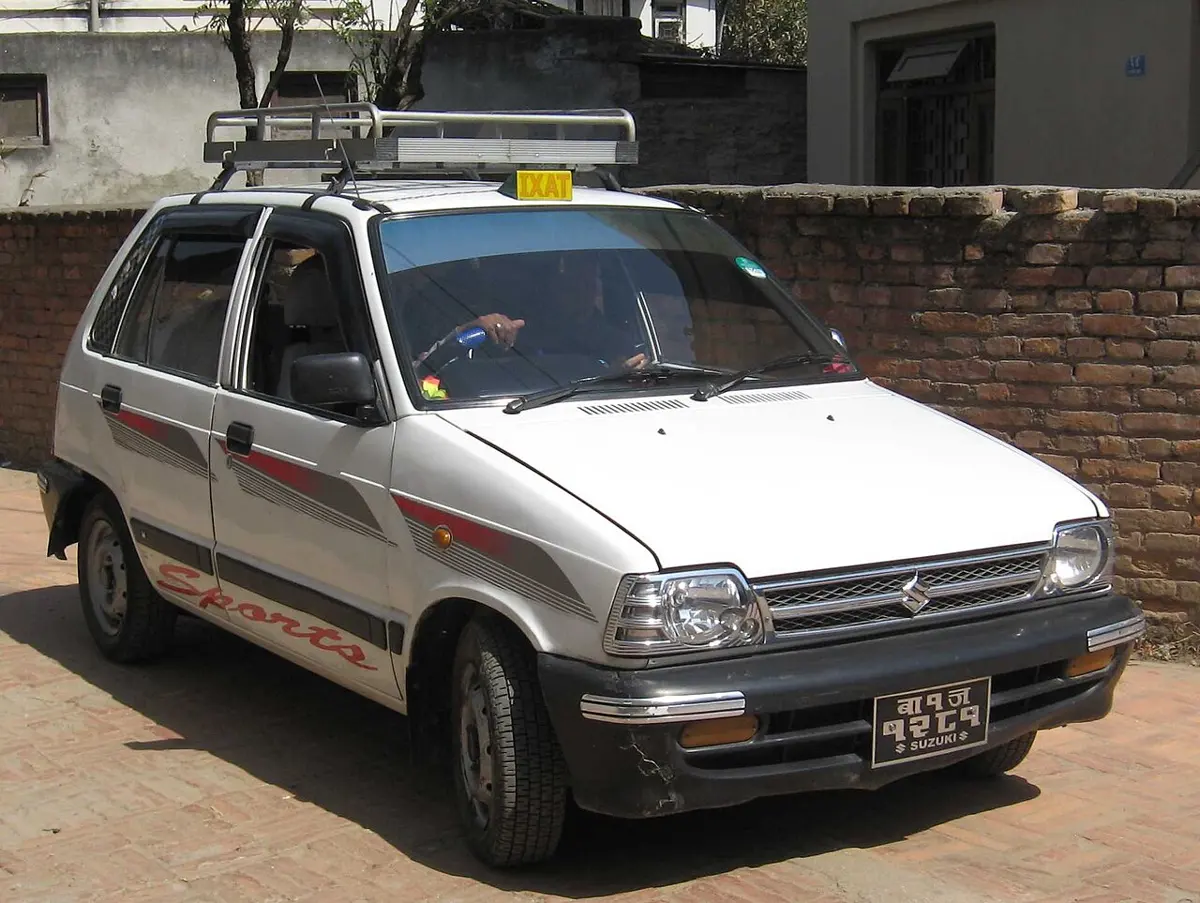
In towns, taxis may or may not run by the meter. A metered fare is the same for everyone, and the chance of being cheated is low. If a fare seems wrong, you can complain to the nearest traffic police office with the taxi’s number.
The meter starts at a fixed amount and then adds a set amount for every 200 meters. These are the fares the Department of Transport Management set on 2075/06/07, as the Nepal Bureau of Standards and Metrology posted them:
| Day (6 AM to 9 PM) | Night (9 PM to 6 AM) | |
|---|---|---|
| Starting charge | Rs 14 | Rs 21 |
| Each 200 m | Rs 7.80 (Rs 39 a km) | Rs 11.70 (Rs 58.50 a km) |
| The first kilometer in all | Rs 53 | Rs 79.50 |
| Waiting | Rs 7.80 for 2 minutes | Rs 11.70 for 2 minutes |
So by day, with distance d km and waiting t minutes,
and at night every rate is 50% more: 21 + 58.50d + 5.85t.
Fares change. In April 2026, the Bagmati Province government’s notice in the Nepal Gazette was reported to set Rs 58 to start, Rs 12 for each 200 m by day (Rs 17 at night, 9 PM to 4 AM) and Re 1 a minute for waiting up to 30 minutes. We could not read the Gazette notice itself, so the questions here use the 2075 fares for practice; check the notice before you rely on any of them.
The meter’s readings at 0 m, 200 m, 400 m, … are Rs 14, Rs 21.80, Rs 29.60, …: each is the one before plus Rs 7.80. A list of numbers that goes up by the same amount each time is an arithmetic sequence.
A day ride of 2 km with no waiting. What does the meter show?
Pick an answer to see why.
Exercise 4.4
Use the 2075 fares from this section.
Question 1
Shreenath took a taxi 9 km from Baneshwar to Bhaktapur by day: Rs 14 to start, then Rs 7.80 for each 200 m, and 6 minutes of waiting at Rs 7.80 for 2 minutes. What was the fare?
Answer
Question 2
Shristi took a taxi 18 km from Jagati, Bhaktapur to Sanepa, Lalitpur by day, with 20 minutes of waiting, at the same rates. What did she pay?
Answer
Question 3
Find the fare in each case.
| Distance | Time | Waiting | |
|---|---|---|---|
| a. | 6 km | 8 AM | 15 minutes |
| b. | 15 km | 3:30 PM | 10 minutes |
| c. | 7.5 km | 11 PM | none |
| d. | 8.75 km | 4 AM | 7 minutes |
6 km at 8 AM, 15 minutes of waiting
Answer
15 km at 3:30 PM, 10 minutes of waiting
Answer
7.5 km at 11 PM, no waiting
Answer
8.75 km at 4 AM, 7 minutes of waiting
Answer
Question 4
Samyog paid Rs 228.50 for a day ride with 10 minutes of waiting: Rs 14 to start, Rs 7.80 for each 200 m, and Rs 7.80 for 2 minutes of waiting. How far did he travel?
Answer
Question 5
Phulmaya paid Rs 1,027.20 for a night ride with 12 minutes of waiting: Rs 21 to start, Rs 11.70 for each 200 m, and Rs 11.70 for 2 minutes of waiting. How far did she travel?
Answer
Project work
Miscellaneous exercise
Question 1
A person earning Rs 7 lakh a year pays income tax of 1% up to Rs 4,50,000 and 10% on the rest. How much income tax is paid?
Answer
Question 2
A person earning Rs 4,60,000 a year pays Rs 5,500 income tax. If the rate is 1% up to Rs 4,50,000, what is the rate on the rest?
Answer
Question 3
An organization pays income tax of 2.5% on income up to Rs 10 lakh, 4% above Rs 10 lakh up to Rs 20 lakh, 5.25% above Rs 20 lakh up to Rs 40 lakh, and 12.75% above Rs 40 lakh. Find the tax on these yearly incomes.
Rs 7,60,000
Answer
Rs 15,70,500
Answer
Rs 23,75,600
Answer
Rs 55,75,000
Answer
Question 4
What is the simple interest on Rs 50,000 for 1 year at 2 paisa per Rs 3 per month? If 5% tax is taken from the interest, what is the interest left?
Answer
Question 5
A shopkeeper bought a bicycle for Rs 7,520 and sold it at its marked price of Rs 10,000, with 13% VAT.
How much does the customer pay?
Answer
What percentage profit did the shopkeeper make?
Answer
Had it been sold at a 30% discount on the marked price, what would the price with VAT have been?
Answer
Would the shopkeeper then have made a profit or a loss, and of what percentage?
Answer
Question 6
A laptop bought for Rs 1,50,000 is sold at a profit of 10%. What is its price with 13% VAT?
Answer
Question 7
An item is sold for Rs 9,040 after a 20% discount and with 13% VAT. How much was the discount?
Answer
Question 8
A dealer bought a computer from an importer for Rs 22,600 with VAT. Adding transport and profit, the dealer sold it to a retailer for Rs 25,990 with VAT, and the retailer sold it to a customer for Rs 28,250 with VAT. VAT is 13%.
What did the dealer pay the importer without VAT?
Answer
What profit did the retailer make?
Answer
How much VAT should reach the government on the computer in all?
Answer
How much VAT should the retailer deposit with the government?
Answer
Question 9
A sales manager’s monthly salary is Rs 22,000, and 0.75% commission on the month’s sales is added to it. If a month’s sales are Rs 6,24,000, what is the income? By what percentage of the salary does the commission add to it?
Answer
Question 10
A house owner gives an agent 3% of the monthly rent for renting out the house. If the rent is Rs 75,000 a month, how much does the agent receive in a year?
Answer
Question 11
Rohan received Rs 1 crore 28 lakh 25 thousand for his house after paying the agent 5% commission. What was the selling price?
Answer
Question 12
25% of a company’s profit is Rs 1,50,000. It shares 65% of the whole profit equally among its 15 employees as a bonus. How much does each receive?
Answer
Question 13
A bank shared 55% of a year’s profit as a bonus among its 275 employees, Rs 65,000 each. What was its profit?
Answer
Question 14
A cement company has 3,50,000 shares of Rs 100. Chiring has 250 of them from its IPO. The company makes a profit of Rs 9,00,00,000 and pays 40% of it as a cash dividend. How much does Chiring get?
Answer
Question 15
A 5 A meter is fixed in a house. Its readings, taken on the last day of each month, are:
| Month | Baishakh | Jestha | Ashar | Shrawan | Bhadra | Ashoj |
|---|---|---|---|---|---|---|
| Reading | 1577 | 1622 | 1647 | 1662 | 1689 | 1731 |
How many units were used in each month from Jestha to Ashoj?
Answer
Which month’s bill is the highest, and how much is it?
Answer
Which month’s bill is the lowest, and how much is it?
Answer
How much is paid if Jestha’s bill is paid on 13 Ashar?
Answer
How much is paid if Ashar’s bill is paid on 27 Shrawan?
Answer
How much is paid if Ashoj’s bill is paid on 5 Kartik?
Answer
Question 16
A hotel used 58,000 liters of water through a ¾ inch pipe. With 50% sewerage, how much does it pay if it pays in the fourth month after the bill is handed out?
Answer
Question 17
The first 175 calls cost Rs 200 and each call after that Re 1. Find the total with 13% TSC and 13% VAT for:
275 calls
Answer
325 calls
Answer
469 calls
Answer
Question 18
At the same rates, with 13% TSC and 13% VAT, how many calls were made if the total was:
Rs 766.14
Answer
Rs 893.83
Answer
Rs 1,021.52
Answer
Rs 1,149.21
Answer
Question 19
A day taxi meter starts at Rs 14 and adds Rs 7.80 for each 200 m. Find the fare, with no waiting, for:
4 km
Answer
9 km
Answer
13 km
Answer
15 km
Answer
Practice every question in the book, and keep track of the ones you miss →
How the exam asks it
Grade 9’s final exam is set to CDC’s specification grid for Compulsory Mathematics, Grades 9–10. There, Arithmetic is 13 marks in three questions; the household arithmetic question is usually 4 marks, all about one setting:
| Part | Level | Marks | What it asks |
|---|---|---|---|
| a. | understanding | 1 | a taxi fare from its rates |
| b. | application | 2 | a water (or electricity) bill from the tariff table |
| c. | higher ability | 1 | worked backwards: the most calls a telephone bill allows |
Here is one in that shape, with how it is marked.
Where these facts come from
- Electricity (the opening, 4.1, Exercise 4.1, Miscellaneous 15): Nepal Electricity Authority, Consumer tariff rates (domestic single-phase minimum and energy charges, the 5 A note on the first 20 units, the 2% discount within 7 days and the Rs 500 reconnection fee), linked from nea.org.np’s Consumer Tariff Rates page, read November 2026; NEA’s own worked examples in that document agree with this unit’s method. The 5%, 10% and 25% fines and the 60-day rule, from NEA’s Tariff Collection Regulations 2078: Urja Khabar, 12 Kartik 2080 (the regulations themselves not read).
- The 2078 tariff and induction cookers (the fact in 4.1): The Himalayan Times, “NERC to implement new power tariff rates”, 28 October 2021.
- VAT on electricity (the fact in 4.1): The Kathmandu Post, 18 July 2026, on the directive collecting 5% from homes above 50 units; Onlinekhabar and The Kathmandu Post, 21 September 2026, on the ministers’ reported agreement to remove it; Ekantipur, 22 September 2026, on the finance ministry’s denial.
- Water (4.2, Exercise 4.2, Miscellaneous 16): Kathmandu Upatyaka Khanepani Limited, Tariff rate from Shrawan 2070 (metered taps, sewerage at 50%, discounts and fines), and KUKL’s Annual Report 2082 (fiscal year 2081/82), page 45, which gives the same tariff and the tanker prices; read November 2026.
- Telephone (4.3): Nepal Telecom’s PSTN, GSM prepaid, GSM postpaid and FNF tariff pages, read November 2026 (rates without taxes; the 175 calls in the Rs 200 rental, a call of 2 minutes within an area code and of 1 minute to another). The 13% TSC and VAT from Shrawan 1, 2075 and the 2% ownership tax from Shrawan 1, 2077: Nepal Telecom’s notice printed on its bills. The 10% service charge under the Finance Act 2082: NepaliTelecom, 20 April 2026, on the Nepal Telecommunications Authority’s notice of 4 Baishakh 2083, and NepseTrading; not confirmed from the Act or the notice.
- Taxi fares (4.4): the Department of Transport Management’s decision of 2075/06/07, as the Nepal Bureau of Standards and Metrology posted it (quoted in CDC’s Mathematics, Grade 9); the Bagmati Province fares of April 2026: Ratopati, 11 April 2026, and The Kathmandu Post, 12 April 2026, on the province’s notice in the Nepal Gazette (the notice itself not read).
- The photo: Wikimedia Commons, credited under the picture.
- The exam’s household arithmetic question (For the exam, How the exam asks it): CDC, Specification Grid, Compulsory Mathematics, Grades 9–10, and the model questions printed with it (question 4: U1, A2, HA1).
A companion to your textbook, not a replacement for it: study from the book your school uses, and where the two differ, follow your teacher. Found a mistake? Please tell us.