
Nepal has no coast. Nor have Bhutan and Afghanistan. The other five countries of SAARC do. Write those countries in lists and two questions keep coming back: what do two lists share, and how many smaller lists can you make from one list?
The first question has only a few possible answers, and a simple drawing shows which one you have. The second has a surprising answer. A Braille letter is a choice of dots from six: how many different patterns can six dots make? By the end of this unit you can draw any two sets in one picture, and answer that without counting.
1.0 Review
A set is a well-defined collection of things, called its elements. You can write one by description, {prime numbers less than 8}, by listing (also called the tabulation method), {2, 3, 5, 7}, or in set-builder form, {x:x is a prime number less than 8}. The universal set U holds everything being talked about.
1.1 Disjoint and overlapping sets
Here is the draw as a picture. The rectangle is U, and each group gets a circle of its own.
Now sort the same countries by a different rule. Let L be the landlocked countries:
L = {Nepal, Bhutan, Afghanistan}

Draw A and L together. Nepal and Bhutan are in both, so the two circles must cross, and those two countries go where they cross. Pakistan and Sri Lanka are in A only, and Afghanistan is in L only. India, Maldives and Bangladesh are in neither, but they are still in U, so they stay inside the rectangle.
Pictures like these are called Venn diagrams. A Venn diagram shows how sets are related: a rectangle stands for the universal set, and circles or ovals inside it stand for its subsets. It shows at a glance what a list can’t: who is together and who is apart.
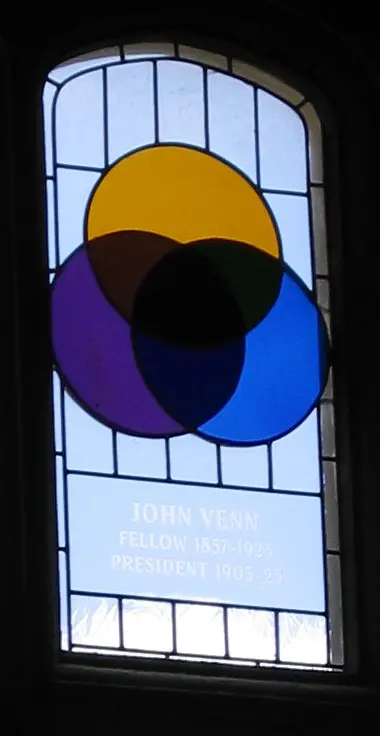
Look at Figure 1.1 and Figure 1.3 again. Is any country in both A and B? No. Is any country in both A and L? Yes: Nepal and Bhutan. That is the whole difference between the two pictures, and each has a name.
Disjoint sets are two or more sets with no element in common, like A and B.
Overlapping sets are two or more sets with at least one element in common and at least one element that isn’t common, like A and L.
The word overlapping needs both halves of that rule. Two sets with exactly the same elements have plenty in common but nothing different: they are equal sets, not overlapping ones. But {1, 2} and {1, 2, 3} are overlapping: they share 1 and 2, and 3 isn’t common. When all of one set lies inside the other like this, we draw its circle inside the other circle.
Are {Monday, Tuesday} and {Tuesday, Friday} disjoint or overlapping?
Pick an answer to see why.
Sorting by two rules is an everyday tool. Tick “under Rs 1,000” and “in stock” on a shopping app, and it shows you only the overlap of the two sets. A survey asks who ticked both boxes, and a science book sorts animals by how they are built and how they live. Each time the same question comes first: do these two groups share anything?
Exercise 1.1
Question 1
Study each Venn diagram. Write each set by description and by listing, and write the universal set U. In c., the one circle carries two names.
Answer
Question 2
Are these sets overlapping or disjoint? Why?
Answer
Question 3
A = {2, 4, 6, 8, 10, 12}, B = {1, 3, 5, 7, 9, 11}, C = {0, 1, 3, 5, 7, 11}, D = {5, 6, 7, 8, 10}, E = {0, 2, 9, 12}. Is each pair overlapping or disjoint?
- a.A and B
- b.A and C
- c.B and C
- d.A and D
- e.A and E
- f.B and D
- g.B and E
- h.C and D
- i.C and E
- j.D and E
Hint
Answer
Question 4
U = {a, b, c, d, e, f, g, h, i, j}, P = {a, b, c, d, e, i}, Q = {a, e, i}, R = {b, c, d, j}, S = {i, e, a}, T = {a, b, c, f}. Show each pair in a separate Venn diagram, and say which pairs are overlapping and which are disjoint.
- a.P and Q
- b.Q and R
- c.Q and S
- d.R and T
Answer
Question 5
A = {0, 1, 2, 3, 4, 5}. List the elements of these sets.
- a.B: add 1 to each element of A.
- b.C: multiply each element of A by 2.
- c.D: the odd numbers of A.
- d.E: the factors of 10 in A.
- e.Write a universal set for all these sets.
- f.Which of A, B, C, D, E are overlapping, and which are disjoint?
Answer
Question 6
M = {x:x is a multiple of 5 less than 40}. List the elements of these sets.
- a.N: add 3 to each element of M.
- b.P: multiply each element of M by 2.
- c.Q: the odd numbers of M.
- d.R: the multiples of 10 in M.
- e.Write a universal set for all these sets.
- f.Which of M, N, P, Q, R are overlapping, and which are disjoint?
Answer
Project work
1.2 Subset
Each of those eight sets is made only of elements of {Dolma, Rakesh, Kritika}. That is what the word subset means.
If every element of A is also an element of B, then A is a subset of B. We write A ⊆ B, or , which says the same thing the other way round.
Be careful to read it as “every”: one element of A outside B and A is not a subset of B. And a subset is a set, so it is written in brackets: {2} ⊆ {1, 2}, while the element is 2 ∈ {1, 2}.
1.2.1 Proper and improper subsets
Subsets come in two kinds, and the difference is whether anything is left out.
If B is a subset of A and has fewer elements than A, then B is a proper subset of A. We write B ⊂ A, or .
If B is made from all the elements of A, then B is an improper subset of A. We write B ⊆ A, or . Then A and B are equal sets, and each is an improper subset of the other.
It helps to read the symbols like < and : ⊂ is “strictly smaller”, and the extra line in ⊆ allows “or the same”. So {1, 2} ⊂ {1, 2, 3} and {1, 2, 3} ⊆ {3, 2, 1}.
Every set has exactly one improper subset, itself. The empty set {} is a subset of every set, and a proper subset of every set except itself.
T = {red, blue}. Which of these is not a proper subset of T?
Pick an answer to see why.
How many subsets?
Pratiksha’s three friends gave 8 subsets and four fruits gave 16. Is there a pattern? Try it.
Here is why. Take any set, and bring in one new element. Each old subset can now go two ways: leave the new element out, or take it. So the number of subsets doubles with every element:
| Elements, n | 0 | 1 | 2 | 3 | 4 | 5 |
|---|---|---|---|---|---|---|
| Subsets | 1 | 2 | 4 | 8 | 16 | 32 |
| As a power of 2 |
Another way to see it: to choose a subset, go through the n elements one at a time, answering “in or out?”. That is n choices of two, which gives different subsets.
A set of n elements has subsets: proper subsets and 1 improper subset.
Back to the questions
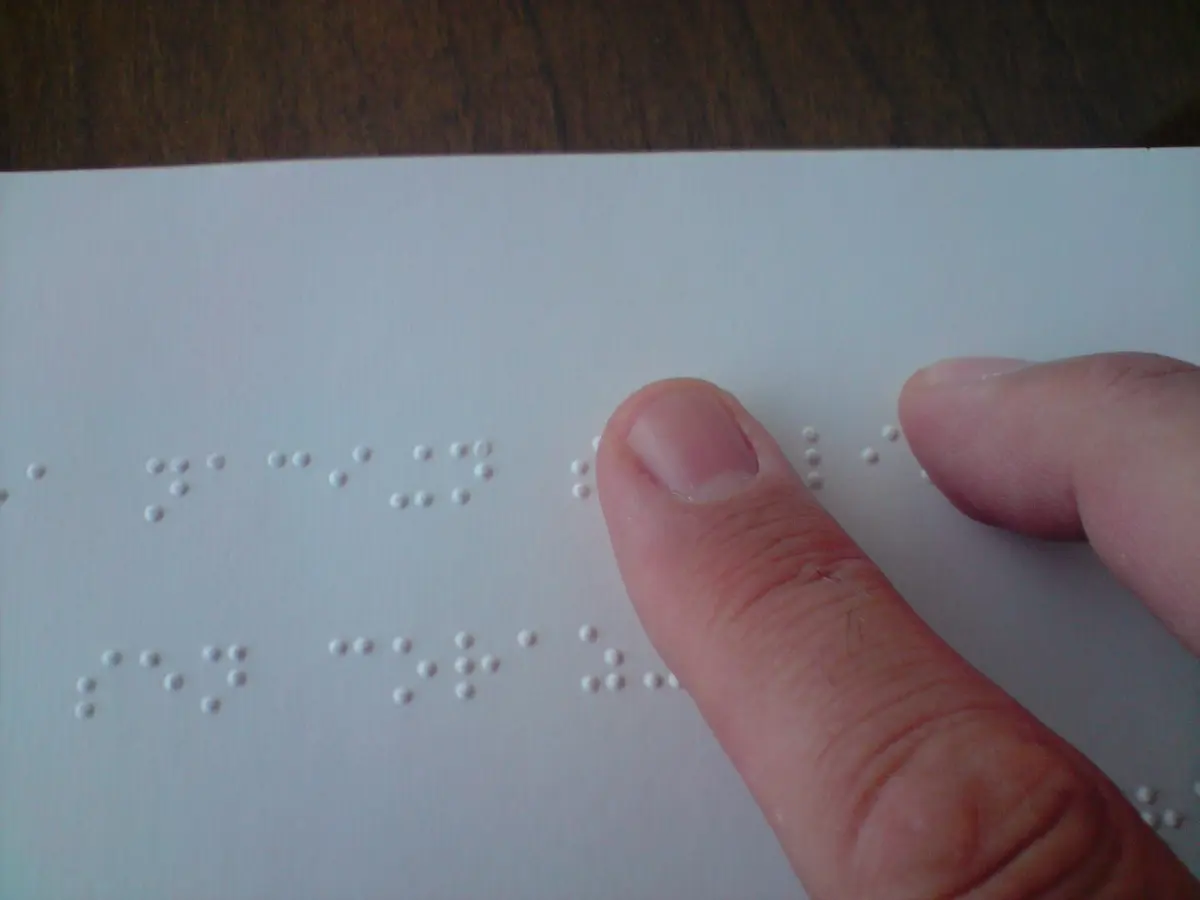
How many patterns can six dots make? 64. A Braille cell is six dots in two columns of three, and a letter is the set of dots raised, so it is a subset of {1, 2, 3, 4, 5, 6}. That gives patterns. One of them, the empty set, is the blank that makes a space between words, which leaves 63 for letters, numbers and signs.
Louis Braille of France made his code in 1824, when he was fifteen. The same six dots now write many scripts: Bharati Braille, settled in India by 1951 and used in Nepal too, writes Devanagari with them, the script of Nepali.
What can two lists share? Nothing, some, or everything. Sort the eight countries of SAARC and you meet every case. The two football groups share nothing: disjoint. The first group and the landlocked countries share Nepal and Bhutan: overlapping. Every country in L is in U, and U has more, so L ⊂ U: a proper subset. And “landlocked SAARC countries” and “SAARC countries with no coast” are two descriptions of one set: equal.
Exercise 1.2
Question 1
Study each Venn diagram. Which sets are proper subsets and which improper? Write each relation with the symbol. In c., the one circle carries two names.
Answer
Question 2
N = {x:x is a counting number up to 5}. Write N by listing. Then make these subsets and name them.
- i.the subsets with one element
- ii.the subsets with two elements
- iii.the subsets with three elements
- iv.the subsets with four elements
- v.the subset with five elements
- vi.the subset with no elements
How many subsets are there altogether?
Answer
Question 3
Make all the subsets of each set, and name them.
- i.F = {mango}
- ii.V = {radish, pumpkin}
- iii.T = {bus, jeep, aeroplane}
- iv.A = {dog, cat, horse, cow}
- v.B = {pigeon, crow, eagle, parrot, crane}
Hint
Answer
Question 4
Sort the subsets you made in question 3 into proper and improper.
Answer
Question 5
Copy the table and fill it in, with n the number of elements of each set. Then find a formula for the number of subsets of a set.
| Set | n | Subsets | Number of subsets |
|---|---|---|---|
| {mango} | 1 | … | … |
| {radish, pumpkin} | 2 | … | … |
| {bus, jeep, aeroplane} | … | … | … |
| {dog, cat, horse, cow} | … | … | … |
| {pigeon, crow, eagle, parrot, crane} | … | … | … |
Answer
Question 6
Make three proper subsets of E = {2, 3, 5, 7}, and show each in a separate Venn diagram.
Answer
Project work
Mixed exercise
Question 1
Make all the subsets of P = {2, 3, 5}, and sort them into proper and improper.
Answer
Question 2
A = {2, 4, 6} and B = {1, 2, 3} are subsets of a universal set U.
- a.Are the sets disjoint or overlapping? Give the reason.
- b.Write the improper subset of A.
- c.Which subsets do A and B have in common?
Answer
Question 3
A = {3, 5} and B = {2, 4, 7}.
- a.Write the proper subsets of A.
- b.What element must be added to A to make A and B overlapping?
Answer
Question 4
Q = {1, 3, 5} and R = {1, 2, 3} are subsets of U = {1, 2, 3, 4, 5}.
- a.Write the proper and improper subsets of Q.
- b.Which proper subsets do R and Q have in common?
- c.Show Q and R in a Venn diagram.
Answer
Question 5
U = {natural numbers up to 20}, A = {even numbers up to 10}, B = {odd numbers up to 10}, C = {prime numbers up to 10} and D = {multiples of 2}. Say whether each pair is disjoint or overlapping, and show it in a Venn diagram.
- a.A and B
- b.A and C
- c.A and D
- d.B and C
- e.C and D
- f.B and D
Answer
Question 6
The Venn diagram shows the elements of A and B.
- a.Are A and B disjoint or overlapping?
- b.Write two proper subsets of A.
- c.What must be done to make the sets disjoint?
Answer
Question 7
The Venn diagram shows the elements of M and N.
- a.Write all the proper and improper subsets of M and of N.
- b.Do M and N have the same number of subsets?
- c.Which element must be taken out of M to make M and N disjoint?
Answer
Question 8
S = {s, o, n, y}. Make five proper subsets S₁, S₂, S₃, S₄, S₅ of S, and show each of these pairs in a Venn diagram.
- a.S₁ and S₂
- b.S₁ and S₃
- c.S₁ and S₄
- d.S₁ and S₅
- e.S₂ and S₃
- f.S₂ and S₄
- g.S₂ and S₅
- h.S₃ and S₄
- i.S₃ and S₅
- j.S₄ and S₅
Answer
Question 9
A = {0, 2}, B = {1, 2} and C = {square numbers between 2 and 5} are subsets of a universal set U.
- a.Write the proper and improper subsets of C.
- b.Show A and B in a Venn diagram.
- c.Which of A and C has more subsets? Give the reason.
Answer
Printable PDFs
- Study notes 2 pages
- Harder practice questions 2 pages Answer key
Practice every question in the book, and keep track of the ones you miss →
How the exam asks it
CDC’s specification grid for Grades 6–8 gives sets and statistics together 6 of the paper’s 50 marks, 3 marks each, and the Grade 8 model paper asks the sets question in three parts of 1 mark, at three levels:
| Part | Level | Marks | What it asks |
|---|---|---|---|
| a. | knowledge | 1 | a definition |
| b. | understanding | 1 | a set read from the diagram |
| c. | higher ability | 1 | what kind of sets, if something changes, with a reason |
Here is one in that shape, with how it is marked.
Where these facts come from
- SAARC’s eight members and its Secretariat in Kathmandu since 1987 (the opening, 1.1): Wikipedia, “South Asian Association for Regional Cooperation”, read November 2026.
- Which of them are landlocked: Wikipedia, “Landlocked country”, read November 2026.
- BIMSTEC’s members (1.1): Wikipedia, “BIMSTEC”, read November 2026.
- Venn’s 1880 paper, Euler’s letters, the name given in 1918 and the window at Gonville and Caius (the story): Wikipedia, “Venn diagram”, read November 2026.
- The Braille cell, its 64 patterns and Louis Braille’s age (“Back to the questions”): Wikipedia, “Braille”, read November 2026.
- Devanagari in Braille and its dots: Wikipedia, “Bharati Braille”, read November 2026.
- Bats as mammals that truly fly (1.2): Wikipedia, “Bat”, read November 2026.
- The exam’s sets question (For the exam, How the exam asks it): CDC, Specification Grid and Model Questions, Mathematics, Grades 6–8 (2080; its chart is dated 2078), its table and Grade 8 model question paper.
A companion to your textbook, not a replacement for it: study from the book your school uses, and where the two differ, follow your teacher. Found a mistake? Please tell us.