
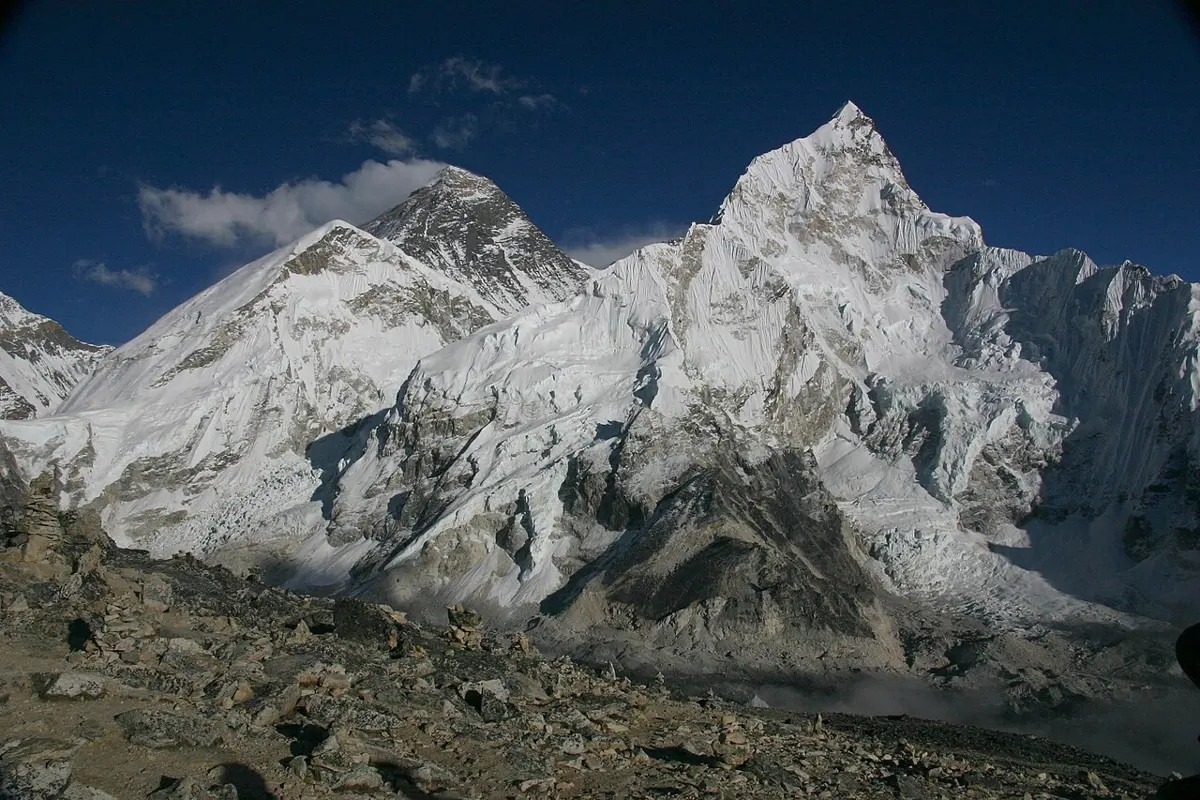
Nepal is home to 8 of the world’s 14 mountains higher than 8,000 m. China has 9 of them. Add the two and you get 17, but there are only 14 such mountains, and one of the fourteen is in neither country. How can all of that be true at once?
Some mountains stand on the border, so they belong to both lists. Sorting things into lists like these, and making new lists from them, is what this unit is about: the union, intersection, difference and complement of sets. By the end of section 1.1 you will list exactly which peaks Nepal and China share, and by the end of 1.2 you will count them without listing anything.
Source: Wikipedia’s table of eight-thousanders, read November 2026.
1.0 Review
Here is what you already know about sets from Grade 8, in one place.
| Idea | What it means | Example |
|---|---|---|
| Set | a well-defined collection of things, its elements | the days of the week |
| Listing method | the elements written inside curly brackets | A = {1, 3, 5} |
| Set-builder method | a rule that says which things belong | A = {x:x is an odd number less than 6} |
| Is an element of | ∈ means “belongs to”, ∉ “does not belong to” | 3 ∈ A, 4 ∉ A |
| Empty set | a set with no elements, written {} or ∅ | the months with 35 days |
| Universal set | everything being talked about, U | all the students of your class |
| Subset | every element of A is also in B | {1, 3} ⊂ {1, 3, 5} |
| Equal sets | exactly the same elements | {1, 3, 5} = {5, 1, 3} |
| Overlapping sets | some elements in common, not all | {1, 2, 3} and {3, 4} |
| Disjoint sets | no element in common | {1, 2} and {7, 8} |
The order of the elements doesn’t matter, and an element is written only once: {b, a, b} is just {a, b}.
1.1 Operation of sets
From two sets you can make new ones: everything in either, only what they share, what one has and the other doesn’t, and everything left out. These four ways are the operations on sets.
1.1.1 Union of sets
In Figure 1.3, the colors collected by Supriya or Anjila or both are everything inside the two circles:
S ∪ A = {red, yellow, blue, pink, white, purple, orange}
Red, yellow and blue are in both sets, but they are written once. This set is called the union of the two sets.
The union of two sets A and B, written A ∪ B and read “A union B”, is the set of all the elements that are in A or in B or in both. In set-builder form,
In a Venn diagram, A ∪ B is everything inside the two circles (Figure 1.4).
The union of three sets works the same way: A ∪ B ∪ C = {x:x ∈ A or x ∈ B or x ∈ C}, everything inside any of the three circles (Figure 1.5). However many sets you join, every element is written once.
If X = {1, 2, 3, 4} and Y = {3, 4, 5}, what is X ∪ Y?
Pick an answer to see why.
1.1.2 Intersection of sets
Some students of Grade 9 were asked which subjects they like. The students who like Science form the set S and those who like Mathematics the set M:
S = {Pemba, Rojina, Abdul, Srijana, Tenzing, Binaya}
M = {Srijana, Tenzing, Manju, Dolma, Kushal, Ajima}
Srijana and Tenzing are in both sets. The set of students who like both subjects, {Srijana, Tenzing}, is the intersection of the two sets.
The intersection of two sets A and B, written A ∩ B and read “A intersection B”, is the set of the elements that are in both A and B. In set-builder form,
In a Venn diagram it is the overlap of the circles (Figure 1.11). A way to remember the symbols: ∪ is a cup that holds everything poured into it; ∩ is an arch over only the shared part. And the words: the union needs or, the intersection and.
In Figure 1.10, which set is S ∩ M?
Pick an answer to see why.
1.1.3 Difference of sets
The students who read a newspaper but don’t watch television are P with T’s members taken away. That set is called the difference of P and T, written P − T. In the same way, the students who watch television only make T − P. The two are different sets.
If A and B are subsets of a universal set U, the difference A − B, read “A difference B”, is the set of the elements that are in A but not in B. Likewise B − A is the set of the elements in B but not in A. In set-builder form,
A − B and B − A in Venn diagrams
How the difference looks depends on how the two sets sit.
A few differences are worth knowing by heart, each one clear from the pictures:
- If A and B are equal sets, A − B = B − A = ∅: nothing is left.
- Taking nothing away leaves the set as it was: A − ∅ = A.
- Nothing minus anything is nothing: ∅ − A = ∅.
- If A is a proper subset of B, then A − B = ∅: every element of A is taken away.
- If A and B are disjoint, A − B = A and B − A = B.
The union of the two differences, (A − B) ∪ (B − A), is called the symmetric difference of A and B, written : the elements in exactly one of the two sets, everything except the overlap.
A = {2, 4, 6, 8} and B = {4, 8, 12}. What is B − A?
Pick an answer to see why.
1.1.4 Complement of a set
Let A be a proper subset of a universal set U. The set of all the elements of U that are not in A is called the complement of A. It is written A (read “A bar”), or A′, or ; all three are used, so recognize each.
The complement is a difference: what is left of U once A is taken away.
In a Venn diagram, A is everything in the rectangle outside A’s circle (Figure 1.24). So a set and its complement together make up U, and the complement of the complement brings you back:
That is why A and A are called complements of each other. Discuss in your group: what is A ∩ A? (Example 13 answers it.)
A complement always depends on U. The complement of “the boys in your class” is “the girls in your class” if U is your class, but “everyone in the school who isn’t a boy of your class” if U is the school. So a question that asks for a complement always says what U is.
Every set made with ∪, ∩, − and bars is a choice of regions in the Venn diagram. Shade the regions first, and the listing is just the elements in them.
U = {1, 2, 3, 4, 5, 6}, A = {1, 2, 3} and B = {3, 4}. What is A ∪ B?
Pick an answer to see why.
Back to the mountains
Now the puzzle of the opening has an exact answer. Let U be the set of the 14 mountains over 8,000 m, N those in Nepal and C those in China. A mountain on the border is in both sets.
Nepal and China share four eight-thousanders: N ∩ C = {Everest, Lhotse, Makalu, Cho Oyu}.
The other operations answer the other questions:
- N − C = {Kangchenjunga, Dhaulagiri I, Manaslu, Annapurna I}: the four that are Nepal’s and not China’s.
- C − N = {K2, Gasherbrum I, Broad Peak, Gasherbrum II, Shishapangma}: the five that are China’s and not Nepal’s. Shishapangma stands wholly in Tibet, just north of Nepal’s Langtang; the other four are on China’s border with Pakistan, in the Karakoram.
- N ∪ C is every peak in either country: 13 of the 14.
- N ∪ C = {Nanga Parbat}: the one in neither.
So 8 + 9 = 17 counted the four border peaks twice, once in each list. Section 1.2 turns that into a rule you can use without listing.
Exercise 1.1
Question 1
In Figure 1.29, F is the set of students who like football and V the set who like volleyball. Rambahadur and Harkabahadur like neither game. Write these sets by the listing method:
- a.F
- b.V
- c.F ∪ V
- d.F ∩ V
- e.U
Answer
Question 2
If U = {a, b, c, d, e, f, g, h, i, j, k}, A = {a, c, e, f, g, i, k} and B = {b, d, i, j, k, h}, find these sets and show each in a Venn diagram:
- a.A ∩ B
- b.B ∪ A
- c.A − B
- d.B − A
Answer
Question 3
If U = {x:x is a whole number from 1 to 30}, A = {x:x is a multiple of 3 from 1 to 30}, B = {x:x is a multiple of 4 from 1 to 30} and C = {x:x is a multiple of 5 from 1 to 30}, write these sets by the listing method and show them in a Venn diagram:
- a.A − B
- b.B − A
- c.A − C
- d.B − C
- e.A ∪ B
- f.A ∪ B ∪ C
- g.A ∩ B ∩ C
- h.B ∪ C
Answer
Question 4
If U = {a, b, c, d, e, f, g, h, i, j, k}, A = {a, c, d, f} and B = {g, h, i}:
- a.Find these sets:
- i.A
- ii.B
- iii.A ∪ B
- iv.A ∩ B
- v.A ∪ B
- vi.A ∩ B
- b.Which of the sets in part a are equal?
Answer
Question 5
If U = {natural numbers from 1 to 12}, E = {even numbers from 1 to 12}, O = {odd numbers from 1 to 12} and P = {prime numbers from 1 to 12}, find these sets and show them in a Venn diagram:
- a.E
- b.O
- c.P
- d.E ∪ P
- e.P ∩ O
- f.P − O
- g.P ∩ E
- h.E ∪ O ∪ P
- i.E ∩ O ∩ P
- j.E ∪ P − (P ∩ O)
- k.P ∪ (E ∩ O)
Answer
Question 6
If U = {m, n, o, p, q, r, s, t, u, v}, A = {q, r, s, t, u, v}, B = {n, o, p, q, r} and C = {m, u, s, t, q, r}, find these sets and show them in Venn diagrams:
- a.A ∩ B
- b.(A ∪ B) ∩ C
- c.A ∪ B ∪ C
- d.A ∩ B ∩ C
- e.A − B
- f.A ∪ B ∪ C
- g.A ∩ B
- h.A
- i.(A ∩ C) ∪ B
Answer
Question 7
Write the set shaded in the Venn diagram in set notation.
Answer
Write the set shaded in the Venn diagram in set notation.
Answer
Write the set shaded in the Venn diagram in set notation.
Answer
Write the set shaded in the Venn diagram in set notation.
Answer
Write the set shaded in the Venn diagram in set notation.
Answer
Write the set shaded in the Venn diagram in set notation.
Answer
Question 8
If P and Q are overlapping subsets of a universal set U, show these sets in Venn diagrams:
- a.P − Q
- b.Q − P
- c.(P − Q) ∪ P
- d.P ∩ (Q − P)
Answer
Question 9
Write a universal set U and two of its subsets X and Y. Then write these sets by the listing method:
- a.X ∪ Y
- b.X ∩ Y
- c.X
- d.X ∩ Y
Answer
Question 10
Make these sets from the students of your class: a. the set of all the students, b. the set of girls, c. the set of boys. Which is the universal set, and which are its subsets? Write them with the right symbols. Then find the complement of each set.
Answer
1.2 Cardinality of sets
The number of elements in a set is called its cardinality, or its cardinal number. For A = {m, a, t, h}, the cardinality is 4, written n(A) = 4 and read “n of A is 4”.
An empty set has cardinality 0. If B is the set of Grade 9 students younger than 5, there is no such student, so n(B) = 0.
Section 1.1 was about which elements; this section is about how many. Counting is often the real question: how many households, how many voters, how many peaks.
That second answer is the most useful rule in this unit. If A and B overlap,
because n(A) + n(B) counts the overlap twice, once in each circle, and subtracting n(A ∩ B) once leaves every element counted exactly once.
“M only” is the difference M − N, so
In Activity 3: n₀(M) = 5 − 2 = 3 and n₀(N) = 6 − 2 = 4. The three regions inside the circles add up to the union: n(M ∪ N) = n₀(M) + n₀(N) + n(M ∩ N) = 3 + 4 + 2 = 9.
If one set is a proper subset of another, A ⊂ B, then A’s circle sits inside B’s, and
Finding cardinality: the formulas
Compare the two Venn diagrams Figure 1.50 and Figure 1.51. For each, find n(U), n(P), n(Q), n(P ∪ Q), n(P ∩ Q) and n(P ∪ Q).
| Figure 1.50: disjoint | Figure 1.51: overlapping | |
|---|---|---|
| n(U) | 7 | 12 |
| n(P) | 3 | 5 |
| n(Q) | 4 | 6 |
| n(P ∪ Q) | 7 | 9 |
| n(P ∩ Q) | 0 | 2 |
| n(P ∪ Q) | 0 | 3 |
| so | n(U) = n(P ∪ Q) | n(U) = n(P ∪ Q) + n(P ∪ Q) |
The two tables of numbers give all the rules. For two sets A and B:
- a.If A and B are disjoint: n(A ∪ B) = n(A) + n(B).
- b.If A and B overlap: n(A ∪ B) = n(A) + n(B) − n(A ∩ B), or n(A ∪ B) = n₀(A) + n₀(B) + n(A ∩ B).
- c.If U holds nothing outside A and B: n(U) = n(A ∪ B).
- d.If U has more elements than A and B hold: n(A ∪ B) = n(U) − n(A ∪ B), that is, n(U) = n(A ∪ B) + n(A ∪ B).
- e.For overlapping A and B: n₀(A) = n(A) − n(A ∩ B) and n₀(B) = n(B) − n(A ∩ B).
Rule a is rule b with n(A ∩ B) = 0: one rule, not two to learn.
n(P) = 12, n(Q) = 9 and n(P ∩ Q) = 4. What is n(P ∪ Q)?
Pick an answer to see why.
Back to the mountains, counted
The opening’s 8 + 9 = 17 is n(N) + n(C), which counts the four border peaks twice. The rule fixes it:
13 of the 14 eight-thousanders are in Nepal or China or both, and n(N ∪ C) = 14 − 13 = 1: Nanga Parbat. And n₀(N) = 8 − 4 = 4 are Nepal’s alone.
The rule also works backwards. If you know only that Nepal has 8, China 9, and that 13 are in one country or the other, then n(N ∩ C) = 8 + 9 − 13 = 4: the number on the border, without naming a single peak.
Exercise 1.2
Question 1
From Figure 1.53, find
- i.n(S)
- ii.n(T)
- iii.n(U)
- iv.n(S ∩ T)
- v.n(R ∪ T)
- vi.n(S ∩ R ∩ T)
- vii.n(S ∪ R ∪ T)
- viii.n(S ∪ R ∪ T)
- ix.n₀(S)
- x.n₀(S ∩ R)
- xi.n(R)
Answer
If A and B are disjoint sets with n(A) = 30 and n(B) = 35, find n(A ∪ B).
Answer
Question 2
From Figure 1.54, find
- i.n(A)
- ii.n(B)
- iii.n(A ∪ B)
- iv.n(A ∩ B)
- v.n₀(A)
- vi.n₀(B)
Answer
If U = {a, b, c, d, e, f, g}, A = {c, d, e, f}, B = {a, b, e, f} and C = {d, e, f, g}, find
- i.n(A − B)
- ii.n(B − C)
- iii.n(A − C)
- iv.n(A)
- v.n(A ∪ B)
- vi.n{(A ∪ B) − (A ∩ B)}
- vii.n{(A − B) ∪ (B − A)}
Answer
Question 3
If U = {natural numbers less than 20}, A = {even numbers less than 20}, B = {prime numbers less than 20} and C = {square numbers less than 20}, find
- i.n(U)
- ii.n(C)
- iii.n(A ∩ B)
- iv.n(B − C)
- v.n(A)
- vi.n(A ∪ C)
- vii.n(A ∩ B)
Answer
If U = {x:x is a natural number from 1 to 20}, A = {y:y is a prime number}, B = {z:z is a factor of 18} and C = {p:p is a multiple of 3 less than 20}, show these sets in Venn diagrams and find
- i.n(A ∪ B)
- ii.n(B ∪ C)
- iii.n(A ∪ B ∪ C)
- iv.n(A ∩ B ∩ C)
- v.n₀(A)
- vi.n(A − B)
- vii.n(A ∩ B)
- viii.n(C)
Answer
Question 4
From Figure 1.56, find
- a.n(P ∪ Q)
- b.n(P ∩ Q)
- c.n(P ∪ Q)
- d.n(P ∩ Q)
Answer
Question 5
Using Figure 1.57, find
- a.n(S)
- b.n(T)
- c.n(S ∩ T)
- d.n(S ∪ T)
- e.n₀(T)
- f.n₀(S)
- g.n(T)
- h.n(S ∪ T)
- i.n(S ∩ T)
- j.n(U)
Answer
Question 6
Look at Figure 1.58 and find
- a.n(A)
- b.n(B)
- c.n(C)
- d.n(A ∪ B)
- e.n(A ∪ B ∪ C)
- f.n(A ∩ B ∩ C)
- g.n(A ∪ B ∪ C)
- h.n₀(A)
- i.n₀(C)
- j.n(U)
Answer
Question 7
Use Figure 1.59 to verify these relations:
- a.n(A) = n(U − A)
- b.n(A ∪ B) = n(A) + n(B) − n(A ∩ B)
- c.n₀(A) = n(A − B)
- d.n(A ∪ B) = n₀(A) + n(B)
- e.n(A ∪ C) = n₀(A) + n(C)
- f.n(B ∪ C) = n₀(B) + n(C)
- g.A ∪ B ∪ C = U − (A ∪ B ∪ C)
In c to f, “only” is with respect to the two sets in the relation: in d, n₀(A) is A outside B; in e, A outside C.
Answer
Project work
Mixed exercise
Question 1
Think of the two words SUSTAINABILITY and URBANIZATION as sets of letters.
- a.Write the set of letters of each word, by the listing method and in set-builder form.
- b.Show the two sets in a Venn diagram.
- c.Write the set of letters that are in both words.
- d.How many letters are in exactly one of the two words?
- e.If U = {a, b, c, …, z}, how many letters are in neither word?
Answer
Question 2
U = {whole numbers from 1 to 25}, A = {multiples of 3 from 1 to 25}, B = {multiples of 4 from 1 to 25} and C = {multiples of 5 from 1 to 25}.
- a.Write all these sets by the listing method.
- b.Show the three sets in a Venn diagram.
- c.Write the set of numbers in all three sets.
- d.How many numbers are in all three sets, and how many in none of them?
Answer
Practice every question in the book, and keep track of the ones you miss →
How the exam asks it
Grade 9’s final exam is set to CDC’s specification grid for Compulsory Mathematics, Grades 9–10 (2078). There, Sets is always one question of 6 marks, in four parts at four levels:
| Part | Level | Marks | What it asks |
|---|---|---|---|
| a. | knowledge | 1 | a cardinal number, a symbol or a formula |
| b. | understanding | 1 | show the sets in a Venn diagram |
| c. | application | 3 | list sets to find, or prove, a relation |
| d. | higher ability | 1 | the relation between two sets, with a reason |
Here is one in that shape, with how it is marked.
Where these facts come from
- The 14 mountains over 8,000 m, their heights and the countries each stands in (the opening, “Back to the mountains”): Wikipedia, “Eight-thousander”, the table of eight-thousanders, read November 2026.
- The search site:youtube.com cat videos (1.1.2): Google Search Help, “Refine Google searches”, read November 2026.
- Peano’s symbol ∈, from the Greek ἐστί, “is” (1.1.4): Wikipedia, “Element (mathematics)”, read November 2026.
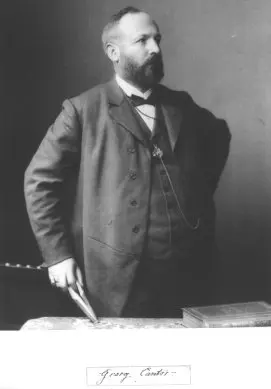
- Georg Cantor’s life, his 1874 paper, Kronecker’s attacks and Hilbert’s words (the story): Wikipedia, “Georg Cantor”, read November 2026.
- The exam’s Sets question (For the exam, How the exam asks it): CDC, Specification Grid 2078, Compulsory Mathematics, Grades 9–10, its table and Grade 9 model question paper.
A companion to your textbook, not a replacement for it: study from the book your school uses, and where the two differ, follow your teacher. Found a mistake? Please tell us.